On this page
A warehouse rota is not an office rota: a truck cannot leave short, a forklift driver cannot be swapped for anyone, and delivery windows decide whether a shift costs double. We compared eight tools on published price, coverage rules and how they handle swaps and time off. Hubstaff is our first pick — scheduling tied to attendance, screenshots and payroll in one seat price.
How we researched this
We started with scheduling tools that publish a real price and can run a warehouse rota, then read each price on the vendor site on November 27, 2026 and noted the trial each plan carries. We judged them for wholesale distributors that roster warehouse staff, drivers and dispatchers across nights, weekends and delivery windows. We dropped quote-only workforce suites and enterprise logistics systems because a distributor needs a price it can budget around and a trial it can test.
Compare the tools
| Name | Best for | Starting price | Free plan | |
|---|---|---|---|---|
 Hubstaff | Distributors that want scheduling tied to attendance and payroll | $10/user/month | No free plan; 14-day free trial | Visit |
 Deputy | Distributors that need labor-law compliance and auto-scheduling | $5/user/month | No free plan; 30-day free trial | Visit |
| When I Work | Distributors that want auto-scheduling at the lowest per-seat price | $2.50/user/month | No free plan; 14-day free trial | Visit |
 Connecteam | Small distributors that want scheduling, time clock and chat free up to ten users | $29/month | Free plan for up to 10 users; 14-day free trial on paid plans | Visit |
| Buddy Punch | Distributors that want photo-verified clock-ins at the gate | $6.99/user/month | No free plan; 14-day free trial | Visit |
 QuickBooks Time | Distributors already on QuickBooks Online that want time tracking and scheduling together | $20/month + $10/user | No free plan; 30-day free trial | Visit |
 Homebase | Distributors that want a flat per-location price as headcount grows | $24/location/month | Free Basic plan for 1 location and up to 10 employees | Visit |
| Humanity Schedule | Distributors that need skills, certifications and rest rules enforced on the rota | $2.75/employee/month | No free plan; 30-day free trial | Visit |
The employee scheduling software for wholesale distributors, compared
1. Hubstaff
Best for: Distributors that want scheduling tied to attendance and payroll
Paid tool Starting price: $10/user/month · Ten dollars per seat a month billed annually on Team, or twelve dollars billed monthly; Starter is four dollars ninety-nine cents and Grow seven dollars fifty cents annual; two-seat minimum
Free plan: No free plan; 14-day free trial
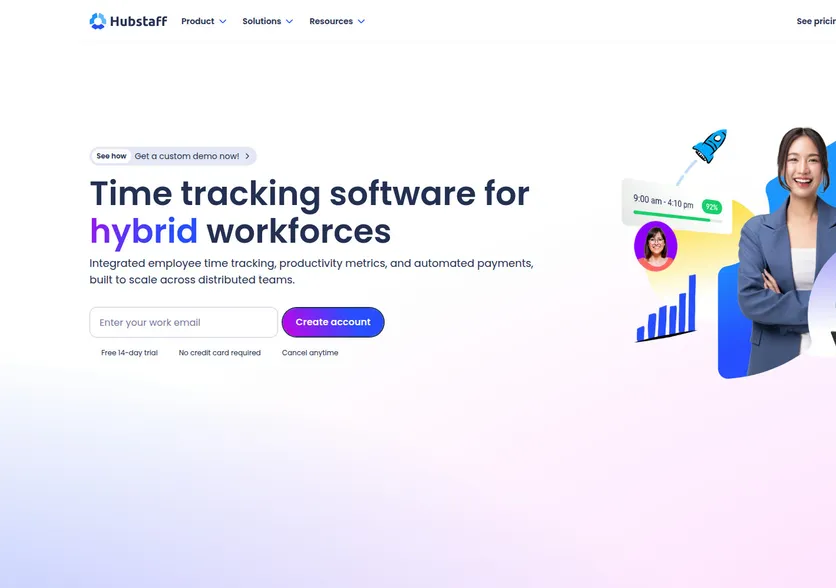
This Hubstaff plan is the pick for a warehouse that wants scheduling tied to proof of hours, with attendance tracking and payroll on the Team plan. Team costs ten dollars per seat a month billed annually and adds unlimited screenshots, integrations and timesheet approvals. The cheaper Starter and Grow plans cannot run a warehouse rota on their own, since scheduling, attendance and payroll sit on Team.
What we like
- Scheduling, attendance, payroll and approvals in one plan
- Unlimited screenshots and integrations on Team
- Two months free on annual billing
Watch out for
- Scheduling is not on Starter or Grow, only on Team
- Owners and managers always count as paid seats
How to try it
- Open the Hubstaff pricing page and start the fourteen-day trial
- Build the warehouse rota on the Team plan and add attendance tracking
- Check the seat count, since leads count as paid seats too
2. Deputy
Best for: Distributors that need labor-law compliance and auto-scheduling
Paid tool Starting price: $5/user/month · Five dollars per user a month billed annually on Lite, or five dollars fifty cents billed monthly; Core is six dollars fifty cents annual and Pro nine dollars; monthly plans carry a thirty-dollar minimum spend per invoice
Free plan: No free plan; 30-day free trial
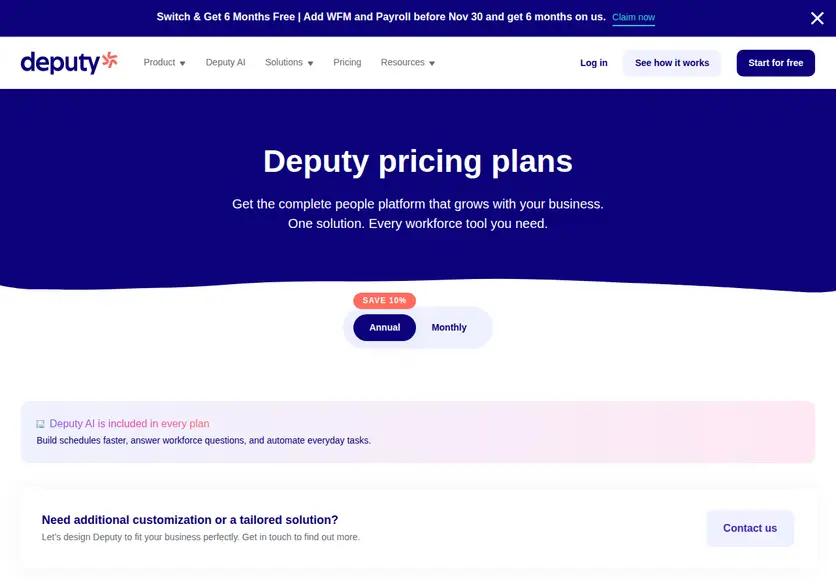
This Deputy plan gives a warehouse the compliance tools a rota needs, with labor-law warnings, shift swaps and leave management from five dollars per user a month. Lite covers basic scheduling, timesheets and a time clock, while Core adds auto-scheduling, demand forecasting and wage budgets. Per-user billing means a large warehouse team costs more, and monthly plans carry a thirty-dollar minimum spend per invoice.
What we like
- Labor-law compliance warnings built into the rota
- Auto-scheduling and demand forecasting from the Core plan
- Clear per-user pricing with a thirty-day trial
Watch out for
- Per-user billing gets expensive with a large warehouse team
- Monthly plans carry a thirty-dollar minimum spend per invoice
How to try it
- Open the Deputy pricing page and start the thirty-day trial
- Set your labor rules and build a week of warehouse rosters
- Test auto-scheduling on Core before you commit to a plan
3. When I Work
Best for: Distributors that want auto-scheduling at the lowest per-seat price
Paid tool Starting price: $2.50/user/month · Two dollars and fifty cents per user a month on Essentials for single-location teams; Pro is five dollars and Premium eight dollars; the vendor FAQ prices multi-location teams at five dollars per user a month; time tracking is a separate add-on
Free plan: No free plan; 14-day free trial
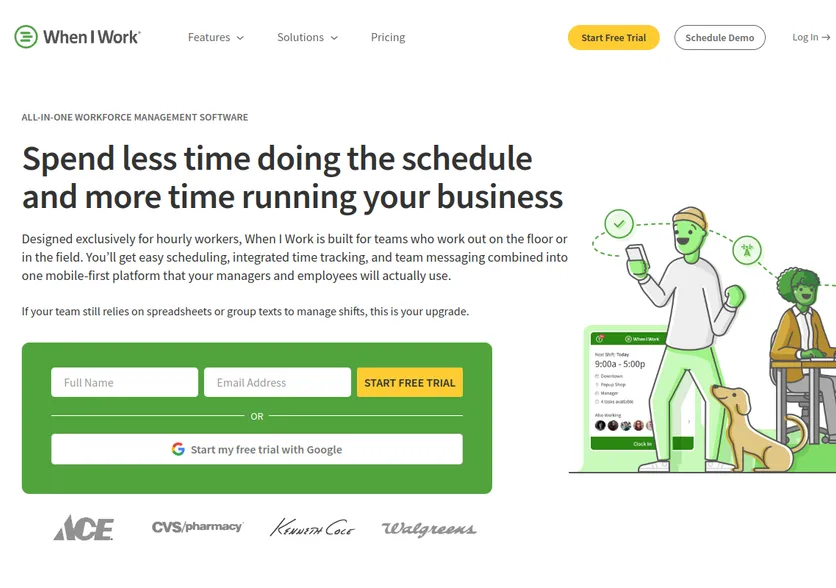
For a warehouse watching every dollar, this When I Work plan packs auto-scheduling and forecast tools into the cheapest per-seat price in this comparison. Essentials covers multi-week schedules, templates, open shifts, shift swapping and team messaging for two dollars and fifty cents per user a month. Time tracking is a paid add-on, and multi-warehouse teams pay five dollars per user a month according to the vendor FAQ.
What we like
- Auto-scheduling and forecast tools on the cheapest plan
- Clean, fast scheduling interface with shift swaps built in
- No minimum seat count and no free-plan limits to outgrow
Watch out for
- Time tracking is a paid add-on, not part of Essentials
- Multi-warehouse teams pay double the single-location rate
How to try it
- Open the When I Work pricing page and start the fourteen-day trial
- Build a week of warehouse shifts with templates and auto-scheduling
- Check the time tracking add-on price before you budget
4. Connecteam
Best for: Small distributors that want scheduling, time clock and chat free up to ten users
Paid tool Starting price: $29/month · Twenty-nine dollars a month billed annually for the Operations hub on Basic, covering the first thirty users, or thirty-five dollars billed monthly; Advanced is forty-nine dollars and Expert ninety-nine; each hub is billed separately
Free plan: Free plan for up to 10 users; 14-day free trial on paid plans
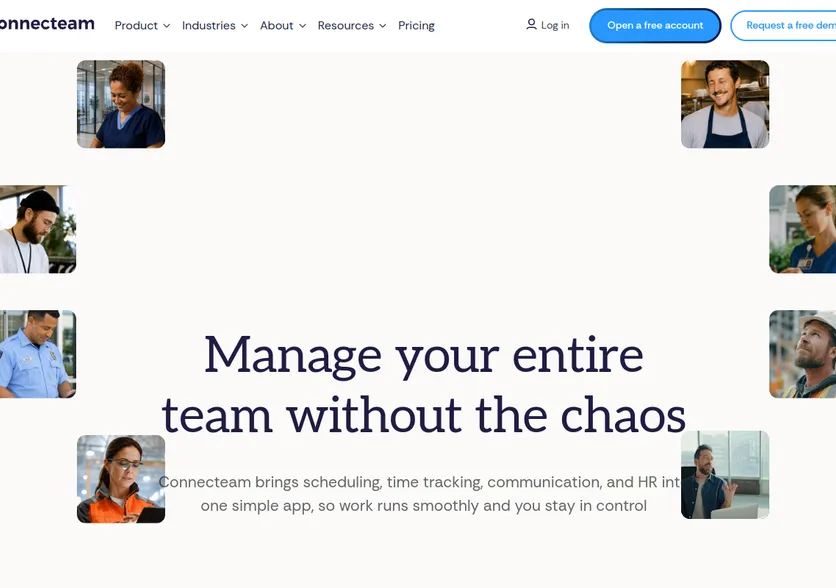
This Connecteam plan gives a small distributor the full product free for up to ten users, with scheduling, time clock, chat and HR in one mobile app. The Operations hub on Basic adds GPS clock-in, open shifts and payroll integration for twenty-nine dollars a month once the team grows past ten. Each hub is billed separately, so the full suite costs three times the entry price.
What we like
- Free for up to ten users with every hub and feature included
- One mobile app covers scheduling, clock-in, chat and HR
- Flat price for the first thirty users keeps small-team costs predictable
Watch out for
- Each hub is a separate subscription, so the full suite costs three times the entry price
- Advanced scheduling tools wait for the higher plans
How to try it
- Open the Connecteam pricing page and start with the free Small Business plan
- Build the warehouse rota in the Operations hub and add the time clock
- Check which hubs you actually need before you upgrade
5. Buddy Punch
Best for: Distributors that want photo-verified clock-ins at the gate
Paid tool Starting price: $6.99/user/month · Six dollars and ninety-nine cents per user a month billed annually on Pro, or seven dollars ninety-nine cents billed monthly, plus a nineteen-dollar monthly base fee; Starter is four dollars ninety-nine cents annual with scheduling as a one-dollar per user add-on; Advanced is twelve dollars ninety-nine cents annual
Free plan: No free plan; 14-day free trial
This Buddy Punch plan is the time-clock-first pick for a warehouse, with photo verification on every punch and scheduling built in. Pro costs six dollars and ninety-nine cents per user a month billed annually, plus a nineteen-dollar monthly base fee, and adds scheduling, time off management and overtime alerts. The cheaper Starter plan needs a one-dollar per user scheduling add-on, so Pro is the honest starting point for a rota.
What we like
- Photo verification on every punch, so buddy punching stops
- Scheduling, time off and overtime alerts on Pro
- Fourteen-day trial with no card required
Watch out for
- A nineteen-dollar monthly base fee sits on top of the per-user price
- Scheduling is an add-on on the cheaper Starter plan
How to try it
- Open the Buddy Punch pricing page and start the fourteen-day trial
- Set up the photo-verified time clock at the warehouse gate
- Build the delivery rota on Pro and test overtime alerts
6. QuickBooks Time
Best for: Distributors already on QuickBooks Online that want time tracking and scheduling together
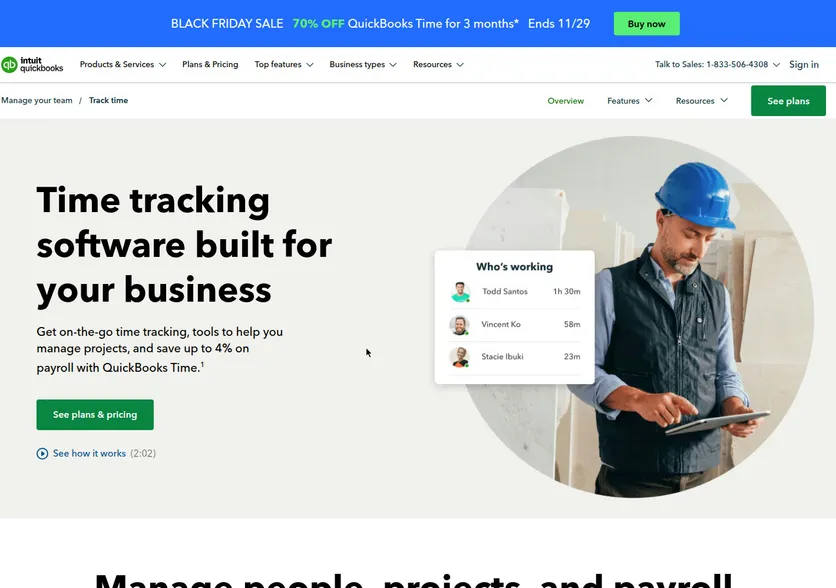
Paid tool Starting price: $20/month + $10/user · Twenty dollars a month base plus ten dollars per user a month on Time Premium, or forty dollars base plus twelve dollars per user on Time Elite; the base fee is seventy percent off for the first three months; a QuickBooks Online account is required
Free plan: No free plan; 30-day free trial
This QuickBooks Time plan is the time-clock-first option for a distributor already running QuickBooks Online. Time Premium covers the workforce app, a time kiosk, scheduling by job or shift, time off and payroll sync for twenty dollars a month plus ten dollars per user. A QuickBooks Online account is required, so a distributor that books elsewhere pays for accounting software it may not use.
What we like
- GPS time clock with a kiosk for shared devices
- Scheduling feeds straight into QuickBooks payroll and invoicing
- Unlimited customer support on both paid plans
Watch out for
- Requires a QuickBooks Online account, which adds cost
- Base fee plus per-user fee makes small teams pay more than flat tools
How to try it
- Open the QuickBooks Time pricing page and confirm your QuickBooks Online plan
- Start the thirty-day trial and set up the workforce app
- Build schedules by shift and check the payroll sync before payday
7. Homebase
Best for: Distributors that want a flat per-location price as headcount grows
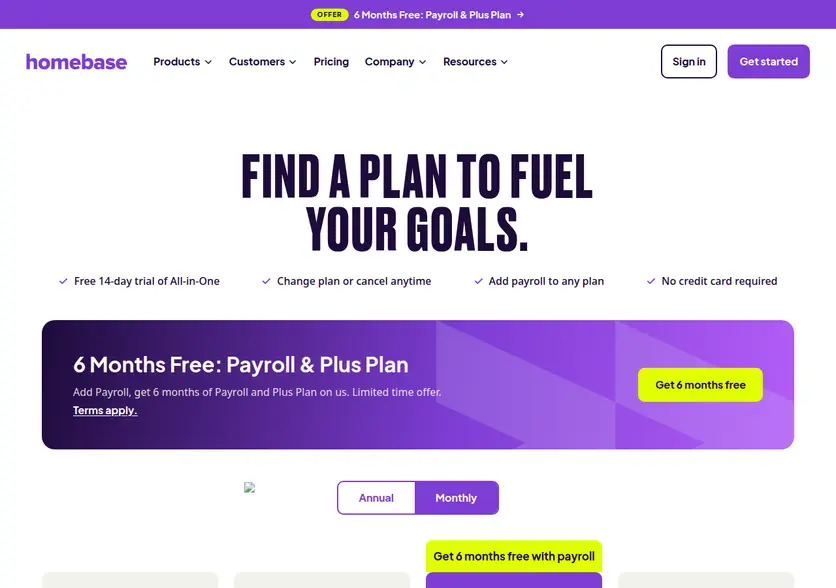
Paid tool Starting price: $24/location/month · Twenty-four dollars per location a month billed annually on Essentials, or thirty dollars billed monthly, with unlimited employees; Plus is fifty-six dollars annual and All-in-One ninety-six dollars; free Basic plan covers one location and up to ten employees
Free plan: Free Basic plan for 1 location and up to 10 employees
This Homebase plan charges per location with unlimited employees, so a warehouse pays the same as headcount rises. Essentials adds advanced scheduling, GPS clock-ins and late arrival alerts for twenty-four dollars per location a month billed annually. The free Basic plan covers one location and up to ten employees, which fits a small depot with no budget at all.
What we like
- Per-location pricing with unlimited employees on paid plans
- Free plan covers a single small depot with no budget
- GPS clock-in and late arrival alerts on Essentials
Watch out for
- AI schedule building waits for the Plus plan
- Payroll is a separate add-on on every plan
How to try it
- Open the Homebase pricing page and start with the free Basic plan
- Add your warehouse staff and build a week of shifts
- Upgrade to Essentials when you need GPS clock-ins and alerts
8. Humanity Schedule
Best for: Distributors that need skills, certifications and rest rules enforced on the rota
Paid tool Starting price: $2.75/employee/month · Two dollars and seventy-five cents per employee a month billed annually on Essentials, or three dollars thirty cents billed monthly, for up to two hundred and fifty employees; Professional starts at three dollars seventy-five cents annual; Enterprise is a custom quote
Free plan: No free plan; 30-day free trial
This Humanity Schedule plan brings warehouse-grade rota rules to a small distributor at two dollars and seventy-five cents per employee a month. Essentials covers drag-and-drop scheduling, shift swaps, geofenced clock-in and basic reporting, while Professional adds auto-fill scheduling, skills and certifications, and labor budgeting. Managers and administrators count toward the bill, since the price is per employee.
What we like
- Skills and certification rules attach to each employee and shift
- Rest and meal break rules are built into scheduling
- Low entry price with a thirty-day trial of Professional
Watch out for
- Auto-fill scheduling and compliance tools wait for Professional
- Enterprise features such as the open API are priced as add-ons
How to try it
- Open the TCP pricing page and start the thirty-day Professional trial
- Add staff skills and certifications, then build a week of rosters
- Test the conflict checker on a shift that breaks a rest rule
Prices above were checked on each vendor’s own website on Nov 27, 2026 and can change — the vendor’s page is the final word. Vendor links are editorial: nobody paid to be listed or ranked here. Vendors who want a featured listing can see how it works on our Get listed page.
How a wholesale distributor should run its rota
Start with licenses, not the calendar. List the certifications each warehouse role needs, the rest rules your contract requires, and the delivery windows that keep customers happy, then pick a tool that enforces those rules instead of letting anyone grab any shift. A swap that puts an uncertified driver on a delivery is worse than an empty slot, so approval should sit with a dispatcher who can see qualifications.
Keep the rota visible a full week ahead and publish changes the moment they happen, because warehouse staff plan childcare and second jobs around the schedule. Count every login when you price a per-seat tool, since leads and dispatchers count as users too, and check whether the cheapest plan covers the overtime alerts and certification tracking you actually need before you commit to a year.
Before you buy
- Check whether the plan tracks driver licenses and forklift certifications per shift
- Count warehouse leads and dispatchers as users when you price a per-seat plan
- Make sure shift swaps need manager approval before they go live
- Confirm the time clock works at the warehouse gate without staff phones
- Test the overtime alerts with a real delivery schedule before you pay
Official websites
Official websites of the products reviewed above. Features and prices were checked against these sites when this guide was written, and they can change, so confirm on the vendor site before you buy.
Frequently asked questions
What is the cheapest scheduling tool for a small distributor?
When I Work Essentials costs two dollars and fifty cents per user a month, and Humanity Essentials costs two dollars and seventy-five cents per employee a month billed annually. Connecteam is free for up to ten users with every hub included, and Homebase Basic is free for one location and up to ten employees. A fifteen-person warehouse can run free on Connecteam or pay thirty-seven dollars fifty cents a month on When I Work.
Do any of these tools handle certifications and overtime?
Yes, if the plan supports skills, certifications and overtime rules. Humanity Professional lets you assign required skills, licenses and certifications at the employee or position level, and Deputy Core adds labor-law compliance and wage budgets. Buddy Punch Pro adds overtime alerts and photo-verified clock-ins at the gate, which matters when buddy punching costs a warehouse real money.
How do we cover a last-minute call-out on a delivery shift?
Use a tool with open shifts and a job board so qualified staff can claim the vacancy themselves, such as Deputy or Humanity Professional. Set the swap rules so only staff with the right certification can claim a delivery shift, and keep manager approval on. A broadcast that reaches every qualified worker at once fills a night shift far faster than phoning down a list.
Do we need a separate time clock with these tools?
Most of these tools include a mobile time clock, so a separate purchase is rarely needed. Buddy Punch and QuickBooks Time are time clocks first, with scheduling built in, and both offer photo-verified or GPS clock-ins. Deputy, Humanity and Connecteam all include GPS clock-in, while Homebase adds late arrival alerts on Essentials.
Can a scheduling tool handle nights and rotating shifts?
Yes, if the plan supports recurring shifts, multi-location rosters and availability rules. Deputy handles recurring rosters with auto-scheduling on Core, Humanity covers multi-location rosters with rest and meal break rules, and Connecteam Expert supports up to twelve schedules. Confirm the overtime calculation specifically, since some tools calculate it per week and others per shift.
Compare the eight tools above, then run a free trial on one warehouse before you move the whole operation over.
Browse Business Tools tools