On this page
An annual engagement survey that nobody acts on is worse than no survey at all, because employees learn that their answers change nothing. The right survey tool for internal culture makes it easy to ask, easy to answer, and easy for managers to act on what they hear. Lattice leads this comparison by tying surveys to performance reviews at four dollars per seat a month, and the other seven tools range from two dollars per user to a flat yearly plan. We checked every price on the vendor site on November 27, 2026.
How we researched this
We started with survey tools built for employee culture rather than general market research, then read each price on the vendor site on November 27, 2026 and noted the free plan or trial each one carries. We judged them for a company that wants honest answers, managers who act on results, and a price that fits the team size. We dropped quote-only engagement platforms because a culture team needs a published price to budget around.
Compare the tools
| Name | Best for | Starting price | Free plan | |
|---|---|---|---|---|
 Lattice | Companies that want engagement surveys tied to performance reviews | $4/seat/month | No free plan; free trial available | Visit |
 15Five | Teams that want weekly check-ins plus quarterly engagement surveys | $4/user/month | No free plan; free trial available | Visit |
| Workleap (formerly Officevibe) | Mid-size companies that want anonymous surveys with manager coaching | from $4,999/year | No free plan or free trial; book a demo | Visit |
 Bonusly | Small teams that want recognition and quick polls in one tool | $3/user/month | Free plan for up to 8 users | Visit |
| ThriveSparrow | Small companies that want engagement surveys at the lowest price | $3/employee/month | No free plan; 14-day free trial | Visit |
| Microsoft Viva Glint | Large companies already running Microsoft 365 | $2/user/month | No free plan listed; contact Microsoft for trial terms | Visit |
 SurveyMonkey | Companies that need deep survey logic and a huge template library | $30/user/month | Free Basic plan | Visit |
 SurveySparrow | Teams that want friendly conversational surveys with high response rates | $19/month | Free plan for 75 responses per quarter | Visit |
The employee survey software for internal culture, compared
1. Lattice
Best for: Companies that want engagement surveys tied to performance reviews
Paid tool Starting price: $4/seat/month · Engagement plan at four dollars per seat a month billed annually with a four thousand dollar annual minimum; Performance and other modules are priced separately
Free plan: No free plan; free trial available
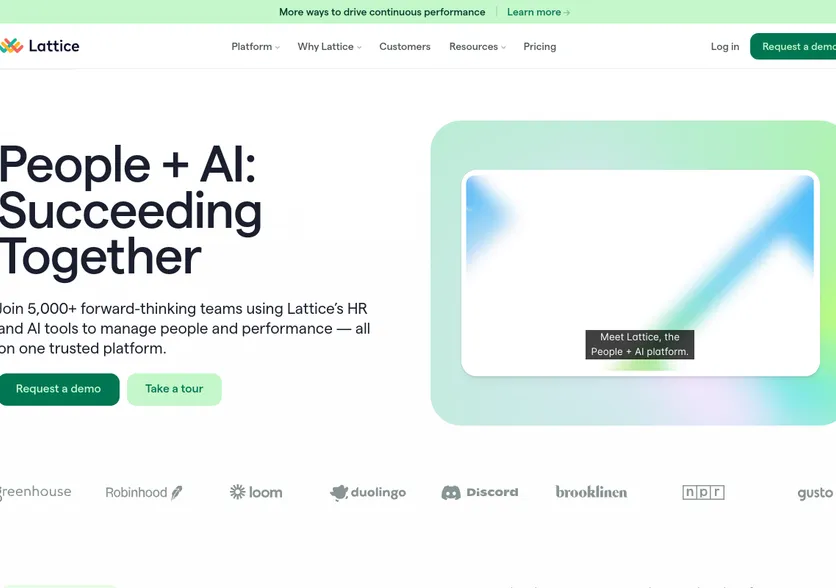
This Lattice platform pairs engagement surveys with performance reviews, so culture feedback and manager conversations live in the same system. Pulse surveys, eNPS and custom questions run alongside one-on-ones and goals, which helps managers act on what employees actually say. The Engagement plan starts at four dollars per seat a month billed annually, with a four thousand dollar annual minimum.
What we like
- Surveys, reviews and goals in one platform
- Pulse surveys and eNPS for regular check-ins
- Manager tools that turn scores into actions
Watch out for
- Annual minimum puts it out of reach for very small teams
- Performance modules cost extra on top of Engagement
How to try it
- Launch a short engagement survey with a mix of scored and open questions
- Review results by team and share the top themes with managers
- Turn the lowest scores into goals and follow up in one-on-ones
2. 15Five
Best for: Teams that want weekly check-ins plus quarterly engagement surveys
Paid tool Starting price: $4/user/month · Engage plan at four dollars per user a month billed annually; Perform and Focus modules are priced separately
Free plan: No free plan; free trial available
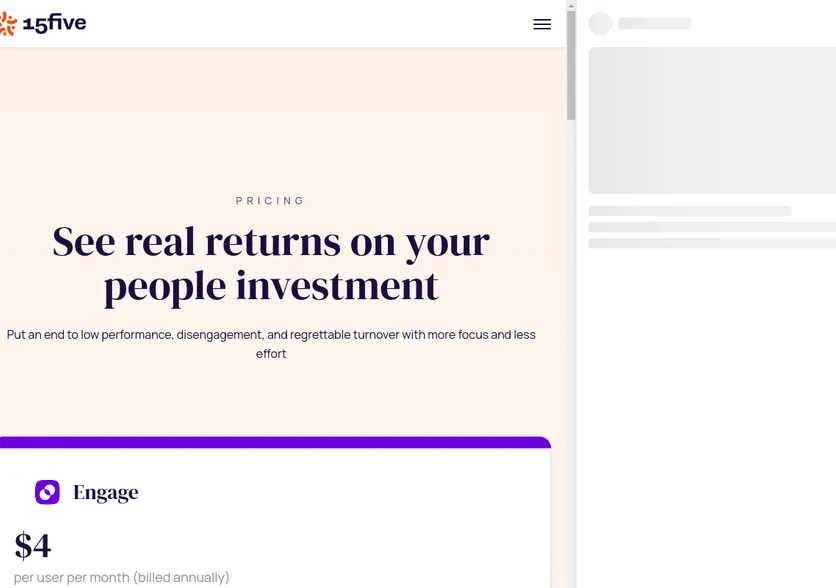
This 15Five tool combines weekly check-ins with engagement surveys, so managers hear about problems while they are still small. Employees answer a few short questions each week and the survey results show how morale moves over time. The Engage plan costs four dollars per user a month billed annually, which puts it at the same price as Lattice with a lighter setup.
What we like
- Weekly check-ins catch issues between surveys
- Simple setup with survey templates included
- Manager dashboard shows trends by team
Watch out for
- Advanced performance features are separate paid modules
- No free plan, only a free trial
How to try it
- Set up weekly check-ins with three or four short questions
- Run a quarterly engagement survey from the template library
- Review team trends in the manager dashboard each month
3. Workleap (formerly Officevibe)
Best for: Mid-size companies that want anonymous surveys with manager coaching
Paid tool Starting price: from $4,999/year · Standard plan from four thousand nine hundred ninety-nine dollars a year plus thirty-two dollars per manager a month, billed annually; Pro from eleven thousand nine hundred ninety-nine dollars a year plus thirty-two dollars per manager a month; Enterprise is custom for two hundred fifty or more employees; no free plan or free trial
Free plan: No free plan or free trial; book a demo
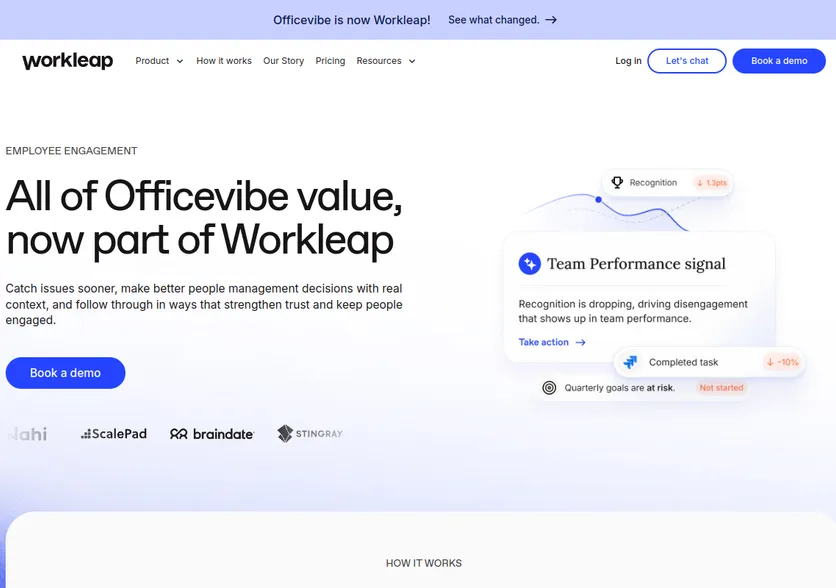
This Workleap (formerly Officevibe) platform runs anonymous pulse surveys and gives managers plain guidance on what to do with the results. The Standard plan starts from four thousand nine hundred ninety-nine dollars a year plus thirty-two dollars per manager a month, which suits a company with a real management layer. There is no free plan or free trial, so budget for a demo before you decide.
What we like
- Anonymous pulse surveys employees actually trust
- Manager guidance built into every survey result
- Strong reporting for larger companies
Watch out for
- Starting price is high for a small company
- No free plan or trial to test before buying
How to try it
- Book a demo and ask for the anonymous survey sample
- Roll out pulse surveys to one department first
- Use the manager guidance to act on the first results
4. Bonusly
Best for: Small teams that want recognition and quick polls in one tool
Paid tool Starting price: $3/user/month · Team plan at three dollars per user a month, or thirty dollars per user a year; free plan for up to eight users; Organization plan is custom
Free plan: Free plan for up to 8 users
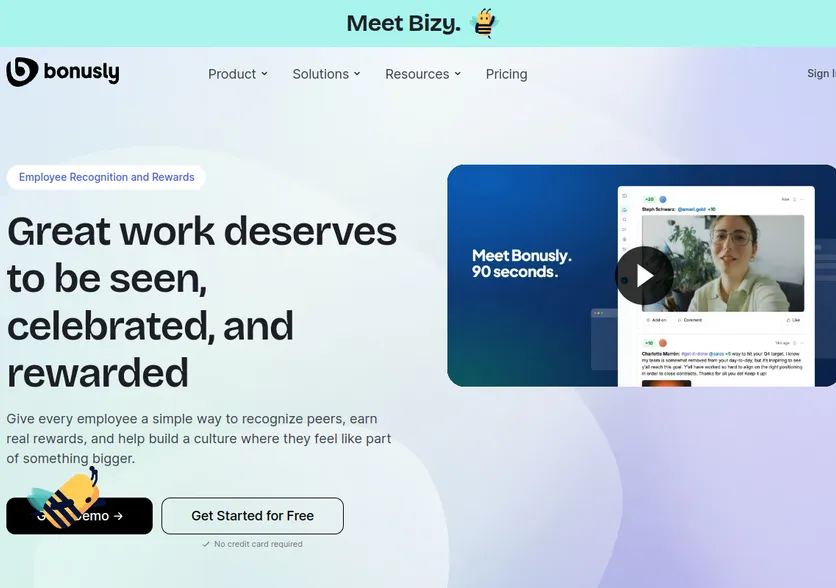
This Bonusly tool mixes peer recognition with short polls, so culture feedback comes from everyday praise as well as formal surveys. Employees give points to colleagues for good work and managers can run quick polls alongside the recognition feed. The Team plan costs three dollars per user a month and the free plan covers up to eight users, which makes it the easiest to start in this comparison.
What we like
- Peer recognition plus polls in one feed
- Free plan for up to eight users
- Fastest setup in this comparison
Watch out for
- Not a full engagement survey platform
- Recognition habits fade without a manager champion
How to try it
- Invite the team and let everyone give their first recognition
- Run a short poll on one culture topic each month
- Review the recognition feed for themes worth a deeper survey
5. ThriveSparrow
Best for: Small companies that want engagement surveys at the lowest price
Paid tool Starting price: $3/employee/month · Engage plan at three dollars per employee a month; Kudos at two dollars and the Engage plus Kudos bundle at four dollars per employee a month; Performance at five dollars and Goals at three dollars per employee a month; fourteen-day free trial
Free plan: No free plan; 14-day free trial
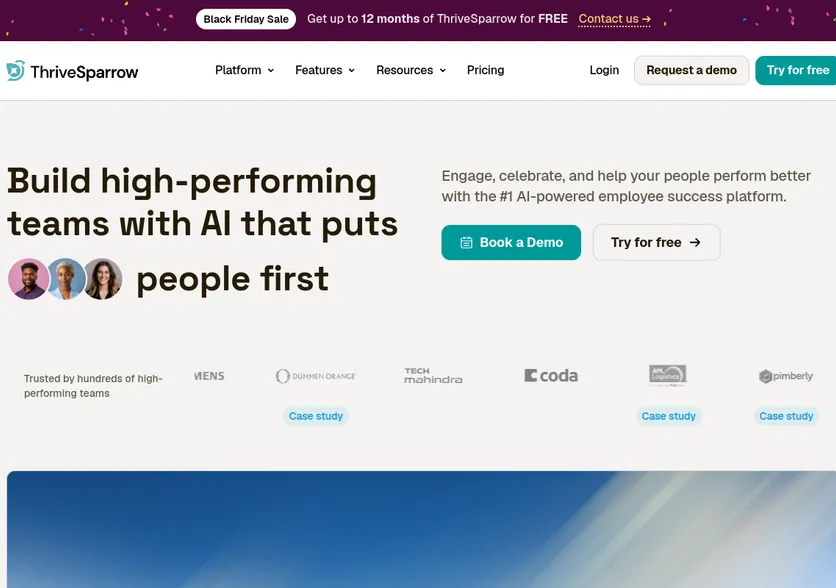
This ThriveSparrow platform is the cheapest engagement survey tool in this comparison at three dollars per employee a month for the Engage plan. Surveys, recognition and goals can be bought separately or bundled, so a small company pays only for what it uses. A fourteen-day free trial lets a team run one real survey before paying anything.
What we like
- Lowest engagement survey price in this comparison
- Modules can be bought separately or bundled
- Fourteen-day free trial for a real test
Watch out for
- Smaller vendor with fewer integrations than Lattice
- No free plan, only a fourteen-day trial
How to try it
- Start the free trial and build an engagement survey
- Send it to the whole team and watch response rates
- Share the top three findings and one action with staff
6. Microsoft Viva Glint
Best for: Large companies already running Microsoft 365
Paid tool Starting price: $2/user/month · Two dollars per user a month paid yearly with a fifty-seat minimum; the Workplace Analytics plus Employee Feedback bundle is six dollars per user a month and the full Viva Suite is twelve dollars per user a month
Free plan: No free plan listed; contact Microsoft for trial terms
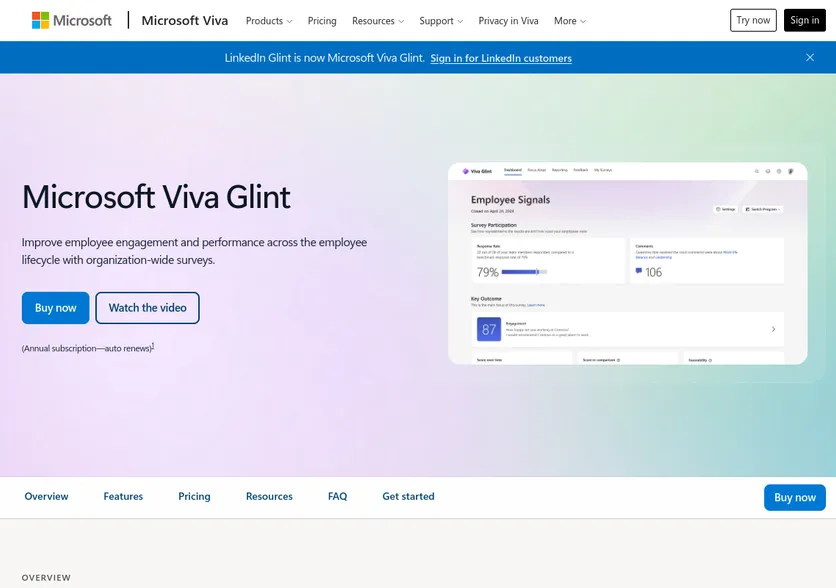
This Microsoft Viva Glint survey tool runs inside the Microsoft Viva suite, so a company already on Microsoft 365 can add engagement surveys without a new vendor. It costs two dollars per user a month paid yearly with a fifty-seat minimum, which makes it the cheapest per-user price here for a large team. Survey results feed into the wider Viva analytics that HR teams already use.
What we like
- Cheapest per-user price for large teams
- Lives inside Microsoft 365 and Viva
- Strong analytics for HR teams
Watch out for
- Fifty-seat minimum rules out small companies
- Needs a Microsoft 365 setup to make sense
How to try it
- Confirm your Microsoft 365 licences cover Viva
- Set up an engagement survey with the template library
- Review results in the Viva analytics dashboard
7. SurveyMonkey
Best for: Companies that need deep survey logic and a huge template library
Paid tool Starting price: $30/user/month · Team Advantage at thirty dollars per user a month billed annually with a three-user minimum; Team Premier at ninety-two dollars per user a month billed annually; Advantage Annual for a single user at thirty-nine dollars a month
Free plan: Free Basic plan
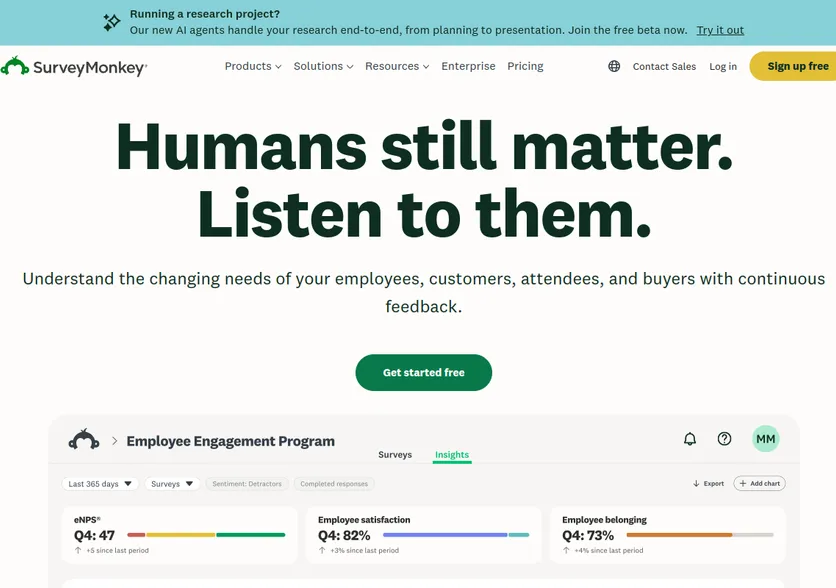
This SurveyMonkey platform is the best-known survey builder in this comparison, with branching logic, a large template library and strong analysis tools. Team Advantage costs thirty dollars per user a month billed annually with a three-user minimum, which makes it the priciest option here for a whole-company survey. It earns that price when a culture team needs complex question logic that the cheaper engagement tools cannot do.
What we like
- Deepest survey logic and branching in this comparison
- Large library of engagement templates
- Strong analysis and reporting tools
Watch out for
- Priciest per-user plan in this comparison
- Built for surveys, not for ongoing engagement tracking
How to try it
- Pick an employee engagement template and adapt the questions
- Add branching so different teams see relevant questions
- Analyse results by department and export the report
8. SurveySparrow
Best for: Teams that want friendly conversational surveys with high response rates
Paid tool Starting price: $19/month · Basic plan at nineteen dollars a month billed annually for two thousand five hundred responses a year; free plan covers seventy-five responses a quarter
Free plan: Free plan for 75 responses per quarter
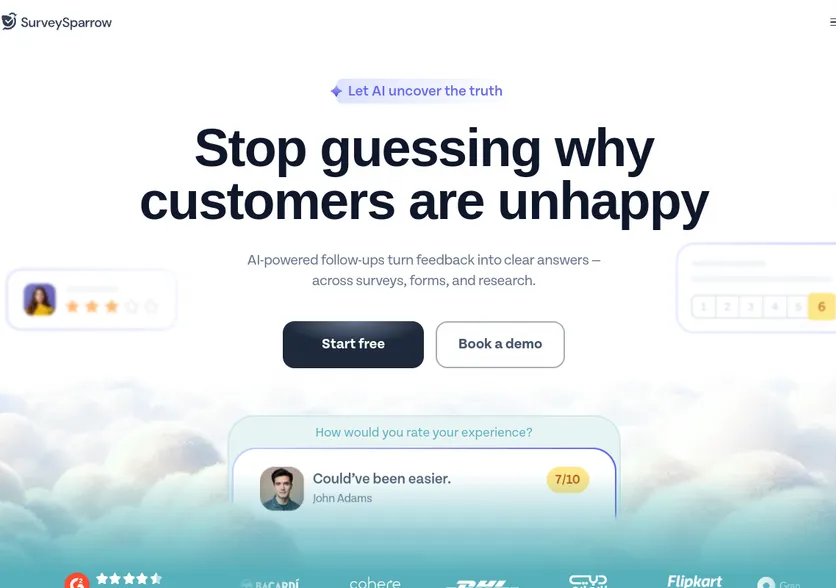
This SurveySparrow tool turns surveys into a chat-style conversation, which lifts response rates from employees who ignore long forms. The Basic plan costs nineteen dollars a month billed annually for two thousand five hundred responses a year, so a small company can survey the whole team several times a year. The free plan covers seventy-five responses a quarter, enough to test one survey with a single department.
What we like
- Chat-style surveys lift response rates
- Free plan for seventy-five responses a quarter
- Simple setup with no survey experience needed
Watch out for
- Response limits can bite on a large team
- Fewer engagement features than Lattice or 15Five
How to try it
- Build a conversational survey from an engagement template
- Send it by email or chat and watch responses arrive live
- Review the results dashboard and share the highlights
Prices above were checked on each vendor’s own website on Nov 27, 2026 and can change — the vendor’s page is the final word. Vendor links are editorial: nobody paid to be listed or ranked here. Vendors who want a featured listing can see how it works on our Get listed page.
How to run a culture survey employees trust
Keep the first survey short, ten questions at most, and ask about things managers can actually change, such as workload, recognition and communication. Long surveys with fifty questions get low response rates and vague answers, while a short survey that leads to one visible change builds trust for the next round. Promise anonymity in writing and keep that promise by never reporting results for groups smaller than five people.
Share the results with the whole team within two weeks, including the bad news, and name the one or two actions you will take. A survey that disappears into HR teaches employees to ignore the next one. Then repeat the pulse survey on a steady rhythm, monthly or quarterly, so the team can see whether the actions actually moved the scores.
Before you buy
- Ask whether survey results stay anonymous when a team has fewer than five people
- Check whether the plan includes benchmarks or only your own past results
- Make sure managers get action guidance, not just a score dashboard
- Confirm the survey tool works on phones for staff without a desk
- Test the free plan or trial with one real survey before a yearly contract
Official websites
Official websites of the products reviewed above. Features and prices were checked against these sites when this guide was written, and they can change, so confirm on the vendor site before you buy.
Frequently asked questions
What is the cheapest employee survey software for internal culture?
ThriveSparrow is the cheapest engagement-specific tool at three dollars per employee a month, and Microsoft Viva Glint is cheaper per user at two dollars a month if your company has fifty or more seats and already uses Microsoft 365. Bonusly is also three dollars per user a month with a free plan for up to eight users. The cheapest option depends on team size, because per-user prices and annual minimums change the real cost fast.
Are employee surveys really anonymous?
Yes, if the survey is set up properly. Lattice, Workleap and 15Five all support anonymous responses, but anonymity breaks down when a team has fewer than five people, because a manager can guess who said what. Tell employees clearly how anonymity works and never report results for tiny groups. Trust matters more than the tool, so publish the results and the actions you take.
How often should a company survey its employees?
Twice a year is the common rhythm for a full engagement survey, with a short pulse survey every month or quarter in between. Surveying too often burns employees out and response rates fall, while surveying once a year leaves problems to grow for months. Whatever cadence you pick, always share the results and one action, or employees will stop answering.
What is the difference between a pulse survey and an engagement survey?
A pulse survey is a short check-in of five to ten questions sent monthly or quarterly, while an engagement survey is a longer annual or twice-yearly study of the whole culture. Pulse surveys track whether things are getting better or worse, and engagement surveys explain why. Most companies in this comparison run both, using the same tool for each.
What should a manager do with a low engagement score?
A low score only helps if a manager acts on it within a few weeks. Pick the one or two lowest themes, tell the team what you heard, and name the change you will make, even if it is small. Tools like Lattice and Workleap give managers suggested actions, but the follow-up conversation matters more than the dashboard. Re-run the survey after a few months to check the change worked.
Compare the eight tools above, then run one short pulse survey with a free plan or trial before you commit the whole company to a yearly plan.
Browse Business Tools tools