On this page
Electrical estimating lives or dies on the takeoff: count every receptacle, every foot of conduit and every breaker wrong, and the bid is lost before the job starts. Spreadsheets hide those mistakes until the invoice arrives, which is why most electrical contractors now price from a digital takeoff tied to a live material database. We compared seven tools on published price, takeoff speed and how well they handle electrical assemblies. PlanSwift is our first pick — the fastest takeoff in this comparison, with a per-seat price that scales cleanly from a one-person shop to a large crew.
How we researched this
We started with the estimating tools electrical contractors actually use to price residential, commercial and industrial work, then read each price on the vendor site on November 27, 2026 and noted the trial each plan carries. We judged them for a contractor who prices from drawings, needs accurate counts of devices and wire, and wants the estimate to turn into a proposal without retyping. We dropped quote-only estimating platforms and generic construction suites with no electrical takeoff, because a bid built on guesswork is worse than no bid at all.
Compare the tools
| Name | Best for | Starting price | Free plan | |
|---|---|---|---|---|
 PlanSwift | Electrical contractors who want the fastest takeoff and a tool their estimators already know | $166.67/seat/month | No free plan; 14-day free trial | Visit |
 STACK Takeoff & Estimate | Electrical contractors who want takeoff and estimating in one cloud workspace | $299/user/month | Free plan: 1 active project per month | Visit |
 Buildxact | Electrical contractors who want estimating plus scheduling and job management in one tool | $169/month | Free Go plan with 5 credits | Visit |
 JobTread | Electrical contractors who want the bid to become the job budget automatically | $159/month | No free plan; 30-day money-back guarantee | Visit |
 Clear Estimates | One-person electrical shops that want the cheapest way off spreadsheets | $59/month | No free plan; 30-day free trial | Visit |
 Houzz Pro | Electrical contractors who already win work through Houzz and want estimating in the same place | $199/month | Free plan available | Visit |
 Bluebeam Revu | Electrical contractors who want the most precise drawing measurement to feed their estimates | $260/user/year | No free plan; 30-day free trial | Visit |
The estimating software for electrical contractors, compared
1. PlanSwift
Best for: Electrical contractors who want the fastest takeoff and a tool their estimators already know
Paid tool Starting price: $166.67/seat/month · Essential costs two thousand dollars per seat a year, about one hundred and sixty-seven dollars a month, and Core costs three thousand dollars per seat a year; buying two or more seats drops the rate to one thousand five hundred dollars per seat on Essential; annual billing only, with a fourteen-day trial and no card required
Free plan: No free plan; 14-day free trial
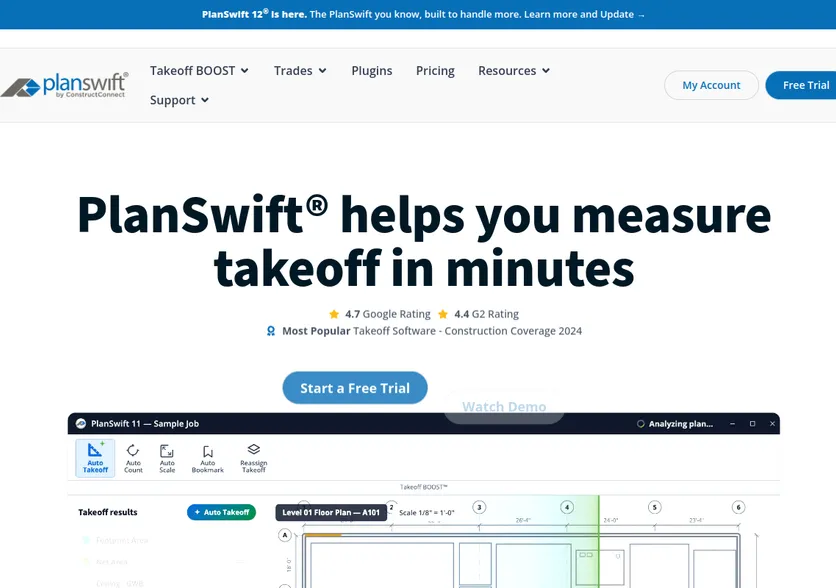
This PlanSwift takeoff is the fastest way to count devices and measure wire runs from digital drawings, and it is the tool most electrical estimators already know. Point and click measuring turns a plan set into quantities in minutes, and the assemblies library stores your standard circuits, panels and homeruns so every bid prices the same way. The per-seat price drops when you buy two or more seats, which makes it affordable for a growing estimating team.
What we like
- Fastest takeoff in this comparison, measured straight from digital drawings
- Assemblies library keeps standard circuits priced consistently
- Per-seat price falls when you buy two or more seats
Watch out for
- Annual billing only, so the full year is paid up front
- No free plan, so the trial is the only way to test it
How to try it
- Open the PlanSwift pricing page and start the fourteen-day trial
- Import one recent plan set and run a full takeoff
- Build your standard circuit and panel assemblies before the trial ends
2. STACK Takeoff & Estimate
Best for: Electrical contractors who want takeoff and estimating in one cloud workspace
Paid tool Starting price: $299/user/month · Premium costs two hundred and ninety-nine dollars per user a month billed annually, or three hundred and forty-nine dollars month to month; Pro costs three hundred and forty-nine dollars a month billed annually; the free plan covers one active project a month, and paid plans run on twelve-month terms
Free plan: Free plan: 1 active project per month
This STACK Takeoff & Estimate plan pairs cloud takeoff with a full estimating workbook, so the quantities measured from the drawings flow straight into the priced estimate. The free plan covers one active project a month, which lets a small contractor test the workflow on a real bid before paying. Collaboration tools let the estimator, the project manager and the owner work on the same job.

What we like
- Takeoff quantities flow straight into the priced estimate
- Free plan covers one active project a month
- Cloud collaboration keeps the estimator and project manager on the same job
Watch out for
- Paid plans run on twelve-month terms with no monthly option at the headline price
- Premium tier is needed for the deeper reporting features
How to try it
- Start on the free plan with one live project
- Run the takeoff and check that quantities flow into the estimate
- Invite the project manager to review the same job before you upgrade
3. Buildxact
Best for: Electrical contractors who want estimating plus scheduling and job management in one tool
Paid tool Starting price: $169/month · Foundation costs one hundred and sixty-nine dollars a month billed annually, or one hundred and ninety-nine dollars month to month; Pro costs three hundred and thirty-nine dollars a month billed annually; Master costs five hundred and nine dollars a month billed annually; the free Go plan includes five credits, and annual billing saves fifteen percent with a twelve-month commitment
Free plan: Free Go plan with 5 credits
This Buildxact plan covers estimating, scheduling and job management in one subscription, so an electrical contractor can price the job and then run it without switching tools. The takeoff is built for residential and light commercial work, and the estimate turns into a quote, a schedule and a purchase order in the same workspace. A free Go plan with five credits lets you test the estimating flow before paying anything.

What we like
- Estimating, scheduling and job management in one subscription
- Estimates become quotes, schedules and purchase orders without retyping
- Free Go plan lets you test the workflow before paying
Watch out for
- Annual billing needs a twelve-month commitment
- Takeoff is lighter than a dedicated takeoff-only tool
How to try it
- Start on the free Go plan and price one small job
- Test turning the estimate into a quote and a schedule
- Compare the Foundation and Pro tiers against your job volume before upgrading
4. JobTread
Best for: Electrical contractors who want the bid to become the job budget automatically
Paid tool Starting price: $159/month · One hundred and fifty-nine dollars a month billed annually, or one hundred and ninety-nine dollars month to month, including one internal user; extra users cost sixteen dollars a user a month billed annually for the second through tenth user, with lower rates above that; no free trial, but a thirty-day money-back guarantee, and every feature is included on every plan
Free plan: No free plan; 30-day money-back guarantee
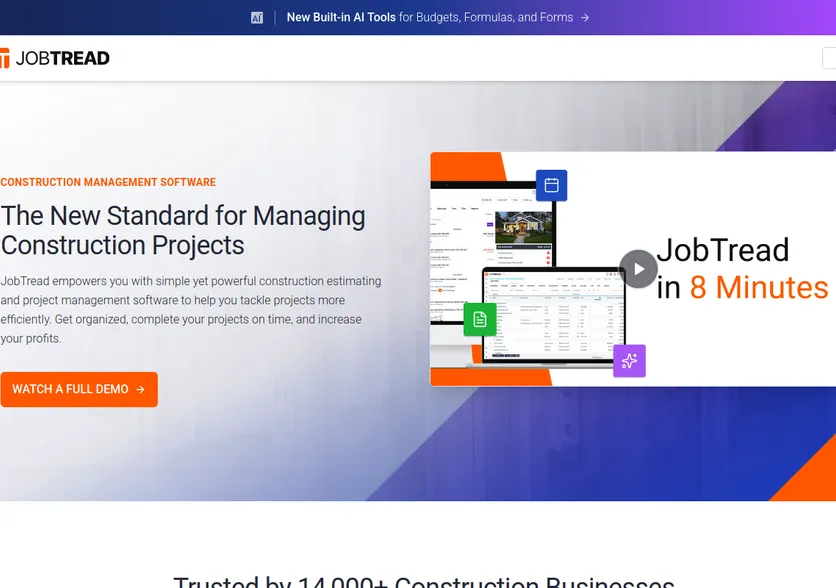
This JobTread plan combines estimating with job costing and project management, so the price you bid is the budget the job is measured against. Every feature is included on every plan, which means there is no tier to outgrow, and the per-user cost falls as the team grows. The flat monthly base includes one internal user, and the money-back guarantee replaces the free trial.
What we like
- Every feature is included on every plan, with no tier to outgrow
- The estimate becomes the job budget, so costing is tracked daily
- Per-user cost falls as the team grows past ten users
Watch out for
- No free trial, only the thirty-day money-back guarantee
- Takeoff is simpler than a dedicated takeoff tool
How to try it
- Open the JobTread pricing page and check the user tier for your team size
- Build one estimate and follow it into the job costing view
- Test the change order flow before the money-back window closes
5. Clear Estimates
Best for: One-person electrical shops that want the cheapest way off spreadsheets
Paid tool Starting price: $59/month · Standard costs fifty-nine dollars a month billed annually, or seventy-nine dollars month to month; Pro costs ninety-nine dollars a month billed annually; Franchise costs one hundred and ninety-nine dollars a month billed annually; thirty-day trial with no contract, Standard covers one login and Pro adds users at nine dollars a user a month
Free plan: No free plan; 30-day free trial
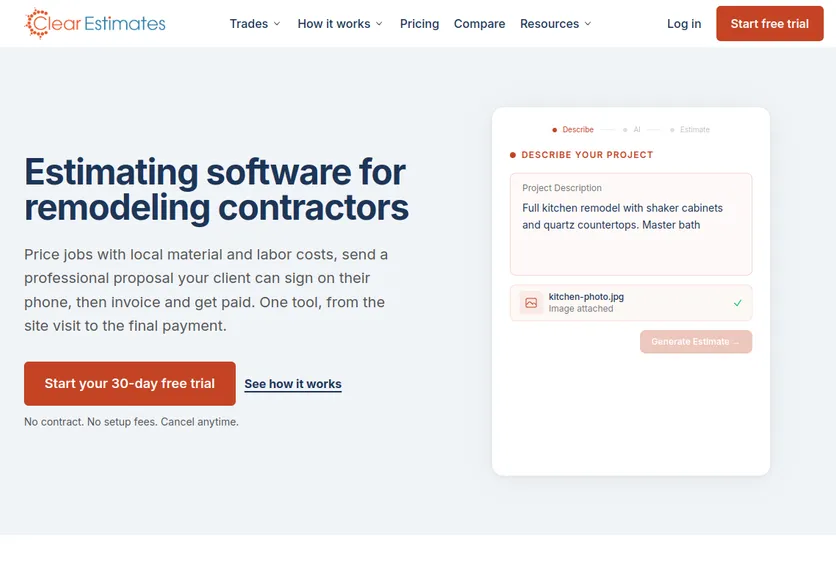
This Clear Estimates plan is the cheapest entry point in this comparison, and it is built around pre-priced electrical assemblies that a small contractor can use on day one. Pick the assemblies for the job, adjust the quantities, and the estimate is ready to send as a professional proposal. The thirty-day trial and the lack of a contract make it the lowest-risk way for a one-person electrical shop to leave spreadsheets behind.
What we like
- Cheapest entry price in this comparison at fifty-nine dollars a month
- Pre-priced electrical assemblies work on day one
- No contract, so you can leave whenever you like
Watch out for
- Standard covers only one login, so a second estimator costs extra
- Takeoff is assembly-based rather than drawing-based
How to try it
- Start the thirty-day trial and price one real job from the assemblies
- Check that the pre-priced assemblies match your local material costs
- Send the generated proposal to a client and see how it reads
6. Houzz Pro
Best for: Electrical contractors who already win work through Houzz and want estimating in the same place
Paid tool Starting price: $199/month · Pro costs one hundred and ninety-nine dollars a month for one user; Teams starts at three hundred and ninety-nine dollars a month for five users; extra users cost fifty dollars a user a month; a free plan is available, and an advertising add-on starts at four hundred and ninety-nine dollars a month
Free plan: Free plan available
This Houzz Pro plan wraps estimating in a full business platform, with lead capture, client communication and invoicing alongside the estimate builder. A contractor who already gets leads from Houzz can turn an enquiry into an estimate and then into an invoice without leaving the platform. The Pro plan covers one user, and the Teams plan adds four more seats.

What we like
- Estimating sits beside lead capture, messaging and invoicing
- Free plan lets you test the platform before paying
- Teams plan covers five users for growing firms
Watch out for
- Estimating is simpler than a dedicated electrical takeoff tool
- Advertising add-on starts at four hundred and ninety-nine dollars a month
How to try it
- Start on the free plan and build one estimate
- Connect your Houzz leads so enquiries flow into estimates
- Check the Teams plan price once you need a second user
7. Bluebeam Revu
Best for: Electrical contractors who want the most precise drawing measurement to feed their estimates
Paid tool Starting price: $260/user/year · Basics costs two hundred and sixty dollars per user a year, Core costs three hundred and thirty dollars, Complete costs four hundred and forty dollars, and Max costs five hundred and ninety dollars as an introductory price locked through the 2027 renewal
Free plan: No free plan; 30-day free trial
This Bluebeam Revu plan is the markup and measurement tool most electrical estimators already open every day, and its takeoff features measure drawings with the precision the trade expects. It is not a full estimating suite, but it pairs with any estimating tool here and handles the drawing side better than most. The Basics plan at two hundred and sixty dollars a user a year is the cheapest way to measure accurately.
What we like
- Most precise drawing measurement in this comparison
- The markup tool most estimators already know how to use
- Cheapest per-user annual price here at two hundred and sixty dollars
Watch out for
- Not a full estimating suite, so it needs a pricing tool beside it
- Higher tiers are needed for the deeper collaboration features
How to try it
- Start the thirty-day trial on the Basics plan
- Measure one plan set and compare the counts against your last bid
- Export the measurements into your estimating tool and check the handoff
Prices above were checked on each vendor’s own website on Nov 27, 2026 and can change — the vendor’s page is the final word. Vendor links are editorial: nobody paid to be listed or ranked here. Vendors who want a featured listing can see how it works on our Get listed page.
How an electrical contractor should build an estimate that holds
Start the takeoff from the drawings, not from a remembered price per square foot, because every job has a different mix of devices, circuits and panel work. Count fixtures and devices first, then measure the wire and conduit runs that connect them, and price the panel and service work last, since those are the items most often underpriced. A material database that updates with supplier pricing saves more money than any discount, because copper and breaker prices move every month.
Keep one assemblies library for the work you repeat, so a new estimator prices from the same assemblies and the bids stay consistent.
Before you buy
- Count every estimator who needs a seat, since most takeoff tools charge per user
- Check whether the material database updates automatically or needs manual price entry
- Make sure the tool handles electrical assemblies like circuits, panels and homeruns
- Confirm the trial length and whether a credit card is required to start it
- Verify the renewal price before you commit, since first-year prices can rise sharply
Official websites
Official websites of the products reviewed above. Features and prices were checked against these sites when this guide was written, and they can change, so confirm on the vendor site before you buy.
Frequently asked questions
What is the cheapest estimating software for electrical contractors?
Clear Estimates Standard costs fifty-nine dollars a month billed annually, the lowest entry price in this comparison, and it includes a thirty-day free trial. PlanSwift Essential costs two thousand dollars per seat a year, which works out to about one hundred and sixty-seven dollars a month. A one-person shop can start on Clear Estimates and move to PlanSwift once takeoff speed becomes the bottleneck.
Do I need takeoff software, or is a spreadsheet enough?
A spreadsheet works until the job has more than a few dozen circuits, because every count and every wire length is typed by hand. Takeoff software measures directly from the digital drawings, counts devices automatically and applies your assemblies, so the same job prices the same way every time. For a contractor bidding five or more jobs a month, the time saved on takeoffs usually pays for the subscription within the first bid cycle.
How does per-seat pricing work for estimating tools?
Most estimating tools charge per estimator, not per company, so a three-person estimating team pays three seats. PlanSwift charges two thousand dollars per seat a year on Essential, with a lower per-seat rate once you buy two or more seats. JobTread charges a flat monthly base that includes one internal user and adds a per-user fee above that. Count everyone who will open the tool, including project managers who only review estimates, before you compare prices.
Can estimating software handle change orders and variations?
Yes, and this is where a proper tool earns its price: you duplicate the original estimate, change only the affected assemblies or quantities, and the software reprices the variation with the same material rates. Buildxact and JobTread carry the estimate into scheduling and job costing, so a change order updates the job budget as well. A spreadsheet change order means retyping the whole section and hoping the formulas still point at the right cells.
What should I check before the free trial ends?
Run one real bid end to end inside the trial, from importing the drawings to sending the proposal, and time how long the takeoff takes against your current method. Check that the material database covers the wire, devices and panels you actually install, and confirm the export looks professional enough to send to a client. Most trials run fourteen to thirty days, and PlanSwift and Clear Estimates both offer one without asking for a card.
Compare the eight tools above, then run one real bid through a free trial before you pay.
Browse Business Tools tools