On this page
A municipal fleet burns fuel across police cars, garbage trucks, buses and public works vehicles, and every gallon is public money that must be accounted for. The tools below log fuel by vehicle and department, flag misuse and feed the chargeback reports a city council asks for. Fleetio leads the list with fuel logs and cost reports from four dollars a vehicle, and the other seven are ranked on the same test: what the fleet pays, and how cleanly its fuel data survives an audit.
How we researched this
We checked every price on the vendor pricing page on November 27, 2026, and only included tools with a published US dollar list price. We ranked each tool on fuel logging, department chargebacks, audit-ready reporting and fit for a public-sector fleet with mixed vehicle types. Tools with quote-only pricing, including most enterprise telematics vendors, were left out, so every price below can be verified on the vendor site.
Compare the tools
| Name | Best for | Starting price | Free plan | |
|---|---|---|---|---|
 Fleetio | Municipal fleets that want fuel logs inside one cost record | $4/vehicle/month | Fourteen-day free trial, no free plan | Visit |
 Azuga | Municipal fleets that want driver accountability behind fuel use | $25/vehicle/month | No free plan; demo available on request | Visit |
 Coast | Municipal fleets that want card-level control of fuel spend | $4/active user/month | No free plan; no setup fee, pay only for active users | Visit |
| EROAD | Municipal fleets that need fuel data with ELD and compliance | $25/vehicle/month | No free plan; demo available on request | Visit |
 Quartix | Municipal fleets that want cheap tracking to cut idling across departments | $14/vehicle/month | No free plan; trial available after a personalised demo | Visit |
 One Step GPS | Municipal fleets that want tracking without a long contract | $13.95/vehicle/month | No free plan; 100-day money-back guarantee | Visit |
 Simply Fleet | Municipal fleets that want low-cost fuel and maintenance records | $3/vehicle/month | Free plan for up to 5 vehicles and 3 users | Visit |
| RTA Fleet360 | Municipal fleets with an in-house shop and department chargebacks | $6/asset/month | No free plan; demo available on request | Visit |
The fleet fuel management software for municipal fleets, compared
1. Fleetio
Best for: Municipal fleets that want fuel logs inside one cost record
Paid tool Starting price: $4/vehicle/month · Four dollars per vehicle per month billed annually on the Essential plan, or five dollars billed monthly; Professional is seven dollars and Premium is ten dollars per vehicle per month, both billed annually only. Prices assume a five-asset plan band, and every plan includes unlimited users.
Free plan: Fourteen-day free trial, no free plan
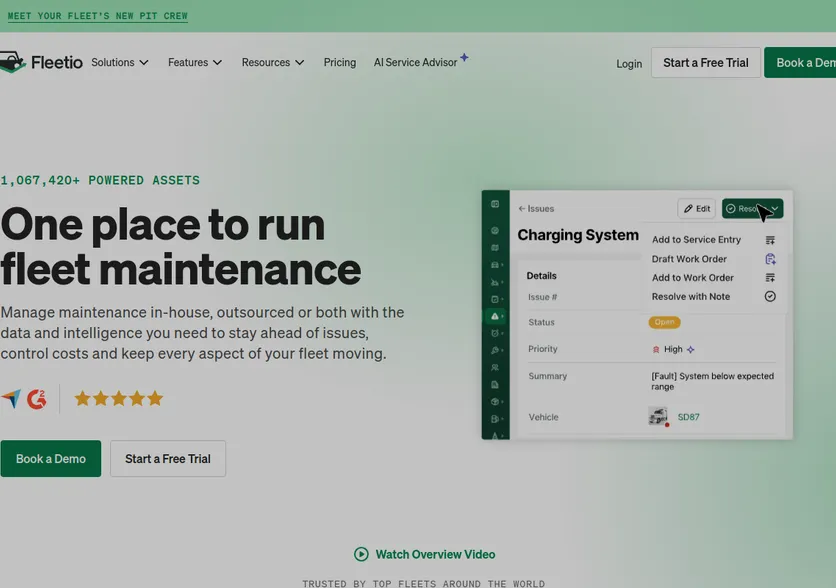
Fleetio gives a municipal fleet fuel logs, cost-per-mile reports and service history in one system, so every gallon sits next to the vehicle and department that used it. Fuel card data flows in automatically, and replacement analysis shows which aging vehicles cost the most to run. Fleetio does no GPS tracking itself, so a city without telematics needs a second vendor for live location and idling data.
What we like
- Published per-vehicle pricing with unlimited users
- Fuel logs and cost reports in the same record as maintenance
- Works with the telematics hardware a fleet already owns
Watch out for
- No GPS tracking of its own, so live location needs a second vendor
- Work orders and parts need the seven-dollar Professional plan
How to try it
- Add each truck with its odometer reading and service history
- Log every fuel fill-up and link it to the right vehicle
- Set service reminders by mileage or date and review cost-per-mile reports
2. Azuga
Best for: Municipal fleets that want driver accountability behind fuel use
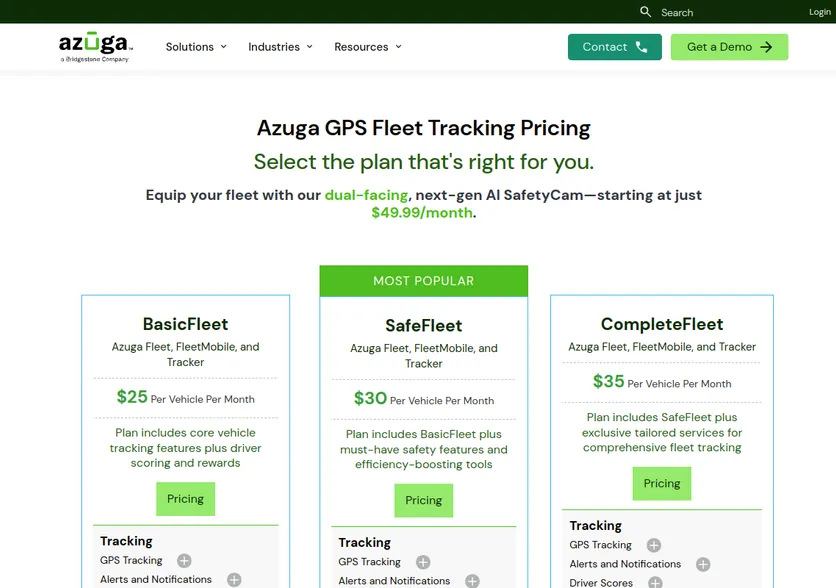
Paid tool Starting price: $25/vehicle/month · Twenty-five dollars per vehicle per month on BasicFleet; SafeFleet is thirty dollars and CompleteFleet is thirty-five dollars. The AI SafetyCam add-on costs forty-one dollars and ninety-nine cents per month, and contracts can run multi-year.
Free plan: No free plan; demo available on request
Azuga ties fuel use to the driver behind the wheel, with driver scores, rewards and FuelSaver reports on a published twenty-five-dollar plan. Its scheduled maintenance and vehicle diagnostics help a public works department catch the faults that push consumption up. Contracts can default to a four-year initial term, so a city should confirm the renewal language before signing.
What we like
- Published prices with no quote needed to see the tiers
- Driver scores and rewards are included on the entry plan
- FuelSaver and scheduled maintenance on higher tiers
Watch out for
- Contracts can default to a four-year initial term
- SafetyCam is a separate add-on at about forty-two dollars a month
How to try it
- Plug the tracker into each truck and add drivers to the portal
- Set geofences around depots and customer sites
- Review driver scores and fuel reports each week
3. Coast
Best for: Municipal fleets that want card-level control of fuel spend
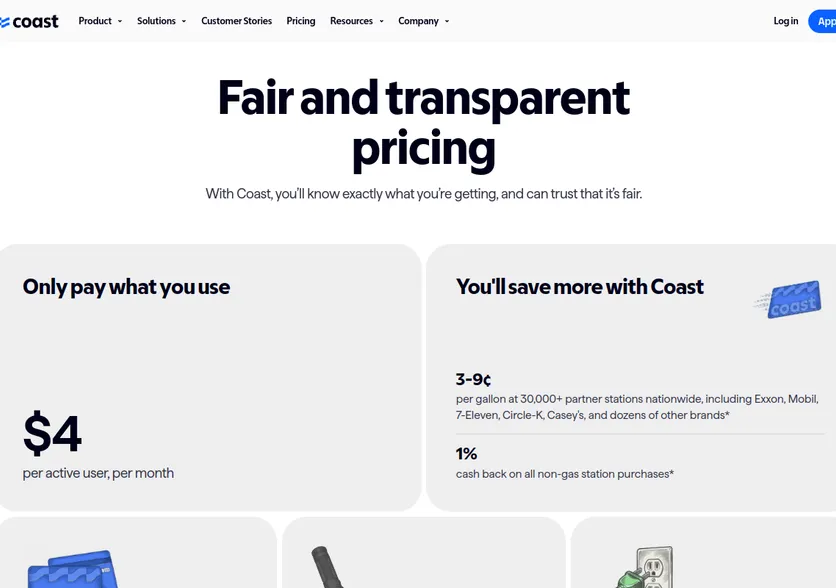
Paid tool Starting price: $4/active user/month · Four dollars per active user per month, charged only for drivers who make at least one purchase that month, with no setup fee and no per-gallon or per-transaction fees. Coast is a charge card, so balances are due in full each month, and the optional Bill Pay product costs ninety-nine dollars a month.
Free plan: No free plan; no setup fee, pay only for active users
Coast gives a municipal fleet card-level control of fuel spend, with limits by driver and vehicle for four dollars per active user a month. Rebates of three to nine cents a gallon at more than thirty thousand partner stations help the budget, and every transaction is visible in real time for audit. It is a charge card, so balances are due in full each month, and it does not track maintenance.
What we like
- Flat four dollars per active user with no hidden fees
- Fuel rebates of three to nine cents a gallon at partner stations
- Only pay for drivers who used the card that month
Watch out for
- It is a charge card, so balances are due in full each month
- No free plan and no trial; Bill Pay costs ninety-nine dollars a month
How to try it
- Order a card for each driver and set vehicle and driver limits
- Drivers fuel anywhere Visa is accepted and receipts are captured
- Review spend by driver and vehicle at month end
4. EROAD
Best for: Municipal fleets that need fuel data with ELD and compliance
Paid tool Starting price: $25/vehicle/month · Twenty-five dollars per vehicle per month with a hardware purchase, or thirty-five dollars without hardware for qualifying fleets; heavy and light vehicle plans are custom priced. The price covers ELD, DVIR, dashcam and asset tracking in one bundle.
Free plan: No free plan; demo available on request
EROAD bundles fuel diagnostics with ELD, DVIR, dashcam and asset tracking at twenty-five dollars a vehicle, so a municipal fleet gets compliance and fuel data from one system. Its trip history and fuel reports feed the same data used for IFTA and WMT reporting. Hardware is a separate purchase, and heavy and light vehicle plans are custom priced rather than published.

What we like
- ELD, DVIR, dashcam and asset tracking in one bundle
- Published starting price, rare for a compliance platform
- Automated IFTA and WMT reporting included
Watch out for
- Hardware is a separate purchase on the twenty-five-dollar rate
- Heavy and light vehicle plans are custom priced
How to try it
- Fit the CoreHub device and add each vehicle to the portal
- Set up ELD logs and DVIR checks for every driver
- Review fuel diagnostics and trip history each week
5. Quartix
Best for: Municipal fleets that want cheap tracking to cut idling across departments
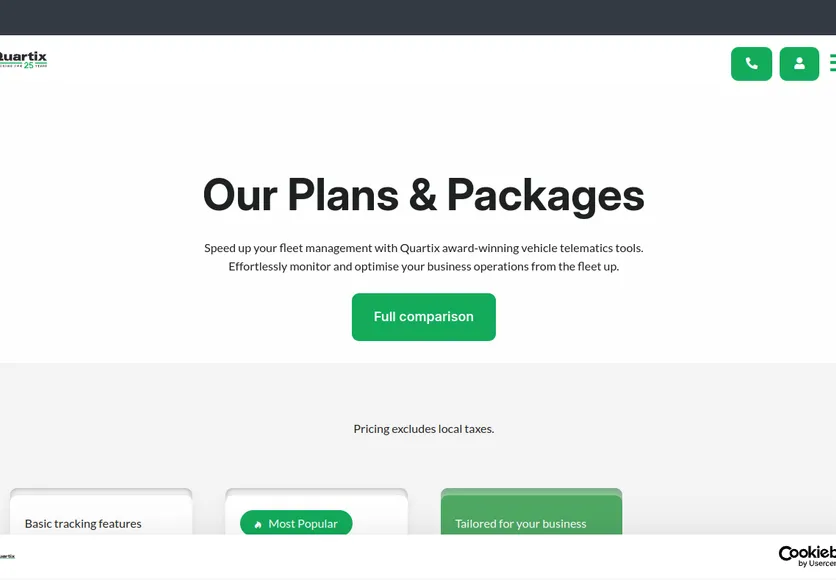
Paid tool Starting price: $14/vehicle/month · Fourteen dollars per vehicle per month on Info Point and fifteen dollars on Info Plus, excluding local taxes, with installation included and no upfront costs. Enterprise is priced on application, and contracts run twelve months before moving to a thirty-day rolling agreement.
Free plan: No free plan; trial available after a personalised demo
Quartix is the cheapest tracking option for a municipal fleet that wants to cut idling across departments, with an idling report on the fourteen-dollar Info Point plan. Installation is included, contracts move to thirty-day rolling terms after twelve months, and there is no auto-renewal. There are no dash cams or ELD workflows, and API access sits on the custom-priced Enterprise tier.
What we like
- Lowest tracking price here with installation included
- No auto-renewal; contracts move to thirty-day rolling terms
- Three years of reporting history on the entry plan
Watch out for
- No dash cams and no ELD workflows
- API access sits on the custom-priced Enterprise tier
How to try it
- Book installation for each vehicle in the fleet
- Group vehicles by depot or route in the dashboard
- Check the idling report weekly and coach the worst offenders
6. One Step GPS
Best for: Municipal fleets that want tracking without a long contract
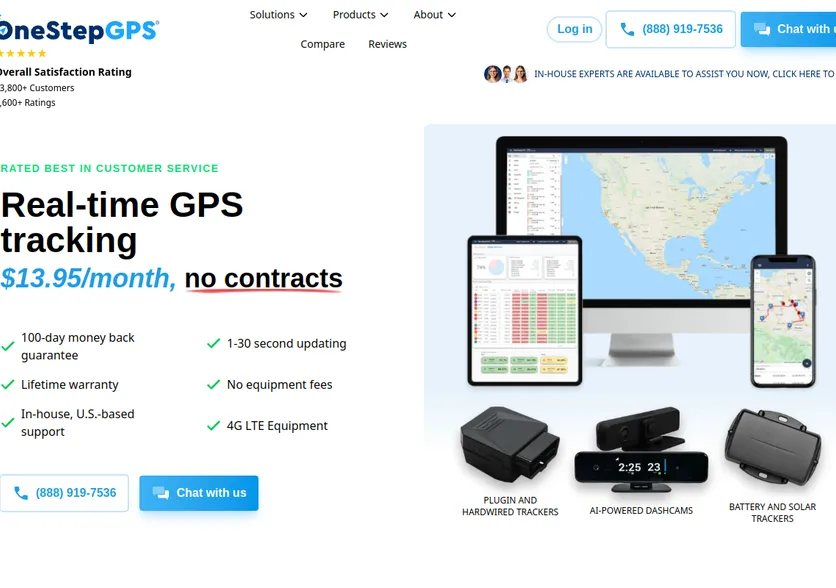
Paid tool Starting price: $13.95/vehicle/month · Thirteen dollars and ninety-five cents per vehicle per month with no contracts; the device is supplied free and must be returned when service ends. GPS tracking plus ELD is twenty dollars and ninety-five cents per vehicle per month, and there is a one-time activation fee of twenty dollars or less per device.
Free plan: No free plan; 100-day money-back guarantee
One Step GPS gives a municipal fleet live tracking at thirteen dollars and ninety-five cents a vehicle a month with no contract and no cancellation fee. The device is supplied free and returned when service ends, and GPS plus ELD costs twenty dollars and ninety-five cents for fleets that need hours-of-service logs. The feature set is thin, with no published plan tiers beyond tracking, ELD and dashcam.
What we like
- Published price with no contract and no cancellation fee
- Device supplied free and returned when service ends
- ELD and dashcam available as simple add-ons
Watch out for
- No published plan tiers beyond tracking, ELD and dashcam
- Activation fee and refundable deposit add to the first bill
How to try it
- Order a device for each truck and plug it in
- Add the truck to the portal and set speed and idle alerts
- Export trip history for fuel and emissions reporting
7. Simply Fleet
Best for: Municipal fleets that want low-cost fuel and maintenance records
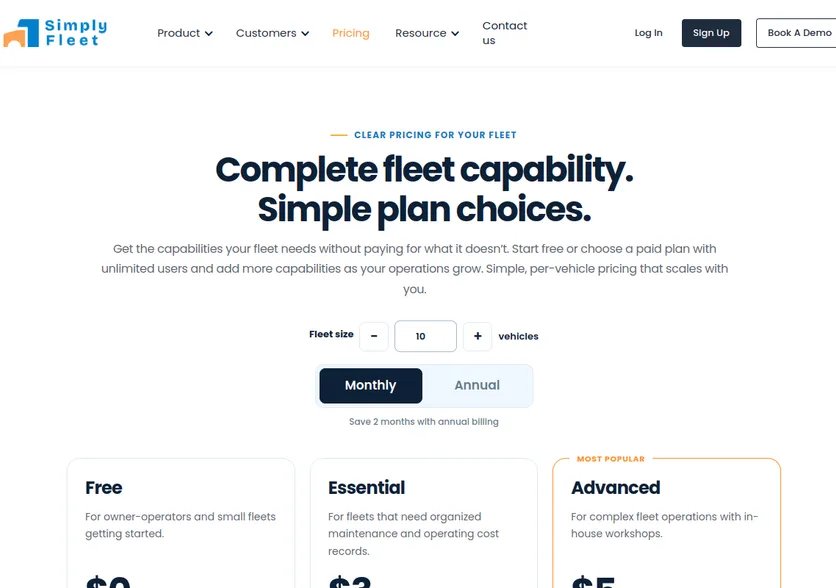
Paid tool Starting price: $3/vehicle/month · Three dollars per vehicle per month on Essential and five dollars on Advanced, with a five-vehicle billing minimum; annual billing costs thirty and fifty dollars per vehicle per year. Telematics and WEX fuel card integrations are fifty-cent add-ons per vehicle per month.
Free plan: Free plan for up to 5 vehicles and 3 users
Simply Fleet is the lowest-cost record for a municipal fleet that tracks fuel through fill-up logs rather than live telematics, at three dollars a vehicle a month. Its free plan covers five vehicles and three users, and the WEX fuel card integration is a fifty-cent add-on that removes manual fuel entry. Work orders and parts inventory need the five-dollar Advanced plan.
What we like
- Free plan covers five vehicles and three users
- Lowest paid price here at three dollars a vehicle
- WEX fuel card integration available as a cheap add-on
Watch out for
- Work orders and parts inventory need the five-dollar Advanced plan
- Pricing page warns that prices change soon
How to try it
- Add vehicles and set reminders by mileage, hours or date
- Log fuel fill-ups and let it calculate efficiency automatically
- Run inspections from the mobile app and raise issues from defects
8. RTA Fleet360
Best for: Municipal fleets with an in-house shop and department chargebacks
Paid tool Starting price: $6/asset/month · Six dollars per asset per month billed annually on Pro; Advanced is eight dollars and Enterprise is eleven dollars. Every plan includes unlimited users, and the plans are built for fleets of one hundred or more assets, so smaller fleets must ask about fit.
Free plan: No free plan; demo available on request
RTA Fleet360 is built for the municipal garage itself, with fuel management, work orders, parts inventory and department chargebacks in one system at six dollars an asset a month. Every plan includes unlimited users, and the system is available through cooperative purchasing contracts such as Sourcewell. The catch is scale: plans are built for fleets of one hundred or more assets.

What we like
- Published per-asset pricing with unlimited users
- Built for public-sector and in-house shops since 1979
- Available through cooperative purchasing contracts
Watch out for
- One-hundred-asset minimum prices out small fleets
- Implementation is scoped and charged separately
How to try it
- Import assets, parts and service history into Fleet360
- Set preventive maintenance schedules by mileage or date
- Run department chargebacks and cost reports each month
Prices above were checked on each vendor’s own website on Nov 27, 2026 and can change — the vendor’s page is the final word. Vendor links are editorial: nobody paid to be listed or ranked here. Vendors who want a featured listing can see how it works on our Get listed page.
How a municipal fleet should pick fuel management software
Start with the audit, not the dashboard, and the paper trail. A city fleet must show which department used each gallon, so pick a tool that tags fuel by vehicle and department and exports chargeback reports a finance office can use. Check the buying route too: cooperative contracts such as Sourcewell can make a six-dollar tool cheaper to procure than a three-dollar one. Finally, confirm the contract term fits a budget cycle, because a four-year deal signed in one administration can outlast the council that approved it.
Before you buy
- Confirm fuel logs tag every fill-up by vehicle and department for chargebacks
- Check whether reports export in a format your finance office and auditors accept
- Ask about cooperative purchasing contracts, which can change the real procurement cost
- Read the contract term and renewal notice period before signing any multi-year deal
- Trial the tool on one department first and reconcile its fuel figures against receipts
Official websites
Official websites of the products reviewed above. Features and prices were checked against these sites when this guide was written, and they can change, so confirm on the vendor site before you buy.
Frequently asked questions
What is fleet fuel management software for municipal fleets?
It is software that logs fuel use by vehicle and department, controls fuel card spend and reports the cost for public accountability. Municipal fleets run mixed vehicles, from police cars to garbage trucks, and the software must separate fuel by department for chargebacks. The tools here combine fuel logs with maintenance or tracking, so fuel data sits next to the service history that explains it.
Which tool is best for a city fleet with an in-house garage?
RTA Fleet360 at six dollars an asset is built for government garages, with fuel management, work orders, parts and department chargebacks in one system. It needs one hundred or more assets, so smaller cities should look at Fleetio at four dollars a vehicle instead. Fleetio covers fuel logs and cost reports, and it integrates with the telematics a city already owns.
Can a municipal fleet buy fleet software through a cooperative contract?
Yes, and it often matters more than the headline price. RTA Fleet360 is available through cooperative purchasing contracts including Sourcewell, NASPO and OMNIA Partners, which lets a city buy without a fresh tender. Ask each vendor which contracts it holds before comparing prices, because procurement cost includes the tender process, not just the subscription.
How does a fuel card help a municipal fleet control spending?
A fuel card such as Coast sets limits by driver and vehicle, so a card cannot buy fuel for a vehicle it is not assigned to. Every transaction is visible in real time, and rebates of three to nine cents a gallon at partner stations cut the net cost. Coast costs four dollars per active user a month and only charges for drivers who used the card that month.
How much does fleet fuel management software cost a municipality?
Published prices in this comparison run from three dollars a vehicle a month for Simply Fleet to twenty-five dollars for Azuga and EROAD. RTA Fleet360 at six dollars an asset suits larger fleets, but its one-hundred-asset minimum sets a six-hundred-dollar monthly floor. Hardware, implementation and cooperative contract terms can add to the subscription, so budget those separately.
Compare the eight tools above, then trial the one that fits your municipal fleet on one department before the next budget cycle.
Browse Business Tools tools