On this page
A small carrier wins contracts on safety: one harsh-braking event or one preventable crash can cost a shipper relationship that took years to build. The right safety tool scores drivers, flags risky behaviour early and keeps the compliance record clean, so the carrier can prove its safety record instead of just claiming it. Azuga leads this list with driver scores and rewards from twenty-five dollars a vehicle a month, and the other seven tools are ranked on what matters to a small carrier: behaviour data that changes driving, compliance that holds up, and prices that fit a small fleet.
How we researched this
We checked every price on the vendor pricing page on November 27, 2026, and only included tools with a published US dollar list price and a free trial or free plan. We ranked each tool on what a small carrier pays in practice, including safety scoring, ELD compliance, hardware costs and contract terms. Tools with quote-only pricing were left out, so every price below can be verified on the vendor site.
Compare the tools
| Name | Best for | Starting price | Free plan | |
|---|---|---|---|---|
 Azuga | Small carriers that want tracking plus driver scoring | $25/vehicle per month | Free demo | Visit |
| EROAD | Small carriers that need ELD, tracking and tax in one platform | $25/vehicle/month | No free plan; demo available | Visit |
| HOS247 | Small carriers that want the cheapest published ELD | $19/vehicle/month | No free plan; no contracts, cancel anytime | Visit |
| Matrack | Small carriers that want GPS and IFTA on a budget | $19.95/truck/month | No free plan; 30-day risk-free trial | Visit |
 Linxup | Small carriers that want plug-in tracking with published prices | $25/vehicle per month | Free demo | Visit |
| Garmin eLog | Small carriers that want ELD compliance with no subscription | $249.99 one-time | No free plan; one-time purchase, no subscription | Visit |
| Bouncie | Small carriers that want a plug-in tracker with no contract | $8.35/device/month | No free plan; month-to-month billing | Visit |
| Vyncs | Small carriers that prefer annual billing over monthly fees | $119.99/year | No free plan; 30-day no-risk trial | Visit |
The fleet safety software for small carriers, compared
1. Azuga
Best for: Small carriers that want tracking plus driver scoring
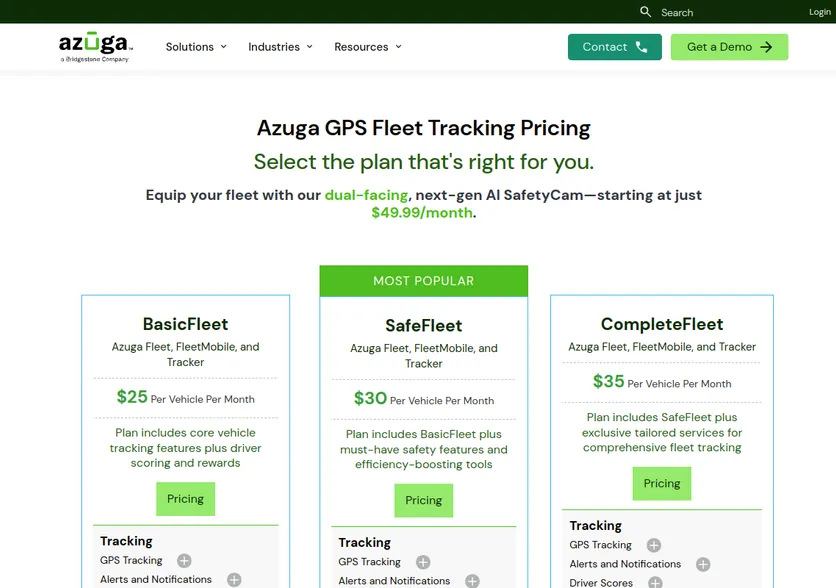
Paid tool Starting price: $25/vehicle per month · BasicFleet plan; SafeFleet is thirty dollars and CompleteFleet is thirty-five dollars a vehicle a month; SafetyCam AI dash cam add-on is forty-one dollars and ninety-nine cents a month
Free plan: Free demo
For a small carrier where one harsh-braking event can cost a contract, Azuga starts at twenty-five dollars a vehicle a month on BasicFleet and pairs GPS tracking with driver scores and rewards. It combines GPS tracking with driver scores, a rewards program for safe driving, geofences, diagnostics and scheduled maintenance in one dashboard. Location updates arrive every two minutes on the entry plan, and the SafetyCam add-on brings AI dash cam footage.
What we like
- Driver scores and rewards on the entry plan
- Location updates every two minutes
- Geofences and scheduled maintenance included
Watch out for
- No free plan or trial, only a demo
- SafetyCam dash cam costs extra
How to try it
- Fit the tracker and set up geofences for depots and job sites
- Review driver scores weekly and reward the safest drivers
- Set maintenance reminders by mileage or date
2. EROAD
Best for: Small carriers that need ELD, tracking and tax in one platform
Paid tool Starting price: $25/vehicle/month · Twenty-five dollars a vehicle a month with hardware bought upfront, or thirty-five dollars without a hardware purchase for qualifying fleets
Free plan: No free plan; demo available
For a small carrier where one harsh-braking event can cost a contract, EROAD lists twenty-five dollars a vehicle a month with hardware bought upfront and covers ELD, tracking and tax reporting. It combines ELD compliance, GPS tracking, driver behaviour monitoring and tax reporting for heavy vehicles in one platform. It does not publish a full price list, so the figures here come from 2026 reviews of its pricing, and buyers should confirm the quote in writing.

What we like
- ELD, tracking and tax reporting in one platform
- Built for heavy vehicles and long-haul work
- Driver behaviour monitoring included
Watch out for
- No full published price list
- Hardware costs sit outside the subscription
How to try it
- Fit the EROAD hardware in each truck
- Set up IFTA reporting by state
- Review driver behaviour scores with each driver
3. HOS247
Best for: Small carriers that want the cheapest published ELD
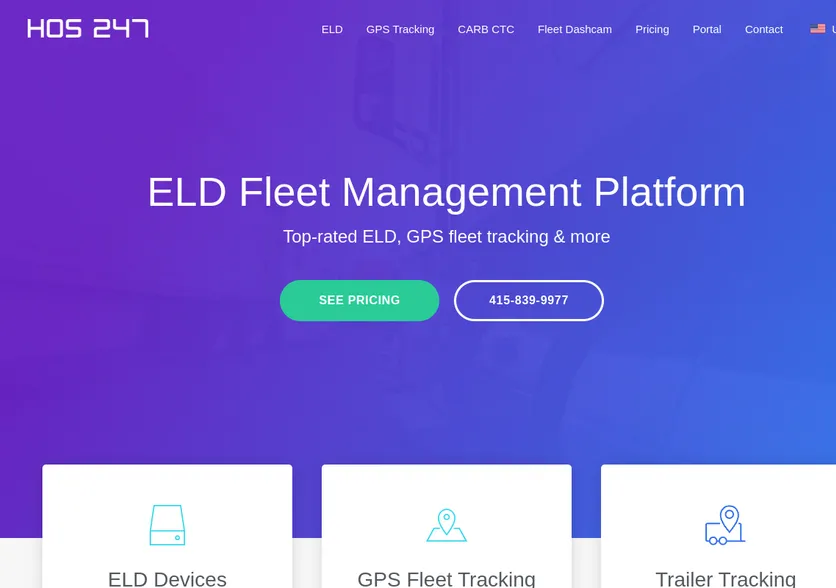
Paid tool Starting price: $19/vehicle/month · ELD Compliance, nineteen dollars a vehicle a month; ELD Track is twenty-two dollars and ELD Plus is twenty-five dollars; the logging device is free on annual billing, otherwise seventy-nine dollars
Free plan: No free plan; no contracts, cancel anytime
For a small carrier where one harsh-braking event can cost a contract, HOS247 charges nineteen dollars a vehicle a month for ELD Compliance and asks for no contract. It keeps hours-of-service logs and DVIRs with no contract, and higher tiers add GPS tracking and IFTA reporting. The logging device is free when a year is paid upfront, or seventy-nine dollars when paying monthly.
What we like
- Cheapest published ELD in this list
- No contracts, cancel anytime
- Device free on annual billing
Watch out for
- Entry plan has no GPS or IFTA
- Support is lighter than full fleet platforms
How to try it
- Choose the Compliance plan for logs only
- Pay annually to get the device free
- Upgrade to Plus when IFTA reporting matters
4. Matrack
Best for: Small carriers that want GPS and IFTA on a budget
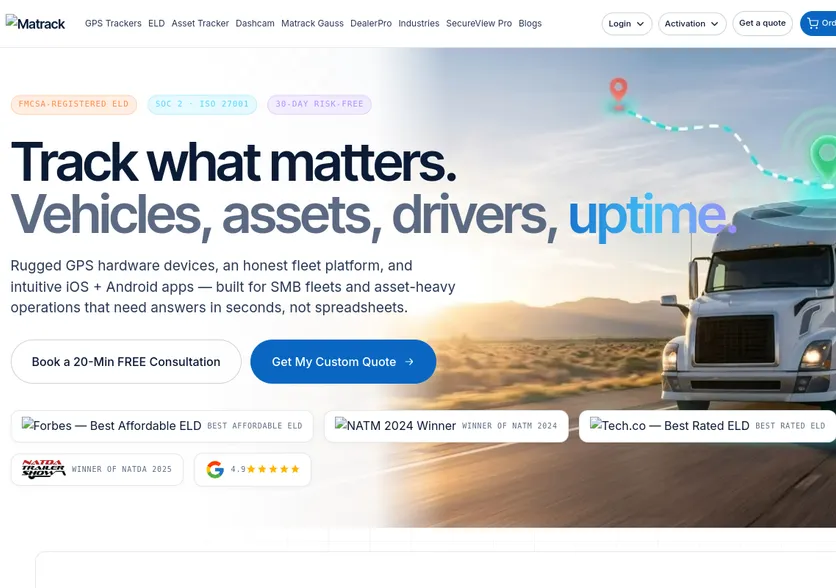
Paid tool Starting price: $19.95/truck/month · Basic plan, nineteen dollars and ninety-five cents a truck a month; Premium is twenty-four dollars and ninety-five cents with GPS and IFTA; hardware is free with annual plans
Free plan: No free plan; 30-day risk-free trial
For a small carrier where one harsh-braking event can cost a contract, Matrack lists Basic at nineteen dollars and ninety-five cents a truck a month with the hardware free on annual plans. It covers hours-of-service logs with GPS tracking and IFTA reporting on the Premium plan, with no long-term contract and no setup fees. Hardware is free with annual plans, and a thirty-day risk-free trial lets a fleet test it on real routes.
What we like
- Low price with GPS and IFTA on Premium
- No long-term contract or setup fees
- Thirty-day risk-free trial
Watch out for
- Basic plan has no GPS tracking
- Dash cam pricing is not listed on the ELD page
How to try it
- Pick Basic for logs or Premium for GPS and IFTA
- Install the device and test it on a real route
- Use the trial month to check log accuracy
5. Linxup
Best for: Small carriers that want plug-in tracking with published prices
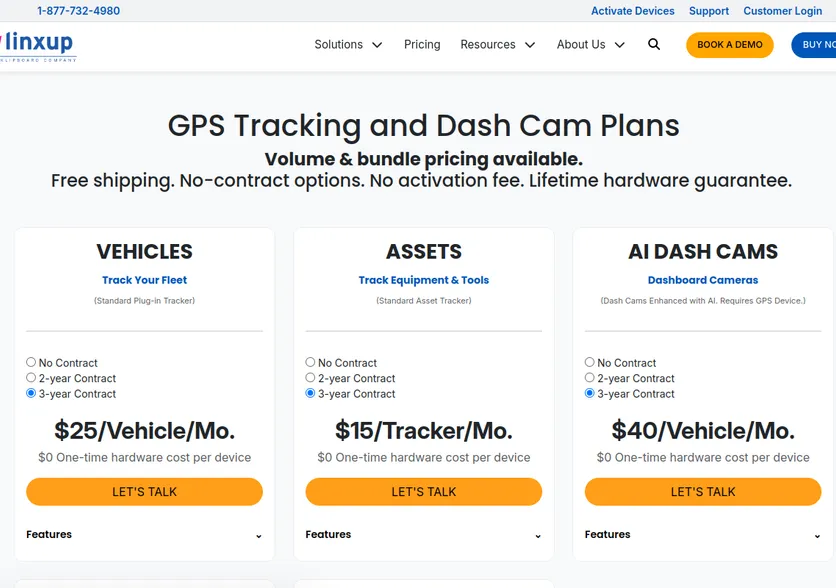
Paid tool Starting price: $25/vehicle per month · GPS tracking plan; plug-in tracker costs sixty-nine dollars one time on month-to-month billing and is free on a three-year contract; ELD is thirty dollars a vehicle a month
Free plan: Free demo
For a small carrier where one harsh-braking event can cost a contract, Linxup charges twenty-five dollars a vehicle a month for GPS tracking with a plug-in tracker and no long contract. It sells plug-in GPS trackers with live maps, geofences, alerts and reports, plus equipment tracking, ELD and AI dash cam options on the same bill. Contracts run month to month or up to three years, and the tracker hardware is free on the longest term.
What we like
- Published prices with no-contract options
- Vehicle, equipment and camera tracking on one bill
- Tracker hardware is free on a three-year term
Watch out for
- ELD and dash cam cost extra on top of tracking
- Early cancellation costs fifteen dollars per remaining month
How to try it
- Plug the tracker into each vehicle and check the live map
- Set alerts for speeding, idling and geofence exits
- Add the ELD package only for trucks that need hours-of-service logs
6. Garmin eLog
Best for: Small carriers that want ELD compliance with no subscription
Paid tool Starting price: $249.99 one-time · Two hundred and forty-nine dollars and ninety-nine cents one time for the device, with no subscription and no monthly fee of any kind
Free plan: No free plan; one-time purchase, no subscription
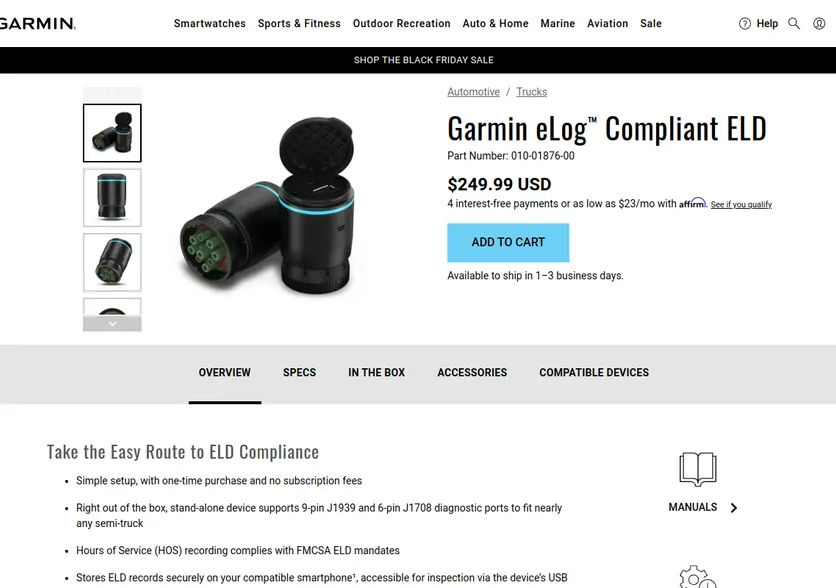
For a small carrier where one harsh-braking event can cost a contract, Garmin eLog costs two hundred and forty-nine dollars and ninety-nine cents once, with no subscription and no monthly fee. It is a small adapter that plugs into the truck and pairs with a phone app to keep compliant hours-of-service logs with no monthly fee. It works without a data plan and suits owner-operators who want ELD compliance at a one-time cost.
What we like
- No subscription or monthly fee at all
- Works without a data plan
- Simple setup for owner-operators
Watch out for
- No GPS tracking or dispatch tools
- One device per truck, bought upfront
How to try it
- Plug the adapter into the truck diagnostic port
- Pair it with the phone app and start logging
- Show the log on the phone at a roadside check
7. Bouncie
Best for: Small carriers that want a plug-in tracker with no contract
Paid tool Starting price: $8.35/device/month · Eight dollars and thirty-five cents a device a month with three or more devices, or nine dollars and sixty-five cents for a single device; hardware costs about ninety dollars one time
Free plan: No free plan; month-to-month billing
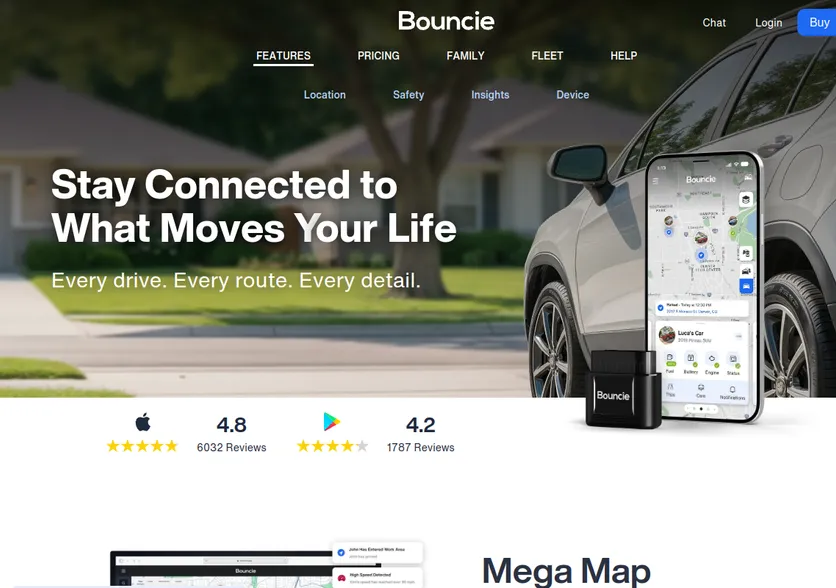
For a small carrier where one harsh-braking event can cost a contract, Bouncie costs eight dollars and thirty-five cents a device a month with three or more devices and plugs into the OBD-II port. It is a plug-in OBD-II tracker with real-time location, driving behaviour alerts, vehicle diagnostics and crash detection. It works only in vehicles with an OBD-II port, and it includes three roadside assistance calls a year.
What we like
- No contract and no activation fee
- Crash detection with roadside assistance
- Lowest monthly fee for a plug-in tracker
Watch out for
- Works only with an OBD-II port
- Single-device rate is higher than the fleet rate
How to try it
- Plug the device into each vehicle
- Set speed and location alerts in the app
- Check vehicle health reports each week
8. Vyncs
Best for: Small carriers that prefer annual billing over monthly fees
Paid tool Starting price: $119.99/year · One hundred and nineteen dollars and ninety-nine cents a year for the Fleet plan, with a forty-five-dollar and ninety-nine-cent activation fee in the first year; Basic costs ninety-nine dollars and ninety-nine cents a year
Free plan: No free plan; 30-day no-risk trial
For a small carrier where one harsh-braking event can cost a contract, Vyncs charges one hundred and nineteen dollars and ninety-nine cents a year for the Fleet plan with no monthly subscription. It is an OBD-II tracker that reports live location, driver safety alerts, vehicle health, fuel use and trip history on an annual plan. There is no monthly subscription, but faster GPS sampling and live map refresh cost extra on some levels.
What we like
- No monthly subscription to manage
- Live tracking with safety and fuel data
- Thirty-day no-risk trial
Watch out for
- Activation fee applies in the first year
- Faster GPS sampling costs extra on some levels
How to try it
- Activate each device and fit it to the vehicle
- Set alerts for speeding and harsh driving
- Review trip history before disputing a delivery time
Prices above were checked on each vendor’s own website on Nov 27, 2026 and can change — the vendor’s page is the final word. Vendor links are editorial: nobody paid to be listed or ranked here. Vendors who want a featured listing can see how it works on our Get listed page.
How a small carrier should pick a fleet safety tool
Start with the behaviour data, because a safety tool only earns its keep when it changes how drivers actually drive. Scores, rewards and coaching matter more than a dashboard full of maps, so check what the driver sees, not just what the manager sees. Then confirm the compliance side, since a carrier needs ELD logs and inspection records that survive a roadside check, and a safety tool without compliance leaves the biggest risk uncovered. Hardware is the hidden cost: a tracker that costs sixty-nine dollars per truck adds up fast across a fleet, while a free device on an annual plan keeps the first year cheap. Finally, coach with the data weekly, because a score that nobody discusses is just a number on a screen.
Before you buy
- Start from the driver behaviour data, because a safety tool only earns its keep when it changes how drivers actually drive
- Confirm ELD logs and inspection records are covered, since a safety tool without compliance leaves the biggest risk open
- Add up hardware costs across the fleet, because a sixty-nine-dollar tracker per truck adds up fast on a small carrier
- Check what the driver sees, not just the manager dashboard, since coaching only works when drivers understand their scores
- Review safety scores with drivers weekly, because a score nobody discusses is just a number on a screen
Official websites
Official websites of the products reviewed above. Features and prices were checked against these sites when this guide was written, and they can change, so confirm on the vendor site before you buy.
Frequently asked questions
What is the best fleet safety software for small carriers?
Azuga is the best overall pick for small carriers because it combines GPS tracking with driver scores and a rewards program from twenty-five dollars a vehicle a month. EROAD is best for heavy trucks, with ELD, tracking and driver behaviour from the same twenty-five-dollar starting rate. HOS247 is the best budget option, with compliant ELD logs from nineteen dollars a vehicle a month and no contract, though it has no driver scoring on the entry plan.
How do small carriers improve driver safety scores?
Small carriers improve scores by reviewing driver behaviour data weekly and coaching the worst events first, usually speeding and harsh braking. Azuga pairs scores with a rewards program that pays safe drivers, which works better than punishment alone. Linxup and EROAD also score driver behaviour, and a carrier should pick the tool whose reports the dispatcher will actually open every week, since unreviewed data changes nothing.
Do small carriers need dash cams for fleet safety?
Dash cams help after an incident, but most small carriers get more safety value from driver scoring and coaching first, since those prevent the incident. Azuga sells its SafetyCam AI dash cam as a forty-one-dollar-and-ninety-nine-cent add-on, and Linxup sells AI dash cams at forty dollars a vehicle a month. A carrier should start with scoring, then add cameras once the coaching routine is working, since cameras are an add-on cost.
What does fleet safety software cost a small carrier?
A carrier with ten trucks pays about two hundred and fifty dollars a month on Azuga BasicFleet or EROAD at twenty-five dollars a vehicle, or about one hundred and ninety dollars a month on HOS247 ELD Compliance at nineteen dollars a vehicle. Plug-in trackers are cheaper: Bouncie costs about eighty-three dollars a month for ten devices, and Vyncs costs about one thousand two hundred dollars a year. Hardware adds sixty-nine to ninety dollars per truck in the first year.
Can fleet safety software lower insurance costs?
It can, because insurers look at driver behaviour data, dash cam footage and a clean compliance record when they price a fleet. A carrier should ask its insurer which data it accepts before buying, since not every insurer credits every tool. The strongest case combines scored driving, coaching records and ELD logs, which is why Azuga and EROAD lead this list for carriers that want their safety record to earn a better premium.
Compare the eight tools above, then trial the one that fits your truck count and coach your drivers on its scores for a month.
Browse Business Tools tools