On this page
A restaurant group hears from guests everywhere: a wrong order on a delivery app, a booking question on the phone, a complaint on social media, a catering request by email. The right help desk pulls those conversations into one queue so no guest waits and no location works blind. LiveAgent leads this list with ticketing, live chat and a call center bundled at fifteen dollars an agent, and the other seven tools are ranked on what matters to a restaurant team: multi-location coverage, phone and chat support, guest feedback handling and honest per-agent pricing.
How we researched this
We checked every price on the vendor pricing page on November 27, 2026, and only included tools with a published US dollar list price and a free trial or free plan. We ranked each tool on what a restaurant group pays in practice, including multi-location support, phone and chat coverage, guest feedback and review handling, ease of use for front-of-house staff, and integrations with ordering and reservation systems. Tools with quote-only pricing were left out, so every price below can be verified on the vendor site.
Compare the tools
| Name | Best for | Starting price | Free plan | |
|---|---|---|---|---|
 LiveAgent | Restaurant groups that need phone, chat and email in one plan | $15/agent/mo | Free plan for 1 agent with limited features, plus a 30-day trial | Visit |
 Freshdesk | Restaurant groups that want solid ticketing at a low price | $15/agent/mo | Free plan for up to 2 agents, with basic ticketing | Visit |
 Help Scout | Restaurants that want guest email to feel personal | $25/user/mo | Free plan for up to 5 users and 100 contacts a month | Visit |
 Zoho Desk | Restaurant groups already using Zoho apps | $14/agent/mo | Free plan for up to 3 agents | Visit |
 Intercom | Restaurants that want live chat and AI cover on the booking page | $29/seat/mo | Fourteen-day free trial, no free plan | Visit |
 HappyFox | Restaurant groups that want simple ticketing with strong SLAs | $24/agent/mo | Fourteen-day free trial, no free plan | Visit |
 Zendesk | Larger restaurant groups that need scale and reporting | $19/agent/mo | Fourteen-day free trial, no free plan | Visit |
 Front | Restaurant groups that run guest support from shared inboxes | $19/seat/mo | Seven-day free trial, no free plan | Visit |
The help desk software for restaurants, compared
1. LiveAgent
Best for: Restaurant groups that need phone, chat and email in one plan
Paid tool Starting price: $15/agent/mo · Fifteen dollars per agent a month billed annually on the Small Business plan, or nineteen dollars billed monthly; Medium is twenty-nine dollars, Large is forty-nine dollars and Enterprise is sixty-nine dollars
Free plan: Free plan for 1 agent with limited features, plus a 30-day trial
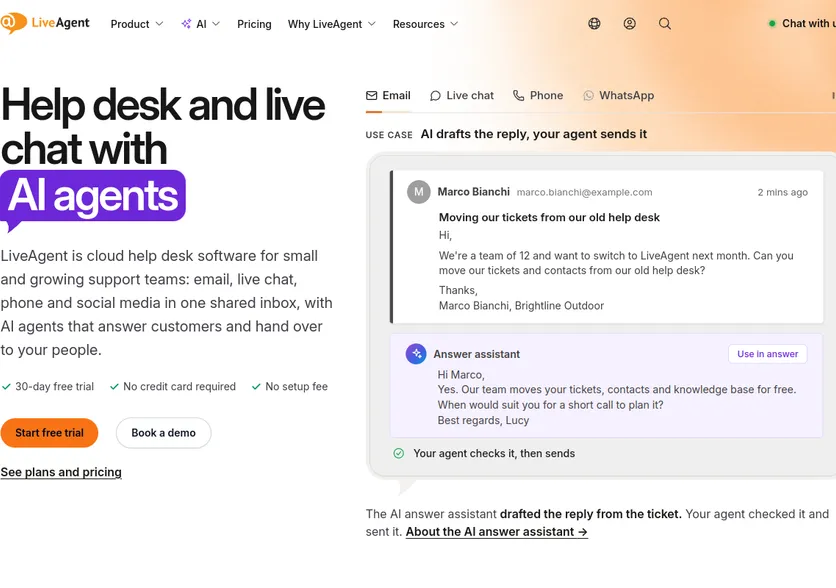
For a restaurant group, LiveAgent Small Business costs fifteen dollars per agent a month billed annually and bundles ticketing, live chat, a knowledge base and a built-in call center that restaurants usually buy separately. A guest can start on chat, switch to a call and stay on the same ticket, while the call center with IVR and recordings covers the reservation phone line. AI Answer Assistant is included on every plan, which keeps the bill predictable when weekend volume spikes.
What we like
- Call center with IVR included at fifteen dollars
- Chat, ticketing and knowledge base in one plan
- AI features included with no per-resolution fee
Watch out for
- SLA and social channels need the Medium plan
- Small plan covers only three email accounts plus chat
How to try it
- Connect the reservation phone line to the built-in call center
- Add live chat to the booking page for quick questions
- Set up the knowledge base with menus, hours and allergy information
2. Freshdesk
Best for: Restaurant groups that want solid ticketing at a low price
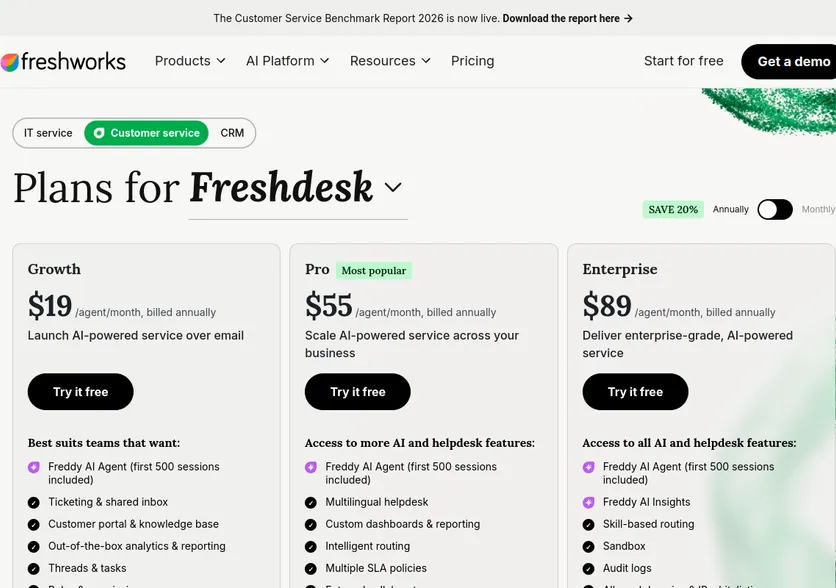
Paid tool Starting price: $15/agent/mo · Fifteen dollars per agent a month billed annually on the Growth plan; Pro is forty-nine dollars and Enterprise seventy-nine dollars, monthly billing is nineteen, fifty-nine and ninety-five dollars, and the omnichannel Omni Growth plan is twenty-nine dollars a month
Free plan: Free plan for up to 2 agents, with basic ticketing
Freshdesk Growth costs fifteen dollars per agent a month billed annually, and it covers the ticketing core a restaurant group needs: shared inbox, automation rules, SLA timers and a customer portal. Automation routes delivery complaints to the right location, collision detection stops two staff answering the same guest, and the portal lets regulars check their own booking or catering questions. The free plan lets a single restaurant test the workflow before paying anything.
What we like
- Fifteen dollars an agent undercuts most rivals
- SLA timers and collision detection on Growth
- Free plan for up to two agents
Watch out for
- Live chat needs the twenty-nine dollar Omni plan
- Freddy AI Copilot adds twenty-nine dollars per agent
How to try it
- Set up automation rules that route complaints to the right location
- Turn on SLA timers for urgent delivery and allergy issues
- Publish a portal with menus, hours and booking FAQs
3. Help Scout
Best for: Restaurants that want guest email to feel personal
Paid tool Starting price: $25/user/mo · Twenty-five dollars a user a month billed annually on the Standard plan, or thirty dollars billed monthly; Plus is forty-five dollars and Pro is seventy-five dollars, and the Envoy AI agent costs seventy-five cents per resolution
Free plan: Free plan for up to 5 users and 100 contacts a month
Help Scout Standard costs twenty-five dollars a user a month billed annually, and it keeps guest email personal with a shared inbox, saved replies and a Docs knowledge base. A complaint about a meal gets a human reply with the full history attached, not a ticket number, and private notes let the manager brief the team before responding. The free plan covers five users, which suits a small restaurant group, and Beacon live chat sits on the same inbox.
What we like
- Email-first inbox feels personal to guests
- Free plan covers five users
- Docs knowledge base included
Watch out for
- Standard caps at twenty-five users
- Envoy AI costs seventy-five cents per resolution
How to try it
- Move guest mail into the shared inbox
- Write saved replies for common booking and menu questions
- Publish a Docs site with menus, hours and allergy details
4. Zoho Desk
Best for: Restaurant groups already using Zoho apps
Paid tool Starting price: $14/agent/mo · Fourteen dollars per agent a month billed annually on the Standard plan; Express is seven dollars with a five-agent cap, Professional is twenty-three dollars and Enterprise is forty dollars, and monthly billing is nine, twenty, thirty-five and fifty dollars
Free plan: Free plan for up to 3 agents
For a restaurant group, Zoho Desk Standard costs fourteen dollars per agent a month billed annually, which makes it the cheapest full ticketing plan on this list for a restaurant group. It adds business messaging, a knowledge base and custom reports, and it connects with Zoho CRM when the group already tracks catering clients there. The free plan covers three agents, so a single restaurant can start free, though multi-department SLAs across locations need the forty-dollar Enterprise plan.
What we like
- Fourteen dollars an agent is hard to beat
- Free plan covers three agents
- Connects with Zoho CRM and Books
Watch out for
- Multi-department SLAs need the forty dollar Enterprise plan
- Express caps at five agents
How to try it
- Connect Zoho Desk to Zoho CRM for catering clients
- Build a knowledge base for menus, hours and booking policies
- Set up custom reports on complaints by location
5. Intercom
Best for: Restaurants that want live chat and AI cover on the booking page
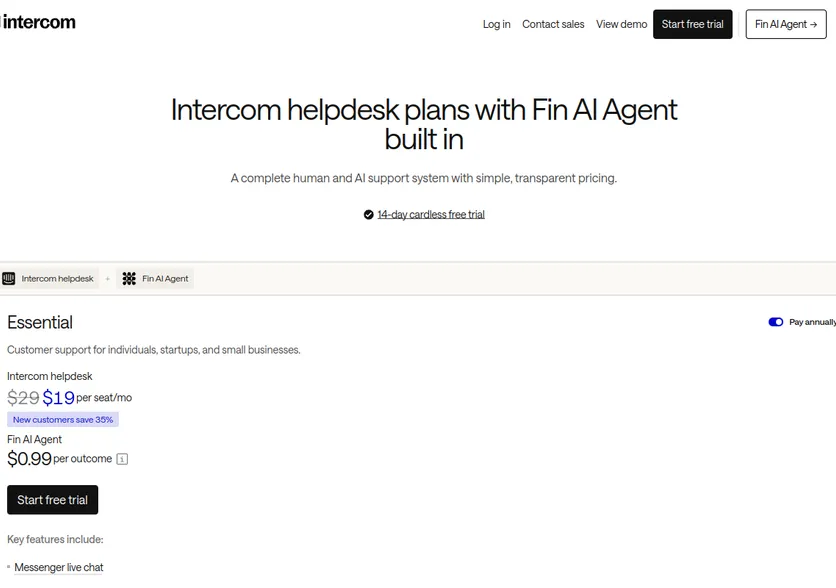
Paid tool Starting price: $29/seat/mo · Twenty-nine dollars a seat a month billed annually on the Essential plan, or thirty-nine dollars billed monthly; Advanced is eighty-five dollars and Expert is one hundred thirty-two dollars, and the Fin AI agent costs ninety-nine cents per resolved outcome on top
Free plan: Fourteen-day free trial, no free plan
Intercom Essential costs twenty-nine dollars a seat a month billed annually, and it gives a restaurant group live chat, a shared inbox, ticketing and a public help center in one place. The Fin AI agent answers routine questions about hours, menus and bookings at ninety-nine cents per resolved outcome, which covers the hours when the front desk is busy with guests. Macros and assignments keep handoffs clean when a chat moves from the website team to a location manager.
What we like
- Fin AI answers routine questions after hours
- Chat, inbox and help center in one place
- Macros speed up booking replies
Watch out for
- Fin costs ninety-nine cents per resolved outcome
- No free plan, only a fourteen-day trial
How to try it
- Add the Messenger to the booking page for live chat
- Turn on Fin AI to answer hours and menu questions
- Use macros for common booking and allergy replies
6. HappyFox
Best for: Restaurant groups that want simple ticketing with strong SLAs
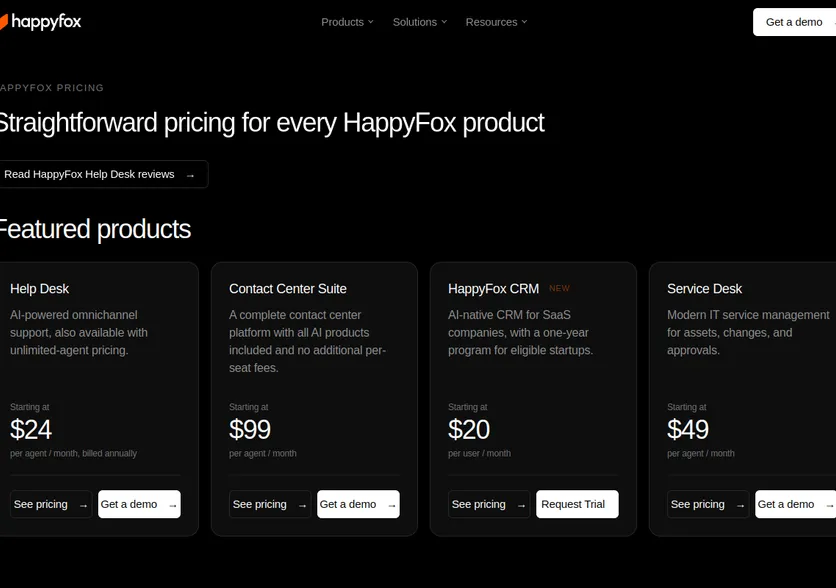
Paid tool Starting price: $24/agent/mo · Twenty-four dollars per agent a month billed annually on the Basic plan, or twenty-nine dollars billed monthly, with a five-agent cap; Team starts at forty-nine dollars and Pro at ninety-nine dollars, and HappyFox AI is a separate add-on from fourteen dollars a month
Free plan: Fourteen-day free trial, no free plan
HappyFox Basic costs twenty-four dollars per agent a month billed annually, and it gives a restaurant group unlimited tickets with SLA management, a knowledge base and single sign-on. Smart rules route tickets by location or priority without manual triage, so a delivery complaint reaches the right kitchen fast, and the Team plan adds multi-brand support for groups running several concepts. The five-agent cap on Basic means a growing group should price the Team plan from forty-nine dollars before committing.
What we like
- Unlimited tickets with SLA management included
- Smart rules cut manual triage
- Single sign-on on the entry plan
Watch out for
- Basic caps at five agents
- AI features are a separate paid add-on
How to try it
- Build smart rules that route tickets by location and priority
- Set SLA timers for delivery complaints and allergy issues
- Create a knowledge base for menus and booking policies
7. Zendesk
Best for: Larger restaurant groups that need scale and reporting
Paid tool Starting price: $19/agent/mo · Nineteen dollars per agent a month billed annually on the Support Team plan, which covers email ticketing; Suite Team is fifty-five dollars per agent a month, Suite Growth eighty-nine dollars and Suite Professional one hundred fifteen dollars, and monthly billing is twenty-five, sixty-nine and one hundred forty-nine dollars
Free plan: Fourteen-day free trial, no free plan
Zendesk Support Team costs nineteen dollars per agent a month billed annually, and it gives a larger restaurant group structured ticketing with routing rules that sort delivery, booking and catering requests automatically. The Agent Workspace pulls email, chat, phone and social messages into one view, so a guest who complains on social media and then calls gets one continuous conversation. Prebuilt dashboards show complaint volume by location, which helps a group spot a struggling kitchen early.
What we like
- Routing rules sort high-volume guest mail
- Omnichannel workspace in one view
- Prebuilt analytics by location
Watch out for
- Full Suite starts at fifty-five dollars an agent
- AI Copilot adds fifty dollars per agent a month
How to try it
- Set up routing rules by request type and location
- Connect email, chat, phone and social into one workspace
- Track complaint volume by location on prebuilt dashboards
8. Front
Best for: Restaurant groups that run guest support from shared inboxes
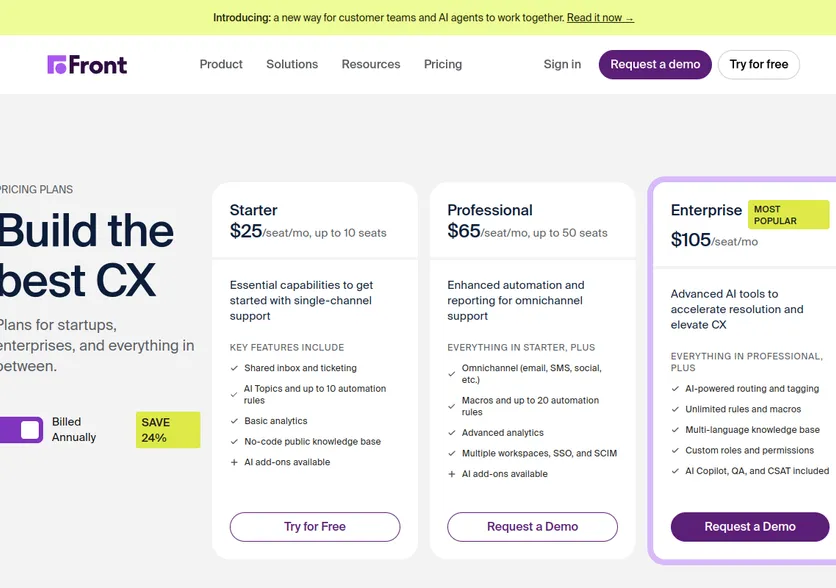
Paid tool Starting price: $19/seat/mo · Nineteen dollars a seat a month billed annually on the Starter plan, or twenty-nine dollars billed monthly, capped at ten seats; Growth is fifty-nine dollars and Scale is ninety-nine dollars, with Premier at two hundred twenty-nine dollars
Free plan: Seven-day free trial, no free plan
Front Starter costs nineteen dollars a seat a month billed annually, and it turns shared inboxes such as bookings@ and feedback@ into a collaborative workspace with assignments, internal comments and collision detection. Staff see who is already answering a guest, so nobody sends a duplicate reply during a busy service, and the mobile app keeps the inbox moving on the floor. Starter caps at ten seats, so a growing group should price the fifty-nine-dollar Growth plan before the eleventh hire.
What we like
- Collision detection stops duplicate guest replies
- Internal comments keep floor staff coordinated
- Mobile app works during service
Watch out for
- Starter caps at ten seats
- Analytics and CRM integrations need Growth
How to try it
- Connect shared inboxes for bookings, feedback and catering
- Assign conversations and use internal comments to coordinate
- Set up basic rules that route mail to the right location
Prices above were checked on each vendor’s own website on Nov 27, 2026 and can change — the vendor’s page is the final word. Vendor links are editorial: nobody paid to be listed or ranked here. Vendors who want a featured listing can see how it works on our Get listed page.
How a restaurant group should pick a help desk
Start with the guest journey, not the feature list. Map where complaints actually arrive — delivery apps, phone, email, social media — and pick a tool that covers those channels on the plan you would buy, not a higher tier. Count the locations honestly, because a per-agent price that looks cheap doubles across five restaurants, and a five-agent cap forces an upgrade at the worst moment. Check the phone story carefully: a bundled call center with IVR beats a separate phone system for the reservation line. Finally, trial the desk during a real weekend service, because the routing and collision behaviour only proves itself when tickets arrive faster than staff can answer them.
Before you buy
- Map where guest complaints actually arrive before you shortlist
- Check phone and chat coverage on the tier you would buy
- Count per-agent costs across every location, not one restaurant
- Test collision detection during a busy weekend service
- Confirm the knowledge base covers menus, hours and allergies
Official websites
Official websites of the products reviewed above. Features and prices were checked against these sites when this guide was written, and they can change, so confirm on the vendor site before you buy.
Frequently asked questions
What help desk features matter most for restaurants?
Multi-channel intake matters most, because guests contact restaurants by phone, chat, email and social media, often about the same order. Collision detection stops two staff answering one guest, SLA timers protect urgent issues such as allergy complaints, and a knowledge base answers routine questions about hours and menus. Multi-location support matters for groups, so each restaurant sees only its own tickets unless head office needs the full picture.
Can a help desk handle delivery app complaints?
Yes, though the help desk does not replace the delivery app itself. Tickets can carry the order number, delivery platform and location through custom fields and integrations, so staff see the context without switching tools. Most groups route delivery complaints to the location that cooked the order, and use SLA timers to make sure a refund or redelivery decision happens fast enough to keep the guest.
How much does help desk software cost a restaurant group?
Entry plans on this list run from fourteen to twenty-nine dollars per agent a month on annual billing, so a five-person support team pays roughly seventy to one hundred forty-five dollars a month before add-ons. The real cost is headcount times locations: a group with two agents at each of five restaurants pays for ten seats. Flat-fee or free plans can beat per-agent pricing for small groups with many part-time staff.
Should restaurants answer guests on social media from a help desk?
Yes, when the volume justifies it. Social complaints are public, so a fast, tracked reply protects the restaurant reputation far better than a missed direct message. Several tools here pull social messages into the same queue as email and chat, with SLA timers for urgent posts. If social volume is low, a shared inbox with manual monitoring is enough; past that, a real desk keeps nothing unanswered.
Can front-of-house staff use a help desk on a phone?
Yes, every tool on this list offers a mobile app or a mobile-friendly inbox, and most let staff read, assign and reply to tickets from a phone on the floor. That matters during service, when nobody sits at a desk. Check that the mobile app covers the actions your team needs, such as adding photos of a wrong order, because some apps limit ticket editing on small screens.
Compare the eight tools above, then trial the one that fits your restaurants with real guest tickets during a weekend service before you commit.
Browse Business Tools tools