
On this page
Patent intake is a conflict check wrapped around an invention disclosure: the firm needs to know who invented what, who else touched it, and whether any deadline is already running before it agrees to take the case. A generic intake form that asks for a name and a phone number misses all three. Clio leads this list because its Grow add-on screens leads, books consultations and captures the first facts inside the platform most patent firms already run, and the other seven are ranked on how well they collect disclosures, run conflicts and keep the filing clock visible.
How we researched this
We checked every price on the vendor pricing page on November 28, 2026, and only included tools with a published US dollar list price and a free trial or free plan, so Lawmatics and Smokeball are not in this list. Prices change, so confirm the current figure on the vendor site before you buy.
Compare the tools
| Name | Best for | Starting price | Free plan | |
|---|---|---|---|---|
 Clio | Patent firms that want intake inside the platform that holds the docket | $49/user/month | Free trial | Visit |
 8am MyCase | Patent firms that want intake plus flat-fee billing together | $50/user/month | Free trial | Visit |
 PracticePanther | Patent firms that want intake forms with fast follow-up | $49/user/month | Free trial | Visit |
 CaseFox | Small patent firms that need intake and conflicts on a budget | $39/user/month | Free Solo plan for 2 users and 4 cases | Visit |
 Lawcus | Patent firms that want a pipeline for every disclosure | $39/user/month | Free trial | Visit |
 CARET Legal | Patent firms that want onboarding help with intake setup | $79/user/month | Free demo | Visit |
 Jotform | Patent firms that need invention disclosure forms fast | $34/month | Free Starter plan | Visit |
 Typeform | Patent firms that want disclosures inventors actually finish | $28/month | Free plan | Visit |
The legal intake software for patent law firms, compared
1. Clio
Best for: Patent firms that want intake inside the platform that holds the docket
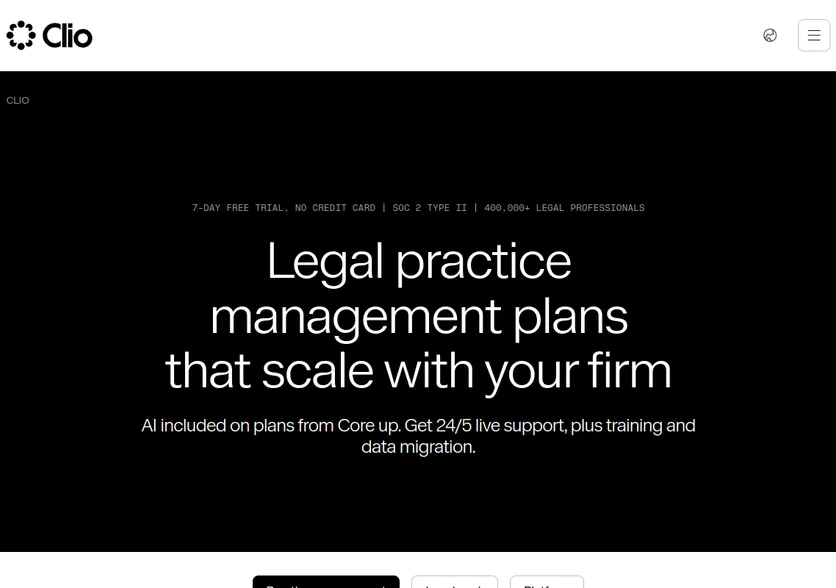
Paid tool Starting price: $49/user/month · Forty-nine dollars per user a month on the Starter plan; Clio Grow, the client-intake suite, is now sold as an add-on to Core and Signature plans and included in Elite, so confirm the add-on price for intake
Free plan: Free trial
For a patent firm that already runs on Clio, this Clio plan starts at forty-nine dollars per user a month, and intake runs through Clio Grow, now sold as an add-on to Core and Signature and included in Elite. Grow screens new inventors, books consultations and captures the first facts with customizable intake forms, while the practice side holds documents, deadlines and trust accounting. That matters when a disclosure becomes an application with a filing clock attached.
What we like
- Intake, matters, documents and deadlines share one system
- Online booking and lead screening cut phone tag with inventors
- Elite bundles Grow with the full practice management suite
Watch out for
- Intake is an add-on, not in the forty-nine-dollar Starter plan
- The add-on price is not published, so the total needs a quote
How to try it
- Add Clio Grow to Core or Signature, or take Elite to include it
- Build an invention disclosure form with inventors, dates and prior art
- Open the matter from the intake record with the deadline already set
2. 8am MyCase
Best for: Patent firms that want intake plus flat-fee billing together
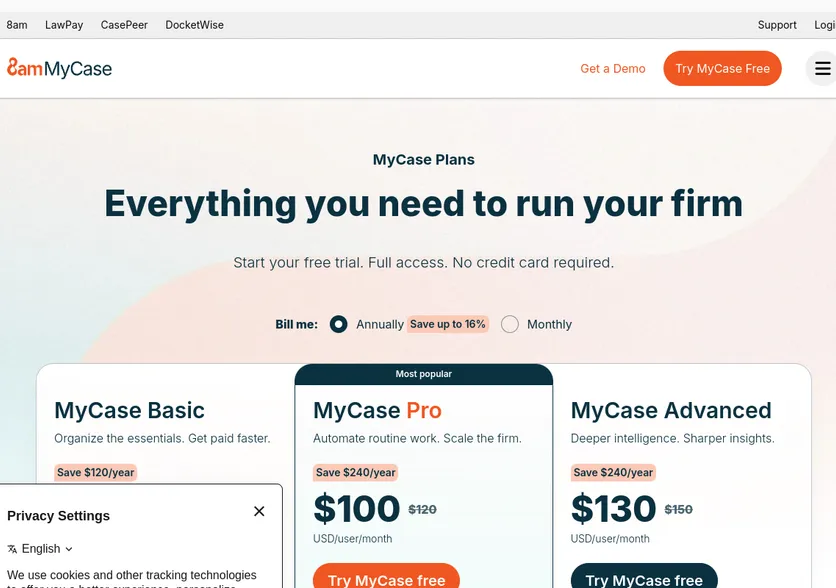
Paid tool Starting price: $50/user/month · Fifty dollars per user a month billed annually on Basic, or sixty dollars month to month; Pro is one hundred dollars and Advanced is one hundred thirty dollars per user a month billed annually, and client intake sits on Pro
Free plan: Free trial
For a patent firm that bills flat fees per application, this 8am MyCase plan costs fifty dollars per user a month billed annually, and its Pro tier adds the client intake, automated workflows and unlimited eSignature a disclosure-heavy practice needs. Inventors sign the engagement letter and pay the filing retainer through the built-in LawPay portal, and the 10-day trial is enough to run one disclosure from first call to signed agreement.
What we like
- Pro adds intake, workflows and unlimited eSignature for one hundred dollars
- LawPay payments and trust accounting are built in, not bolted on
- No setup fee and no long-term contract on any tier
Watch out for
- Intake is not on Basic, so the real price for intake is the Pro tier
- The client portal is limited on Basic until the firm upgrades
How to try it
- Start on Basic and move to Pro to switch on client intake
- Build one intake workflow for disclosures, with automated follow-ups
- Send the engagement letter for eSignature and collect the retainer online
3. PracticePanther
Best for: Patent firms that want intake forms with fast follow-up
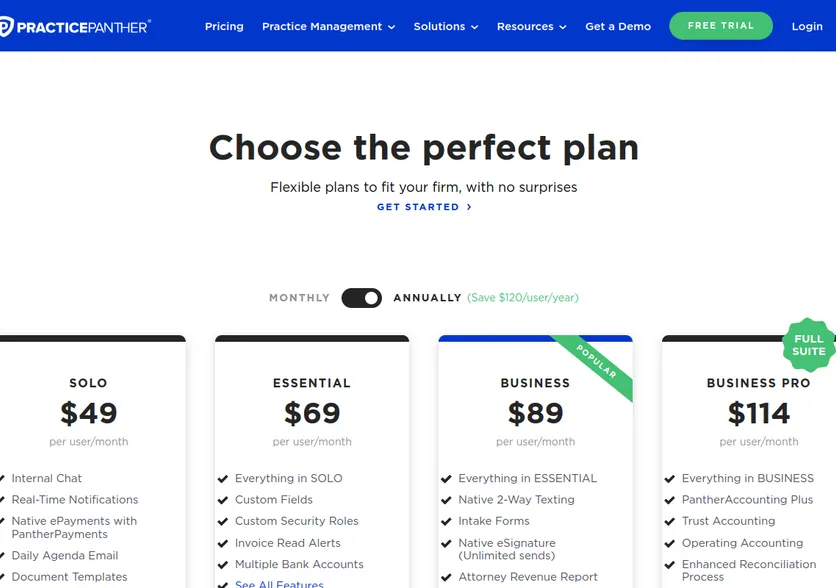
Paid tool Starting price: $49/user/month · Forty-nine dollars per user a month billed annually on Solo, or fifty-nine dollars month to month; Essential is sixty-nine dollars, Business is eighty-nine dollars and Business Pro is one hundred fourteen dollars a month billed annually, and intake forms sit on Business
Free plan: Free trial
For a patent firm that answers inventors quickly, this PracticePanther plan costs forty-nine dollars per user a month billed annually, and its Business tier adds the intake forms and native two-way texting that keep inventors responding. A disclosure that becomes an application carries its documents, deadlines and billing into the same record, so nothing is retyped when the firm accepts the case. A seven-day trial covers a full week of real intake before the firm pays.
What we like
- Native two-way texting reaches inventors who rarely answer email
- Business adds intake forms, eSignature and LEDES billing
- Seven-day trial needs no credit card
Watch out for
- Intake forms need the eighty-nine-dollar Business tier
- Trust accounting waits for Business Pro at one hundred fourteen dollars
How to try it
- Start on Solo and upgrade to Business to switch on intake forms
- Send the disclosure form and engagement letter by text
- Convert the accepted disclosure into a matter with billing attached
4. CaseFox
Best for: Small patent firms that need intake and conflicts on a budget
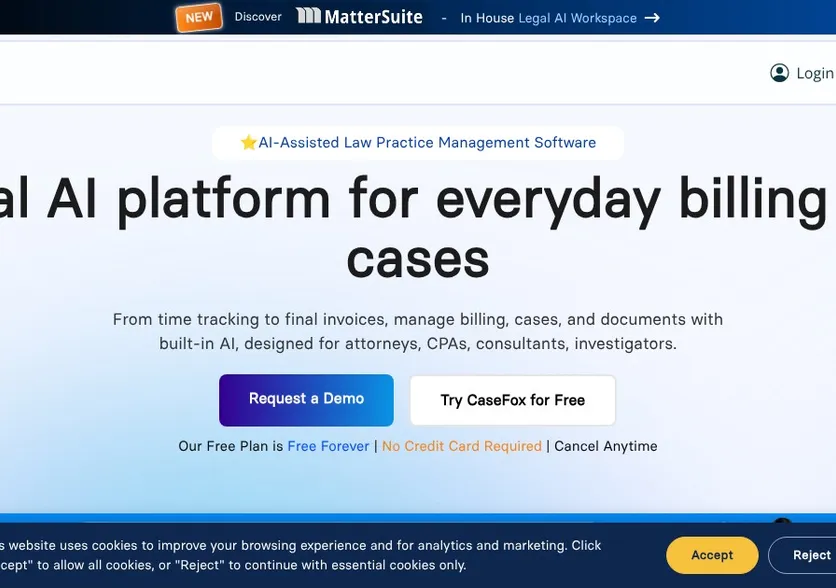
Paid tool Starting price: $39/user/month · Thirty-nine dollars per user a month billed annually on Pro, or forty-five dollars month to month; the free Solo plan covers two users and four cases, Enterprise is seventy-nine dollars billed annually, and the vendor pricing page no longer resolves, so confirm the current price before buying
Free plan: Free Solo plan for 2 users and 4 cases
For a small patent practice watching every dollar, this CaseFox plan costs thirty-nine dollars per user a month billed annually, and its free Solo plan covers two users and four cases with the full Pro feature set. Intake and conflict checks run beside time tracking, billing and trust accounting, so a two-attorney firm can take a disclosure from first call to invoice without a second subscription. AI document drafting helps turn intake answers into the first draft of an application.
What we like
- The only free plan in this list that covers real cases
- Intake and conflict checks sit beside billing and trust accounting
- Lowest paid starting price in this list
Watch out for
- Fewer intake automations than the dedicated intake tools here
- The vendor pricing page no longer resolves, so confirm the price first
How to try it
- Start on the free Solo plan and test intake on live disclosures
- Run the conflict check on every inventor before opening a matter
- Move to Pro when the caseload passes four cases
5. Lawcus
Best for: Patent firms that want a pipeline for every disclosure
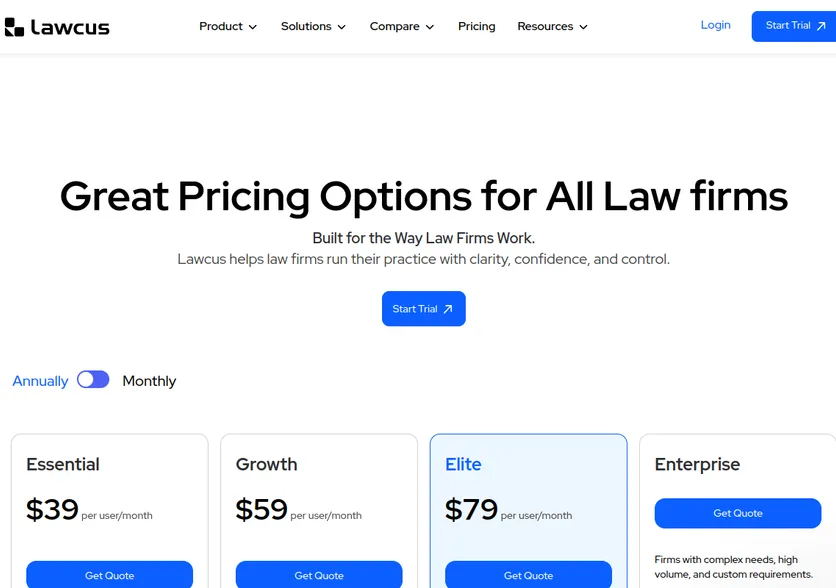
Paid tool Starting price: $39/user/month · Thirty-nine dollars per user a month billed annually on Essential, or forty-nine dollars month to month; Growth is fifty-nine dollars and Elite is seventy-nine dollars a month billed annually
Free plan: Free trial
For a patent firm that tracks disclosures on a board, this Lawcus plan costs thirty-nine dollars per user a month billed annually, and its kanban pipelines show every inquiry from first call through conflict check to filed application. Intake and CRM tools sit beside case management, billing and trust accounting, and the Growth tier adds Nova AI and custom fields for inventors, dates and prior art. Text messaging is a ten-dollar add-on per attorney a month for firms that chase inventors by SMS.
What we like
- Visual pipelines make a disclosure-heavy intake easy to manage
- Essential covers case, billing and trust accounting at thirty-nine dollars
- Growth adds AI, custom fields and accounting integrations
Watch out for
- The deepest intake automation sits on the seventy-nine-dollar Elite tier
- Two-way texting costs extra as a paid add-on
How to try it
- Set up one kanban pipeline per matter type, from inquiry to filing
- Add custom fields for inventors, disclosure dates and prior art
- Move the card to a matter when the client signs and pays
6. CARET Legal
Best for: Patent firms that want onboarding help with intake setup
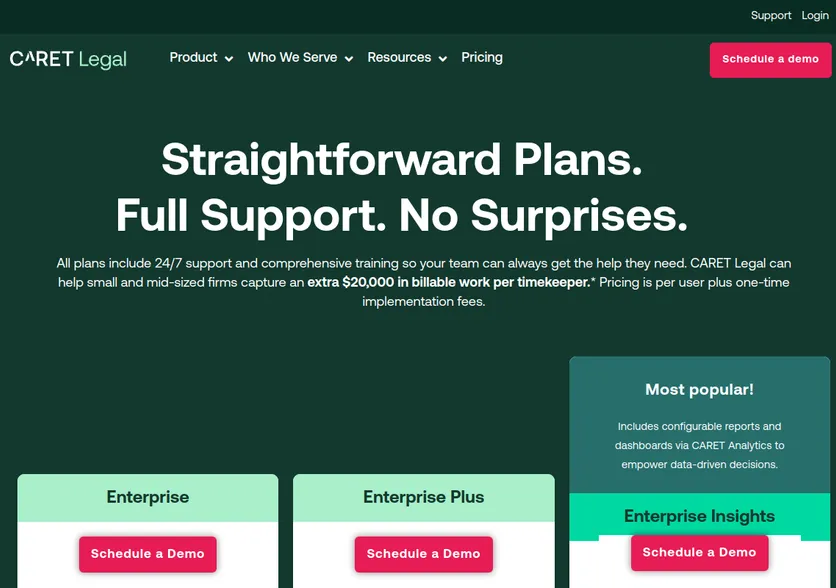
Paid tool Starting price: $79/user/month · Seventy-nine dollars per user a month billed annually on Enterprise; Enterprise Plus is ninety-nine dollars and Enterprise Insights is one hundred nineteen dollars a month billed annually, plus one-time implementation fees
Free plan: Free demo
For a patent firm that wants help configuring intake, this CARET Legal plan costs seventy-nine dollars per user a month billed annually, and every plan includes dedicated onboarding, training and 24/7 phone support. Built-in email, document management and calendaring hold the disclosure file together, while Enterprise Plus adds automated workflows that route a new inquiry to the right attorney. One-time implementation fees apply, so the first bill is higher than the monthly rate.
What we like
- 24/7 phone support and hands-on onboarding on every plan
- Enterprise Plus adds workflows, analytics and custom permissions
- Built-in email keeps disclosure messages on the matter
Watch out for
- One-time implementation fees sit on top of the monthly price
- No free plan, only a demo before buying
How to try it
- Take Enterprise and let onboarding configure the disclosure workflow
- Route each new inquiry to the attorney who handles that technology
- Use the client portal to collect disclosures and signed agreements
7. Jotform
Best for: Patent firms that need invention disclosure forms fast
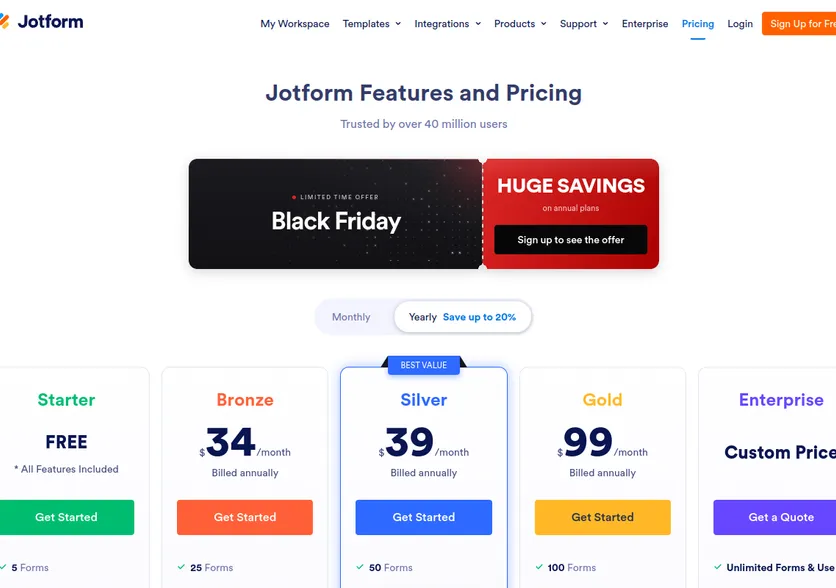
Paid tool Starting price: $34/month · Thirty-four dollars a month billed annually on Bronze, or thirty-nine dollars month to month; Silver is thirty-nine dollars and Gold is ninety-nine dollars a month billed annually, and a free Starter plan covers five forms and one hundred submissions a month
Free plan: Free Starter plan
For a patent firm that needs a disclosure form live today, this Jotform plan costs thirty-four dollars a month billed annually, and its form builder covers the invention questionnaire, the document upload and the signature in one link. Conditional logic shows each inventor only the questions their invention needs, so a software disclosure never asks about chemical compounds. A free Starter plan handles five forms and one hundred submissions a month, enough to test intake before paying.
What we like
- Conditional logic keeps long disclosure forms short for each inventor
- Uploads and eSignatures ride on the same form
- Free Starter plan is genuinely usable for a small firm
Watch out for
- It is a forms tool, not a case system, so matters live elsewhere
- HIPAA features need the ninety-nine-dollar Gold plan
How to try it
- Build the disclosure form with conditional logic per technology
- Collect prior art documents and the inventor signature on the same form
- Send completed disclosures into the case system with an integration
8. Typeform
Best for: Patent firms that want disclosures inventors actually finish
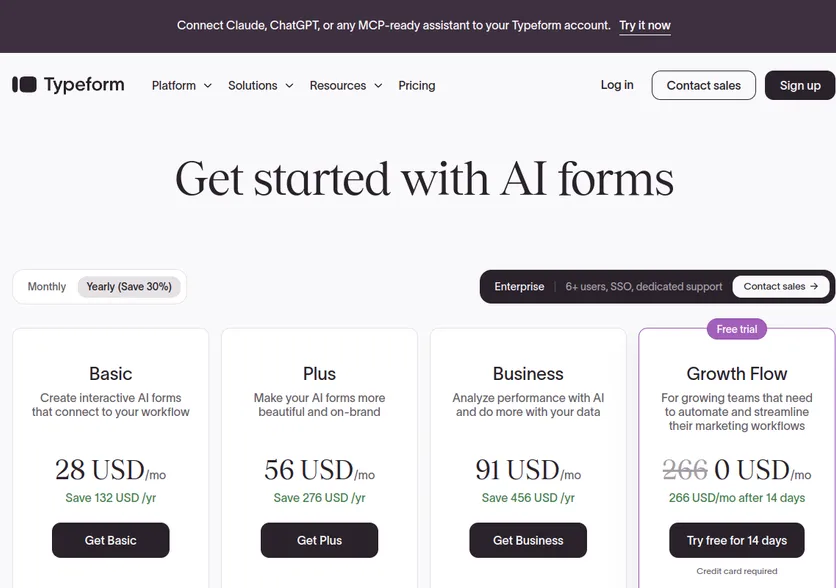
Paid tool Starting price: $28/month · Twenty-eight dollars a month billed annually on Basic, or thirty-nine dollars month to month; Plus is fifty-six dollars and Business is ninety-one dollars a month billed annually, and a free plan exists with limited responses
Free plan: Free plan
For a patent firm losing inventors to long disclosure packets, this Typeform plan costs twenty-eight dollars a month billed annually, and its one-question-at-a-time forms feel more like a conversation than a patent office filing. Logic jumps skip irrelevant sections, so an inventor answers only what their invention needs, and integrations push the answers into the firm case system. The free plan covers a small intake flow while the firm tests whether completion rates improve.
What we like
- Conversational forms lift completion rates on long disclosures
- Logic jumps hide irrelevant questions from each inventor
- Hundreds of integrations move answers into case software
Watch out for
- Only one hundred responses a month on Basic
- No case management, so it always pairs with another tool
How to try it
- Build the disclosure form one question at a time with logic jumps
- Embed it on the firm site or send it after the first call
- Push finished responses into the case system automatically
Prices above were checked on each vendor’s own website on Nov 28, 2026 and can change — the vendor’s page is the final word. Vendor links are editorial: nobody paid to be listed or ranked here. Vendors who want a featured listing can see how it works on our Get listed page.
How a patent firm should run intake
Start with the conflict check, not the invention. A patent firm that spends an hour on a disclosure before checking conflicts has spent an hour it cannot bill, so the first step is always the parties, the inventors and the assignees. Collect the disclosure in writing, with dates, because the filing clock and the prior art picture both depend on when the invention was made and shown. Keep the file in one place from disclosure to application, because a disclosure that lives in email while the application lives in a docketing system will drift apart. Finally, decline fast when the invention is not patentable or the deadline has passed, because a quick no protects the calendar for the applications that can be filed.
Before you buy
- Check that conflict checks run on inventors, assignees and related parties before the first consultation
- Confirm disclosure answers flow into the matter file instead of waiting in an inbox for retyping
- Ask whether filing deadlines are set automatically when the disclosure date is entered
- Count the cost per user across the whole intake desk, including agents and paralegals
- Run one real disclosure end to end, from first call to filed application, on the free trial before you commit
Official websites
Official websites of the products reviewed above. Features and prices were checked against these sites when this guide was written, and they can change, so confirm on the vendor site before you buy.
Frequently asked questions
What is legal intake software for patent law firms?
It is software that collects a new patent client's facts before the firm agrees to take the case: the inventors, the assignees, the disclosure date, the prior art and the filing deadlines, then turns that intake into a matter file. The tools in this list do it through intake pipelines, disclosure forms, or intake suites inside a practice system. The goal is the same in every case: a clean conflict check and a complete disclosure before the clock starts.
Do patent firms need patent-specific intake software?
No dedicated patent intake tool publishes a price, so patent firms run on general legal intake tools and adapt them. The adaptation is mostly custom fields: inventors, disclosure dates and prior art, plus a conflict check that covers assignees as well as inventors. A firm that files mostly one technology can template its disclosure form once and reuse it. A firm across many technologies needs the flexible fields more than any patent label.
What does Clio cost for a patent firm?
Clio plans start at forty-nine dollars per user a month on Starter. Intake runs through Clio Grow, which is now sold as an add-on to Core and Signature plans and included in Elite, and the add-on price is not published, so the firm needs a quote for the intake total. A free trial is available. Confirm the add-on price in writing before budgeting, because intake is the part a patent firm actually buys Clio Grow for.
Can a generic form tool handle patent intake?
It can handle the disclosure, not the intake. Jotform and Typeform collect invention facts, prior art uploads and signatures well, and they cost far less than a practice platform. What they cannot do is run conflict checks, open a matter, or set a filing deadline. Most patent firms pair a form tool with a case system, or pick one platform that does both, and the right answer depends on how many applications the firm files each month.
Compare the eight tools above, then start with a free trial on the tool that matches how your firm takes a disclosure before you pay for a full year.
Browse Business Tools tools