On this page
Government contractors run networks where control matters as much as visibility, so a monitoring tool has to fit the security boundary as well as the device list. The eight tools below cover that job for teams of different sizes, from a small cleared crew to a multi-site operation. SolarWinds Network Performance Monitor leads the list because its self-hosted install keeps data inside your own boundary for two thousand eight hundred and twenty-nine dollars, and the rest are ranked on the same practical test: how much control they give you over your own monitoring data.
How we researched this
We checked every price on the vendor pricing page on November 28, 2026, and only included tools with a published US dollar list price. Quote-only tools such as Cisco ThousandEyes, Auvik, NinjaOne and LogicMonitor publish no prices, so they are not in this list. Prices change, so confirm the current figure on the vendor site before you buy.
Compare the tools
| Name | Best for | Starting price | Free plan | |
|---|---|---|---|---|
 SolarWinds Network Performance Monitor | Large networks that need deep traffic and performance data | $2,829 | 30-day free trial | Visit |
 Datadog | Contractors already running cloud workloads alongside on-premise networks | $5/host/month | 14-day free trial | Visit |
 PRTG Network Monitor | Teams that want one install for the whole infrastructure | $200/month | Free plan (100 sensors) | Visit |
 Nagios XI | Teams that want to own their monitoring platform outright | $2,595 | Free plan (7 nodes) | Visit |
 ManageEngine OpManager | Small estates that need simple device monitoring | $95/year | Free plan | Visit |
| WhatsUp Gold | Windows shops that want live network maps | $1,229/year | Free plan (10 devices) | Visit |
 Site24x7 | Teams that want website, server and network checks together | $9/month | Free plan (50 resources) | Visit |
 Atera | Contractor teams that support endpoints as well as networks | $129/month | 30-day free trial | Visit |
The network monitoring software for government contractors, compared
1. SolarWinds Network Performance Monitor
Best for: Large networks that need deep traffic and performance data
Paid tool Starting price: $2,829 · Two thousand eight hundred and twenty-nine dollars for the SL100 subscription covering up to one hundred nodes, interfaces and volumes; larger tiers are quoted, and the same monitoring also ships inside Observability Self-Hosted from eight dollars per node per month on multi-year contracts billed annually
Free plan: 30-day free trial
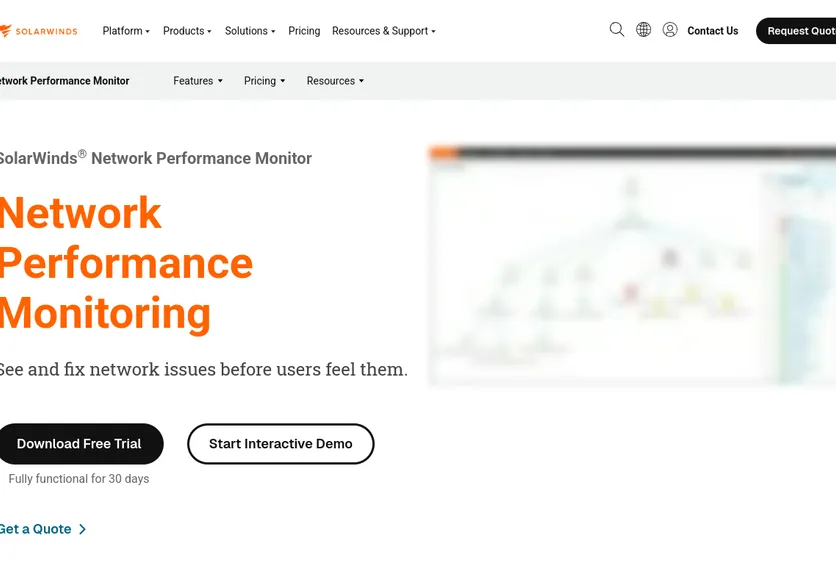
Government contractors that run mixed on-premise and cloud networks pay two thousand eight hundred and twenty-nine dollars for SolarWinds Network Performance Monitor at the SL100 subscription, covering one hundred nodes. The self-hosted install keeps monitoring data inside the contractor's own boundary, which matters for controlled environments, and NetPath shows where a slow link actually breaks. Larger estates move to quoted tiers, so the entry figure is a floor rather than a ceiling.
What we like
- Hop-by-hop NetPath traces across networks you do not own
- NetFlow analysis with deep performance history
- Multi-vendor device support with strong alerting
Watch out for
- Self-hosted install needs Windows servers you maintain
- Entry price is steep for small estates
How to try it
- Install NPM on a Windows server and discover devices by SNMP
- Add NetPath probes for the links between your sites
- Set thresholds and alert actions for each critical device
2. Datadog
Best for: Contractors already running cloud workloads alongside on-premise networks
Paid tool Starting price: $5/host/month · Five dollars per host per month billed annually for Network Performance Monitoring, on top of Infrastructure Monitoring Pro at fifteen dollars per host per month billed annually; Network Device Monitoring is seven dollars per device per month, with wireless access points at four dollars per device
Free plan: 14-day free trial
A contractor already running cloud workloads can add Datadog Network Monitoring for five dollars per host a month billed annually, on top of Infrastructure Pro. Flow data, DNS requests and device health land in the same console as logs and traces, which helps a small cleared team correlate a network fault with the application behind it. The per-host bill needs careful forecasting as environments grow.

What we like
- Network flows correlated with traces and logs in one console
- Flow and DNS visibility across cloud and hybrid estates
- Device monitoring by SNMP alongside cloud flow data
Watch out for
- The network add-on sits on top of the Infrastructure Pro bill
- Per-host metering grows fast as host counts rise
How to try it
- Add the Datadog agent to each host and enable network monitoring
- Tag hosts by site, team or role so filters match your estate
- Build a network dashboard and set alerts on traffic anomalies
3. PRTG Network Monitor
Best for: Teams that want one install for the whole infrastructure
Paid tool Starting price: $200/month · Two hundred dollars per month billed annually for PRTG 500, covering five hundred sensors or about fifty devices; PRTG 1000 is three hundred and fifty-eight dollars a month, and the Freeware Edition covers one hundred sensors at no cost
Free plan: Free plan (100 sensors)
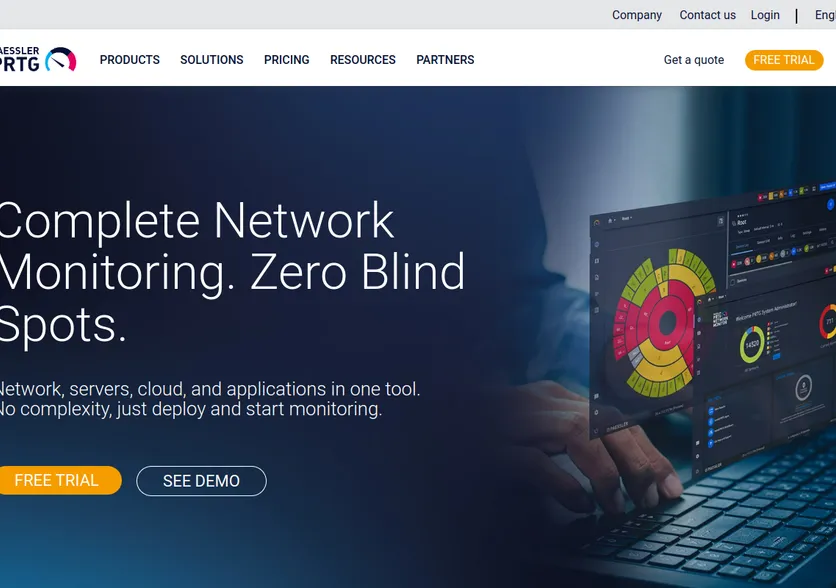
Contractor networks with fixed device counts suit sensor billing, and PRTG Network Monitor costs two hundred dollars a month billed annually for five hundred sensors. Each check on a device is one sensor, so the team can count the bill exactly before buying, and the Freeware Edition covers one hundred sensors for a pilot. PRTG runs on Windows servers only, which fits shops that already standardize on Windows.
What we like
- Sensor model makes the bill easy to count before you buy
- Auto-discovery maps a new site in minutes
- One install covers routers, switches, servers and applications
Watch out for
- Windows-only server install
- Sensor counts climb fast on busy devices
How to try it
- Install PRTG on a Windows server and run auto-discovery
- Group sensors by site so each location has its own view
- Set sensor thresholds and notification triggers per group
4. Nagios XI
Best for: Teams that want to own their monitoring platform outright
Paid tool Starting price: $2,595 · Two thousand five hundred and ninety-five dollars one time for the Standard edition covering one hundred nodes, with the first year of maintenance and support included; Enterprise starts at four thousand six hundred and ninety dollars for one hundred nodes
Free plan: Free plan (7 nodes)
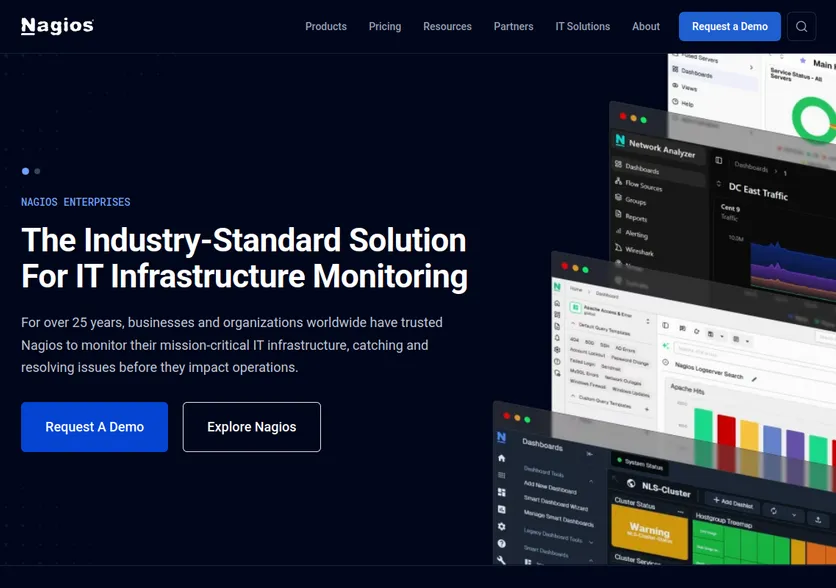
For a contractor that must own its monitoring stack outright, Nagios XI Standard costs two thousand five hundred and ninety-five dollars one time for a one hundred node licence. The perpetual model avoids recurring cloud fees, and the plugin library covers the odd devices that turn up on government sites. The trade-off is hands-on configuration and a maintenance renewal after the first included year.
What we like
- Thousands of community plugins extend monitoring to anything
- Perpetual licence with no monthly bill
- Mature alerting, dashboards and reporting
Watch out for
- Self-hosted setup takes real configuration effort
- Maintenance renewals add cost after year one
How to try it
- Install Nagios XI and add hosts with the configuration wizards
- Apply service checks for ping, SNMP and common protocols
- Set contact groups and notification rules for outages
5. ManageEngine OpManager
Best for: Small estates that need simple device monitoring
Paid tool Starting price: $95/year · Ninety-five dollars per year for the Standard edition covering ten devices, per the vendor store; larger device bundles and the Professional and Enterprise editions cost more
Free plan: Free plan
Small contractor teams watching a modest device estate can start with ManageEngine OpManager at ninety-five dollars a year for the Standard edition covering ten devices. It discovers routers, switches and servers quickly and alarms on failures without a long setup project. Ten devices is a small ceiling, so teams should confirm the price of the next bundle before the estate grows past it.
What we like
- Straightforward device monitoring with little setup
- Affordable entry price for small estates
- Maps, workflows and alarms included in the base product
Watch out for
- Entry edition covers only ten devices
- Advanced features sit in higher editions
How to try it
- Install OpManager and discover devices on the network
- Apply device templates for routers, switches and servers
- Configure alarms and escalation rules for critical devices
6. WhatsUp Gold
Best for: Windows shops that want live network maps
Paid tool Starting price: $1,229/year · One thousand two hundred and twenty-nine dollars per year for the Business subscription covering fifty devices; Enterprise is two thousand and forty-nine dollars and Enterprise Plus is three thousand four hundred and sixty-nine dollars, all per year for fifty devices
Free plan: Free plan (10 devices)
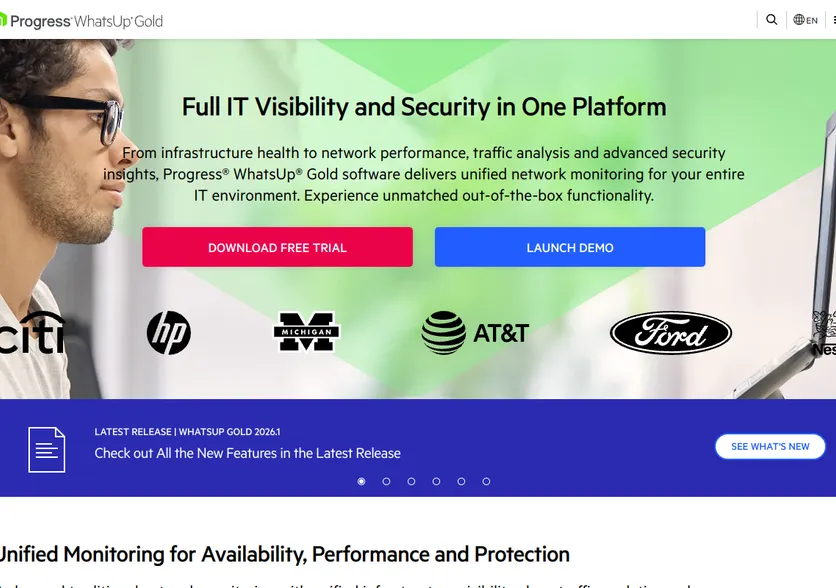
Contractors that want interactive network maps will find WhatsUp Gold Business priced at one thousand two hundred and twenty-nine dollars per year for fifty devices. Discovery builds a live topology map, and traffic analysis shows which links carry the load, which helps when a site outage needs a fast explanation. The install runs on Windows Server only, and add-on modules carry no published price.
What we like
- Interactive topology maps of the whole network
- Free Edition covers ten devices
- Traffic analysis through NetFlow and sFlow
Watch out for
- Windows Server install only
- Add-on modules carry no published price
How to try it
- Install WhatsUp Gold on a Windows server
- Run discovery to map devices and connections
- Enable traffic analysis on key interfaces
7. Site24x7
Best for: Teams that want website, server and network checks together
Paid tool Starting price: $9/month · Nine dollars per month billed annually for the Lite infrastructure plan covering two servers and five websites, or for Web Uptime covering twenty-five websites; Professional is forty-two dollars a month billed annually and adds network components
Free plan: Free plan (50 resources)
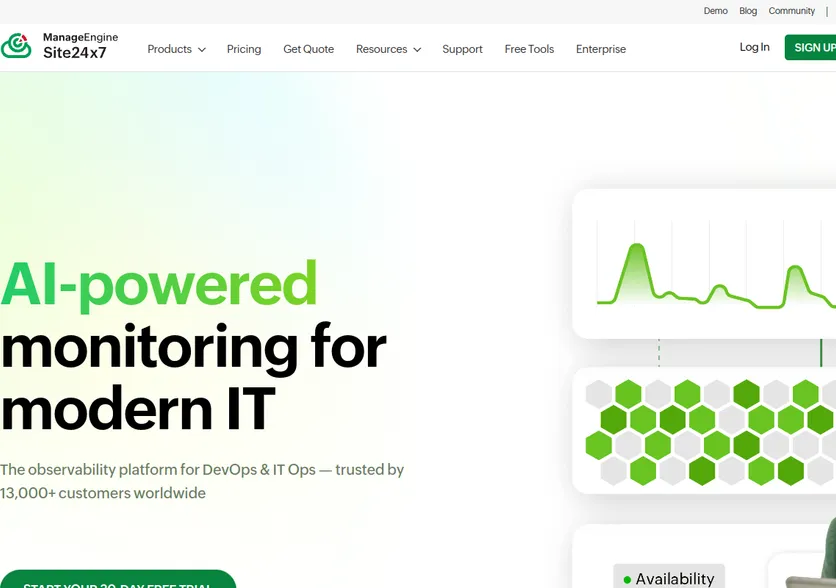
When a contractor also needs to watch public-facing portals, Site24x7 starts at nine dollars a month billed annually for the Lite plan, covering two servers and five websites. Website, server and network monitoring share one account, and the free plan watches uptime on fifty resources at no cost. Entry caps are low, so larger estates should look at Professional at forty-two dollars a month.
What we like
- One account covers websites, servers and network devices
- Free plan monitors uptime on fifty resources
- Thirty-day trial needs no credit card
Watch out for
- Entry plans cap servers and resources tightly
- Website and infrastructure plans are sold separately
How to try it
- Create an account and add your websites and servers
- Enable network monitoring for routers and switches
- Set alert thresholds and notification channels
8. Atera
Best for: Contractor teams that support endpoints as well as networks
Paid tool Starting price: $129/month · One hundred and twenty-nine dollars per technician per month billed annually on the MSP Pro plan, or one hundred and thirty-nine dollars month to month, with unlimited endpoints; Growth is one hundred and fifty-nine dollars billed annually, and internal IT plans start at one hundred and forty-nine dollars
Free plan: 30-day free trial
A contractor whose technicians also support endpoints may prefer Atera at one hundred and twenty-nine dollars per technician per month billed annually on the MSP Pro plan. One licence covers unlimited endpoints, so the bill follows the size of the team rather than the size of the device fleet. It bundles remote monitoring, patching and ticketing, which suits a small crew that does everything.
What we like
- Per-technician pricing covers unlimited endpoints
- RMM, patching and helpdesk in one console
- Thirty-day trial with no credit card
Watch out for
- Entry MSP plan is Windows-focused
- One technician licence is pricey for a solo operator
How to try it
- Install agents on every endpoint you manage
- Set monitoring thresholds and patch policies
- Route alerts into the built-in ticketing queue
Prices above were checked on each vendor’s own website on Nov 28, 2026 and can change — the vendor’s page is the final word. Vendor links are editorial: nobody paid to be listed or ranked here. Vendors who want a featured listing can see how it works on our Get listed page.
How to choose monitoring that fits a controlled environment
Start with the boundary, not the feature list. A contractor network may need self-hosted monitoring that never sends data to a vendor cloud, so confirm where every component stores its data before you shortlist anything. Then count the devices that sit inside each enclave, because per-device and per-node licensing behave very differently at scale. Give the team that holds the clearances the dashboards they need, and keep alerting on systems you control. Finally, trial the tool on a non-production segment first, so configuration mistakes stay out of the live network. Document the decision too, so the next contract renewal does not reopen the same debate from scratch.
Before you buy
- Confirm whether the tool can run fully self-hosted inside your boundary
- Check how licensing counts devices, nodes or sensors across enclaves
- Ask where alert data and reports are stored, and who can see them
- Make sure the tool supports the device types on your network, not just common ones
- Trial on a non-production segment before touching the live environment
Official websites
Official websites of the products reviewed above. Features and prices were checked against these sites when this guide was written, and they can change, so confirm on the vendor site before you buy.
Frequently asked questions
What should government contractors look for in network monitoring software?
Prioritise deployment control, so the tool can run self-hosted inside your boundary, and support for the device types on your network. Licensing matters too: per-node and per-device models behave very differently as enclaves grow. Check where alert data is stored and confirm the vendor can support a controlled environment before you commit.
How much does SolarWinds NPM cost?
SolarWinds Network Performance Monitor lists the SL100 subscription from two thousand eight hundred and twenty-nine dollars, covering up to one hundred nodes, interfaces and volumes. Larger tiers are quoted rather than published. The same monitoring also ships inside Observability Self-Hosted from eight dollars per node per month on multi-year contracts billed annually.
Is self-hosted monitoring better for contractors?
Self-hosted tools such as SolarWinds NPM, Nagios XI and PRTG keep monitoring data inside your own boundary, which suits controlled environments. The trade-off is that your team runs the servers, patches and capacity planning. Cloud tools are easier to run but send data to a vendor, so the choice depends on your security requirements.
Which tool is cheapest for a small contractor team?
OpManager Standard is ninety-five dollars a year for ten devices, and Site24x7 starts at nine dollars a month billed annually. Nagios XI has a free edition covering seven nodes. These fit a small estate, while deeper tools such as SolarWinds NPM start at two thousand eight hundred and twenty-nine dollars for the SL100 subscription.
Can one tool monitor classified and unclassified networks?
It depends on the tool and your rules, but most contractors run separate monitoring instances per enclave rather than one shared system. Self-hosted tools make that easier, since each instance stays inside its own boundary. Ask the vendor how licensing works across multiple instances before you plan the deployment.
Compare the eight tools above, then trial the one that fits your boundary on a non-production segment before you buy.
Browse Network & IP Tools tools