On this page
Warehouses order the same things every day, consumables, pallets, labels and spares, and the cost of getting it wrong is a stalled shift or a shelf full of stock nobody needs. The eight tools below keep that daily buying under control, from a nine-dollar-a-seat starter to a flat-fee suite. Precoro leads because its flat four-hundred-and-ninety-nine-dollar monthly fee buys approvals, budgets and three-way matching without charging per seat, and the rest are ranked on how well they fit daily warehouse buying for the price.
How we researched this
We checked every price on the vendor pricing page on November 28, 2026, and only included tools with a published US dollar list price. The big enterprise suites that sell warehouse procurement by quote, including Coupa, SAP Ariba, Jaggaer, Ivalua, GEP and Zycus, publish no prices, so they are not in this list. Prices change, so confirm the current figure on the vendor site before you buy.
Compare the tools
| Name | Best for | Starting price | Free plan | |
|---|---|---|---|---|
 Precoro | Flat-fee procurement for growing teams | $499/month | No free plan; 14-day free trial | Visit |
 Procurify | Mid-market teams that want a flat monthly rate | $1,000/month | Free demo | Visit |
 Tradogram | Small teams that need purchase orders first | $99/month | No free plan; free trial | Visit |
 ProcureDesk | Mid-size teams buying from PunchOut catalogs | $830/month | No free plan; 14-day free trial | Visit |
 Spendwise | Small teams replacing spreadsheet purchase orders | $9/user/month | No free plan; free trial | Visit |
 ProcurementExpress.com | Teams that buy against fixed budgets | $415/month | No free plan; 14-day free trial | Visit |
 Zoho Inventory | Stock and order control for small product teams | $29/month | Free plan (50 orders a month) | Visit |
 Ramp | Card-based spend control with free core tools | $15/user/month | Free plan | Visit |
The procurement software for warehouses, compared
1. Precoro
Best for: Flat-fee procurement for growing teams
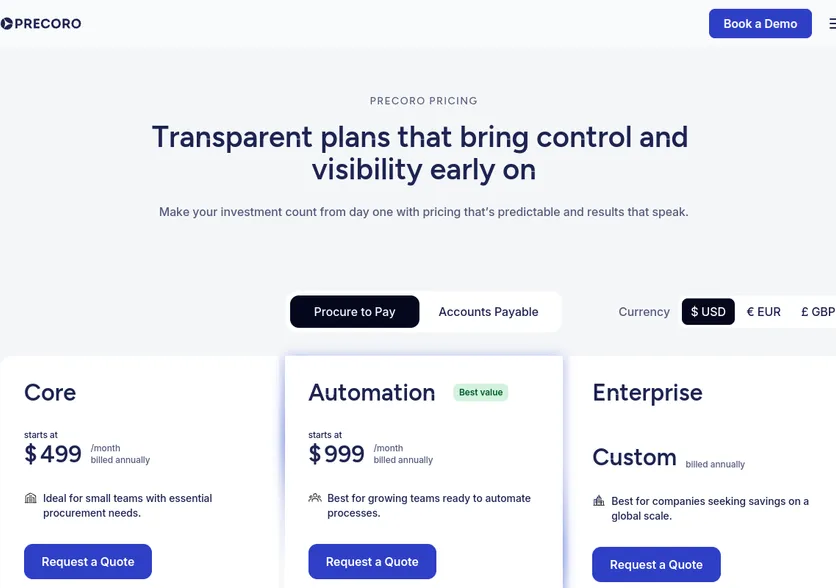
Paid tool Starting price: $499/month · Core is $499 a month billed annually ($5,988 a year); Automation is $999 a month billed annually; Enterprise is quoted; a standalone AP module starts at $499 a month
Free plan: No free plan; 14-day free trial
For a warehouse team ordering consumables, pallets and spares every day, this Precoro plan costs four hundred and ninety-nine dollars a month billed annually, and it runs purchase requests, approvals and three-way matching in one place. Its budget tracking shows what is left before an order is approved, and PunchOut catalogs keep buyers on contracted prices. It is the most complete flat-fee option here for a warehouse team that wants control without per-seat billing.
What we like
- Flat monthly fee with no per-seat charge on Core
- Three-way matching and budget tracking in one place
- PunchOut catalogs and supplier portal on Automation
Watch out for
- Core lacks the supplier portal and RFP tools, which sit on Automation
- Annual billing means the entry commitment is about six thousand dollars a year
How to try it
- Create a purchase request and route it through the approval chain
- Convert the approved request into a purchase order and send it to the supplier
- Match the invoice against the order and receipt, then release payment
2. Procurify
Best for: Mid-market teams that want a flat monthly rate
Paid tool Starting price: $1,000/month · $1,000 a month flat, widely reported in November 2026 reads; the vendor pricing page routes buyers to a quote, so confirm the figure in writing before budgeting; add-ons such as accounts payable and guided intake are priced separately
Free plan: Free demo
For a warehouse team ordering consumables, pallets and spares every day, this Procurify plan costs one thousand dollars a month flat, and it covers the whole buying flow from request to payment. Every request carries its budget position with it, so approvers see the remaining money before they sign. It suits a warehouse team that wants one predictable monthly bill whatever the headcount.
What we like
- Flat monthly rate that does not rise with headcount
- Request, approval, purchase order and payment in one flow
- Real-time budget visibility on every request
Watch out for
- The vendor page itself routes to a quote, so the flat rate needs written confirmation
- Add-on modules for payables and intake push the real bill higher
How to try it
- Raise a purchase request from the catalog or a blank form
- Send it through the approval chain and convert it to a purchase order
- Receive the goods, match the invoice and pay from the same record
3. Tradogram
Best for: Small teams that need purchase orders first
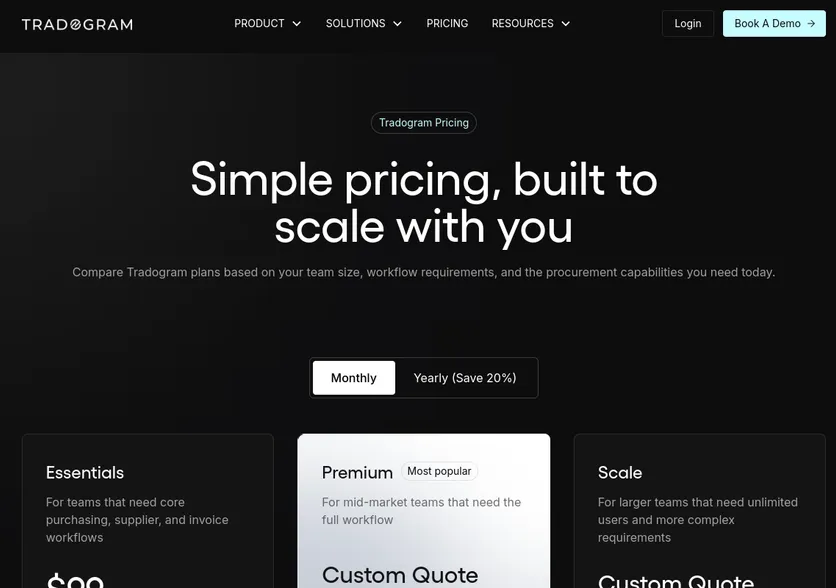
Paid tool Starting price: $99/month · Essentials is $99 a month billed monthly; annual billing is $950.40 a year, about $79.20 a month; Premium and Scale are quoted; an extra fee applies per additional user and is not published
Free plan: No free plan; free trial
For a warehouse team ordering consumables, pallets and spares every day, this Tradogram plan costs ninety-nine dollars a month, and it covers purchase orders, supplier records and invoices for small teams. TradoScan AI reads supplier invoices without manual entry, and TradoPay settles them from the same screen. It is the cheapest real procurement suite here for a warehouse team that needs purchase orders first.
What we like
- Lowest published entry price of any full procurement suite here
- Purchase orders, supplier records and AP invoices in one place
- TradoScan AI reads invoices without manual entry
Watch out for
- Requisitions, receiving and budget tracking are add-ons on Essentials
- The per-user fee is unpublished, so team costs are hard to model
How to try it
- Create a purchase order from the catalog or a supplier quote
- Send it for approval, then track delivery against the order
- Scan the supplier invoice and match it before paying
4. ProcureDesk
Best for: Mid-size teams buying from PunchOut catalogs
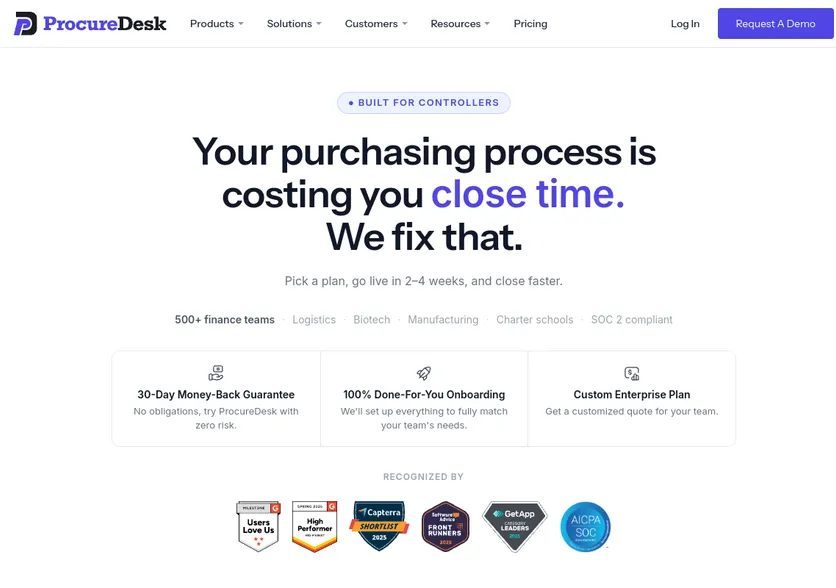
Paid tool Starting price: $830/month · Startup is $830 a month billed annually for 10 users ($996 a month on monthly billing); Growth is $1,250 a month billed annually for 20 users; extra users are $20 a month each; Enterprise is quoted
Free plan: No free plan; 14-day free trial
For a warehouse team ordering consumables, pallets and spares every day, this ProcureDesk plan costs eight hundred and thirty dollars a month billed annually, and it automates purchase orders, approvals and invoice matching for mid-size teams. More than two hundred PunchOut catalogs are included on Startup, and Growth adds OCR invoice capture with advanced three-way matching. It is the strongest mid-market pick here for a warehouse team that buys from catalogs every week.
What we like
- More than 200 PunchOut catalogs included on Startup
- Three-way matching with OCR invoice capture on Growth
- Done-for-you onboarding with a 30-day money-back guarantee
Watch out for
- Startup caps at 10 users, so bigger teams pay for extra seats
- Supplier onboarding and single sign-on need the Growth plan
How to try it
- Raise a requisition and route it to the budget owner for approval
- Issue the purchase order through a PunchOut catalog or supplier email
- Capture the invoice with OCR and match it three ways before paying
5. Spendwise
Best for: Small teams replacing spreadsheet purchase orders
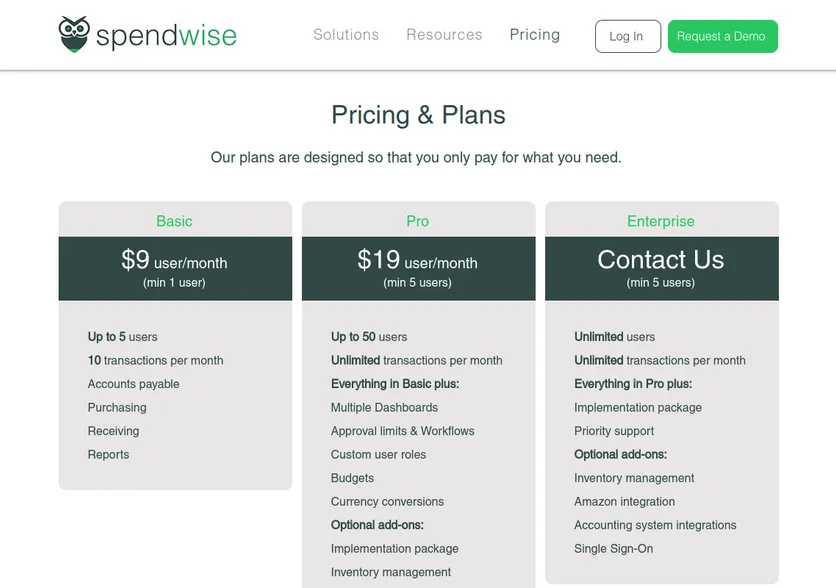
Paid tool Starting price: $9/user/month · Basic is $9 a user a month for up to 5 users and 10 transactions a month; Pro is $19 a user a month for 5 to 50 users with unlimited transactions; Enterprise is quoted
Free plan: No free plan; free trial
For a warehouse team ordering consumables, pallets and spares every day, this Spendwise plan costs nine dollars a user a month, and it replaces spreadsheet purchase orders with requisitions, approvals and receiving. Purchase orders, budgets, vendor records and receiving sit in one simple screen that a small team learns in a day. It is the lowest-cost way in here for a warehouse team to put purchase orders under control.
What we like
- Cheapest per-seat procurement on this list by a wide margin
- Purchase orders, receiving, budgets and vendor records included
- Set-up takes days rather than weeks
Watch out for
- Basic stops at 5 users and 10 transactions a month
- Implementation and accounting integrations are paid add-ons with unpublished prices
How to try it
- Raise a purchase requisition and send it for approval
- Convert the approved request into a purchase order
- Receive the goods and match the invoice before releasing payment
6. ProcurementExpress.com
Best for: Teams that buy against fixed budgets
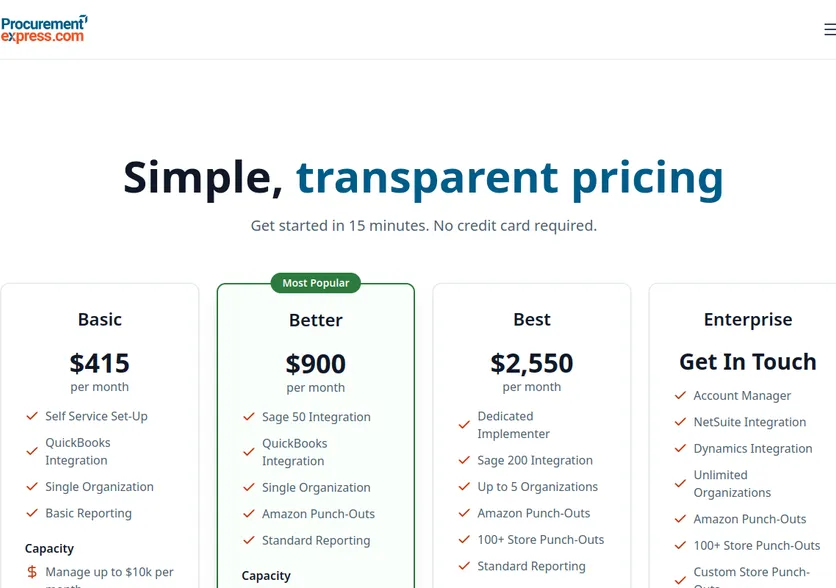
Paid tool Starting price: $415/month · Basic is $415 a month flat for up to $10,000 of monthly spend; Better is $900 a month for up to $1,000,000 of spend; Best is $2,550 a month; Enterprise is quoted
Free plan: No free plan; 14-day free trial
For a warehouse team ordering consumables, pallets and spares every day, this ProcurementExpress.com plan costs four hundred and fifteen dollars a month flat, and it shows approvers the remaining budget on every single order. Plans are priced by monthly spend under management rather than by seats, so the whole team can raise requests. It is the budget-first pick here for a warehouse team that buys against fixed budgets.
What we like
- Approvers see the remaining budget on every single order
- Flat pricing that does not rise with user count
- QuickBooks integration included on the Basic plan
Watch out for
- Basic caps managed spend at $10,000 a month
- The next tier more than doubles the price when spend grows
How to try it
- Raise a purchase request and let the budget owner approve it
- Turn the approved request into a purchase order in one click
- Check the budget remaining before approving the next order
7. Zoho Inventory
Best for: Stock and order control for small product teams
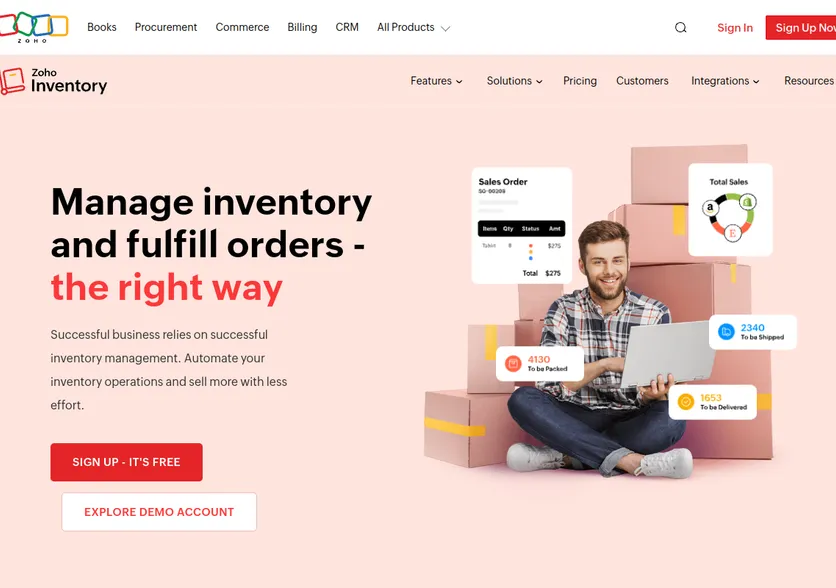
Paid tool Starting price: $29/month · Standard is $29 a month billed annually per organization ($39 billed monthly); Professional is $79, Premium is $129 and Enterprise is $249 a month billed annually
Free plan: Free plan (50 orders a month)
For a warehouse team ordering consumables, pallets and spares every day, this Zoho Inventory plan costs twenty-nine dollars a month billed annually, and it manages purchase orders, stock and supplier bills per organization. It tracks serial numbers and batches, handles dropshipping and backorders, and syncs stock with Zoho Books. It is the stock-first pick here for a warehouse team that orders against what is actually on the shelf.
What we like
- Priced per organization, not per user, so the whole team can log in
- Free plan covers 50 orders a month with no time limit
- Serial and batch tracking from the paid plans upward
Watch out for
- Standard caps at 500 orders and two warehouses
- It manages stock and orders, not approvals or sourcing
How to try it
- Create a purchase order for the items running low
- Receive the delivery and update stock in the right warehouse
- Match the supplier bill against the order before paying
8. Ramp
Best for: Card-based spend control with free core tools
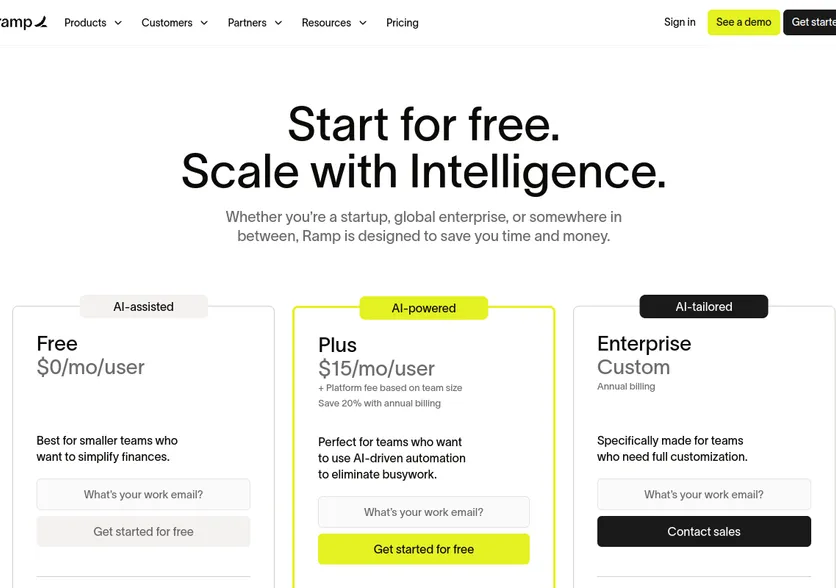
Paid tool Starting price: $15/user/month · Plus is $15 a user a month, plus a platform fee based on team size that Ramp does not publish; annual billing takes 20% off the per-user rate; the core card and expense platform is free; Enterprise is quoted
Free plan: Free plan
For a warehouse team ordering consumables, pallets and spares every day, this Ramp plan costs fifteen dollars a user a month on Plus, and it pairs corporate cards with approval workflows and bill pay. The free core covers unlimited cards, OCR invoice capture and basic accounting sync, which is rare at this price. It is the card-first pick here for a warehouse team that wants spend control without a software fee.
What we like
- Core corporate cards and bill pay cost nothing at all
- Price intelligence flags savings on vendor contracts
- Approval workflows and real-time budgets on Plus
Watch out for
- The unpublished platform fee makes the true Plus total hard to pin down
- Procurement controls are an add-on, not part of the free core
How to try it
- Issue virtual cards with spend limits for each buyer
- Route purchase requests through the approval workflow
- Pay the approved bill and sync the record to the ledger
Prices above were checked on each vendor’s own website on Nov 28, 2026 and can change — the vendor’s page is the final word. Vendor links are editorial: nobody paid to be listed or ranked here. Vendors who want a featured listing can see how it works on our Get listed page.
How a warehouse team should run daily consumables buying
Set a reorder point for every consumable and let the number trigger the order, not a memory, because the most common stockout is the item everyone assumed was fine. Keep one owner per category, so pallets, labels and spares each have someone watching the level. Approve anything above the normal restock amount, and let routine top-ups flow without a meeting. Check every delivery against the order at the dock, since a short delivery found at invoice time is already paid for. Review the top five consumables by spend every month and renegotiate the worst one.
Before you buy
- Set a reorder point for every consumable and let the number trigger the order
- Keep one owner per category so pallets, labels and spares each have a watcher
- Approve anything above the normal restock amount and let routine top-ups flow
- Check every delivery against the order at the dock, not at invoice time
- Test the tool on one warehouse for a month before rolling it out to every site
Official websites
Official websites of the products reviewed above. Features and prices were checked against these sites when this guide was written, and they can change, so confirm on the vendor site before you buy.
Frequently asked questions
What is procurement software for warehouses?
It is software that runs the buying side of a warehouse, from requests and approvals through purchase orders, receiving and invoice matching, for the consumables, pallets, labels and spares a site uses every day. For a warehouse team that means orders trigger on reorder points rather than memory, deliveries are checked at the dock, and every invoice is matched before payment. The tools here cover buying; the warehouse management system still runs the shelves.
How much does Precoro cost for a warehouse?
Precoro costs four hundred and ninety-nine dollars a month billed annually on Core, or about five thousand nine hundred and eighty-eight dollars a year. That plan covers purchase requests, purchase orders, receipts, invoices, two-way and three-way matching and automated approvals with no per-seat charge, which suits a warehouse with many staff raising requests.
Can a warehouse run procurement for free?
Yes, in a limited way. Ramp offers a genuinely free core plan covering corporate cards, bill pay and basic reporting, and Zoho Inventory is free for fifty orders a month. Both suit a small single-site warehouse, though the free tiers cap volume and features. The cheapest paid step up is Spendwise at nine dollars a user a month.
Which tool is best for keeping consumables spend under control?
ProcurementExpress.com is the strongest for budget control, because approvers see the remaining budget on every order and plans are priced by spend under management. Precoro is the better all-round pick at four hundred and ninety-nine dollars a month, since its budget tracking and three-way matching cover the whole order flow rather than just the budget view.
Do these tools track stock levels too?
Some do. Zoho Inventory manages stock levels, purchase orders and receiving in one place, with batch and serial tracking from twenty-nine dollars a month billed annually. Precoro, Procurify and ProcureDesk focus on the buying flow and leave stock to the warehouse system, syncing approved bills into the ledger instead. Pick Zoho Inventory when the warehouse itself holds the stock.
Compare the eight tools above, then start with a free trial on the one that matches how the warehouse already buys before paying for a full year.
Browse Business Tools tools