On this page
Startups that sell across borders cannot afford a customs mistake, and they cannot afford an enterprise trade platform either, so the tool has to be cheap, fast and right. The seven tools below cover that job for young companies, from a fifteen-dollar duty calculator to a full landed-cost platform. Dutify leads because it answers duty and HS code questions from fifteen dollars a month, and the rest are ranked on how well they help a startup ship worldwide without a compliance department.
How we researched this
We checked every price on the vendor pricing page on November 29, 2026, and only included tools with a published US dollar list price. The big trade platforms that sell by quote, including Avalara AvaTax Cross-Border, Descartes and Thomson Reuters ONESOURCE, publish no prices, so they are not in this list. Prices change, so confirm the current figure on the vendor site before you buy.
Compare the tools
| Name | Best for | Starting price | Free plan | |
|---|---|---|---|---|
 Dutify | Startups that need duty answers on day one | $15/month | Free plan (3 calculations a month) | Visit |
 Dutyfinch | Startups that wire duty checks into their checkout | $19/month | Free plan (50 calls a day) | Visit |
 Easyship | Startups shipping small parcels worldwide | $29/month | Free plan (50 shipments a month) | Visit |
 Tarifyx | Startups that add products fast and classify in bulk | $49/month | No free plan; demo on request | Visit |
 Tarifflo | Startups that file their own customs entries | $150/month | Free plan (50 credits) | Visit |
 GingerLite by GingerControl | Startups that check duties by hand from a dashboard | $150/month | No free plan; demo on request | Visit |
 Zonos | Startups scaling worldwide that need the full platform | $500/month | No free plan; demo on request | Visit |
The trade compliance software for startups, compared
1. Dutify
Best for: Startups that need duty answers on day one
Paid tool Starting price: $15/month · Fifteen dollars a month on Basic for 200 calculations and 50 HS lookups; Plus is $75 a month and Pro is $149; free plan covers three calculations and three HS lookups a month; the Shopify app listing shows from $30 a month, which conflicts with the $15 website price, so confirm at checkout
Free plan: Free plan (3 calculations a month)
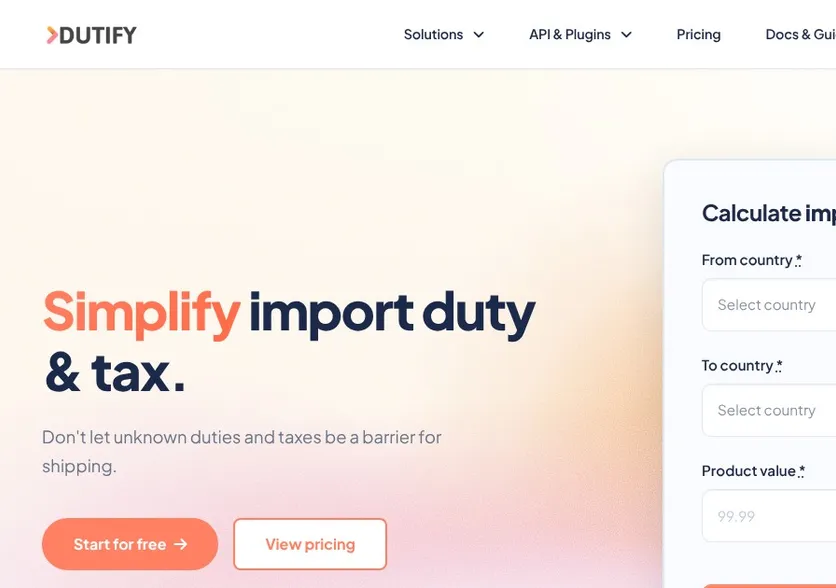
A startup that needs duty answers on day one will find the cheapest start here, because this Dutify plan costs fifteen dollars a month on Basic for two hundred calculations and fifty HS lookups. Its API and bulk tools cover the basics, and the free plan handles three calculations a month. It is the cheapest pick here for a young company that mostly needs answers, not a platform.
What we like
- Cheapest paid plan in this list
- API and bulk tools included
- Free plan covers three calculations a month
Watch out for
- The Shopify listing shows from $30 a month, which conflicts
- No shipping labels or tracking included
How to try it
- Add the products and look up their HS codes
- Run the first duty calculations
- Connect the API if the startup needs it
2. Dutyfinch
Best for: Startups that wire duty checks into their checkout
Paid tool Starting price: $19/month · Nineteen dollars a month on Importer for 2,500 calls; Broker is $49 a month for 7,500 calls and Team is $149 for 40,000; pay as you go is $5 once for 500 calls; free tier covers 50 calls a day; Dutyfinch is a small indie tool, so confirm support terms before relying on it
Free plan: Free plan (50 calls a day)
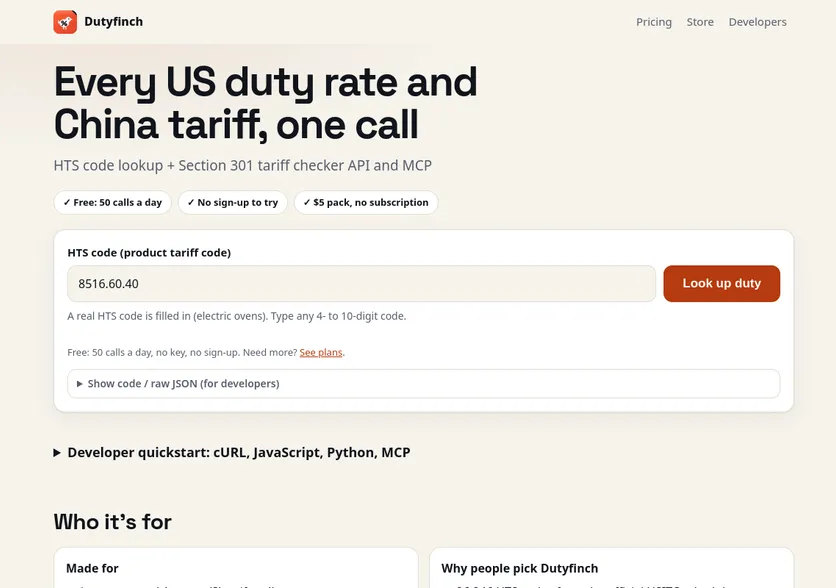
A startup that wires duty checks into its own checkout will like the API price here, since this Dutyfinch plan costs nineteen dollars a month on Importer for two thousand five hundred calls. Its pay-as-you-go option is five dollars once for five hundred calls, and the free tier covers fifty calls a day. It is the best API value here for a team that builds the checks into its own systems.
What we like
- 2,500 calls for $19 a month
- Pay as you go at $5 once for 500 calls
- Free tier covers 50 calls a day
Watch out for
- A small indie tool, so confirm support terms
- No shipping labels or tracking included
How to try it
- Test the API with the free tier first
- Wire the duty check into the checkout
- Watch the call volume as orders grow
3. Easyship
Best for: Startups shipping small parcels worldwide
Paid tool Starting price: $29/month · Twenty-nine dollars a month on Plus ($23 billed annually); Premier is $69 ($55 annually) and Scale is $99 to $199 ($79 annually); free plan covers 50 shipments a month; label fees are $0.05, $0.04 and $0.03 per label with your own courier
Free plan: Free plan (50 shipments a month)
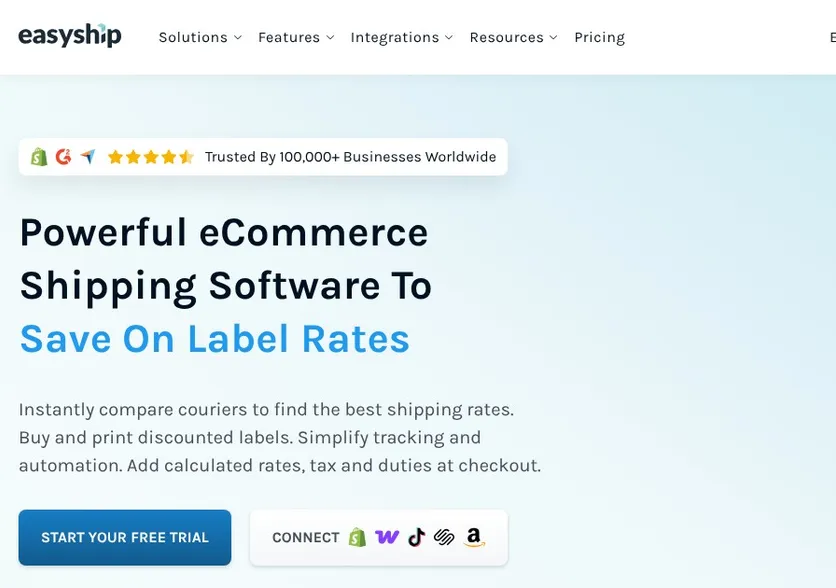
A startup that ships small parcels worldwide will like the courier choice here, because this Easyship plan costs twenty-nine dollars a month on Plus. Its labels, duty estimates and tracking cover hundreds of couriers in one dashboard, and the free plan handles fifty shipments a month. It is the best all-rounder here for a startup that wants one home for every parcel.
What we like
- Labels, duty estimates and tracking in one dashboard
- Hundreds of couriers to choose from
- Free plan covers 50 shipments a month
Watch out for
- Label fees apply on top of the plan price
- Own-courier rates vary by plan
How to try it
- Connect the store and pick the couriers
- Set the duty and tax rules for each country
- Ship the first parcel and check the tracking
4. Tarifyx
Best for: Startups that add products fast and classify in bulk
Paid tool Starting price: $49/month · Forty-nine dollars a month on Starter for 25 classifications; Growth is $99 a month with unlimited classifications and 100 API calls a month; Pro is $249 a month with unlimited API and five team seats
Free plan: No free plan; demo on request
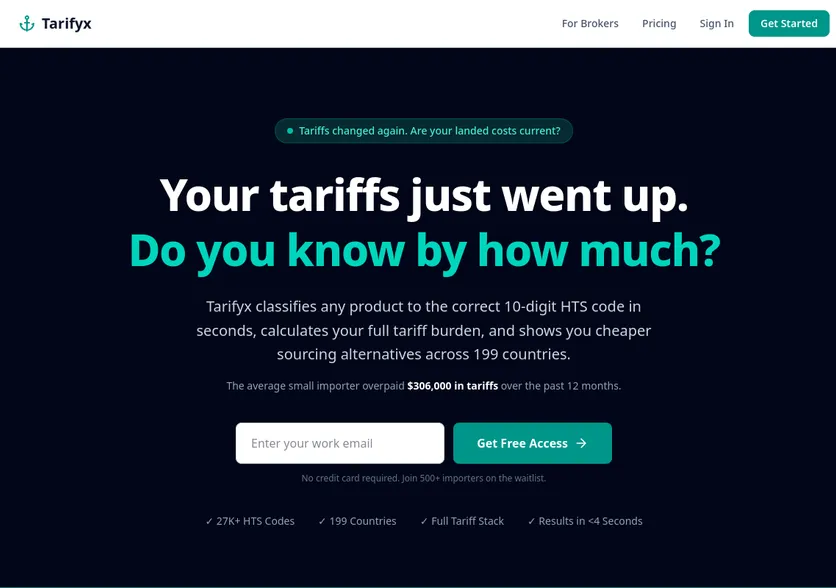
A startup that classifies new products every week will like the flat pricing here, since this Tarifyx plan costs forty-nine dollars a month on Starter for twenty-five classifications. Its Growth tier adds unlimited classifications and a hundred API calls a month for ninety-nine dollars, so the per-item cost falls as the catalogue grows. It suits a startup that adds products fast and classifies in bulk.
What we like
- Unlimited classifications on the Growth tier
- API included from the Growth plan
- Team seats on the Pro tier
Watch out for
- Starter covers only 25 classifications
- No shipping labels or courier tools
How to try it
- Add the products and classify the first batch
- Connect the API if the startup needs it
- Upgrade to Growth when the volume grows
5. Tarifflo
Best for: Startups that file their own customs entries
Paid tool Starting price: $150/month · One hundred and fifty dollars a month on Starter for 200 credits; Growth is $500 a month for 750 credits; free plan covers 50 credits; ABI filing is $6 an entry on Standard down to $1.50 at enterprise volume; one credit equals one dollar of actions
Free plan: Free plan (50 credits)
A startup that files its own customs entries will find the maths handled here, because this Tarifflo plan costs one hundred and fifty dollars a month on Starter for two hundred credits. Its classification, duty calculation and ABI filing tools cover the whole entry, and one credit equals one dollar of actions. It fits a startup that files entries itself rather than paying a broker.
What we like
- Classification, duty calculation and ABI filing in one tool
- One credit equals one dollar of actions
- Free plan covers 50 credits
Watch out for
- ABI filing costs extra per entry
- No shipping labels or courier tools
How to try it
- Classify the products and check the duties
- File the first entry through the tool
- Review the credit use each month
6. GingerLite by GingerControl
Best for: Startups that check duties by hand from a dashboard
Paid tool Starting price: $150/month · One hundred and fifty dollars a month for GingerLite with 300 credits, app only with no API; the Classification and Tariff Calculation API is enterprise-only and quoted; the figure is published in the vendor comparison pages
Free plan: No free plan; demo on request
A startup that works from a dashboard rather than an API will like the app-first approach here, since this GingerLite by GingerControl plan costs one hundred and fifty dollars a month for GingerLite with three hundred credits. Its classification and tariff tools run in the app, and the API is reserved for the enterprise tier. It fits a small team that checks duties by hand and wants the answers fast.
What we like
- Classification and tariff tools in one app
- 300 credits a month on the GingerLite plan
- Simple pricing with no per-user maths
Watch out for
- The API is enterprise-only and quoted
- No shipping labels or courier tools
How to try it
- Add the products and classify them in the app
- Run the tariff calculations for each country
- Export the results for the shipping team
7. Zonos
Best for: Startups scaling worldwide that need the full platform
Paid tool Starting price: $500/month · Five hundred dollars a month for Classify; guaranteed landed cost is $2 an order plus ten percent of duties, taxes and fees; the Duty and Tax Shopify app is $2,500 a year on Standard and $4,000 on Premium, with setup of $2,000 or $4,000 outside Shopify; there is no single flat SaaS price card
Free plan: No free plan; demo on request
A startup that is ready to show buyers the true landed cost will find the full platform here, because this Zonos plan costs five hundred dollars a month for Classify. Its classification, duty calculation and tax tools show the buyer the whole cost before checkout, and the guaranteed landed cost option covers the duties for two dollars an order plus ten percent. It is the most complete pick here for a startup that is scaling worldwide.
What we like
- Classification, duty calculation and tax in one platform
- Guaranteed landed cost covers duties and taxes
- Buyer sees the true cost before checkout
Watch out for
- There is no single flat SaaS price card
- Shopify app and setup cost extra
How to try it
- Connect the store or checkout first
- Classify the top-selling products
- Turn on landed cost at checkout
Prices above were checked on each vendor’s own website on Nov 29, 2026 and can change — the vendor’s page is the final word. Vendor links are editorial: nobody paid to be listed or ranked here. Vendors who want a featured listing can see how it works on our Get listed page.
How a startup ships worldwide without a compliance department
Classify every product before the first order, because a code chosen in a rush at the border is the one that gets the shipment held. Show the landed cost at checkout, since a startup cannot afford the returns and the bad reviews that follow a surprise duty bill. Start with the cheapest calculator that answers the questions, and only pay for a platform when the order volume justifies it. Review the tariff codes every quarter, because trade rules change often and a stale code is a shipment stuck at customs.
Before you buy
- Confirm the tool covers the countries the startup plans to sell into first
- Check whether the free plan is enough for the first month of orders
- Ask if the API is included in the plan or locked behind an enterprise tier
- Make sure landed cost is shown at checkout, not only after the order is placed
- Test the tool on ten real products before routing live orders through it
Official websites
Official websites of the products reviewed above. Features and prices were checked against these sites when this guide was written, and they can change, so confirm on the vendor site before you buy.
Frequently asked questions
What is the best trade compliance software for startups?
Dutify is the cheapest, at fifteen dollars a month for two hundred calculations and fifty HS lookups, and Dutyfinch is the best API value, at nineteen dollars a month for two thousand five hundred calls. Easyship is the best all-rounder, at twenty-nine dollars a month, because it covers labels, duties and tracking in one dashboard. Zonos is the most complete, at five hundred dollars a month, for startups that are scaling worldwide.
Can a startup afford trade compliance software?
Yes, Dutify starts at fifteen dollars a month and Dutyfinch at nineteen dollars, and both offer free tiers for a handful of checks a month. Easyship is free for fifty shipments a month. A startup can start on a free plan, classify its first products, and only pay when the order volume grows. The expensive platforms, like Zonos at five hundred dollars a month, come later.
What is the cheapest way to calculate duties?
Dutify is the cheapest, at fifteen dollars a month on Basic, with a free plan covering three calculations a month. Dutyfinch is next, at nineteen dollars a month, with a free tier of fifty calls a day and a pay-as-you-go option of five dollars once for five hundred calls. Both suit a startup that mostly needs duty answers, not a full shipping platform.
Do startups need an HS code for every product?
Yes, every product that crosses a border needs an HS code, because it decides the duty rate and the documents the shipment needs. A wrong code can hold a shipment or trigger a fine. The tools in this list look up HS codes and calculate the duty from them, so a startup classifies each product once and reuses the code on every order.
When should a startup move to a platform like Zonos?
A startup should move to Zonos when it sells into many countries and needs the landed cost shown at checkout, not just duty answers. Zonos Classify costs five hundred dollars a month, and the guaranteed landed cost option covers duties for two dollars an order plus ten percent. Until then, Dutify or Easyship covers the basics for a fraction of the price.
Compare the seven tools above, then start with Dutify or Dutyfinch on the free plan and classify ten real products before routing live orders through it.
Browse Business Tools tools