On this page
An enterprise runs on data that lives in a dozen systems, and every report depends on those systems agreeing with each other. The seven tools below move data from apps and databases into a warehouse, with the connectors and monitoring a large team needs. Every price was checked on the vendor site on November 27, 2026, and the list runs from five dollars a month to one thousand nine hundred and ninety-nine dollars a month. Fivetran is our first pick — the fully managed service that keeps seven hundred and fifty sources in sync without a pipeline to babysit.
How we researched this
We started with the data integration tools enterprises actually buy, then read each price on the vendor pricing page on November 27, 2026 and noted the trial each plan carries. We judged them for a team that moves data from many sources into a warehouse every day and needs to know when a sync breaks. We left out Informatica, Talend, SnapLogic, Matillion and IBM DataStage because none of them publishes a list price, so an enterprise cannot compare them without a sales call.
Compare the tools
| Name | Best for | Starting price | Free plan | |
|---|---|---|---|---|
 Fivetran | Enterprises that want fully managed pipelines across hundreds of sources | $5/month | Free plan; 14-day free trial | Visit |
 Airbyte | Teams that want open-source connectors with a managed cloud option | $20/month | Free trial | Visit |
 Hevo Data | Teams that want a no-code pipeline with built-in transformations | $265/month | 14-day free trial | Visit |
 Stitch | Small teams that want simple ETL with a predictable monthly price | $100/month | Free trial | Visit |
 Integrate.io | Enterprises that want one flat fee and no metering surprises | $1,999/month | 14-day free trial | Visit |
 Qlik | Enterprises that want integration and analytics from one vendor | $300/month | No free plan; 30-day free trial | Visit |
| Workato | Enterprises that want automation and integration governed in one platform | $75/month | Free plan (50,000 one-time credits) | Visit |
The cloud data integration software for enterprise, compared
1. Fivetran
Best for: Enterprises that want fully managed pipelines across hundreds of sources
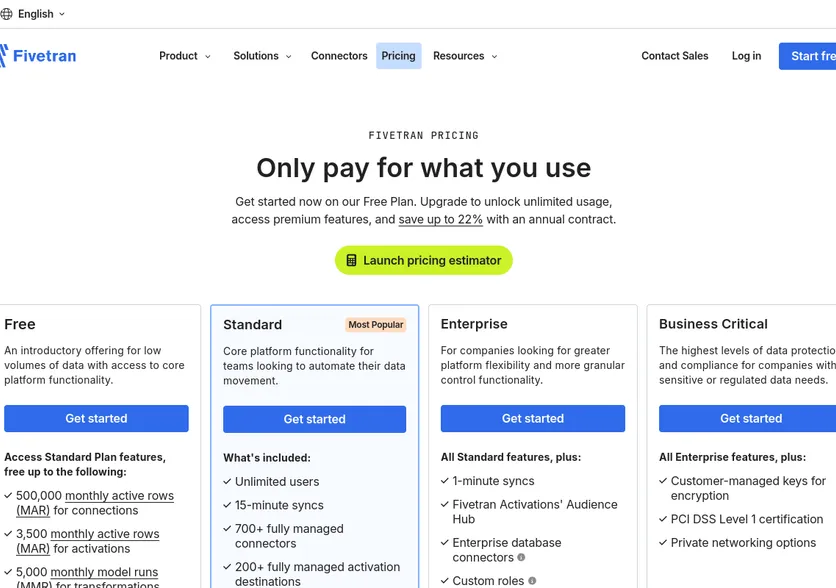
Paid tool Starting price: $5/month · Five dollars a month is the base charge for each standard connection with one to one million monthly active rows; the real bill depends on row volume, the free plan covers five hundred thousand rows a month, and annual contracts save up to twenty-two percent
Free plan: Free plan; 14-day free trial
Fivetran is the fully managed data integration service that moves data from apps and databases into a warehouse without a pipeline to babysit. This Fivetran Standard plan carries a five-dollar base charge per connection, with usage priced on monthly active rows. An enterprise gets seven hundred and fifty sources maintained by the vendor, with schema changes handled automatically.
What we like
- Fully managed, with no pipeline code to maintain
- Seven hundred and fifty sources kept working by the vendor
- Schema changes handled without breaking the sync
Watch out for
- The bill grows with row volume, so the five-dollar base is not the total
- Per-connection pricing penalises many small sources
How to try it
- Open the Fivetran site and start a free trial
- Connect your first source and pick a warehouse destination
- Check the first sync and set the schedule for the rest
2. Airbyte
Best for: Teams that want open-source connectors with a managed cloud option
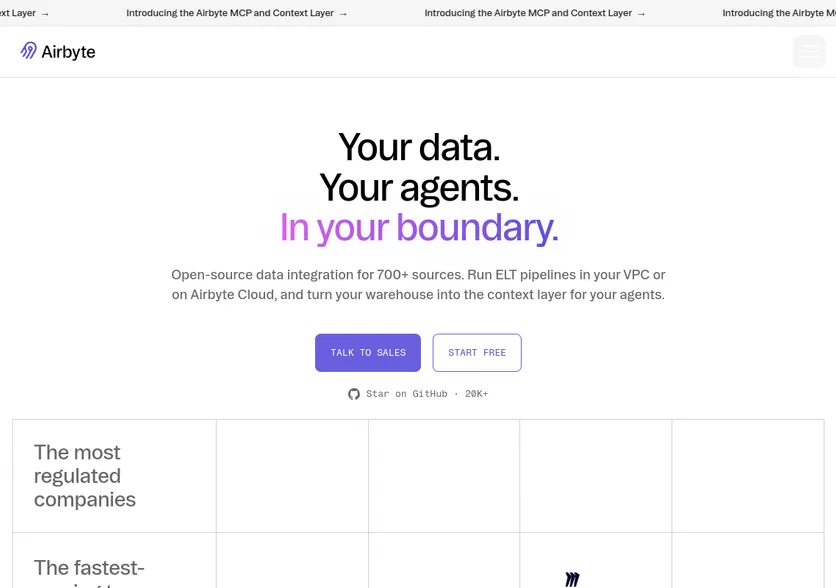
Paid tool Starting price: $20/month · Twenty dollars a month for the Standard cloud plan with five credits, or about one gigabyte of syncs; self-hosted Airbyte Core is free and a fourteen-day cloud trial includes four hundred credits
Free plan: Free trial
Airbyte is the open-source data integration platform that pairs a free self-hosted core with a managed cloud for teams that want no servers to run. This Airbyte Standard cloud plan costs twenty dollars a month with five credits, or about one gigabyte of syncs. An enterprise gets thousands of connectors and the freedom to move to self-hosting later.
What we like
- Open-source connectors with a huge community
- Self-hosted core is free if you want to run it
- Managed cloud for teams that want no servers
Watch out for
- Credit pricing needs care, because a gigabyte of syncs is not much
- Advanced features sit on the higher Pro and Enterprise plans
How to try it
- Open the Airbyte site and start the 14-day cloud trial
- Connect a source and a warehouse destination
- Run the first sync and check the data lands correctly
3. Hevo Data
Best for: Teams that want a no-code pipeline with built-in transformations
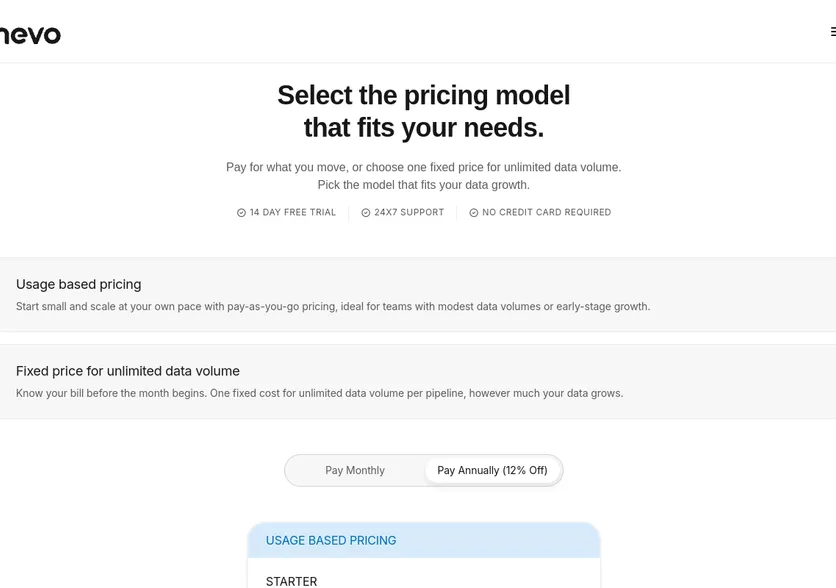
Paid tool Starting price: $265/month · Two hundred and sixty-five dollars a month for the entry paid plan; pricing is usage-based on events and the exact bill depends on volume, so confirm your tier on the pricing page before you buy
Free plan: 14-day free trial
Hevo Data is the no-code data pipeline for teams that want to move data and transform it without writing code. This Hevo Data entry paid plan costs two hundred and sixty-five dollars a month, with pricing based on events moved. An enterprise gets drag-and-drop transformations and automatic schema handling in one login.
What we like
- No-code setup with built-in transformations
- Automatic schema and data-type handling
- One hundred and fifty sources ready to connect
Watch out for
- Usage-based pricing makes the monthly bill hard to predict
- Fewer enterprise sources than Fivetran or Airbyte
How to try it
- Open the Hevo site and start the 14-day free trial
- Connect a source and pick your warehouse
- Build a transformation in the drag-and-drop editor and run it
4. Stitch
Best for: Small teams that want simple ETL with a predictable monthly price
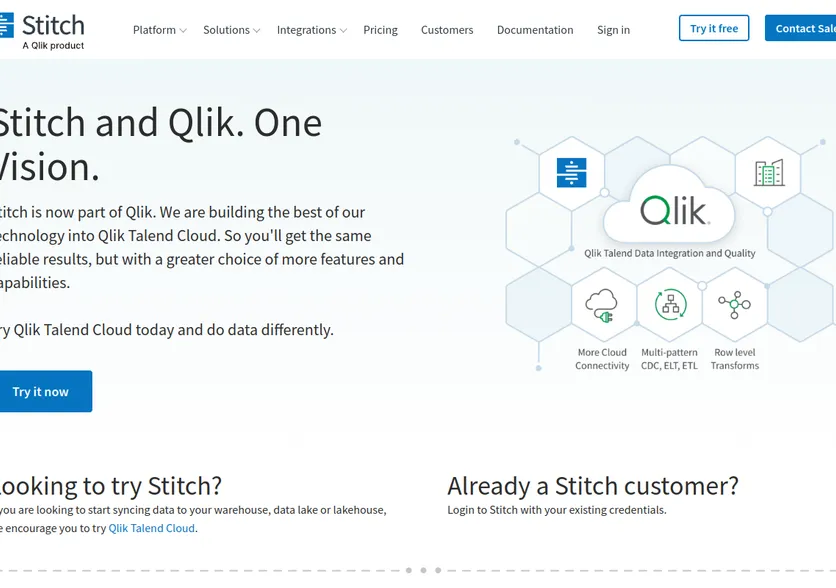
Paid tool Starting price: $100/month · One hundred dollars a month for the Standard plan; Advanced costs one thousand five hundred dollars and Premium costs three thousand dollars a month billed annually
Free plan: Free trial
Stitch is the straightforward ETL service for teams that want data moved on a schedule without a platform to learn. This Stitch Standard plan costs one hundred dollars a month. An enterprise team that needs a few reliable pipelines gets them running in an afternoon, with a price that does not move with row volume.
What we like
- Simple setup with no platform to learn
- Predictable monthly price with no row metering
- Replication schedules that just keep running
Watch out for
- Advanced jumps to one thousand five hundred dollars a month
- No built-in transformations, so data lands raw
How to try it
- Open the Stitch site and start a free trial
- Connect your sources and pick a warehouse
- Set the replication schedule and check the first load
5. Integrate.io
Best for: Enterprises that want one flat fee and no metering surprises
Paid tool Starting price: $1,999/month · One thousand nine hundred and ninety-nine dollars a month for the flat-rate Unlimited plan with no row limits; the price is the same whatever the volume, which suits teams with heavy or spiky loads
Free plan: 14-day free trial
The data integration platform with one flat monthly fee and no row limits keeps the bill steady whatever the volume. This Integrate.io Unlimited plan costs one thousand nine hundred and ninety-nine dollars a month. An enterprise with heavy or spiky loads gets every pipeline it needs for one predictable price.
What we like
- One flat fee with no row limits or metering
- Visual pipeline builder with no code needed
- Predictable bill whatever the volume does
Watch out for
- The flat fee is high for a team with only two sources
- Fewer pre-built connectors than Fivetran
How to try it
- Open the Integrate.io site and start the 14-day free trial
- Connect your sources and build a pipeline in the visual editor
- Run the pipeline and check the data in your warehouse
6. Qlik
Best for: Enterprises that want integration and analytics from one vendor
Paid tool Starting price: $300/month · Three hundred dollars a month for the entry analytics and integration plan; Qlik bought Talend, so the data integration catalogue now sits beside Qlik analytics on the same pricing page
Free plan: No free plan; 30-day free trial
Qlik is the analytics platform that now carries data integration beside it, after buying Talend and folding its catalogue into the same suite. This Qlik entry plan costs three hundred dollars a month. An enterprise gets pipelines and dashboards from one vendor, with one contract and one support team.
What we like
- Integration and analytics from one vendor
- Strong governance for regulated data
- Talend catalogue now inside the Qlik suite
Watch out for
- The suite is broad, so setup takes longer than a point tool
- Pricing varies by module, so confirm the integration price in writing
How to try it
- Open the Qlik site and start the 30-day free trial
- Connect a source and build your first pipeline
- Check the data in a Qlik dashboard to confirm the flow
7. Workato
Best for: Enterprises that want automation and integration governed in one platform
Paid tool Starting price: $75/month · From seventy-five dollars a month for the Workato Pro self-service plan with two thousand five hundred credits; higher credit bands cost one hundred, two hundred and seventy-five, seven hundred and eighty or one thousand two hundred and seventy-five dollars a month, and the enterprise editions are quote-only
Free plan: Free plan (50,000 one-time credits)
Workato is the integration and automation platform that governs every workflow, recipe and API in one place, with the controls an enterprise demands. This Workato Pro self-service plan starts at seventy-five dollars a month with two thousand five hundred credits. An enterprise gets automation and data integration under one governance model, with usage billed in credits.
What we like
- Automation and integration under one governance model
- Pre-built recipes for hundreds of apps
- Credit billing that scales with actual use
Watch out for
- Enterprise editions are quote-only, so large teams need a sales call
- Credit billing is hard to forecast until you run real recipes
How to try it
- Open the Workato site and create a free account
- Build a recipe that moves data between two apps
- Check the credit usage and set the monthly limit
Prices above were checked on each vendor’s own website on Nov 27, 2026 and can change — the vendor’s page is the final word. Vendor links are editorial: nobody paid to be listed or ranked here. Vendors who want a featured listing can see how it works on our Get listed page.
What enterprise data integration costs in 2026
Enterprise data integration charges in three ways, a flat monthly fee, a per-connection charge, or a metered price on rows moved. Flat pricing suits a team with many sources and steady volume, while metered pricing suits a team with few sources and spiky loads. The cheapest tool here carries a five-dollar base charge per connection, while the most expensive costs one thousand nine hundred and ninety-nine dollars a month flat.
Start with a trial on two tools and sync your three most important sources into a test warehouse. Watch the first week for failed syncs, schema changes and late data. Pick the tool whose syncs stay green without daily attention, because a pipeline that needs babysitting is a second job, not a tool.
Before you buy
- Check whether the price is per connection or per row, because a usage-based bill grows with every new source you add.
- Confirm the connectors you need are included, because a missing source means a second tool and a second bill.
- Ask how often the sync runs, because a daily sync leaves yesterday's data in today's report.
- Test a sync with your messiest source, because clean demo data hides the schema changes that break real pipelines.
- Check the cost at your row volume, because a five-dollar base charge is not the bill when millions of rows move.
Official websites
Official websites of the products reviewed above. Features and prices were checked against these sites when this guide was written, and they can change, so confirm on the vendor site before you buy.
Frequently asked questions
Which cloud data integration software is best for enterprise in 2026?
Fivetran is the best overall pick, with a five-dollar base charge per connection and seven hundred and fifty sources maintained by the vendor. Airbyte is the best pick for open-source flexibility at twenty dollars a month, with a free self-hosted core underneath. Integrate.io is the best pick for flat pricing at one thousand nine hundred and ninety-nine dollars a month, with no row limits whatever the volume.
How much does cloud data integration software for enterprise cost?
Prices in this list run from a five-dollar base charge per connection for Fivetran to one thousand nine hundred and ninety-nine dollars a month flat for Integrate.io, with most tools landing between twenty and three hundred dollars a month. Metered pricing suits a team with few sources, while flat pricing suits a team with many sources and heavy volume. Add the cost of transformations and extra destinations to the subscription before you compare totals.
Does enterprise data integration need monitoring?
Yes, because a pipeline that breaks silently leaves yesterday's data in today's report, and nobody notices until a decision goes wrong. Monitoring shows failed syncs, schema changes and late data the moment they happen. A tool without monitoring is a pipeline you check by hand, which is the job you bought the tool to avoid.
Is the cheapest data integration plan enough for an enterprise?
No, because the cheapest plan usually covers a handful of sources with basic syncs, while the enterprise plan adds the connectors, the sync frequency and the support a large team needs. Fivetran at five dollars a connection is the entry meter, not the bill, and the real cost depends on row volume. Price the plan that covers your sources and your volume, not the headline.
Do schema changes break data pipelines?
Yes, because a renamed field or a changed data type can break a pipeline overnight, and the break shows up as missing data, not an error. A tool that handles schema changes automatically keeps the sync running while the team sleeps. Test every shortlisted tool with your messiest source before you sign, because clean demo data hides the changes that break real pipelines.
Need everyday developer help too? Try Toolsvine's free developer tools right in your browser.
Browse Developer Tools tools