On this page
An online store loses money when customer data sits in five places, because the next email, discount or support reply goes to the wrong person. The eight tools below run from nine dollars a user a month to about thirty dollars a user a month, and every price was checked on the vendor site on November 26, 2026. Most connect with Shopify, WooCommerce or BigCommerce, so compare the integration and the automation rather than the contact list alone. HubSpot is our first pick — the strongest free CRM for a growing online store.
How we researched this
We started with the CRM tools online stores actually buy, then read each price on the vendor pricing page on November 26, 2026 and noted the free plan or trial each plan carries. We judged them for a store that needs customer records, abandoned-cart recovery and email automation in one login, and we kept only tools with a published price. Quote-only enterprise suites were left out, because a store cannot compare a price that is not published.
Compare the tools
| Name | Best for | Starting price | Free plan | |
|---|---|---|---|---|
 HubSpot | Online stores that want the strongest free CRM with store integrations | $20/seat/month | Free CRM for up to 2 users | Visit |
 Freshsales | Stores that want AI-assisted selling at the lowest paid price here | $9/user/month | No free plan; 21-day free trial | Visit |
 Nutshell | Small stores that want a pipeline-first CRM with simple pricing | $13/user/month | No free plan; 14-day free trial | Visit |
 Zoho CRM | Stores that already run on Zoho apps and want orders in the CRM | $14/user/month | Free plan for up to 3 users | Visit |
 Pipedrive | Stores that sell by phone and chat and live by their pipeline | $14/user/month | No free plan; 14-day free trial | Visit |
 ActiveCampaign | Stores that live or die by email automation and abandoned-cart recovery | $15/month | No free plan; 14-day free trial | Visit |
 Copper | Small stores that run on Google Workspace and want a CRM inside Gmail | $23/user/month | No free plan; free trial available | Visit |
 Insightly | Stores that sell custom or made-to-order products and need project tracking | $29/user/month | No free plan; 14-day free trial | Visit |
The CRM software for ecommerce, compared
1. HubSpot
Best for: Online stores that want the strongest free CRM with store integrations
Paid tool Starting price: $20/seat/month · Sales Hub Starter $20 a seat a month; Professional $90 and Enterprise $150 a seat a month billed annually; a first-year promotion is not the list price
Free plan: Free CRM for up to 2 users
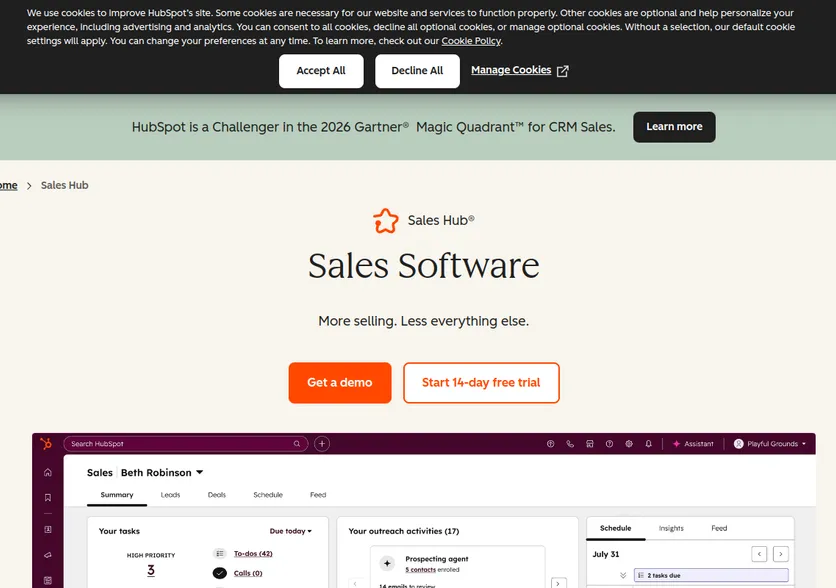
For an online store, HubSpot turns every order, abandoned cart and support chat into a customer record that the whole team can see. This HubSpot Sales Hub Starter plan costs twenty dollars a seat a month and adds meeting scheduling, calling and simple automation, so a small store can follow up every buyer without a spreadsheet. A store that grows can move up the same platform instead of migrating, because the paid plans add the reporting and forecasting that owners ask for.
What we like
- Free CRM for up to two users
- Store integrations pull orders into the record
- Same platform scales from small store to team
Watch out for
- Starter is twenty dollars a seat a month
- Onboarding fees apply on the higher plans
How to try it
- Open the HubSpot pricing page and claim the free CRM
- Connect your store and check that orders land on customer records
- Build a follow-up workflow for first-time buyers
2. Freshsales
Best for: Stores that want AI-assisted selling at the lowest paid price here
Paid tool Starting price: $9/user/month · Growth plan $9 a user a month billed annually; Pro $39 and Enterprise $59 a user a month
Free plan: No free plan; 21-day free trial
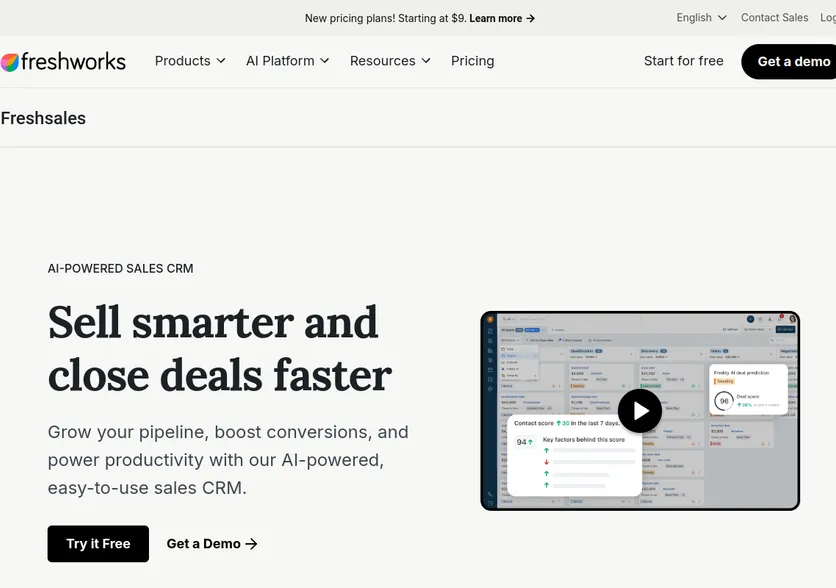
Freshsales suits an online store that wants AI-assisted selling without a big monthly bill, because the Growth plan starts at nine dollars a user a month. This Freshsales Growth plan includes AI insights, email tracking and built-in phone and chat, so a small team can chase every lead from the same screen. A store that answers customer questions by chat will like that the conversation sits next to the order history.
What we like
- Cheapest paid plan in this comparison
- AI insights included on the Growth plan
- Chat and phone sit next to order history
Watch out for
- No free plan, so the trial is the only test
- Higher plans climb fast once you add automation
How to try it
- Open the Freshsales pricing page and start the free trial
- Import your customers and set up a sales pipeline
- Answer a customer chat and check the order history beside it
3. Nutshell
Best for: Small stores that want a pipeline-first CRM with simple pricing
Paid tool Starting price: $13/user/month · Foundation plan $13 a user a month billed annually; Growth $25, Pro $42, Business $59 and Enterprise $79 a user a month
Free plan: No free plan; 14-day free trial
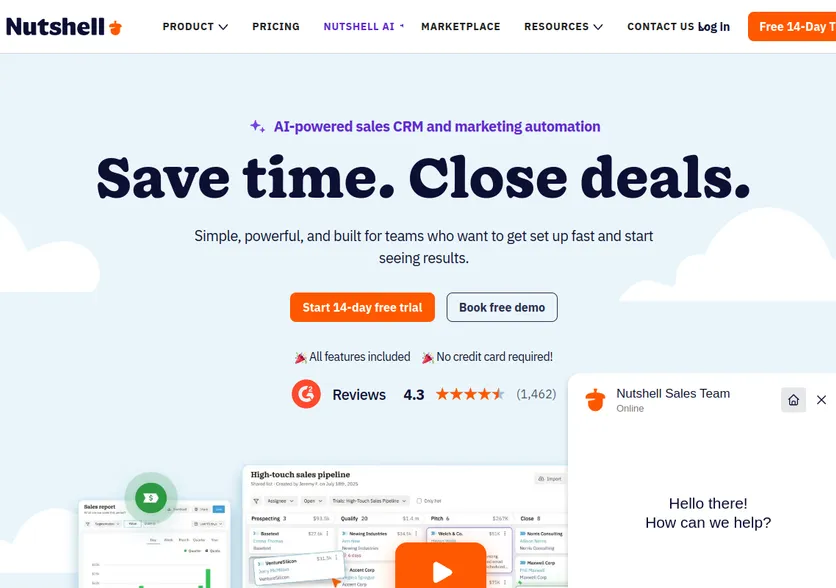
Nutshell is the small-store CRM that puts the pipeline first, with a Foundation plan at thirteen dollars a user a month. This Nutshell Foundation plan covers contacts, pipelines and email sync, so a store team can track every wholesale or repeat buyer without learning a big platform. A store that sells to other businesses as well as consumers will like the pipeline view that shows both kinds of deals side by side.
What we like
- Cheapest pipeline-first CRM here
- Simple pricing that is easy to compare
- Email sync keeps buyer messages on the deal
Watch out for
- No free plan, so the trial is the only test
- Automation depth waits for the higher plans
How to try it
- Open the Nutshell pricing page and start the free trial
- Import your buyers and build a pipeline for repeat orders
- Sync your email and check that messages land on the deal
4. Zoho CRM
Best for: Stores that already run on Zoho apps and want orders in the CRM
Paid tool Starting price: $14/user/month · Standard plan $14 a user a month billed annually; Professional $23, Enterprise $40 and Ultimate $52 a user a month
Free plan: Free plan for up to 3 users
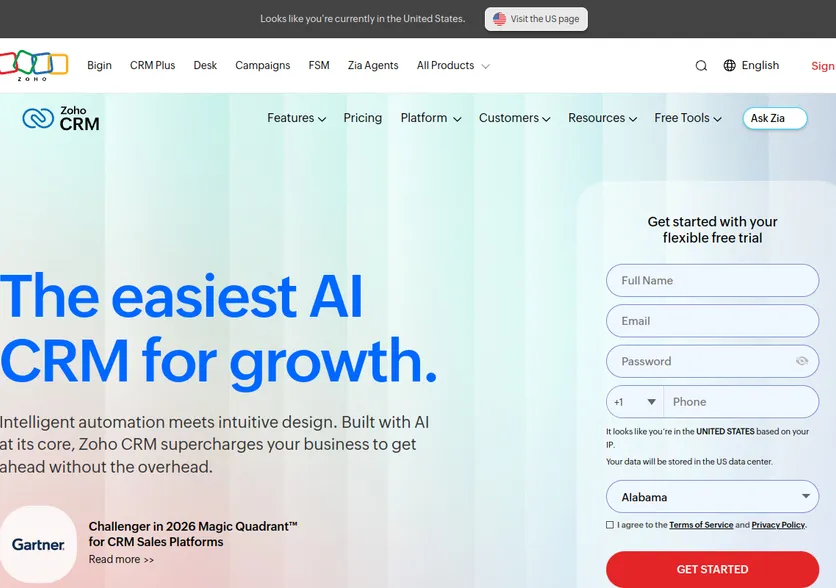
Zoho CRM fits an online store that already runs on Zoho apps, because orders, inventory and support share the same customer record. This Zoho CRM Standard plan costs fourteen dollars a user a month and includes forecasting, workflow rules and a free plan for up to three users, so a small store can start without paying. A store that uses Zoho Books will get the most from the two tools sharing orders and invoices.
What we like
- Free plan for up to three users
- Orders and inventory share the customer record
- Workflows and forecasting on the Standard plan
Watch out for
- Interface feels busier than simpler CRMs
- Some features need the higher plans
How to try it
- Open the Zoho CRM pricing page and claim the free plan
- Connect your store and check that orders land on customer records
- Set up a workflow that flags repeat buyers
5. Pipedrive
Best for: Stores that sell by phone and chat and live by their pipeline
Paid tool Starting price: $14/user/month · Essential plan $14 a user a month billed annually, or $24 billed monthly; higher plans rise to $99 a user a month
Free plan: No free plan; 14-day free trial
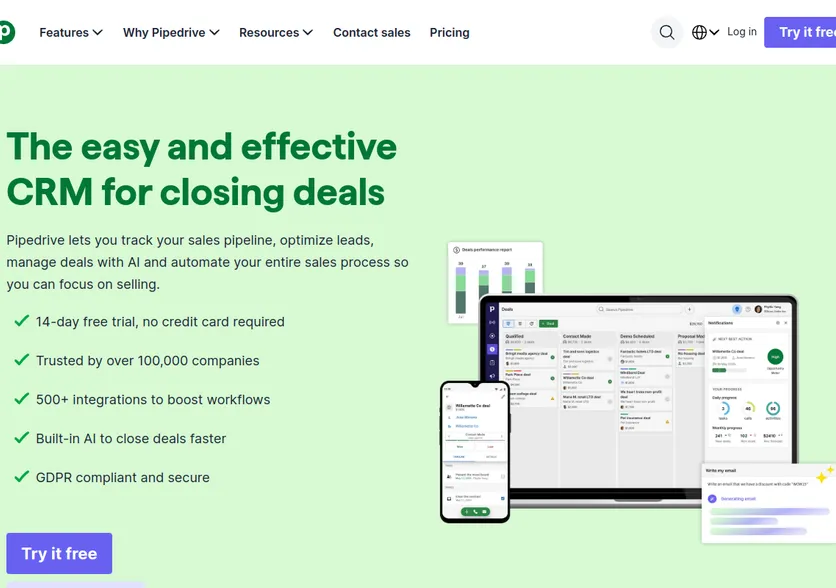
Pipedrive is the pipeline CRM for stores that sell by phone and chat, because every deal shows its stage, value and next step at a glance. This Pipedrive Essential plan costs fourteen dollars a user a month on annual billing and covers leads, deals and email sync, which is enough for a store team that closes sales in conversation. A seller who works the phone all day will know exactly which buyer to call next without opening a single spreadsheet.
What we like
- Clearest visual pipeline in this list
- Every deal shows stage, value and next step
- Quick to set up for a small team
Watch out for
- No free plan, so the trial is the only test
- Reporting depth waits for the higher plans
How to try it
- Open the Pipedrive pricing page and start the free trial
- Build a pipeline for phone and chat sales
- Sync your email and drag a buyer deal through the stages
6. ActiveCampaign
Best for: Stores that live or die by email automation and abandoned-cart recovery
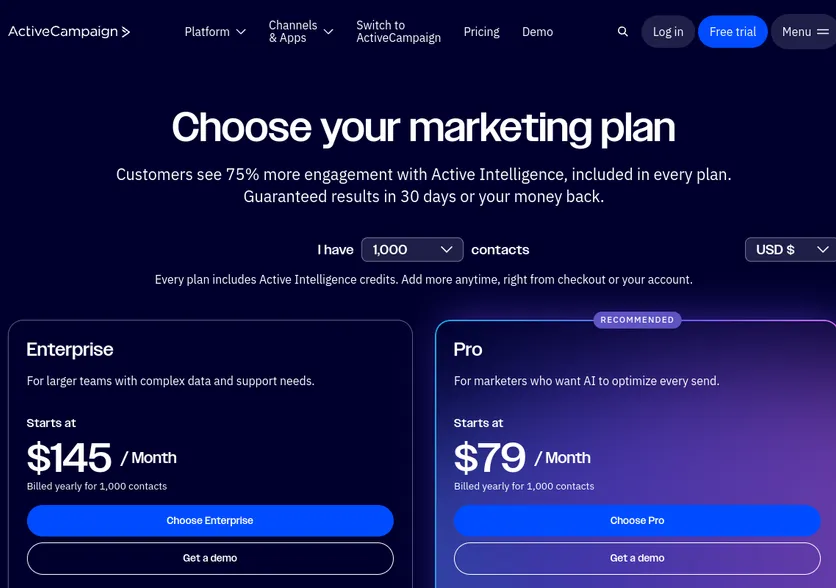
Paid tool Starting price: $15/month · Starter plan $15 a month billed annually, or $19 billed monthly, for 1,000 contacts; Plus $49, Pro $79 and Enterprise $145 a month billed annually
Free plan: No free plan; 14-day free trial
ActiveCampaign is the email-first CRM for stores that live or die by abandoned-cart recovery and repeat purchases. This ActiveCampaign Starter plan costs fifteen dollars a month billed annually for one thousand contacts and includes multi-step automation, so a store can recover carts, win back lapsed buyers and welcome new ones without manual work. A store whose revenue comes mostly from email will get the most from the automation builder, because every flow runs on real order data.
What we like
- Strongest email automation in this list
- Abandoned-cart flows run on order data
- Scales from one thousand contacts upward
Watch out for
- No free plan, only a fourteen-day trial
- Price rises with contact count, not seats
How to try it
- Open the ActiveCampaign pricing page and start the free trial
- Connect your store and import your customer list
- Build one abandoned-cart flow and check that it sends
7. Copper
Best for: Small stores that run on Google Workspace and want a CRM inside Gmail
Paid tool Starting price: $23/user/month · Basic plan $23 a user a month billed annually, or $29 billed monthly; Professional $59 and Business $99 a user a month
Free plan: No free plan; free trial available
Copper fits a small store that runs on Google Workspace, because orders and customer emails land in the CRM without leaving Gmail. This Copper Basic plan costs twenty-three dollars a user a month on annual billing and pulls customer emails, meetings and files into one record. A store team that answers buyers from the inbox will save the most time, because no one has to open a second app to find an order.
What we like
- Built into Gmail and Google Calendar
- Customer emails and files land on the record
- No second app to open for buyer work
Watch out for
- Basic is twenty-three dollars a user a month
- Best value only for Google Workspace stores
How to try it
- Open the Copper pricing page and start the free trial
- Connect your Google account and import your customers
- Open a buyer email and check the record builds itself
8. Insightly
Best for: Stores that sell custom or made-to-order products and need project tracking
Paid tool Starting price: $29/user/month · Plus plan $29 a user a month billed annually; Professional $49 and Enterprise $99 a user a month
Free plan: No free plan; 14-day free trial
Insightly works for stores that sell custom or made-to-order products, because the project tracking follows each order from quote to delivery. This Insightly Plus plan costs twenty-nine dollars a user a month on annual billing and links contacts, opportunities and projects, which suits a store that builds to order. A seller who juggles quotes, production and shipping will like seeing the order status next to the customer record.
What we like
- CRM and project tracking in one system
- Follows each order from quote to delivery
- Good fit for made-to-order stores
Watch out for
- Plus is twenty-nine dollars a user a month
- No free plan, so the trial is the only test
How to try it
- Open the Insightly pricing page and start the free trial
- Add a customer and link a project to the order
- Track the project stages until the order ships
Prices above were checked on each vendor’s own website on Nov 26, 2026 and can change — the vendor’s page is the final word. Vendor links are editorial: nobody paid to be listed or ranked here. Vendors who want a featured listing can see how it works on our Get listed page.
What CRM software costs for ecommerce in 2026
Most stores pay per user, so the headline price is only part of the bill, and this list runs from nine dollars a user a month at Freshsales to about thirty dollars at Insightly. The store integration matters more than the price, because a CRM that never sees an order cannot recover an abandoned cart. The headline plan each vendor shows on its own pricing page is the number in the table above, checked on November 26, 2026.
Start with the free trial on two tools and run one real order through each, from first purchase to follow-up email. Compare how the customer record shows orders, how fast you can build an abandoned-cart flow, and whether email automation needs a second app. Pick the tool that turns a one-time buyer into a repeat customer, because that is where the money is.
Before you buy
- Count the seats first, because a five-person support team pays five times the headline price.
- Check the store integration, because a CRM that never sees an order cannot recover a cart.
- Check the contact pricing, because ActiveCampaign charges by contacts and the bill grows with your list.
- Test an abandoned-cart flow, because a demo never shows whether the automation actually sends.
- Compare annual and monthly billing, because ActiveCampaign costs fifteen dollars a month billed annually and nineteen dollars billed monthly.
Official websites
Official websites of the products reviewed above. Features and prices were checked against these sites when this guide was written, and they can change, so confirm on the vendor site before you buy.
Frequently asked questions
Which CRM software is best for ecommerce in 2026?
HubSpot is the safest default because its free CRM covers two users and connects with the big store platforms, and the paid plans scale with the store. Freshsales wins on price at nine dollars a user a month with AI insights included, while ActiveCampaign is the strongest choice when email automation drives most of your revenue. Pick the tool that sees your orders, because a CRM without order data cannot recover a cart.
How much does CRM software cost for ecommerce?
Paid plans here run from nine dollars to about thirty dollars a user a month, with annual billing cutting the monthly rate on most tools. ActiveCampaign is the exception, because it charges by contact count, so a growing list raises the bill even when the team stays small. Expect to pay more once you add team members, automations or advanced reporting.
Do I need a CRM that connects to my online store?
Yes, because a CRM that never sees an order cannot show lifetime value, recover an abandoned cart or target repeat buyers. HubSpot, Zoho CRM and Freshsales all connect with the major store platforms, though the depth varies by plan. Check that your store platform is supported on the plan you buy, because some integrations wait for higher tiers.
Is there a free CRM for ecommerce?
Yes, HubSpot offers a free CRM for up to two users and Zoho CRM covers three users, which is enough for a small store to start. The other six tools offer free trials of fourteen to twenty-one days instead of a permanent free plan. A trial is enough to connect your store and test one abandoned-cart flow before you commit.
What should online stores look for in a CRM?
Look for a store integration that pulls orders into the customer record, email automation that recovers abandoned carts, and reporting that shows lifetime value by customer. Check the per-user cost if you plan to add staff, and test the CRM with a real order before you buy. The best CRM for a store is the one that turns one-time buyers into repeat customers.
Need everyday business help too? Try Toolsvine's free business tools for ecommerce right in your browser.
Browse Business Tools tools