On this page
A CRM is the memory of a startup, and the wrong one means lost deals and forgotten follow-ups. The eight tools below run from nine dollars a user a month to thirty five dollars a user a month, and every price was checked on the vendor site on November 26, 2026. Four include a free plan, so a startup can track real deals before paying. HubSpot Sales Hub is our first pick — the most popular CRM, from twenty dollars a seat a month.
How we researched this
We started with the CRM tools startups actually buy, then read each price on the vendor pricing page on November 26, 2026 and noted the free plan or trial each one carries. We judged them for a founder who needs to track deals without hiring a sales operations team. We kept only tools with a published dollar price, and we dropped any tool whose price we could not verify on the vendor site.
Compare the tools
| Name | Best for | Starting price | Free plan | |
|---|---|---|---|---|
 HubSpot Sales Hub | Startups that want a free CRM with room to grow | $20/seat/month | Free CRM tier with contact management and deal pipelines | Visit |
 Pipedrive | Startups that want a simple visual sales pipeline | $14/seat/month | No free plan; 14-day free trial | Visit |
 Zoho CRM | Startups that want a full CRM at a low monthly price | $14/user/month | Free plan for up to 3 users | Visit |
 Freshsales | Startups that want the cheapest full CRM with AI | $9/user/month | Free plan with contact management and basic reports | Visit |
 Close | Startups that sell by phone and email every day | $35/user/month | No free plan; 14-day free trial | Visit |
 Capsule | Startups that want a simple CRM without the bloat | $18/user/month | Free plan with 250 contacts and 2 users | Visit |
 Insightly | Startups that want CRM plus project management in one tool | $29/user/month | No free plan; 14-day free trial | Visit |
 Copper | Startups that live in Google Workspace and want a CRM inside it | $23/seat/month | No free plan; 14-day free trial | Visit |
The CRM software for startups, compared
1. HubSpot Sales Hub
Best for: Startups that want a free CRM with room to grow
Paid tool Starting price: $20/seat/month · Sales Hub Starter, $20 a seat a month; free CRM tier included
Free plan: Free CRM tier with contact management and deal pipelines
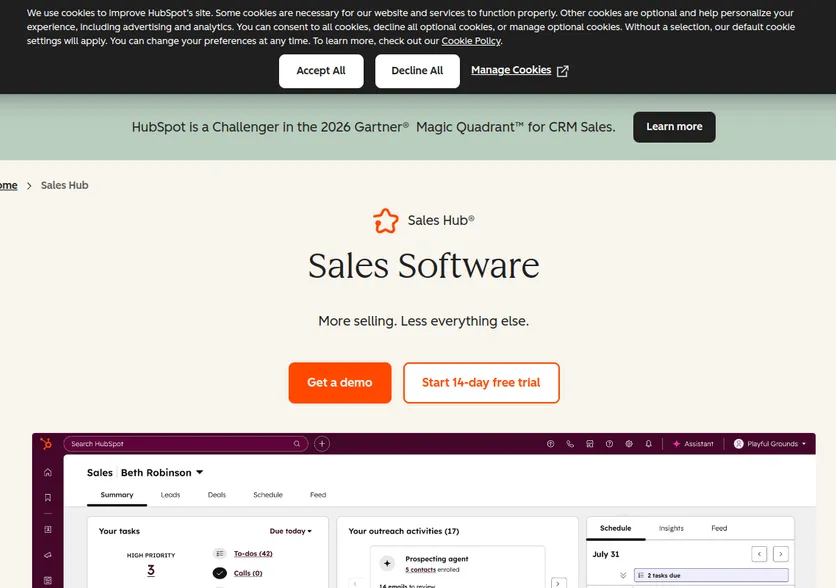
HubSpot Sales Hub is the most popular CRM on this list, and its free tier is the reason most startups start here. This HubSpot Sales Hub Starter plan adds deal pipelines, email tracking and meeting scheduling, so a small sales team can work from one shared pipeline. A startup gets a CRM that grows with it, from a free tier to a full sales platform.
What we like
- Generous free CRM tier to start
- Huge ecosystem of apps and integrations
- Scales from startup to enterprise
Watch out for
- Starter costs twenty dollars a seat a month
- Advanced features need pricier plans
How to try it
- Open the HubSpot pricing page and create a free account
- Add your first contacts and set up a deal pipeline
- Upgrade to Sales Hub Starter when you need email tracking
2. Pipedrive
Best for: Startups that want a simple visual sales pipeline
Paid tool Starting price: $14/seat/month · Essential plan, $14 a seat a month billed annually
Free plan: No free plan; 14-day free trial
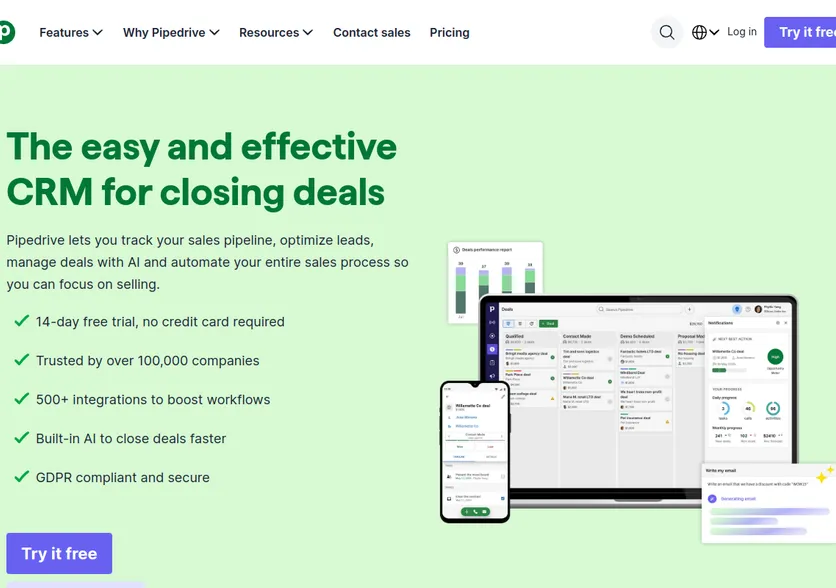
Pipedrive is the visual pipeline tool on this list, built for sales teams that think in deals rather than databases. This Pipedrive Essential plan adds unlimited pipelines, custom fields and integrations, so a small team can track every deal from first call to close. A startup gets a CRM that a new rep can learn in an afternoon.
What we like
- Clearest visual pipeline on this list
- Easy for new reps to learn
- Integrations with common sales tools
Watch out for
- Essential costs fourteen dollars a seat a month billed annually
- No free plan, only a trial
How to try it
- Open the Pipedrive pricing page and start the 14-day trial
- Set up your pipeline stages and add your first deals
- Subscribe to Essential when the trial ends
3. Zoho CRM
Best for: Startups that want a full CRM at a low monthly price
Paid tool Starting price: $14/user/month · Standard plan, $14 a user a month billed annually
Free plan: Free plan for up to 3 users
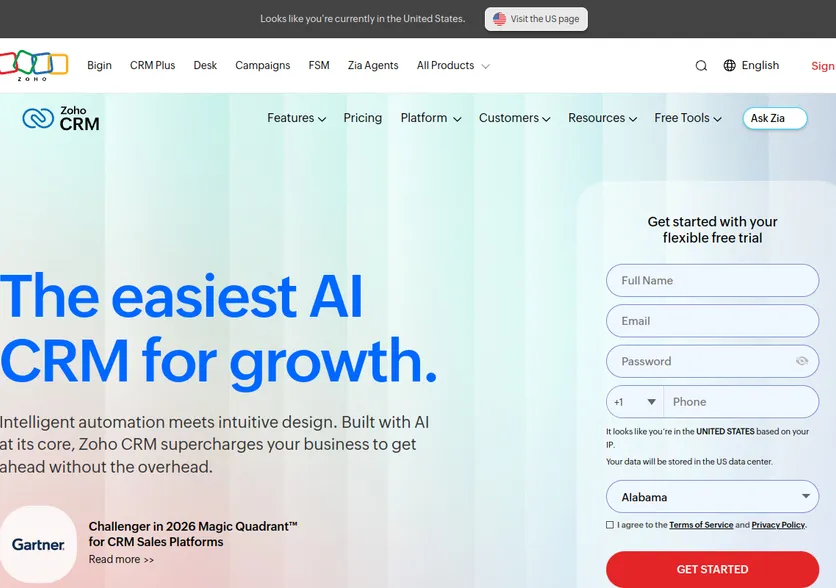
Zoho CRM is the value pick on this list, giving a small team a full CRM with automation at a low monthly price. This Zoho CRM Standard plan adds workflows, scoring and integrations, so a startup can automate follow-ups without paying for a premium tier. A team already using Zoho apps gets deep integration with books, desk and campaigns.
What we like
- Full CRM at a low monthly price
- Free plan for three users
- Deep integration with Zoho apps
Watch out for
- Standard costs fourteen dollars a user a month billed annually
- Free plan caps users at three
How to try it
- Open the Zoho CRM pricing page and create a free account
- Add your contacts and set up your first workflow
- Upgrade to Standard when you need automation and scoring
4. Freshsales
Best for: Startups that want the cheapest full CRM with AI
Paid tool Starting price: $9/user/month · Growth plan, $9 a user a month billed annually
Free plan: Free plan with contact management and basic reports
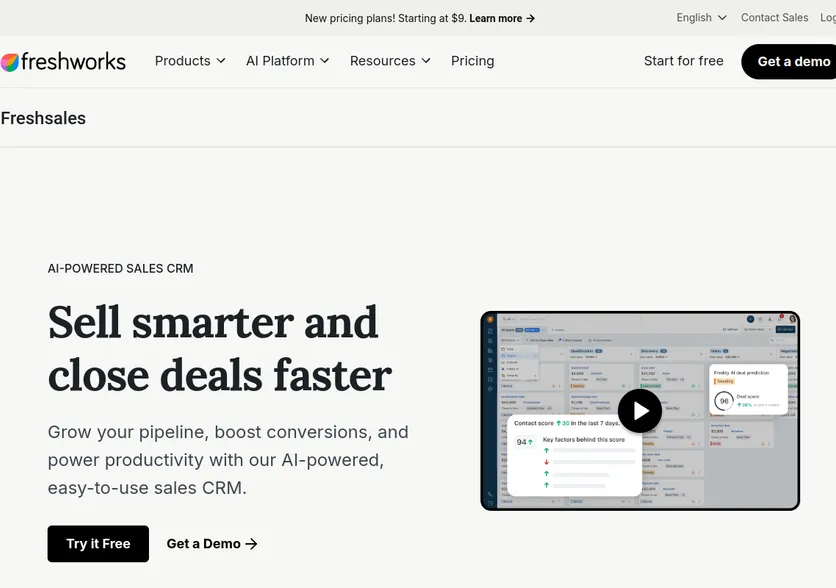
Freshsales is the cheapest full CRM on this list, with AI features included on a plan that costs less than a lunch. This Freshsales Growth plan adds AI contact scoring, workflows and custom reports, so a small team gets smart selling without a big budget. A startup gets a modern CRM with email, phone and chat in one place.
What we like
- Cheapest full CRM on this list
- AI scoring included on Growth
- Email, phone and chat in one place
Watch out for
- Growth costs nine dollars a user a month billed annually
- Advanced features need pricier plans
How to try it
- Open the Freshsales pricing page and create a free account
- Add your contacts and set up your pipeline
- Upgrade to Growth for AI scoring and workflows
5. Close
Best for: Startups that sell by phone and email every day
Paid tool Starting price: $35/user/month · Essentials plan, $35 a user a month billed annually or $49 billed monthly; Solo is $9 a month for one user
Free plan: No free plan; 14-day free trial
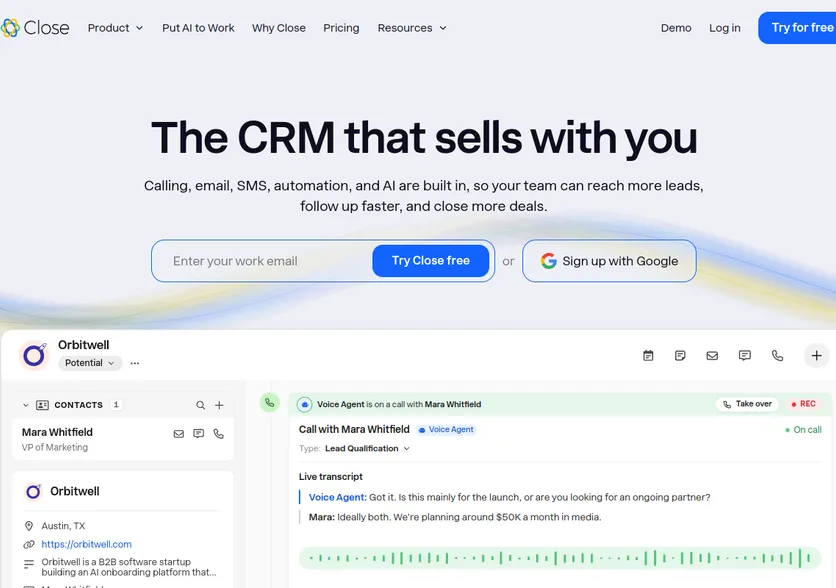
Close is the calling CRM on this list, built for teams that sell by phone and email all day long. This Close Essentials plan adds power dialing, email sequences and reporting, so a small sales team can make more calls in less time. A startup that lives on the phone gets a CRM with calling built in, not bolted on.
What we like
- Calling and email built into the CRM
- Power dialing saves time every day
- Sequences automate follow-ups
Watch out for
- Essentials costs thirty five dollars a user a month billed annually
- No free plan, only a trial
How to try it
- Open the Close pricing page and start the 14-day trial
- Set up your pipeline and connect your email
- Subscribe to Essentials when the trial ends
6. Capsule
Best for: Startups that want a simple CRM without the bloat
Paid tool Starting price: $18/user/month · Starter plan, $18 a user a month billed annually or $22 billed monthly; Growth is $36 a user a month
Free plan: Free plan with 250 contacts and 2 users
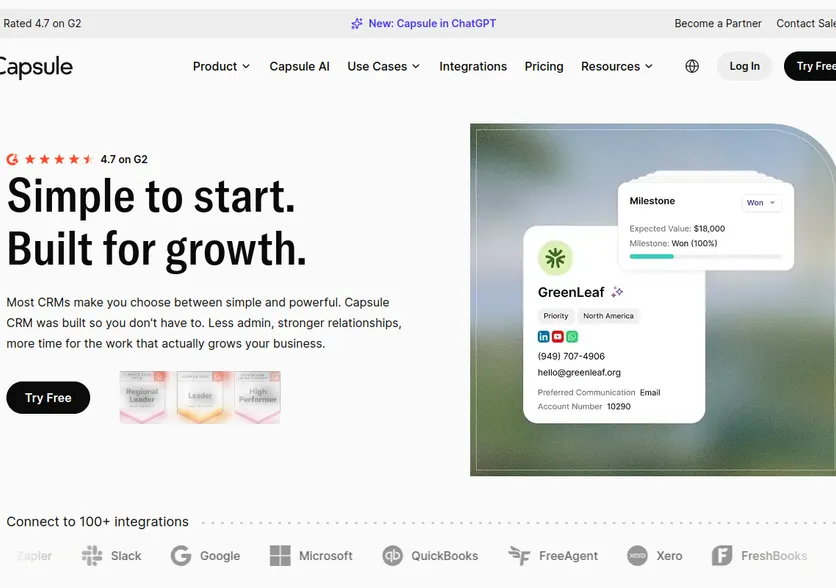
Capsule is the simplest CRM on this list, with a clean interface that a small team can learn in an hour. This Capsule Starter plan adds unlimited contacts, tasks and integrations, so a startup can track every customer without fighting the tool. A team that hates bloated software gets a CRM that does the basics brilliantly.
What we like
- Simplest CRM on this list
- Unlimited contacts on Starter
- Clean interface everyone can use
Watch out for
- Starter costs eighteen dollars a user a month billed annually
- Free plan caps contacts at two hundred and fifty
How to try it
- Open the Capsule pricing page and create a free account
- Add your contacts and set up your first tasks
- Upgrade to Starter for unlimited contacts
7. Insightly
Best for: Startups that want CRM plus project management in one tool
Paid tool Starting price: $29/user/month · Plus plan, $29 a user a month billed annually; Professional is $49, Enterprise is $99
Free plan: No free plan; 14-day free trial
Insightly is the two-in-one tool on this list, combining CRM with project management so a startup can track deals and deliver work in one place. This Insightly Plus plan adds workflow automation, custom dashboards and integrations, so a small team can manage the whole customer journey. A startup that delivers projects after the sale gets a CRM that follows the customer past the close.
What we like
- CRM and projects in one tool
- Workflow automation on Plus
- Custom dashboards built in
Watch out for
- Plus costs twenty nine dollars a user a month billed annually
- No free plan, only a trial
How to try it
- Open the Insightly pricing page and start the 14-day trial
- Set up your pipeline and link your first project
- Subscribe to Plus when the trial ends
8. Copper
Best for: Startups that live in Google Workspace and want a CRM inside it
Paid tool Starting price: $23/seat/month · Basic plan, $23 a seat a month billed annually or $29 billed monthly; Professional is $59, Business is $99
Free plan: No free plan; 14-day free trial
Copper is the Google Workspace CRM on this list, living inside Gmail and Calendar instead of asking teams to open another app. This Copper Basic plan adds pipelines, tasks and reporting, so a startup can manage deals from the inbox. A team that lives in Google Workspace gets a CRM that feels like part of Gmail.
What we like
- Lives inside Gmail and Calendar
- No new app to learn
- Reports built into Basic
Watch out for
- Basic costs twenty three dollars a seat a month billed annually
- No free plan, only a trial
How to try it
- Open the Copper pricing page and start the 14-day trial
- Connect your Google account and import your contacts
- Subscribe to Basic when the trial ends
Prices above were checked on each vendor’s own website on Nov 26, 2026 and can change — the vendor’s page is the final word. Vendor links are editorial: nobody paid to be listed or ranked here. Vendors who want a featured listing can see how it works on our Get listed page.
What CRM software costs in 2026
Startup CRMs charge per seat or per user, so the team size is the budget. This list runs from nine dollars a user a month for Freshsales Growth to thirty five dollars a user a month for Close Essentials, with most tools near fourteen to twenty dollars a month. The headline plan each vendor shows on its own pricing page is the number in the table above, checked on November 26, 2026.
Start with the free plan on two CRMs and run a real month of deals through both. Watch which one your sales team actually updates, then pay for that one. A CRM nobody updates is worse than a spreadsheet, because it teaches the team to ignore the pipeline.
Before you buy
- Count the seats first, because most CRMs here charge per seat and a growing sales team adds up fast.
- Check whether the plan includes email and calling, because some CRMs charge extra for the tools sales teams use daily.
- Test the tool on your real pipeline, because a demo never shows how it handles your messiest deal.
- Ask whether the free plan fits your team, because free tiers cap contacts and users.
- Compare the monthly and annual prices, because annual billing cuts most plans here by about a fifth.
Official websites
Official websites of the products reviewed above. Features and prices were checked against these sites when this guide was written, and they can change, so confirm on the vendor site before you buy.
Frequently asked questions
What is the best CRM software for startups in 2026?
HubSpot Sales Hub Starter, at twenty dollars a seat a month, is the safest default because the free CRM tier lets a startup begin without paying, and the platform grows with the team. Pipedrive Essential, at fourteen dollars a seat a month, is the best pick when you want a clear visual pipeline. Freshsales Growth, at nine dollars a user a month, is the best value pick with AI scoring included.
What is the cheapest CRM software for startups?
Freshsales Growth, at nine dollars a user a month billed annually, is the cheapest full CRM here. Pipedrive Essential and Zoho CRM Standard both cost fourteen dollars a month, and Capsule Starter costs eighteen dollars a user a month. HubSpot, Zoho CRM, Freshsales and Capsule all have free plans, so a startup can start without paying anything.
Can I use a CRM for free as a startup?
Yes, HubSpot has a free CRM tier with contact management and deal pipelines, and Zoho CRM has a free plan for three users. Freshsales has a free plan with contact management and basic reports, and Capsule has a free plan with two hundred and fifty contacts. Pipedrive, Close, Insightly and Copper offer fourteen-day trials instead of free plans.
Should I choose HubSpot or Pipedrive?
HubSpot is the broader platform, with marketing, sales and service tools in one place and a free tier that suits startups. Pipedrive is the simpler tool, with a clear visual pipeline that a new rep can learn in an afternoon. Startups that want one platform for everything pick HubSpot, while startups that want the simplest pipeline pick Pipedrive.
Which CRM is best for a small sales team that calls all day?
Close, at thirty five dollars a user a month, is the best pick when your team sells by phone and email every day, because calling and sequences are built in. Copper, at twenty three dollars a seat a month, is the best pick when your team lives in Google Workspace, because it works inside Gmail and Calendar. Insightly, at twenty nine dollars a user a month, is the best pick when you also need project management.
Want more business help? Try Toolsvine's free business tools right in your browser.
Browse Business Tools tools