On this page
Startups collect data in a dozen tools that never talk to each other, so the founder waits a week for one number. The seven tools below connect sources, move data and keep it fresh, so a small team gets one trusted record without hiring a data team. Every price was checked on the vendor site on November 27, 2026, and the list runs from twenty dollars a month to twelve thousand dollars a year. Hevo is our first pick — a no-code pipeline platform from two hundred and thirty-nine dollars a month, with a free plan to start.
How we researched this
We started with the data integration tools startups actually buy, then read each price on the vendor pricing page on November 27, 2026 and noted the trial each plan carries. We judged them for a small team that needs data in one place fast, with no-code setup, a free plan to prove the fit, and pricing that grows with usage instead of headcount. We dropped Matillion and Census because neither fits a startup budget, and Funnel because it is a marketing tool, not a data fabric.
Compare the tools
| Name | Best for | Starting price | Free plan | |
|---|---|---|---|---|
 Fivetran | Startups that can afford the most reliable managed pipelines in the market | $12,000/year | No free plan; 14-day free trial | Visit |
 Hevo | Startups that want no-code pipelines with a free plan to start | $239/month | Free plan for 1M events | Visit |
 Stitch | Startups that want simple ELT with predictable pricing | $100/month | No free plan; 14-day free trial | Visit |
 Airbyte | Startups that want the largest connector library at the lowest price | $20/month | Free self-hosted Core edition | Visit |
 Integrate | Startups with heavy data that want a flat price with no volume meter | $1,999/month | No free plan; free trial available | Visit |
| Boomi | Startups that want a mature integration platform with pay-as-you-go pricing | $99/month | No free plan; 30-day free trial | Visit |
 Skyvia | Startups that want integration, backup and query in one tool | $79/month | Free plan for 10,000 records a month | Visit |
The data fabric software for startups, compared
1. Fivetran
Best for: Startups that can afford the most reliable managed pipelines in the market
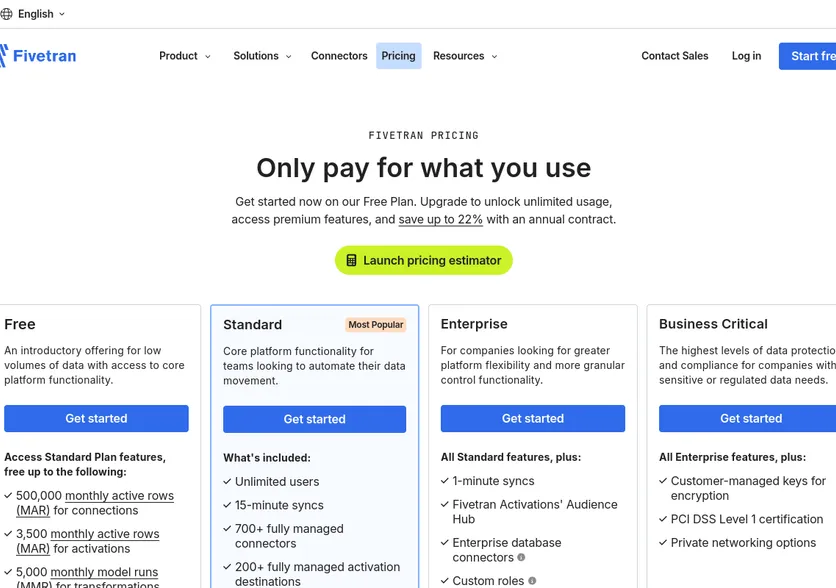
Paid tool Starting price: $12,000/year · Twelve thousand dollars a year is the annual contract minimum; usage costs four hundred and ninety-five dollars per one million monthly active rows plus a five dollar base per connection on Standard
Free plan: No free plan; 14-day free trial
Fivetran is the managed pipeline platform that moves data from hundreds of sources into a warehouse with almost no setup. This Fivetran Standard plan has a twelve thousand dollar a year contract minimum, with usage priced per million monthly active rows. A startup that can afford it gets the most reliable pipelines in the market, with no maintenance.
What we like
- The most reliable managed pipelines here
- Hundreds of connectors with no maintenance
- Automatic schema migration when sources change
Watch out for
- Twelve thousand dollars a year is the highest entry price here
- Usage pricing can surprise a fast-growing team
How to try it
- Open the Fivetran pricing page and start the 14-day trial
- Connect your top three sources
- Check the usage estimate before you commit
2. Hevo
Best for: Startups that want no-code pipelines with a free plan to start
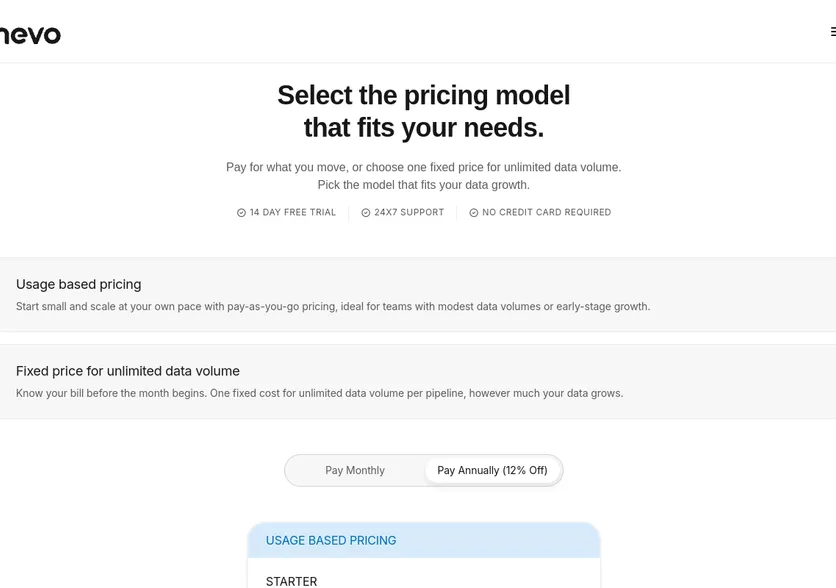
Paid tool Starting price: $239/month · Two hundred and thirty-nine dollars a month billed annually for the Starter plan with five million events; Professional costs six hundred and seventy-nine dollars a month and Business is quoted
Free plan: Free plan for 1M events
Hevo is the no-code pipeline platform that moves data from apps and databases into a warehouse with a visual interface anyone can use. This Hevo Starter plan costs two hundred and thirty-nine dollars a month billed annually for five million events. A startup gets one hundred and fifty plus connectors, transformations and a free plan to prove the fit.
What we like
- No-code setup that anyone can use
- One hundred and fifty plus connectors included
- Free plan for one million events
Watch out for
- Starter caps at five million events a month
- Transformations need a higher plan
How to try it
- Open the Hevo pricing page and start the free plan
- Connect your CRM and database
- Build a pipeline and check the warehouse
3. Stitch
Best for: Startups that want simple ELT with predictable pricing
Paid tool Starting price: $100/month · One hundred dollars a month for the Standard plan with five million rows; Advanced costs one thousand five hundred dollars and Premium costs three thousand dollars a month
Free plan: No free plan; 14-day free trial
Stitch is the simple ELT platform that moves data from apps into a warehouse with a clean interface and predictable pricing. This Stitch Standard plan costs one hundred dollars a month for five million rows with one hundred and thirty plus sources. A startup gets a straightforward pipeline tool without the complexity of an enterprise platform.
What we like
- Simple setup with predictable pricing
- One hundred and thirty plus sources included
- Free trial to test the fit
Watch out for
- No free plan to test with
- Advanced is fifteen times the Standard price
How to try it
- Open the Stitch pricing page and start the 14-day trial
- Connect your top three sources
- Check the row count before you commit
4. Airbyte
Best for: Startups that want the largest connector library at the lowest price
Paid tool Starting price: $20/month · Twenty dollars a month for the Cloud Standard plan with five credits included; extra credits cost five dollars each and the self-hosted Core edition is free
Free plan: Free self-hosted Core edition
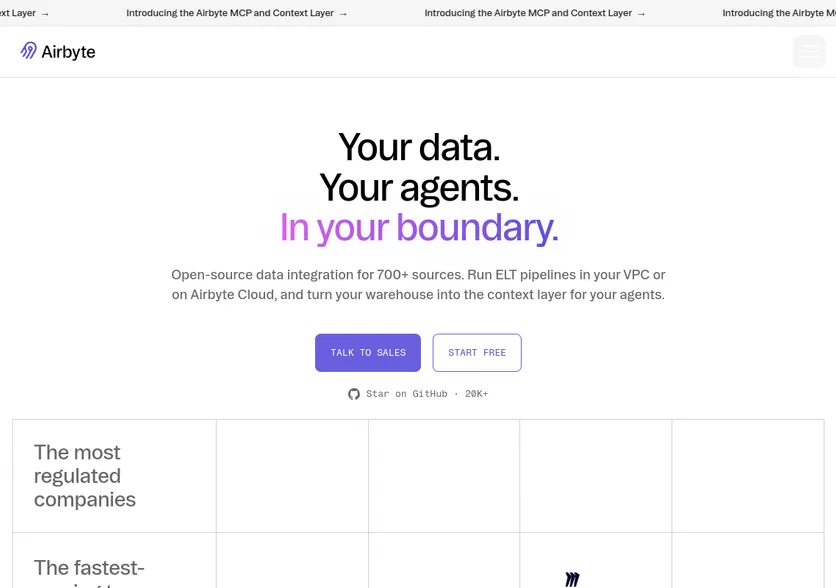
Airbyte is the open-source data integration platform with the largest connector library in the market, and the hosted Cloud plan makes it easy to start. This Airbyte Cloud Standard plan costs twenty dollars a month with five credits included. A startup gets hundreds of connectors, a free self-hosted edition, and pricing that grows with usage.
What we like
- The largest connector library in this comparison
- Free self-hosted edition to start
- Lowest entry price in this list
Watch out for
- Cloud pricing is credit-based, so usage varies
- Support on Standard is limited
How to try it
- Open the Airbyte pricing page and start the Cloud plan
- Connect your top three sources
- Check the credit usage after a week
5. Integrate
Best for: Startups with heavy data that want a flat price with no volume meter
Paid tool Starting price: $1,999/month · One thousand nine hundred and ninety-nine dollars a month flat for the Core plan, with unlimited data volume; higher plans are quoted
Free plan: No free plan; free trial available
Integrate is the low-code data integration platform that combines ETL, ELT and API management in one tool, with a flat price that does not grow with volume. This Integrate Core plan costs one thousand nine hundred and ninety-nine dollars a month flat, with unlimited data volume. A startup with heavy data gets predictable pricing and a visual builder that a small team can use.
What we like
- Flat price with unlimited data volume
- ETL, ELT and API management in one tool
- Visual builder that a small team can use
Watch out for
- One thousand nine hundred and ninety-nine dollars a month is steep for a startup
- No free plan to test with
How to try it
- Open the Integrate pricing page and start a free trial
- Connect your top three sources
- Build a pipeline and check the volume
6. Boomi
Best for: Startups that want a mature integration platform with pay-as-you-go pricing
Paid tool Starting price: $99/month · Ninety-nine dollars a month for the Pay-As-You-Go plan, plus five cents per Boomi Message; a thirty-day trial is included
Free plan: No free plan; 30-day free trial
Boomi is the integration platform that connects apps, data and APIs with a visual builder, and the pay-as-you-go plan makes it accessible to small teams. This Boomi Pay-As-You-Go plan costs ninety-nine dollars a month plus five cents per Boomi Message. A startup gets a mature platform with a large connector library and pricing that starts low.
What we like
- Mature platform with a large connector library
- Pay-as-you-go pricing that starts low
- Visual builder for integrations
Watch out for
- Per-message pricing can grow fast
- The platform is complex for a small team
How to try it
- Open the Boomi pricing page and start the 30-day trial
- Connect your top two apps
- Check the message count after a week
7. Skyvia
Best for: Startups that want integration, backup and query in one tool
Paid tool Starting price: $79/month · Seventy-nine dollars a month billed annually for the Basic plan at five million records, or ninety-nine dollars month to month; Standard costs one hundred and fifty-nine dollars a month billed annually
Free plan: Free plan for 10,000 records a month
Skyvia is the cloud data platform that covers integration, backup and query in one tool, with a simple interface and a free plan to start. This Skyvia Basic plan costs seventy-nine dollars a month billed annually for five million records. A startup gets ETL, ELT and backup in one subscription, without a separate tool for each job.
What we like
- Integration, backup and query in one tool
- Free plan for ten thousand records a month
- Simple interface that a small team can use
Watch out for
- Basic caps at five million records a month
- Fewer connectors than larger platforms
How to try it
- Open the Skyvia pricing page and start the free plan
- Connect your CRM and database
- Build a pipeline and check the record count
Prices above were checked on each vendor’s own website on Nov 27, 2026 and can change — the vendor’s page is the final word. Vendor links are editorial: nobody paid to be listed or ranked here. Vendors who want a featured listing can see how it works on our Get listed page.
What data fabric software costs in 2026
Data fabric tools charge in two ways, per month for a flat plan or per row and event for usage, and the difference decides the bill. Flat pricing suits a team with predictable volume, while usage pricing suits a team that grows fast and wants to pay only for what it moves. The cheapest plan here costs twenty dollars a month, while the most expensive costs twelve thousand dollars a year.
Start a trial on two tools and move the same three sources in each one: your CRM, your database and your billing app. Check how long the setup takes, whether the data lands clean, and what the usage meter shows after a week. Pick the tool whose pipeline a non-technical founder can set up, because a data fabric that needs a data engineer is not a startup tool.
Before you buy
- Check the usage meter on the entry plan, because a row cap can force an upgrade in the first month.
- Confirm the tool covers your sources, because a missing connector means a custom build.
- Test the data quality on a real sync, because a pipeline that moves bad data is worse than no pipeline.
- Ask how schema changes are handled, because a source that changes a field should not break the pipeline.
- Check the export terms before you sign, because a pipeline you cannot leave locks your data history inside.
Official websites
Official websites of the products reviewed above. Features and prices were checked against these sites when this guide was written, and they can change, so confirm on the vendor site before you buy.
Frequently asked questions
Which data fabric software is best for startups in 2026?
Hevo is the best overall pick at two hundred and thirty-nine dollars a month billed annually, with no-code pipelines and a free plan to start. Airbyte is the best budget pick at twenty dollars a month, with the largest connector library. Stitch is the best pick for simple ELT at one hundred dollars a month.
How much does data fabric software cost for a startup?
Prices in this list run from twenty dollars a month for Airbyte to twelve thousand dollars a year for Fivetran, with most tools landing between seventy-nine and two hundred and thirty-nine dollars a month. Flat pricing suits predictable volume, while usage pricing suits fast growth. Add extra rows, events and connectors before you compare totals.
What is a data fabric, and why do startups need one?
A data fabric is a layer that connects all of a company's data sources, moves the data into one place, and keeps it fresh and governed. Startups need one because their data lives in a CRM, a billing app, a database and a spreadsheet, and none of them agree. A fabric gives the founder one trusted number instead of five conflicting reports.
Do startups need a data fabric, or is a spreadsheet enough?
A spreadsheet works until the data lives in five systems and the numbers disagree. A data fabric pulls the sources into one warehouse, refreshes them on a schedule, and shows the same number to everyone. The value is not the pipeline, it is the shared truth: one revenue figure that the whole team trusts.
Can a small startup use data fabric software?
Yes, and Airbyte at twenty dollars a month with a free self-hosted edition and Hevo with a free plan are built for exactly that buyer. The enterprise suites in this market charge by quote and need a data team, but the tools here start with a trial and a pipeline you build yourself. A team with three sources already has enough data to justify one connected record.
Need everyday business help too? Try Toolsvine's free business tools right in your browser.
Browse Business Tools tools