On this page
Enterprise data rarely arrives in the shape you need. One system exports XML, another hands you JSON, a third keeps everything in a database with its own naming, and somebody has to map it all together before anyone can analyse it. The tools below convert, catalogue and move data between systems, from visual mapping workbenches to cloud integration platforms. We checked list prices on November 27, 2026 and compared eight tools that enterprises actually run. Integrate.io is our first pick for teams that want flat pricing with unlimited volume, pipelines and users.
How we researched this
We compared data mapping and integration tools that enterprises use to convert, catalogue and move data between systems. Every tool below lists a public United States dollar price on its own site, so nothing here is priced by guess or by quote. We checked those prices on November 27, 2026 and ranked the tools on format coverage, mapping quality and value at enterprise scale.
Compare the tools
| Name | Best for | Starting price | Free plan | |
|---|---|---|---|---|
| FME Flow Hosted | Enterprises that need a managed mapping and integration engine | $12,000/year | No free plan; free trial available | Visit |
| Altova MapForce | Developers who want a one-time perpetual mapping tool | $349 one-time | No free plan; thirty-day trial available | Visit |
| Dataedo | Teams that need data catalogues with lineage and documentation | $18,000/year | No free plan; free trial available | Visit |
 Integrate.io | Teams that want flat pricing with unlimited volume and users | $1,999/month | No free plan; free trial available | Visit |
 Skyvia | Small teams that need cloud integration at a low monthly price | $79/month | Free plan covering ten thousand records a month | Visit |
 Coupler.io | Teams that sync spreadsheets and apps into a warehouse | $24/month | Free plan available | Visit |
| Dataddo | Teams that want AI-ready pipelines from any source | $99/month | Free plan available | Visit |
| AWS Glue | Teams that already run analytics on AWS | $0.44/DPU-hour | No free plan; pay as you go | Visit |
The 8 best enterprise data mapping tools
1. FME Flow Hosted
Best for: Enterprises that need a managed mapping and integration engine
Paid tool Starting price: $12,000/year · Annual instance plans run from twelve thousand dollars a year for Standard to seventy-five thousand dollars a year for Enterprise. Hourly plans run from two dollars and forty cents to fifteen dollars an hour.
Free plan: No free plan; free trial available
FME Flow Hosted is the cloud version of the FME data integration platform, used by enterprises to map, transform and move spatial and business data. It handles hundreds of formats with a visual workspace, so teams build complex mappings without writing code. Annual instance plans start at twelve thousand dollars, which suits organisations with serious data volumes.
What we like
- Hundreds of formats with a visual workspace
- Managed cloud hosting with no servers to run
- Strong spatial and enterprise data support
Watch out for
- Annual plans start high for small teams
- Learning curve on complex workspaces
How to try it
- List the formats your data arrives in
- Build one mapping in the visual workspace
- Schedule it and check the output against the source
2. Altova MapForce
Best for: Developers who want a one-time perpetual mapping tool
Paid tool Starting price: $349 one-time · Basic costs three hundred and forty-nine dollars once as a perpetual licence. Professional costs six hundred and seventy-nine dollars and Enterprise one thousand and ninety-nine dollars once.
Free plan: No free plan; thirty-day trial available
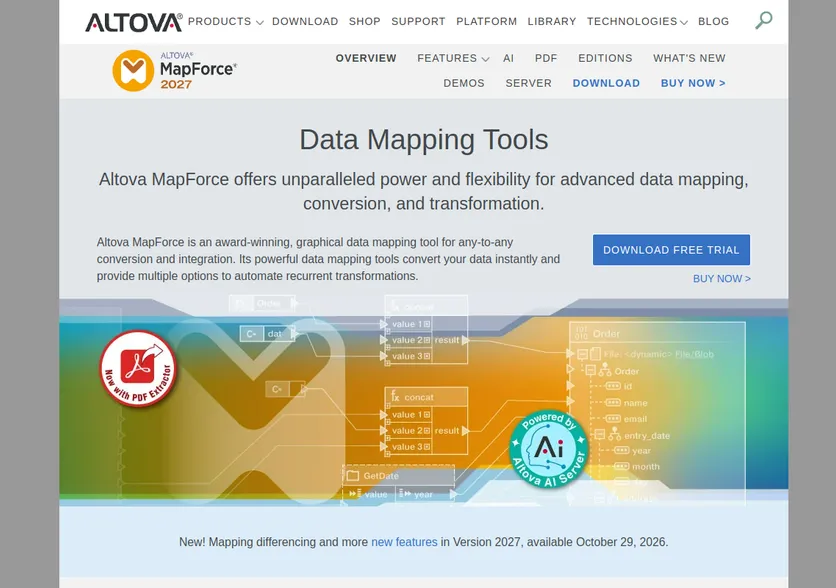
Altova MapForce is a graphical data mapping tool that converts between XML, JSON, databases, flat files and more. It generates code and documentation from visual mappings, so developers keep a record of every transformation. The Basic edition costs three hundred and forty-nine dollars once, with no subscription to maintain.
What we like
- One-time perpetual price with no subscription
- Generates code and documentation from mappings
- Covers XML, JSON, databases and flat files
Watch out for
- Desktop tool, not a cloud service
- Advanced formats need the higher editions
How to try it
- Open your source and target schemas side by side
- Draw the field mappings in the visual editor
- Generate code and run it against real data
3. Dataedo
Best for: Teams that need data catalogues with lineage and documentation
Paid tool Starting price: $18,000/year · Essentials costs eighteen thousand dollars a year with three editors minimum and unlimited viewers. Data Lineage costs twenty-four thousand dollars a year and Data Quality thirty-two thousand dollars a year.
Free plan: No free plan; free trial available
Dataedo is a data catalogue and documentation platform that maps data lineage across databases, reports and pipelines. It builds a searchable catalogue of tables, columns and flows, so teams answer where data came from without chasing the original developer. The Essentials plan starts at eighteen thousand dollars a year with unlimited viewers.
What we like
- Searchable catalogue of tables and lineage
- Unlimited viewers on the Essentials plan
- Documentation stays current with automated scans
Watch out for
- Three-editor minimum raises the starting cost
- Enterprise pricing, not a small-team tool
How to try it
- Connect your main databases and warehouses
- Let the catalogue scan schemas and lineage
- Invite viewers and test search on a real question
4. Integrate.io
Best for: Teams that want flat pricing with unlimited volume and users
Paid tool Starting price: $1,999/month · Core costs one thousand nine hundred and ninety-nine dollars a month billed annually, flat, with unlimited volume, pipelines, connectors and users.
Free plan: No free plan; free trial available
Integrate.io is a cloud data integration platform that maps and moves data between apps, databases and warehouses with a drag-and-drop builder. It charges a flat monthly price with unlimited volume, pipelines, connectors and users, so the bill never surprises you. The Core plan starts at one thousand nine hundred and ninety-nine dollars a month billed annually.
What we like
- Flat price with unlimited volume and users
- Drag-and-drop pipeline builder
- No per-record overage surprises
Watch out for
- Flat price starts high for small teams
- No free tier for ongoing use
How to try it
- Connect your first source and destination
- Build a pipeline in the drag-and-drop builder
- Schedule the sync and check row counts
5. Skyvia
Best for: Small teams that need cloud integration at a low monthly price
Paid tool Starting price: $79/month · Data Integration Basic costs seventy-nine dollars a month billed annually for five million records. Professional costs three hundred and ninety-nine dollars a month billed annually, and the free plan covers ten thousand records a month.
Free plan: Free plan covering ten thousand records a month
Skyvia is a cloud data integration platform that moves and maps data between apps, databases and warehouses without code. It offers backup, replication and sync in one service, so small teams cover several jobs with one subscription. The Basic plan starts at seventy-nine dollars a month billed annually for five million records.
What we like
- Backup, replication and sync in one service
- Low entry price with a free plan
- No-code setup for small teams
Watch out for
- Record caps limit larger workloads
- Advanced features need the Professional tier
How to try it
- Connect your source app or database
- Pick the destination and map the fields
- Run a sync and verify the records landed
6. Coupler.io
Best for: Teams that sync spreadsheets and apps into a warehouse
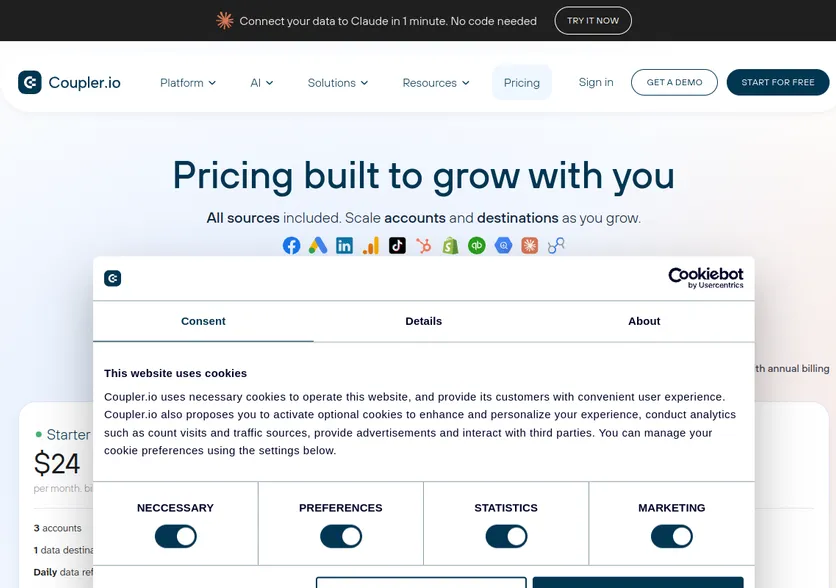
Paid tool Starting price: $24/month · Starter costs twenty-four dollars a month billed annually for three accounts, one destination and daily refresh. Active costs ninety-nine dollars a month and Pro one hundred and ninety-nine dollars a month billed annually.
Free plan: Free plan available
Coupler.io is a data integration tool that moves data from spreadsheets, apps and databases into warehouses and dashboards on a schedule. It automates the exports that teams used to do by hand, so reports stay current without manual work. The Starter plan starts at twenty-four dollars a month billed annually with a free plan available.
What we like
- Automates spreadsheet and app exports
- Free plan available for small use
- Scheduled refresh keeps reports current
Watch out for
- Starter caps at three accounts and daily refresh
- Heavy volumes need the higher tiers
How to try it
- Connect your spreadsheet or app source
- Pick the destination warehouse or dashboard
- Set the refresh schedule and check the first run
7. Dataddo
Best for: Teams that want AI-ready pipelines from any source
Paid tool Starting price: $99/month · Data Anywhere costs ninety-nine dollars a month for three flows and ten million rows a month. Data to AI costs thirteen dollars and ninety-nine cents per seat a month, or ten dollars and forty-nine cents billed annually, and a free plan is available.
Free plan: Free plan available
Dataddo is a data integration platform that moves data from apps and databases into warehouses, lakes and AI tools. It offers a Data Anywhere plan for general pipelines and a Data to AI plan for feeding models, so teams cover both analytics and AI use cases. The Data Anywhere plan starts at ninety-nine dollars a month.
What we like
- Covers warehouses, lakes and AI destinations
- Data to AI plan built for model feeding
- Free plan available for small use
Watch out for
- Flow and row caps on the entry plan
- AI plan pricing is per seat
How to try it
- Connect your first source from the catalog
- Choose a warehouse or AI destination
- Run the flow and check the data quality
8. AWS Glue
Best for: Teams that already run analytics on AWS
Paid tool Starting price: $0.44/DPU-hour · Forty-four cents per DPU hour for ETL jobs, with data catalogue storage billed separately. There is no monthly minimum, so small jobs cost very little.
Free plan: No free plan; pay as you go
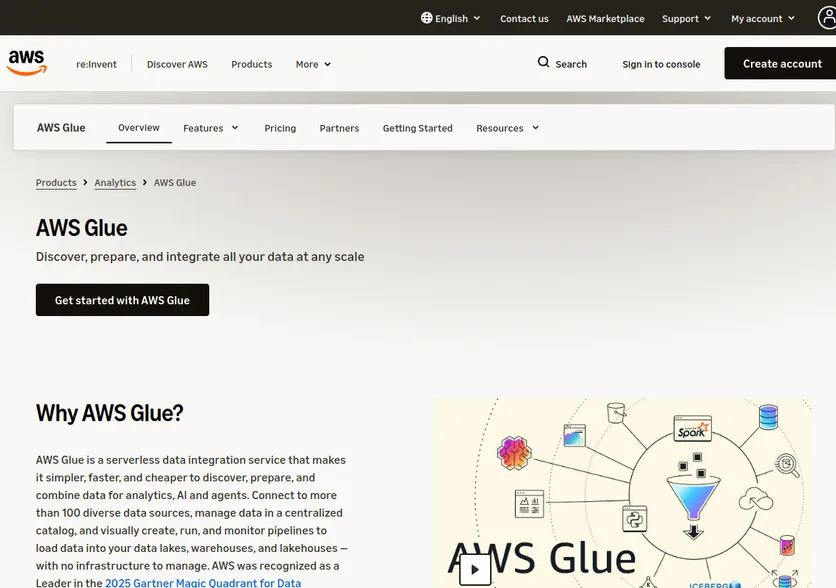
AWS Glue is a serverless data integration service that discovers, catalogues and transforms data across AWS storage and databases. It runs ETL jobs without servers to manage, and its data catalogue tracks schemas and lineage across your data estate. Pricing is usage based at forty-four cents per DPU hour.
What we like
- Serverless ETL with no servers to manage
- Built-in data catalogue with lineage
- Pay only for the DPU hours you use
Watch out for
- Usage bills vary with job size and frequency
- AWS knowledge helps to get the most from it
How to try it
- Point the crawler at your S3 buckets or databases
- Review the generated data catalogue
- Build a job and run it on a sample dataset
Prices above were checked on each vendor’s own website on Nov 27, 2026 and can change — the vendor’s page is the final word. Vendor links are editorial: nobody paid to be listed or ranked here. Vendors who want a featured listing can see how it works on our Get listed page.
How to pick an enterprise mapping tool
Start with your formats. List every source format and destination your data must travel between, and check each one against the tool before you trial anything else. A mapping tool that cannot read your core format is useless no matter how cheap it is, and enterprise estates usually include at least one awkward legacy format that only some tools handle.
Then compare the pricing model, not just the headline. Flat pricing suits steady volumes, while usage pricing suits spiky workloads, and per-user pricing punishes large teams. Test a real mapping with your own messy data, and confirm the lineage output will satisfy the people who audit your data flows.
Before you buy
- List every source format and destination you must map
- Check whether pricing is flat or per volume, user or record
- Test a real mapping with your own messy data, not a sample file
- Confirm lineage and documentation output for compliance reviews
- Ask what support costs, because enterprise tools often charge extra
Official websites
Official websites of the products reviewed above. Features and prices were checked against these sites when this guide was written, and they can change, so confirm on the vendor site before you buy.
Frequently asked questions
What is the best data mapping software for enterprise?
Integrate.io is our first pick for its flat price with unlimited volume, pipelines and users. Skyvia is the cheapest cloud start at seventy-nine dollars a month, and FME Flow Hosted is the strongest choice for enterprises with complex format needs. Coupler.io suits teams that mainly sync spreadsheets and apps.
How much does enterprise data mapping software cost?
List prices run from twenty-four dollars a month for Coupler.io Starter to twelve thousand dollars a year for FME Flow Hosted. Integrate.io costs one thousand nine hundred and ninety-nine dollars a month flat, Dataedo starts at eighteen thousand dollars a year, and AWS Glue charges forty-four cents per DPU hour with no minimum.
Is there a one-time purchase data mapping tool?
Altova MapForce Basic costs three hundred and forty-nine dollars once as a perpetual licence, which is the only one-time price on this list. All other tools here charge monthly or yearly, though Skyvia, Coupler.io and Dataddo offer free plans for small use. A perpetual licence suits developers who map data on one machine.
What is the difference between data mapping and data cataloguing?
A data mapping tool converts fields between source and target systems, while a data catalogue documents tables, columns and lineage across your estate. Dataedo is the catalogue-first option here, and FME Flow Hosted covers both mapping and movement. Most enterprises end up using one of each.
How do I choose an enterprise data mapping tool?
Count the formats you must support, because a tool that lacks one critical format will force manual work. Check whether pricing is flat or per volume, and test a real mapping with your own messy data before you sign. Confirm that lineage output satisfies your compliance reviews.
Pick the mapping tool that covers your formats, then test it on one real pipeline before you commit.
Browse Business Tools tools