On this page
Supply chain planners lose money twice when a forecast misses: once on the stock-out that loses the sale, and again on the excess stock that sits in the warehouse. The six tools below turn sales history into purchase orders, safety stock levels and reorder dates, so the right quantity arrives before the shelf empties. Every price was checked on the vendor site on November 27, 2026, and the list runs from forty-nine dollars a month to nine hundred dollars a month. Netstock is our first pick — the ERP-connected planning platform that forecasts demand across every warehouse from one dashboard.
How we researched this
We started with the demand planning tools supply chain teams actually buy, then read each price on the vendor pricing page on November 27, 2026 and noted the trial each plan carries. We judged them for a planner who manages hundreds of stock keeping units across warehouses and needs a forecast that turns into a purchase order without a spreadsheet rebuild. We dropped Anaplan, o9 Solutions, Kinaxis, Blue Yonder, SAP Integrated Business Planning and RELEX because none of them publishes a list price, so a buyer cannot compare them without a sales call.
Compare the tools
| Name | Best for | Starting price | Free plan | |
|---|---|---|---|---|
| Prediko | Shopify and direct-to-consumer brands that want AI forecasting without an enterprise contract | $49/month | No free plan; 14-day free trial | Visit |
| StockTrim | Small businesses selling on several channels that want machine learning forecasts at a low price | $49/month | No free plan; 14-day free trial | Visit |
| Sumtracker | Multichannel sellers that manage bundles and kits across marketplaces | $100/month | No free plan; free trial available | Visit |
| Flieber | High-volume brands selling on Amazon, Shopify and wholesale together | $299/month | No free plan; 14-day free trial | Visit |
| SKU Science | Mid-market planners that want statistical forecasting as the whole product | $349/month | No free plan; book a demo to try it | Visit |
| Netstock | Distributors and manufacturers planning inside an ERP system across warehouses | $900/month | No free plan; book a demo to try it | Visit |
The demand planning software for supply chain, compared
1. Prediko
Best for: Shopify and direct-to-consumer brands that want AI forecasting without an enterprise contract
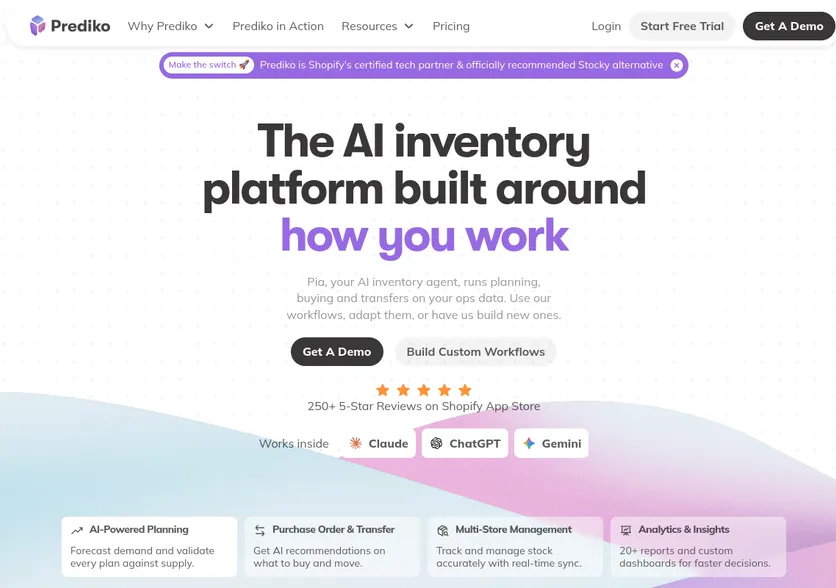
Paid tool Starting price: $49/month · Forty-nine dollars a month for the starter plan for stores under one hundred thousand dollars in annual gross merchandise value, or forty-two dollars a month billed annually, with higher tiers at one hundred and nineteen dollars and one hundred and ninety-nine dollars a month as sales grow
Free plan: No free plan; 14-day free trial
Shopify brands that forecast from store sales alone use Prediko to turn order history into a twelve-month demand plan with purchase orders attached. This Prediko starter plan costs forty-nine dollars a month for stores under one hundred thousand dollars in annual sales, with unlimited users and unlimited stock keeping units included. A small brand gets artificial intelligence forecasting, stock alerts and a purchase order calendar without hiring a planner or buying an enterprise suite.
What we like
- Cheapest entry price in this comparison
- Unlimited users and stock keeping units on every tier
- Purchase orders built straight from the forecast
Watch out for
- The price rises with annual sales, so a fast-growing store moves tiers quickly
- Built for Shopify first, so other channels need a connector
How to try it
- Open the Prediko site and connect your Shopify store
- Let the forecast build from your sales history and check the stock alerts
- Turn the top replenishment suggestion into a purchase order
2. StockTrim
Best for: Small businesses selling on several channels that want machine learning forecasts at a low price
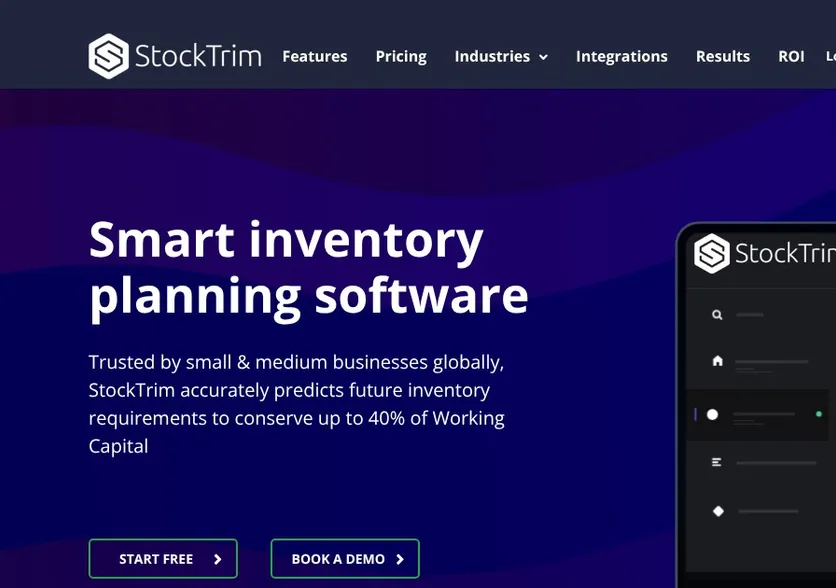
Paid tool Starting price: $49/month · Forty-nine dollars a month billed annually for businesses under one hundred thousand dollars in annual revenue, with higher revenue bands moving to one hundred and ninety-nine dollars a month and above for larger catalogues
Free plan: No free plan; 14-day free trial
Small businesses that sell on several channels use StockTrim to forecast demand from sales history and build replenishment orders for every location. This StockTrim direct plan costs forty-nine dollars a month billed annually for businesses under one hundred thousand dollars in annual revenue, with unlimited stock keeping units and automatic seasonality modeling included. A growing seller gets machine learning forecasts, new-product demand simulation and supplier purchase orders without an enterprise contract.
What we like
- Low entry price with unlimited stock keeping units
- Connects to Shopify, BigCommerce, accounting tools and ERPs
- New-product forecasting without past sales data
Watch out for
- Revenue-banded pricing means the bill grows with your sales
- The cheapest tier is built for small catalogues and single channels
How to try it
- Open the StockTrim site and connect your store or accounting tool
- Check the forecast for your top twenty products against last year
- Approve the suggested order quantities and send the purchase order
3. Sumtracker
Best for: Multichannel sellers that manage bundles and kits across marketplaces
Paid tool Starting price: $100/month · One hundred dollars a month billed annually, or one hundred and nineteen dollars month to month, for the Replenish plan with twelve-month demand forecasting and automated reorder suggestions for up to five thousand orders a year; the basic Manage plan costs fifty-nine dollars a month without forecasting
Free plan: No free plan; free trial available
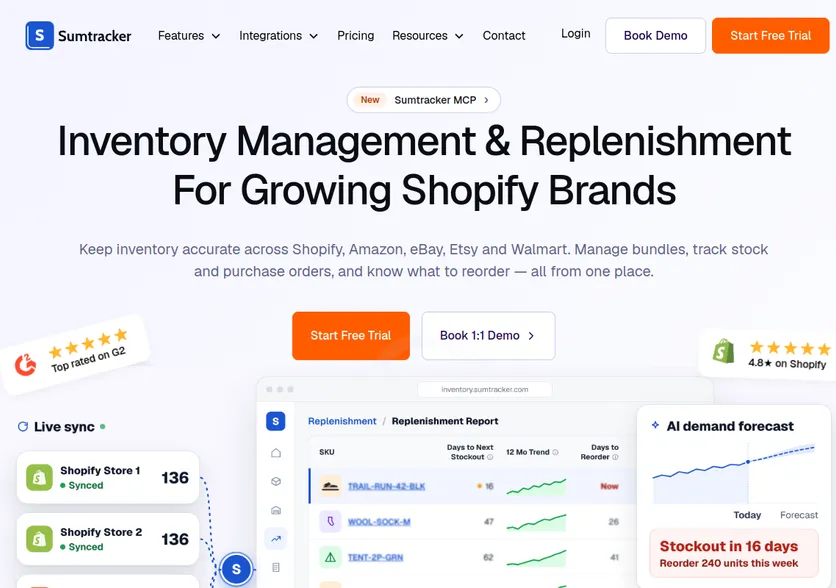
Sellers that manage bundles across marketplaces use Sumtracker to keep stock in sync and build reorder suggestions from the last twelve months of sales. This Sumtracker Replenish plan costs one hundred dollars a month billed annually for up to five thousand orders a year, with twelve-month demand forecasting and automated reorder suggestions included. A multichannel seller gets purchase orders and stock transfers in the same place as the sync, so a bundle never sells what the warehouse cannot ship.
What we like
- Stock sync across Shopify, Amazon, Etsy, Walmart and eBay
- Reorder suggestions with stock-out dates attached
- Bundles and kits planned alongside single products
Watch out for
- Forecasting only starts on the Replenish plan, not the cheaper Manage plan
- The order cap means high-volume sellers move to a higher tier
How to try it
- Open the Sumtracker site and connect your stores and marketplaces
- Check the reorder suggestions for your bundle-heavy products
- Create a purchase order and a stock transfer from the same screen
4. Flieber
Best for: High-volume brands selling on Amazon, Shopify and wholesale together
Paid tool Starting price: $299/month · Two hundred and ninety-nine dollars a month for the Essentials plan, with Pro at three hundred and ninety-nine dollars and Max at five hundred and ninety-nine dollars a month for larger omnichannel teams
Free plan: No free plan; 14-day free trial
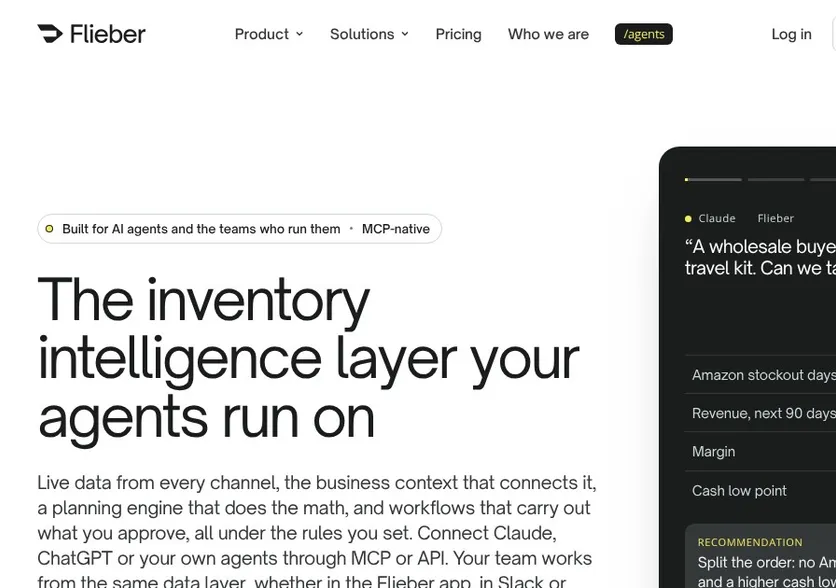
Brands that sell on Amazon alongside their own store use Flieber to forecast sales across marketplaces, direct sales and wholesale from one planning view. This Flieber Essentials plan costs two hundred and ninety-nine dollars a month, with artificial intelligence forecasting models that adjust for anomalies and consolidate stock by warehouse. A high-volume seller gets marketplace-specific demand predictions and a plan that covers wholesale orders beside retail ones.
What we like
- One forecast across Amazon, Shopify, wholesale and Magento
- Anomaly adjustment so one viral week does not wreck the plan
- Stock consolidation by warehouse in the same view
Watch out for
- The entry price is six times the cheapest tools here
- AI forecasting models sit on the higher Pro plan
How to try it
- Open the Flieber site and connect your marketplaces and store
- Review the forecast for your top Amazon listings against wholesale demand
- Consolidate stock by warehouse and build the next replenishment plan
5. SKU Science
Best for: Mid-market planners that want statistical forecasting as the whole product
Paid tool Starting price: $349/month · Three hundred and forty-nine dollars a month as the published starting price for the dedicated statistical demand planning platform, with larger plans priced by scope
Free plan: No free plan; book a demo to try it
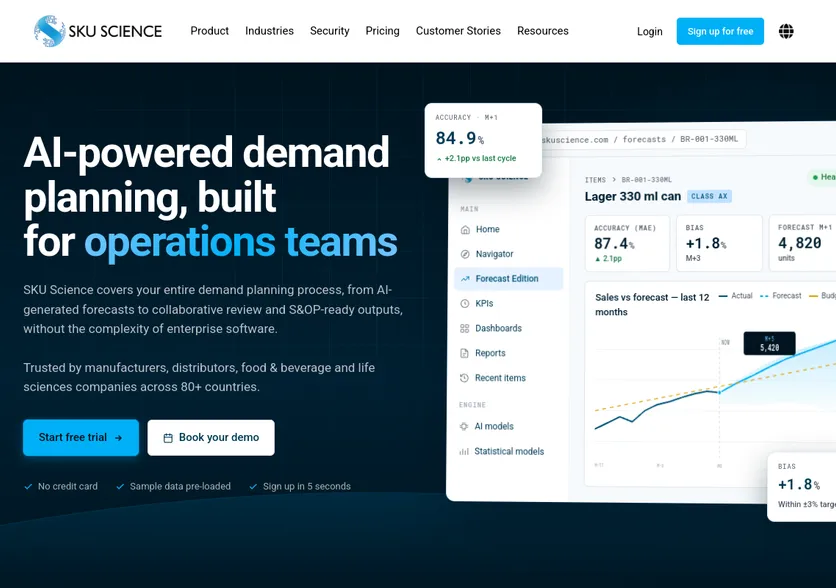
Planners that want statistics instead of guesswork use SKU Science as a dedicated demand planning platform built around forecasting methods rather than a wider inventory suite. This SKU Science starting plan costs three hundred and forty-nine dollars a month, with statistical models that fit a separate forecast to every product. A mid-market team gets a planning-first tool that treats forecast accuracy as the product, not as one feature among many.
What we like
- A separate statistical model fitted to every SKU
- Planning-first design with no inventory-suite clutter
- Forecast accuracy treated as the core metric
Watch out for
- No free plan or trial, so the demo is the only way to test it
- Built for planning only, so ordering and warehousing need other tools
How to try it
- Open the SKU Science site and book a product demo
- Bring two years of sales history and check the per-SKU forecast fit
- Compare the forecast error against your current spreadsheet method
6. Netstock
Best for: Distributors and manufacturers planning inside an ERP system across warehouses
Paid tool Starting price: $900/month · Nine hundred dollars a month for the Essentials bundle on an annual subscription, with Advanced from one thousand five hundred dollars and Commercial from two thousand dollars a month; the Demand Planning add-on for promotions and launches is custom-priced
Free plan: No free plan; book a demo to try it
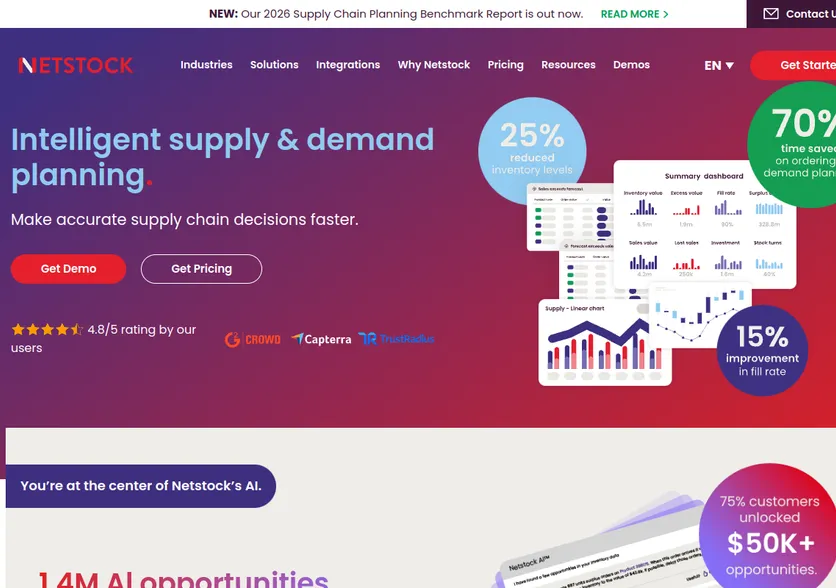
Distributors and manufacturers that plan inside an enterprise resource planning system use Netstock to turn live inventory data into forecasts, safety stock and order suggestions. This Netstock Essentials bundle costs nine hundred dollars a month on an annual subscription, with demand forecasting, classification and ordering for teams that connect more than sixty enterprise systems. A supply chain team gets a six to ten week implementation and a planning horizon that stretches to twenty-four months on the Advanced bundle.
What we like
- Connects to more than sixty ERP systems out of the box
- Safety stock set per SKU at each location
- Planning horizon up to twenty-four months on Advanced
Watch out for
- Annual subscriptions only, with no monthly option
- Implementation takes six to ten weeks before the forecast pays off
How to try it
- Open the Netstock site and request a custom quote for your bundle
- Connect your ERP system and let the forecast build from live stock data
- Review the safety stock per SKU at each location before ordering
Prices above were checked on each vendor’s own website on Nov 27, 2026 and can change — the vendor’s page is the final word. Vendor links are editorial: nobody paid to be listed or ranked here. Vendors who want a featured listing can see how it works on our Get listed page.
What demand planning software costs in 2026
Demand planning tools charge in two ways, by revenue band or by bundle, and the difference decides the bill. Revenue-banded tools start near forty-nine dollars a month for a small store and rise as sales grow, so a fast-growing brand should price the tier it will reach next year rather than the tier it sits in today. Bundle tools start near nine hundred dollars a month and cover the whole planning team, which suits a distributor whose planners share one forecast.
Start with a trial on two tools and load twelve months of real sales into each one. Compare the forecast against what actually sold, check how the safety stock changes when a supplier lead time doubles, and build one purchase order from the recommendation. Pick the tool whose forecast you can explain to a warehouse manager in one sentence, because a plan nobody trusts is just a prettier spreadsheet.
Before you buy
- Check whether the price rises with revenue or orders, because a cheap starter tier can double before your second year.
- Confirm the forecast covers new products, because a tool that only reads past sales cannot plan a launch.
- Test the safety stock math on your longest supplier lead time, because a short horizon hides the real stock-out risk.
- Ask how the tool handles promotions and seasons, because a flat forecast over-orders after every sale event.
- Check the export terms before you sign, because a forecast you cannot take with you locks you into the vendor.
Official websites
Official websites of the products reviewed above. Features and prices were checked against these sites when this guide was written, and they can change, so confirm on the vendor site before you buy.
Frequently asked questions
Which demand planning software is best for supply chain teams in 2026?
Netstock is the best overall pick at nine hundred dollars a month, because it forecasts from live ERP data across every warehouse and sets safety stock per product at each location. Prediko is the best budget pick at forty-nine dollars a month for Shopify brands that need AI forecasting without an enterprise contract. SKU Science is the best mid-market pick at three hundred and forty-nine dollars a month for teams that want statistical forecasting as the whole product.
How much does demand planning software cost?
Prices in this list run from forty-nine dollars a month for Prediko and StockTrim to nine hundred dollars a month for Netstock, with most tools landing between one hundred and three hundred and forty-nine dollars a month. Revenue-banded tools rise as your sales grow, while bundle tools charge a flat monthly rate for the whole planning team. Add implementation time and any per-order or per-backorder fees to the subscription before you compare totals.
Do small manufacturers need demand planning software?
Yes, because a small manufacturer that guesses wrong on one raw material can stall a whole production run. Prediko at forty-nine dollars a month and StockTrim at the same price give a small team a real forecast, safety stock levels and purchase orders without an enterprise budget. A team that manages a hundred products across two locations already has enough volume to justify the spend.
What is the difference between demand planning and inventory management software?
Inventory management software tracks what you have in the warehouse today, while demand planning software predicts what you will need next month and turns that prediction into an order. A team that only needs stock counts can buy inventory software alone for less money. A team that keeps running out of best sellers, or keeps over-ordering slow ones, needs the forecast that demand planning adds.
Can demand planning software connect to an ERP system?
Most of the tools here connect to an ERP system, and Netstock lists more than sixty of them, including NetSuite, Sage, Acumatica and SAP Business One. The connection matters because a forecast built on yesterday's stock data is already wrong when a shipment lands. Ask the vendor to name your exact ERP version on a call, and confirm whether the sync runs daily or in real time before you sign.
Forecast set? Try Toolsvine's free business tools for the everyday math behind the plan.
Browse Business Tools tools