On this page
A newsletter earns money in two ways: readers pay for a subscription, or advertisers pay to reach those readers. The platforms below differ sharply in how much of that money they keep, from zero percent to ten percent, and in what they charge before you earn a cent. Beehiiv is our first pick — its Lite plan charges zero percent on paid subscriptions and adds an ad network on top.
How we researched this
We looked for newsletter platforms that support paid subscriptions with a published dollar price, then read each price on the vendor site on November 27, 2026. We judged them on the platform fee, the monthly cost and the growth tools each one carries. Platforms without paid subscriptions, and tools with no published price, were left out.
Compare the tools
| Name | Best for | Starting price | Free plan | |
|---|---|---|---|---|
| Beehiiv | Writers who want paid subscriptions with zero percent platform fee | $49/month | Free plan: up to 2,500 subscribers | Visit |
| Ghost(Pro) | Writers who want full ownership and zero percent fees | $29/month | No free plan; 14-day free trial | Visit |
 Kit | Creators who want a generous free plan and paid subscriptions | $39/month | Free plan: up to 10,000 subscribers | Visit |
| Buttondown | Writers who want a minimal tool with cheap paid subscriptions | $9/month | Free plan: first 100 subscribers | Visit |
| SparkLoop | Newsletter writers who want referral growth and paid recommendations | $16/month | No free plan; see the vendor pricing page for trial terms | Visit |
| Substack | Writers who want to start free and pay only from revenue | $0 + 10% of paid revenue | Free to publish; 10% fee on paid revenue only | Visit |
| SendFox | Writers who want the cheapest paid-newsletter plan with no platform fee | $19/month | Free plan: 1,000 contacts | Visit |
The email software for newsletter monetization, compared
1. Beehiiv
Best for: Writers who want paid subscriptions with zero percent platform fee
Paid tool Starting price: $49/month · Forty-nine dollars a month for the Lite plan billed annually at one thousand subscribers, or fifty-nine dollars billed monthly; Pro costs ninety-five dollars a month billed annually; paid subscriptions carry zero percent platform fee on Lite and above
Free plan: Free plan: up to 2,500 subscribers
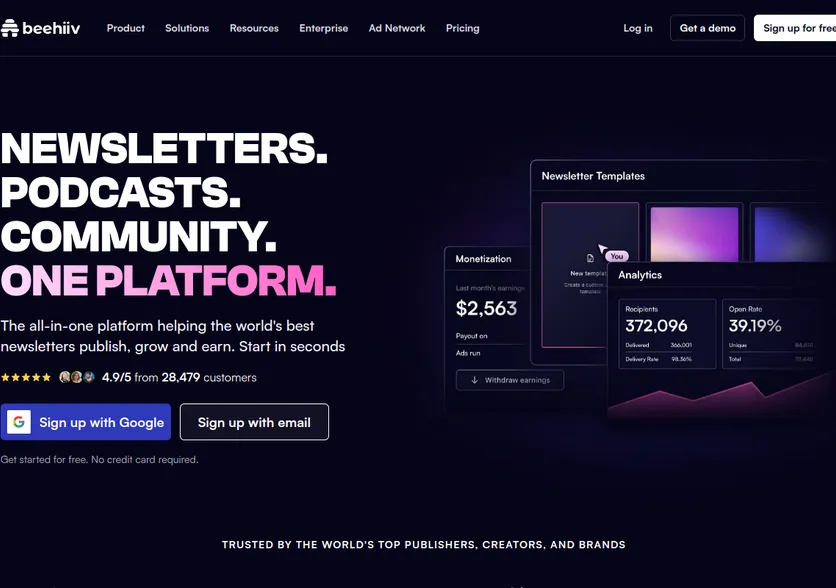
This Beehiiv plan is the monetization pick in this comparison, built for writers who want paid subscriptions without giving up a cut. Paid subscribers carry zero percent platform fee on the Lite plan and above, so the revenue stays with the writer. The ad network and referral programme add income beyond subscriptions, and the editor keeps the writing experience clean.
What we like
- Zero percent platform fee on paid subscriptions from Lite up
- Built-in ad network and referral programme for extra income
- Free plan covers up to two thousand five hundred subscribers
Watch out for
- Lite plan costs forty-nine dollars a month once you outgrow free
- Ad network earnings depend on your audience size
How to try it
- Import your list and publish the first issue
- Turn on paid subscriptions with zero percent platform fee
- Apply to the ad network once your audience is large enough
2. Ghost(Pro)
Best for: Writers who want full ownership and zero percent fees
Paid tool Starting price: $29/month · Twenty-nine dollars a month for the Publisher plan; Starter costs fifteen dollars a month and Business one hundred and ninety-nine dollars a month; zero percent transaction fees on all plans; self-hosted Ghost is free and open source
Free plan: No free plan; 14-day free trial
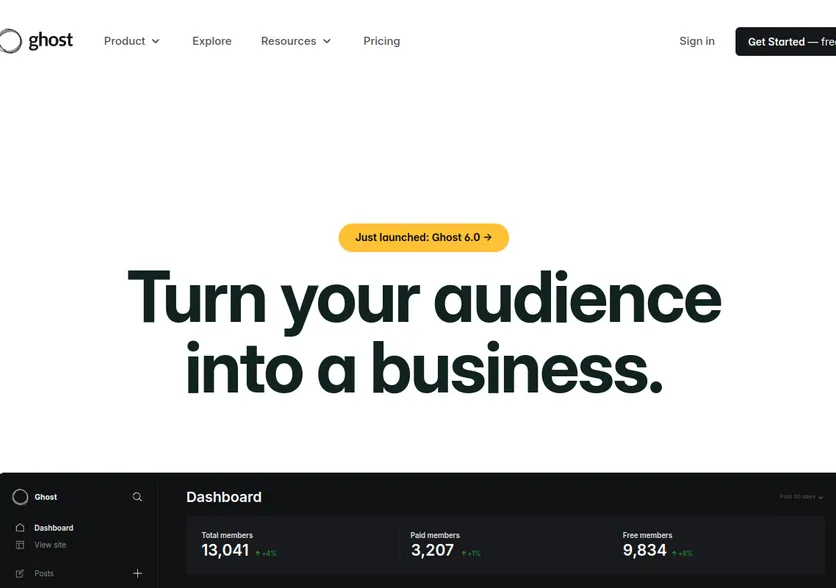
This Ghost plan gives a writer full ownership of the publication, with zero percent transaction fees on every plan. You connect your own Stripe account and keep the full subscription revenue, and the membership tools handle paid tiers, newsletters and the website in one place. Self-hosted Ghost is free and open source for a writer who wants to run the server themselves.
What we like
- Zero percent transaction fees, with your own Stripe account
- Membership, newsletter and website in one system
- Self-hosted version is free and open source
Watch out for
- No free plan on the hosted service, only a trial
- Self-hosting needs a server and some technical skill
How to try it
- Start the hosted trial and connect your Stripe account
- Set up one free tier and one paid tier
- Publish the first issue and invite readers to subscribe
3. Kit
Best for: Creators who want a generous free plan and paid subscriptions
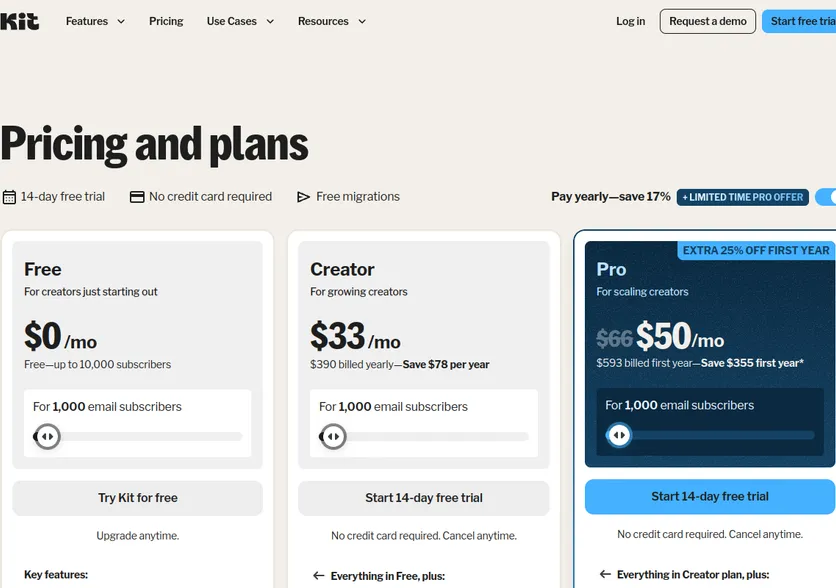
Paid tool Starting price: $39/month · Thirty-nine dollars a month for the Creator plan at up to one thousand subscribers, with annual billing equal to two months free; Pro costs seventy-nine dollars a month
Free plan: Free plan: up to 10,000 subscribers
This Kit plan is the creator favourite in this comparison, with a free plan that covers up to ten thousand subscribers. Paid subscriptions run on the Creator plan, and the visual automation builder handles welcome sequences and paid-tier upsells without code. The free plan is unusually generous, so a new writer can build an audience before paying anything.
What we like
- Free plan covers up to ten thousand subscribers
- Visual automation for welcome sequences and upsells
- Paid subscriptions on the Creator plan from thirty-nine dollars
Watch out for
- Paid subscriptions need the Creator plan, not the free one
- The price rises with the subscriber count
How to try it
- Start on the free plan and import your list
- Build a welcome sequence for new subscribers
- Upgrade to Creator and turn on paid subscriptions
4. Buttondown
Best for: Writers who want a minimal tool with cheap paid subscriptions
Paid tool Starting price: $9/month · Nine dollars a month for one thousand subscribers, with the first one hundred subscribers free; twenty-nine dollars a month at two thousand subscribers and seventy-nine dollars at ten thousand
Free plan: Free plan: first 100 subscribers
This Buttondown plan is the minimalist pick here, with a clean writing interface and a price that starts at nine dollars a month. It supports paid subscriptions through Stripe, and the first one hundred subscribers are free. The tool stays out of the way, which suits a writer who wants to publish without learning a marketing platform.
What we like
- Clean, minimal writing interface with no clutter
- Paid subscriptions through Stripe from nine dollars a month
- First one hundred subscribers free
Watch out for
- Fewer growth tools than Beehiiv or Kit
- No built-in ad network for extra income
How to try it
- Create the newsletter and write the first issue
- Connect Stripe for paid subscriptions
- Import your list and send the first paid issue
5. SparkLoop
Best for: Newsletter writers who want referral growth and paid recommendations
Paid tool Starting price: $16/month · Sixteen dollars a month for the Lite plan billed annually, for up to five thousand subscribers; the Optimized Partner Program starts at one hundred dollars a month and Custom plans at two thousand dollars a month; paid recommendations earn two to seven dollars per referral, with SparkLoop withholding twenty percent plus processing
Free plan: No free plan; see the vendor pricing page for trial terms
This SparkLoop plan is not a newsletter platform on its own: it is a referral and recommendation engine that plugs into the newsletter you already run. Its paid recommendations pay two to seven dollars per referral, and the referral programme turns readers into promoters. The Lite plan costs sixteen dollars a month for up to five thousand subscribers, which makes it a cheap add-on for a growing newsletter.
What we like
- Paid recommendations earn two to seven dollars per referral
- Referral programme turns readers into promoters
- Cheap Lite plan for up to five thousand subscribers
Watch out for
- Not a full newsletter platform, so it pairs with another tool
- SparkLoop withholds twenty percent plus processing on recommendations
How to try it
- Connect SparkLoop to your existing newsletter platform
- Turn on paid recommendations from other newsletters
- Launch a referral reward and promote it in your next issue
6. Substack
Best for: Writers who want to start free and pay only from revenue
Paid tool Starting price: $0 + 10% of paid revenue · Free to publish, with a ten percent fee on paid subscription revenue only; the writer keeps ninety percent, less Stripe fees
Free plan: Free to publish; 10% fee on paid revenue only
This Substack plan is the only free entry in this comparison, with no monthly charge at all. The platform takes ten percent of paid subscription revenue, so a writer pays nothing until readers pay. Discovery is built in, with recommendations and the app putting new writers in front of readers. The trade-off is control: the design and the audience tools are simpler than the paid platforms here.
What we like
- Completely free to start, with no monthly charge
- Built-in discovery through recommendations and the app
- Simple setup with no design work needed
Watch out for
- Ten percent of every paid subscription goes to the platform
- Less control over design and audience data than the paid tools
How to try it
- Create the publication and publish the first post
- Turn on paid subscriptions and set the price
- Ask readers to recommend the newsletter to friends
7. SendFox
Best for: Writers who want the cheapest paid-newsletter plan with no platform fee
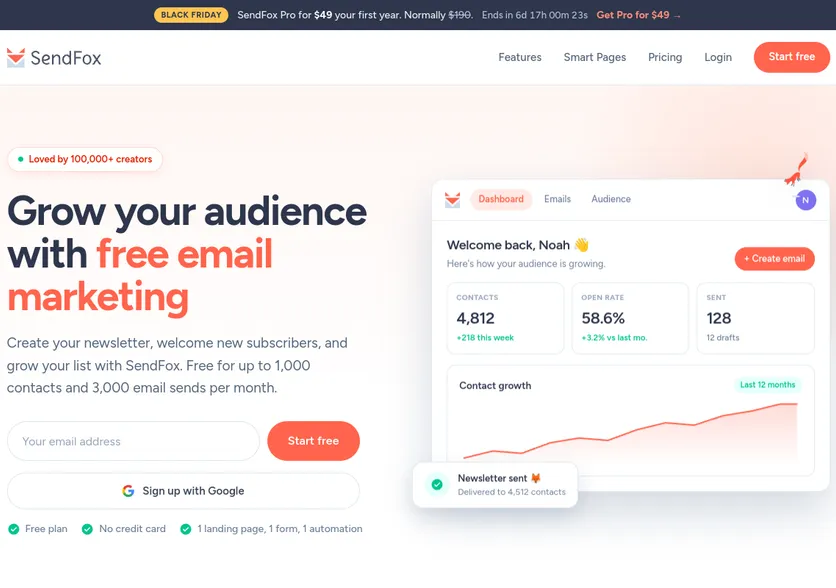
Paid tool Starting price: $19/month · Nineteen dollars a month for the Pro plan, which runs paid newsletters on your own Stripe with no platform fee; a lifetime deal costs twenty-nine dollars once for five thousand contacts; free plan covers one thousand contacts
Free plan: Free plan: 1,000 contacts
This SendFox plan is the budget pick for paid newsletters, running subscriptions on your own Stripe with no platform fee. The Pro plan costs nineteen dollars a month, and a lifetime deal covers five thousand contacts for twenty-nine dollars once. The interface is simple and the automation covers the basics, which suits a writer who wants low costs above all.
What we like
- Paid newsletters on your own Stripe, with no platform fee
- Lifetime deal covers five thousand contacts for twenty-nine dollars once
- Free plan for one thousand contacts
Watch out for
- Simpler automation than Kit or Beehiiv
- The lifetime deal has a cap on total sends
How to try it
- Start on the free plan and import your contacts
- Connect your Stripe account for paid newsletters
- Upgrade to Pro when you are ready to charge readers
Prices above were checked on each vendor’s own website on Nov 27, 2026 and can change — the vendor’s page is the final word. Vendor links are editorial: nobody paid to be listed or ranked here. Vendors who want a featured listing can see how it works on our Get listed page.
How to make a newsletter pay
Start free or cheap, because a newsletter earns nothing until the audience trusts it. Publish on a fixed schedule for three months before you charge anyone, and use a free tier to build the list. When you do add a paid tier, price it by value rather than by length: a weekly briefing that saves a reader an hour is worth more than a daily dump of links.
Watch the platform fee as closely as the monthly price: ten percent of a large paid list costs far more than a fifty-dollar subscription. Add a referral programme early, because a reader who recommends you is worth more than any ad. Keep one channel for growth, such as the ad network or paid recommendations, and measure the revenue per thousand subscribers every month.
Before you buy
- Compare the platform fee on paid revenue, not just the monthly price
- Check the free subscriber limit before you import your list
- Confirm paid subscriptions run on your own Stripe account
- Make sure a free tier exists so new readers can sample the work
- Test the referral tools before you rely on them for growth
Official websites
Official websites of the products reviewed above. Features and prices were checked against these sites when this guide was written, and they can change, so confirm on the vendor site before you buy.
Frequently asked questions
Which newsletter platform takes the smallest cut of paid subscriptions?
Beehiiv, Ghost and SendFox all take zero percent: Beehiiv charges no platform fee on Lite and above, Ghost takes zero percent on every plan, and SendFox runs paid newsletters on your own Stripe with no fee. Kit also uses your own Stripe account for paid subscriptions. Substack is the most expensive on fees, taking ten percent of paid revenue, though it charges no monthly fee at all.
Can I monetize a newsletter for free?
Yes, on Substack. Publishing is free and you pay nothing until a reader subscribes, at which point Substack takes ten percent of the paid revenue. Beehiiv and Kit also have free plans, but paid subscriptions need a paid plan on both. Buttondown is free for the first one hundred subscribers. For a writer starting from zero, Substack is the cheapest way to test whether readers will pay.
What is the difference between Beehiiv and Ghost?
Beehiiv is a hosted newsletter platform with a free plan, a built-in ad network and a referral programme, and it charges zero percent on paid subscriptions from the Lite plan up. Ghost is a publishing system that combines a website, memberships and a newsletter, with zero percent fees on every plan and a free self-hosted version. Beehiiv suits a writer who wants growth tools; Ghost suits a writer who wants full ownership.
How does SparkLoop make money for a newsletter?
SparkLoop is not a newsletter platform: it is a referral and recommendation engine that plugs into the one you already use. Paid recommendations pay two to seven dollars per referral when another newsletter promotes you, and the referral programme rewards your own readers for bringing new subscribers. The Lite plan costs sixteen dollars a month for up to five thousand subscribers. It earns its keep when the referrals it brings in cost less than the subscribers they replace.
Should I use a lifetime deal for my newsletter?
A lifetime deal such as SendFox at twenty-nine dollars once for five thousand contacts is cheap if you plan to write for years, but it caps the sends and the contact count. A monthly plan costs more over time, yet it grows with your list and includes new features as they ship. If your list is small and your budget is tight, the lifetime deal is a good bet; if you expect fast growth, a monthly plan is safer.
Compare the platform fees above, then start on a free plan and publish weekly for three months before you charge anyone.
Browse Marketing & Ads Calculators tools