On this page
Goals that live in a spreadsheet die in a spreadsheet. Nobody checks them, nobody updates them, and the quarterly review becomes a guessing game about what anyone actually did. This comparison ranks eight goal tracking tools for HR departments on whether they keep goals visible, updated and connected to reviews. Lattice leads the list because its goals, reviews and engagement data share one record, and every tool below is judged on the same test: can a manager see progress, can an employee update a goal in a minute, and does the review reflect the work?
How we researched this
We checked every price on the vendor pricing page on November 27, 2026, and only included tools with a published US dollar list price. We ranked each tool on goal and OKR tracking, check-ins, review connections, and whether the price is published or hidden behind a quote. Tools with quote-only pricing were left out, so every price below can be verified on the vendor site.
Compare the tools
| Name | Best for | Starting price | Free plan | |
|---|---|---|---|---|
 Lattice | Mid-size teams that want goals, reviews and engagement together | $10/seat/mo | No free plan, demo available | Visit |
 15Five | Teams where manager skill is the real bottleneck | $11/user/mo | No free plan, free trial available | Visit |
 Betterworks | Teams that want continuous performance with goals at the center | $8/user/mo | No free plan, demo available | Visit |
 Leapsome | Teams that want goals plus learning and HRIS in one system | $7/employee/mo | 14-day free trial, no free plan | Visit |
 PerformYard | Teams that need flexible review cycles at a low price | $5/person/mo | No free plan, demo available | Visit |
 Small Improvements | Growing teams that want structured reviews without overhead | $3/user/mo | 30-day free trial, no free plan | Visit |
 Profit.co | Enterprises that need deeply customizable OKR frameworks | $9/user/mo | Free plan for up to 5 users | Visit |
 Weekdone | Small teams that want weekly check-ins beside their OKRs | $9/user/mo | Free plan for up to 3 users | Visit |
The goal tracking software for hr departments, compared
1. Lattice
Best for: Mid-size teams that want goals, reviews and engagement together
Paid tool Starting price: $10/seat/mo · Performance plan at ten dollars a seat a month billed annually, with a four thousand dollar annual minimum; the standalone Goals and OKRs module is eight dollars a seat a month and Engagement is four dollars
Free plan: No free plan, demo available
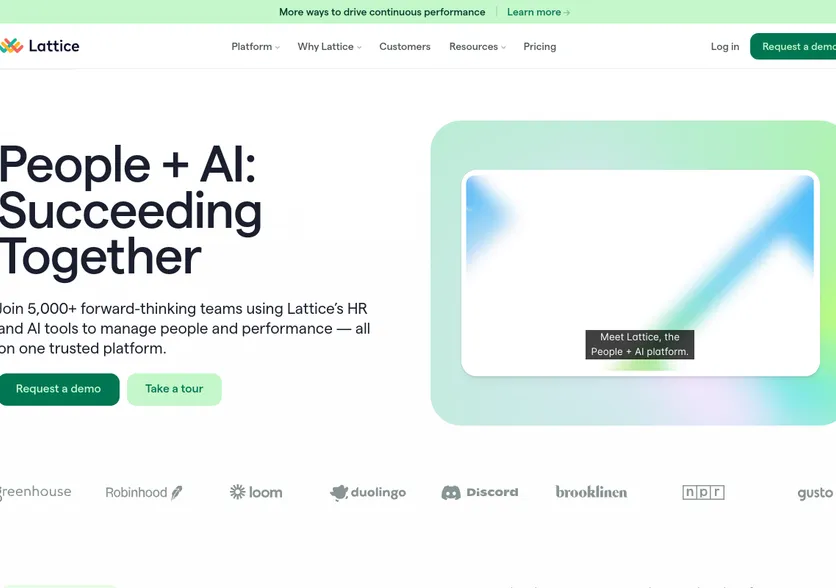
This Lattice Performance plan costs ten dollars a seat a month billed annually, and it keeps goals, reviews, one-on-ones and engagement on a single employee record. A manager can see a goal, the check-ins behind it and the review that judges it without opening three systems. It suits mid-size teams best, because the modular pricing covers everything but the four thousand dollar annual minimum makes it expensive for very small teams.
What we like
- Goals, reviews and engagement on one record
- Cascading goals from company to individual
- Strong manager experience that people finish
Watch out for
- Four thousand dollar annual minimum hurts small teams
- Modules stack up fast when several are bought
How to try it
- Set company goals and cascade them to teams and people
- Run weekly check-ins against each goal
- Pull goal progress straight into the performance review
2. 15Five
Best for: Teams where manager skill is the real bottleneck
Paid tool Starting price: $11/user/mo · Perform plan at eleven dollars a user a month billed annually and includes OKRs and goals; Engage is four dollars a user a month and the Total Platform is sixteen dollars
Free plan: No free plan, free trial available
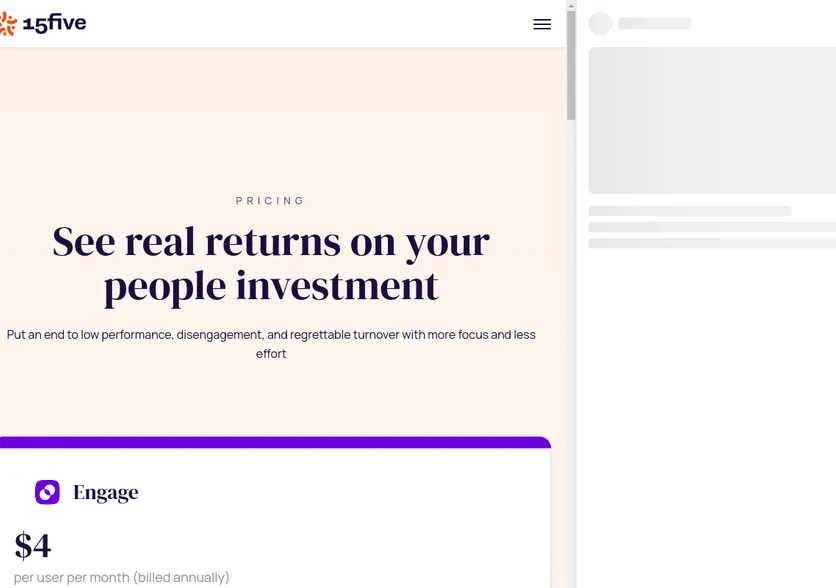
This 15Five Perform plan costs eleven dollars a user a month billed annually, and it pairs OKRs and goals with weekly check-ins and manager coaching content. The weekly check-in is the heart of the tool: a short update that keeps goals alive between reviews instead of letting them sleep for a quarter. It suits teams where the problem is manager capability rather than the review form, because the coaching material is built into the platform.
What we like
- Weekly check-ins keep goals alive
- OKRs included in the Perform plan
- Manager coaching content built into the platform
Watch out for
- No free plan at any tier
- Coaching add-ons are priced per manager
How to try it
- Set OKRs and goals for the quarter
- Run the weekly check-in ritual with each report
- Review goal progress with the manager coaching content
3. Betterworks
Best for: Teams that want continuous performance with goals at the center
Paid tool Starting price: $8/user/mo · Performance plan at eight dollars a user a month; the earlier promotional rate expired on August 31, 2026, leaving eight and nine dollars as the published prices, plus an implementation fee
Free plan: No free plan, demo available
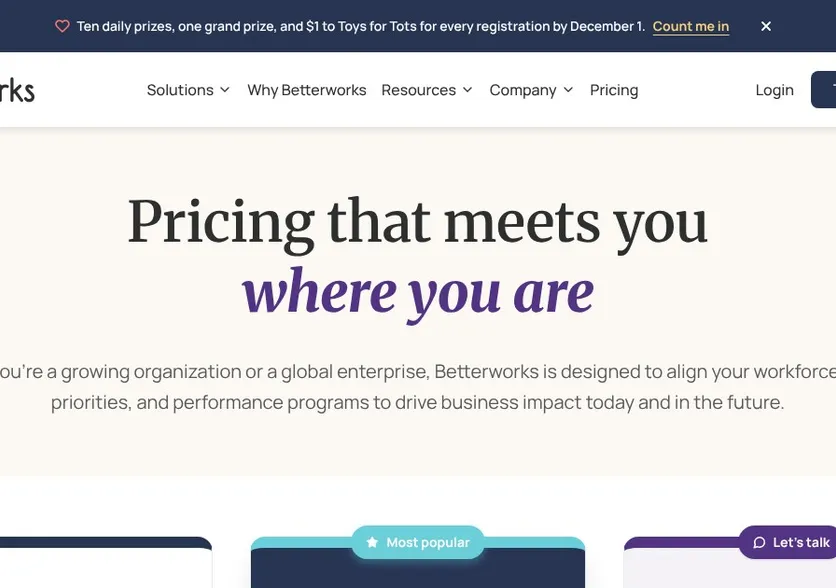
This Betterworks Performance plan costs eight dollars a user a month, and it runs goals, check-ins, feedback and reviews as one continuous cycle rather than a yearly event. Goals update in real time, managers see progress without chasing updates, and the review draws on months of recorded work. It suits teams that want performance management to run all year, though an implementation fee sits on top of the per-user price.
What we like
- Continuous performance cycle, not a yearly event
- Goals update in real time for managers
- Reviews draw on months of recorded work
Watch out for
- Implementation fee on top of the per-user price
- Published prices changed after the promo expired
How to try it
- Set goals with clear key results for the quarter
- Update progress in regular check-ins
- Run the review from the recorded goal history
4. Leapsome
Best for: Teams that want goals plus learning and HRIS in one system
Paid tool Starting price: $7/employee/mo · Foundation HRIS plan at seven dollars an employee a month billed annually; the Goals and OKRs module is four dollars an employee a month, and the Performance Reviews module is seven dollars
Free plan: 14-day free trial, no free plan
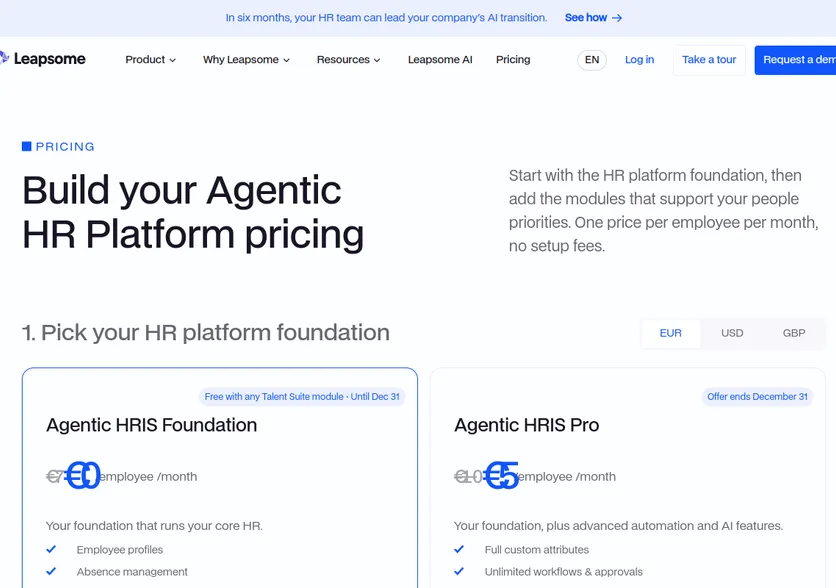
This Leapsome Foundation plan costs seven dollars an employee a month billed annually, and its talent modules add goals, reviews, learning and engagement on top of the HRIS. A team can track a goal, link it to a learning course, and review both in the same cycle without a second system. It suits growing teams that want one platform for people work, though the full set of modules adds up once several are switched on.
What we like
- Goals, learning and HRIS in one platform
- Modular pricing buys only what the team uses
- Clear per-module prices published on the site
Watch out for
- Full module set adds up to a high per-person total
- First-year offers can confuse the list price
How to try it
- Set up the HRIS Foundation and invite the team
- Add the Goals and OKRs module for the team
- Link goals to learning and review them each cycle
5. PerformYard
Best for: Teams that need flexible review cycles at a low price
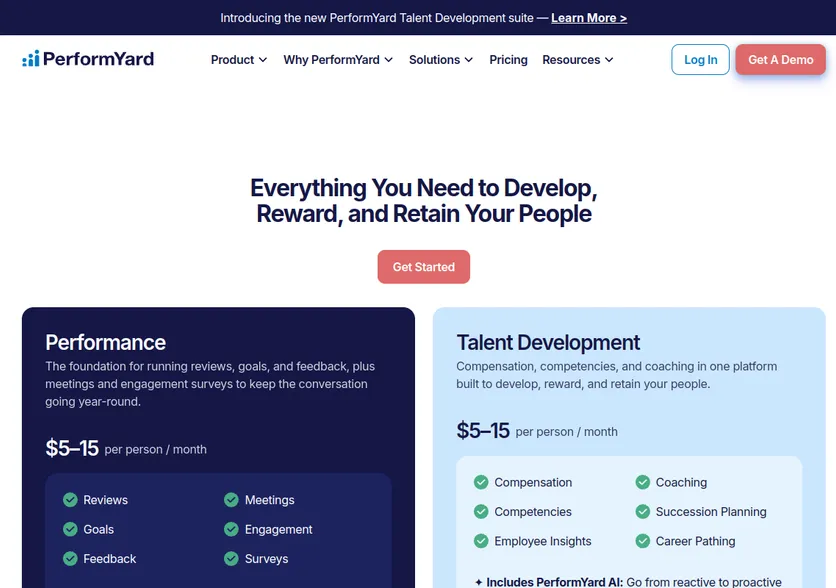
Paid tool Starting price: $5/person/mo · Performance Management plan from five dollars a person a month billed annually, rising to ten dollars by headcount and configuration; AI, engagement, meetings and surveys are paid add-ons
Free plan: No free plan, demo available
This PerformYard plan starts at five dollars a person a month billed annually, and it is the most flexible review builder in this list: any cycle, any form, any schedule, with goals tracked beside the reviews. A dedicated customer success manager is assigned to every account, which is rare at this price. It suits HR teams with non-standard cycles that bigger platforms force into a template.
What we like
- Most flexible review cycle builder in this list
- Lowest entry price among the full suites
- Dedicated success manager on every account
Watch out for
- Price rises to ten dollars by headcount and setup
- No self-serve trial, evaluation runs through a demo
How to try it
- Build the review cycle and goal structure to match the team
- Assign goals and run check-ins on the chosen schedule
- Report on goal completion across the whole company
6. Small Improvements
Best for: Growing teams that want structured reviews without overhead
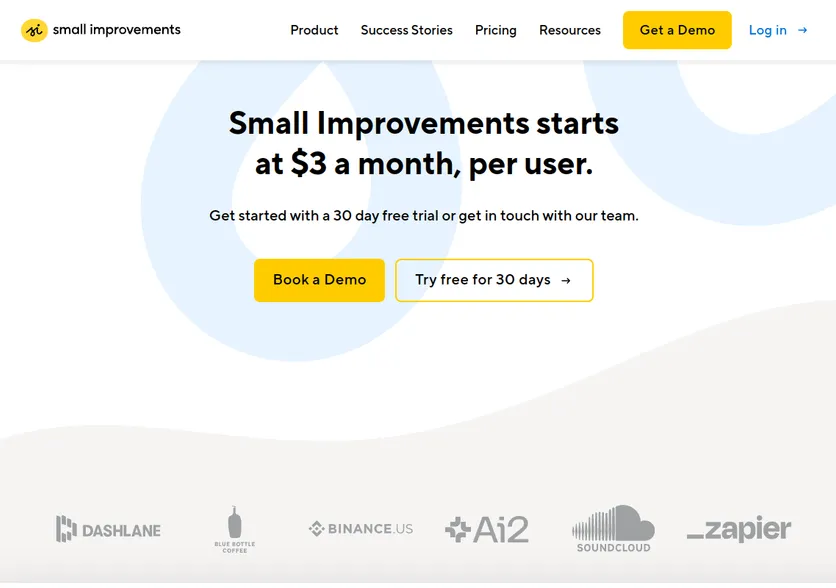
Paid tool Starting price: $3/user/mo · Launch plan at three dollars a user a month billed annually with a three thousand dollar annual minimum; the Grow plan is six dollars a user a month billed annually
Free plan: 30-day free trial, no free plan
This Small Improvements Launch plan costs three dollars a user a month billed annually, and it covers goals, reviews, feedback and one-on-ones without the weight of a full HR suite. The interface is light, the setup is fast, and the price is the lowest in this list for a proper review platform. It suits teams of twenty or more that want structure without hiring someone to run the software.
What we like
- Lowest entry price in this comparison
- Light interface with fast setup
- Goals, reviews and feedback in one place
Watch out for
- Three thousand dollar annual minimum applies
- Fewer enterprise controls than the bigger suites
How to try it
- Set team and individual goals for the quarter
- Run lightweight reviews with feedback and one-on-ones
- Track goal completion in the reporting dashboard
7. Profit.co
Best for: Enterprises that need deeply customizable OKR frameworks
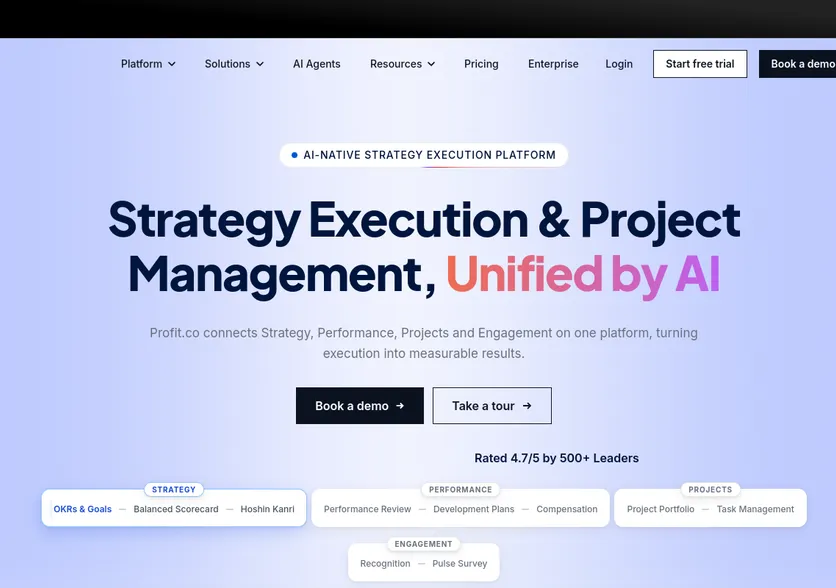
Paid tool Starting price: $9/user/mo · Growth plan at nine dollars a user a month; some directories list seven dollars as the starting figure, and a ten thousand dollar minimum annual spend applies
Free plan: Free plan for up to 5 users
This Profit.co Growth plan costs nine dollars a user a month, and it is the most customizable OKR platform in this list, with task management and KPI tracking built into the goal hierarchy. Complex organizations can mirror their real structure in cascading objectives, and the progress heatmaps show at a glance which teams are on track. It suits enterprises with layered goals, though the ten thousand dollar minimum spend rules out small teams.
What we like
- Deepest OKR customization in this list
- Tasks and KPIs linked to key results
- Free plan for up to five users
Watch out for
- Ten thousand dollar minimum annual spend
- Starting price is reported differently across directories
How to try it
- Build the OKR hierarchy to mirror the organization
- Link tasks and KPIs to each key result
- Watch the progress heatmaps to spot teams falling behind
8. Weekdone
Best for: Small teams that want weekly check-ins beside their OKRs
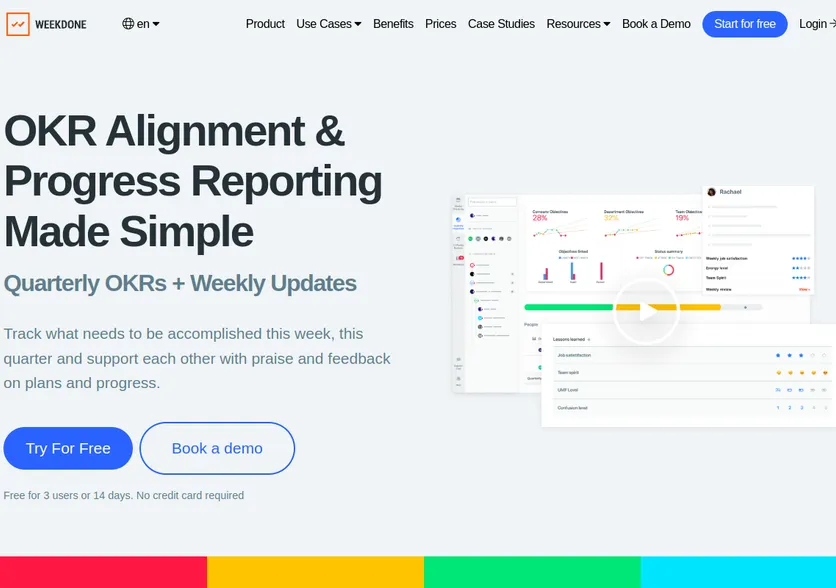
Paid tool Starting price: $9/user/mo · Paid plans from nine dollars a user a month, or ninety dollars a month for a team of four to ten users; the free plan covers up to three users
Free plan: Free plan for up to 3 users
This Weekdone plan costs nine dollars a user a month, and it pairs OKR tracking with a weekly planning ritual: each person writes a short plan, reports progress, and the dashboard shows which objectives moved. It is the lightest tool in this list, built for teams that want goals to feel like a habit rather than a quarterly chore. The free plan covers three users, so a tiny team can start at no cost.
What we like
- Weekly check-in ritual keeps goals visible
- Simplest OKR tool in this comparison
- Free plan for up to three users
Watch out for
- Light on enterprise features and integrations
- Pricing is quoted per team size, not per seat alone
How to try it
- Set quarterly OKRs for the team
- Write the weekly plan and progress update each Monday
- Review the dashboard to see which objectives moved
Prices above were checked on each vendor’s own website on Nov 27, 2026 and can change — the vendor’s page is the final word. Vendor links are editorial: nobody paid to be listed or ranked here. Vendors who want a featured listing can see how it works on our Get listed page.
How an HR department should pick goal tracking software
Start with the review cycle the company actually runs, not the one in the brochure. A team that reviews yearly needs a tool that keeps goals alive between reviews, like 15Five with its weekly check-ins, while a team that reviews quarterly can use a lighter tool like Weekdone. Count the real cost per person including minimums, because Lattice charges a four thousand dollar annual minimum and Profit.co sets a ten thousand dollar floor, which changes the maths for a small team. Check whether goals connect to reviews, since a goal tracker that cannot feed the review is just a prettier spreadsheet. Test the update flow with real employees during the trial, because a goal that takes ten minutes to update will never be updated. Finally, confirm who owns the rollout, since the tools that include a dedicated success manager get adopted far faster than the ones that leave HR to do it alone.
Before you buy
- Count the real cost per person including annual minimums, since floors of four and ten thousand dollars change the maths
- Check whether goals feed straight into the performance review or sit in a separate module
- Confirm the check-in rhythm matches the team, because weekly updates suit some teams and quarterly suits others
- Test the goal update flow with real employees during the trial, not only with the HR team
- Look at whether a dedicated success manager is included, since adoption depends on the rollout
Official websites
Official websites of the products reviewed above. Features and prices were checked against these sites when this guide was written, and they can change, so confirm on the vendor site before you buy.
Frequently asked questions
What is the best goal tracking software for HR departments?
Lattice is the best all-round pick, because goals, reviews, one-on-ones and engagement share one employee record. 15Five is the best choice when manager skill is the problem, since its weekly check-ins and coaching content keep goals alive. PerformYard suits teams with non-standard review cycles, and Small Improvements is the best value at three dollars a user a month. Pick Lattice for the full suite, 15Five for managers, and Small Improvements for price.
How much does goal tracking software cost?
Published entry prices in this comparison run from three dollars a user a month for Small Improvements to eleven dollars a user a month for 15Five Perform, all billed annually. Lattice Performance costs ten dollars a seat a month with a four thousand dollar annual minimum, and Profit.co sets a ten thousand dollar minimum annual spend. A team of fifty people should budget between two thousand and seven thousand dollars a year, depending on the modules it buys.
What is the difference between goals and OKRs?
A goal is a broad aim, like improving customer retention, while an OKR pairs an objective with measurable key results, like raising retention from eighty to eighty-five percent by March. OKRs force a number and a deadline onto every goal, which makes progress visible and reviewable. Every tool in this list supports OKRs, but Lattice, Leapsome, Profit.co and Weekdone make the OKR structure the center of the product, while others treat goals more loosely.
Can goal tracking software replace the annual review?
It can replace the annual review as a single event, but not the review itself. Tools like Betterworks and 15Five turn performance into a continuous cycle of goals, check-ins and feedback, so the year-end conversation draws on months of recorded work instead of memory. The formal review still happens, but it takes an hour instead of a week, and nobody is surprised by the outcome. The software changes the rhythm, not the need for a human judgment.
Is there free goal tracking software for HR teams?
Free plans exist but they are small. Profit.co is free for up to five users, and Weekdone is free for up to three users, which suits a tiny team or a pilot. Lattice, 15Five, Betterworks, Leapsome, PerformYard and Small Improvements offer no free plan, only a trial or a demo. A department tracking goals for the whole company should expect to pay, starting at three dollars a user a month for Small Improvements.
Compare the eight tools above, then start with a free trial on the tool that matches your review cycle before you pay for a full year.
Browse Business Tools tools