On this page
Startups pick OKRs to keep a small team pulling in the same direction, but the tool market is split between dedicated OKR apps and full performance suites that charge for far more than goal tracking. The right choice depends on team size, check-in rhythm and whether you need reviews in the same system. We compared seven paid tools on list prices, free tiers, trial terms, seat minimums and check-in workflows, using each vendor's own pricing page. The cheapest dedicated tool starts at six dollars a user a month, and the best value for a small team is Perdoo.
How we researched this
We shortlisted tools that publish a per-user list price on their own pricing page and that serve teams under fifty people. Quote-only platforms and retired products were dropped, and every price below is the vendor's list price checked on 26 November 2026, with annual billing where the vendor lists it first.
Compare the tools
| Name | Best for | Starting price | Free plan | |
|---|---|---|---|---|
 Lattice | Startups that want OKRs inside a full performance platform | $8/seat/month | No free plan or free trial; demo and free interactive product tour available | Visit |
 15Five | Startups that want OKRs tied to weekly check-ins and reviews | $11/user/month | No free plan; 14-day free trial and demo available | Visit |
 Perdoo | Small teams that want a dedicated OKR tool with a free tier | $9/user/month | Free plan for up to 5 users | Visit |
 Quantive | Startups that want OKRs with strategy maps and KPIs | $9/user/month | Free Essentials plan for up to 5 users | Visit |
 Tability | Small teams that want lightweight OKR check-ins in Slack or Teams | $6/user/month | No free plan; 14-day free trial | Visit |
 Weekdone | Small teams that want OKRs with included coaching and weekly check-ins | $9/user/month | Free plan for up to 3 users with every feature included | Visit |
 Profit.co | Startups that want OKR execution with built-in coaching and KPIs | $12/user/month | Free Launch plan for up to 5 users | Visit |
The 7 best OKR tools for startups, compared
1. Lattice
Best for: Startups that want OKRs inside a full performance platform
Paid tool Starting price: $8/seat/month · Goals and OKRs module billed annually at eight dollars a seat a month; the Foundations bundle with Performance is thirteen dollars; a four thousand dollar annual minimum applies and billing is annual only
Free plan: No free plan or free trial; demo and free interactive product tour available
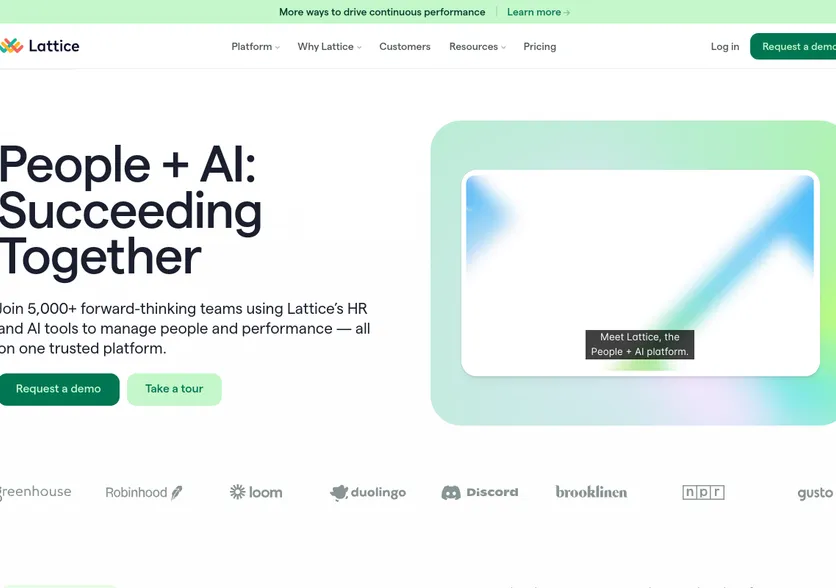
Lattice is a people management platform that ties goals and OKRs to performance reviews, one-on-ones, engagement surveys and career frameworks, so a quarter's objectives feed straight into the review that follows. Its Goals and OKRs module is sold on its own or inside the Foundations bundle with Performance, and the vendor charges no implementation fees. The four thousand dollar annual minimum is the catch for small teams, since a thirty person company pays that floor whatever the seat maths says. See the full module list on Lattice.
What we like
- OKRs, reviews, one-on-ones and engagement in one system
- Foundations bundle adds analytics and an AI agent
- No implementation fees and a free interactive product tour
Watch out for
- Four thousand dollar annual minimum, with no free plan or free trial
- Module prices stack up fast when you add engagement, growth and compensation
How to try it
- Start with a demo to map your review cycle and goal hierarchy
- Buy the Goals and OKRs module alone or the Foundations bundle with Performance
- Set company objectives, cascade them to teams, and review progress in one-on-ones
2. 15Five
Best for: Startups that want OKRs tied to weekly check-ins and reviews
Paid tool Starting price: $11/user/month · Perform plan billed annually at eleven dollars a user a month; Engage starts at four dollars and Total Platform is sixteen dollars; annual billing only with no monthly option
Free plan: No free plan; 14-day free trial and demo available
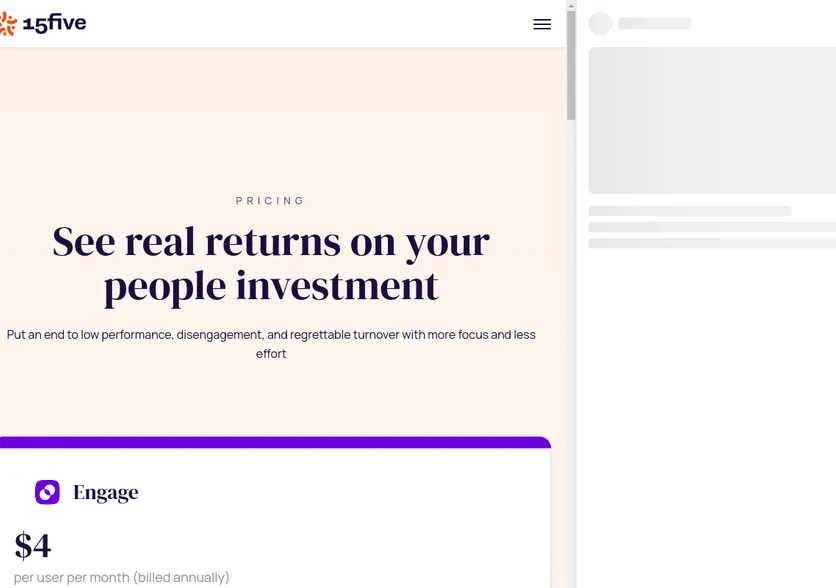
15Five builds OKRs into a weekly management rhythm of check-ins, one-on-ones, 360 reviews and High Fives recognition, so goal progress comes up in the same conversations as feedback. Its Perform plan carries OKRs alongside reviews and check-ins, while Engage covers surveys and Total Platform bundles both sets of tools. Every plan is billed annually with no monthly option, and there is no free plan, only a fourteen day trial. Try the workflow on 15Five before committing to an annual contract.
What we like
- OKRs tied to weekly check-ins, one-on-ones and reviews
- Fourteen day free trial with a demo also available
- Total Platform caps the all-in cost at sixteen dollars a user a month
Watch out for
- Annual billing only, with no monthly option and no free plan
- Reviewers mention rigid OKR tracking and repetitive check-in questions
How to try it
- Start the fourteen day free trial and run one weekly check-in cycle
- Choose Perform for OKRs with reviews or Engage for surveys alone
- Set objectives, assign key results, and track progress in the weekly check-in
3. Perdoo
Best for: Small teams that want a dedicated OKR tool with a free tier
Paid tool Starting price: $9/user/month · Premium plan billed annually at nine dollars a user a month for teams of five to twenty four users; Supreme is eleven dollars; a minimum of five paid licences applies and the vendor also shows euro prices
Free plan: Free plan for up to 5 users
Perdoo is a dedicated OKR tool that pairs goal tracking with KPIs and integrations for Slack and Teams, built for teams adopting the method for the first time. Its free tier covers up to five users, and the Premium plan adds unlimited objectives, custom fields and reporting. Pricing is transparent and per user, with a minimum of five paid licences on the paid plan. Read the full plan comparison on Perdoo.
What we like
- Free plan for up to five users with core OKR tracking
- Clear per-user pricing with no hidden modules
- KPI tracking alongside OKRs in the same workspace
Watch out for
- Five paid licence minimum on the Premium plan
- Smaller feature set than full performance suites
How to try it
- Start on the free plan with up to five users
- Define company objectives and link key results to teams
- Upgrade to Premium when you need custom fields and reporting
4. Quantive
Best for: Startups that want OKRs with strategy maps and KPIs
Paid tool Starting price: $9/user/month · Scale plan billed annually at nine dollars a user a month; Essentials is free forever for up to five users; Enterprise is quoted
Free plan: Free Essentials plan for up to 5 users
Quantive is a strategy execution platform that combines OKRs with strategy maps, KPIs and dashboards, aimed at teams that want goals connected to wider business planning. Its Essentials tier is free forever for up to five users, and the Scale plan adds advanced reporting and integrations. Enterprise pricing is quoted, so larger teams need a sales conversation. Explore the plans on Quantive.
What we like
- Free Essentials tier for up to five users
- Strategy maps and KPI dashboards in the same tool
- Scale plan at nine dollars a user a month is competitive
Watch out for
- Enterprise pricing is quote-only with no published figure
- Broader than a simple OKR tracker, so setup takes longer
How to try it
- Try the free Essentials tier with up to five users
- Map objectives on the strategy map and link KPIs
- Move to Scale when you need advanced reporting
5. Tability
Best for: Small teams that want lightweight OKR check-ins in Slack or Teams
Paid tool Starting price: $6/user/month · Basic plan billed yearly at six dollars a user a month, or seven dollars billed monthly; Premium is ten dollars yearly or twelve dollars monthly; no free plan
Free plan: No free plan; 14-day free trial
Tability is a lightweight OKR tool built around the weekly check-in, where each key result owner updates progress in a few minutes and the tool chases anyone who has not. AI-assisted goal drafting, a strategy map and Slack and Teams integrations come with the Basic plan, while Premium adds data connectors, SAML SSO and an AI assistant. Every paid seat includes two free read-only seats, so stakeholders can watch without becoming line items. See the plan table on Tability.
What we like
- Weekly check-in discipline built into the product
- Two free read-only seats per paid seat
- Cheapest paid plan in this list at six dollars a user a month
Watch out for
- No free plan, only a fourteen day trial
- Made for small teams, with limited multi-level consolidation
How to try it
- Start the fourteen day free trial on the Basic plan
- Set objectives, assign owners, and run the first weekly check-in
- Upgrade to Premium for data connectors, SSO and AI retrospectives
6. Weekdone
Best for: Small teams that want OKRs with included coaching and weekly check-ins
Paid tool Starting price: $9/user/month · Packages priced by team size; four to ten users cost nine dollars a user a month on annual billing, or ten dollars and eighty cents billed monthly; the per-user rate falls as the team grows and teams over five hundred users are quoted
Free plan: Free plan for up to 3 users with every feature included
Weekdone builds OKRs around a weekly Plans, Progress and Problems check-in, with an OKR wizard, visual alignment trees and coaching bundled into every paid plan. Its free plan covers up to three users with every feature included, and paid packages are sold by team size with the per-user rate falling as the team grows. All paid tiers include OKR coaching, onboarding and quarterly review sessions at no added cost. Check the package prices on Weekdone.
What we like
- Free plan for up to three users with every feature
- OKR coaching and onboarding included on every paid plan
- Per-user price falls as the team grows
Watch out for
- Pricing is sold in headcount packages, so the per-user rate depends on team size
- Adding a fourth user starts a fourteen day trial before payment
How to try it
- Start free with up to three users and every feature
- Set quarterly objectives with the OKR wizard and weekly check-ins
- Pick the package that matches your headcount when you add a fourth user
7. Profit.co
Best for: Startups that want OKR execution with built-in coaching and KPIs
Paid tool Starting price: $12/user/month · Essentials plan billed annually at twelve dollars a user a month; plans start at three thousand dollars a year; Strategy Execution, Portfolios and Projects and People Management are paid add-on modules; a Black Friday half-price promotion is running on the vendor page and is not the list price
Free plan: Free Launch plan for up to 5 users
Profit is an OKR platform combined with task management, performance reviews and team engagement, aimed at teams that want deep execution coaching alongside goal tracking. Every plan includes OKRs, reviews, task management and AI agents, with Strategy Execution, Portfolios and Projects and People Management available as paid modules. Plans start at three thousand dollars a year, so it is a bigger commitment than the dedicated tools in this list. Review the current pricing on Profit.
What we like
- OKRs, reviews, tasks and AI agents in every plan
- Deep coaching and a large library of key result examples
- Free Launch plan for up to five users
Watch out for
- Three thousand dollar yearly minimum makes it a mid-size buy
- A Black Friday half-price promotion is running and is not the list price
How to try it
- Start on the free Launch plan with up to five users
- Set OKRs and link them to tasks and reviews
- Add Strategy Execution or People Management modules when you need them
Prices above were checked on each vendor’s own website on Nov 26, 2026 and can change — the vendor’s page is the final word. Vendor links are editorial: nobody paid to be listed or ranked here. Vendors who want a featured listing can see how it works on our Get listed page.
How to choose an OKR tool for a startup
Start with the free tier where one exists. Perdoo gives five free users, Quantive five, Profit five and Weekdone three, which is enough for a founding team to run a full quarter before paying anything. If you need a paid plan, work out the real yearly cost first: Lattice has a four thousand dollar floor, Profit starts at three thousand dollars a year, and the per-user tools look cheap until you multiply by headcount. Annual billing is the norm here, so check the monthly-billed figure too, since Tability and Weekdone both charge more month to month. Trial length matters as well: fourteen days is standard, while Lattice offers no self-serve trial at all, only a demo. Finally, pick the tool that matches how your team actually works. If weekly check-ins drive your rhythm, Tability and Weekdone are built for that; if OKRs must feed performance reviews, Lattice and 15Five fit better.
Before you buy
- Check whether the free tier covers your team, since Perdoo, Quantive and Profit allow five free users and Weekdone allows three.
- Confirm the annual minimum before buying, because Lattice charges a four thousand dollar floor and Profit starts at three thousand dollars a year.
- Compare the billed yearly and billed monthly figures, since Tability and Weekdone both cost more month to month.
- Ask whether a trial exists, because Lattice offers no self-serve trial while 15Five, Tability and Weekdone offer fourteen days.
- Count read-only seats too, since Tability gives two free read-only seats per paid seat and Perdoo needs five paid licences minimum.
Official websites
Official websites of the products reviewed above. Features and prices were checked against these sites when this guide was written, and they can change, so confirm on the vendor site before you buy.
Frequently asked questions
What is the cheapest OKR software for a startup?
Tability Basic is the cheapest paid plan in this list at six dollars a user a month billed yearly, or seven dollars billed monthly. Perdoo Premium is nine dollars a user a month, and Quantive Scale is also nine dollars. If your team is five people or fewer, Perdoo, Quantive and Profit all offer free tiers, so the cheapest option can be free. Weekdone is free for up to three users with every feature included.
Do any OKR tools offer a free plan for startups?
Yes. Perdoo is free for up to five users, Quantive Essentials is free forever for up to five users, Profit has a free Launch plan for up to five users, and Weekdone is free for up to three users with every feature. Tability, 15Five and Lattice have no free plan. Tability and 15Five offer fourteen day free trials, while Lattice offers a demo and a free interactive product tour instead of a trial.
How much does OKR software cost for a startup with ten people?
At ten people, Tability Basic costs sixty dollars a month billed yearly, Perdoo Premium costs ninety dollars a month, and Quantive Scale costs ninety dollars a month. Weekdone charges a ninety dollar monthly package for four to ten users on annual billing. Lattice would cost at least four thousand dollars a year because of its annual minimum, and Profit starts at three thousand dollars a year. Add-ons and modules can push the total higher.
Should a startup buy a dedicated OKR tool or a performance suite?
A dedicated tool such as Perdoo, Tability or Weekdone is usually the better first buy, because it is cheaper, faster to set up and focused on goals and check-ins. A performance suite such as Lattice or 15Five makes sense when OKRs must feed reviews, one-on-ones and engagement surveys in the same system. Suites cost more and often carry annual minimums, so buy one only when you need the wider toolkit, not just goal tracking.
What should a startup check before signing an annual OKR contract?
Check the seat minimum first, since Perdoo needs five paid licences, Lattice enforces a four thousand dollar annual floor and Profit starts at three thousand dollars a year. Confirm whether the price is billed yearly or monthly, because Tability and Weekdone charge more month to month. Ask about trial length, read-only seats and which features sit on higher tiers, since SSO and advanced reporting often cost extra.
Pick the OKR tool that fits your team size and check-in rhythm, then run one quarter on it before judging the results.
Browse Business Tools tools