On this page
An ecommerce brand that guesses its buy plan pays twice: once in stockouts on the products customers actually want, and once in dead stock that only moves on discount. The tools below forecast demand from real sales history and turn the forecast into purchase orders, so ordering becomes a decision backed by numbers. Prediko leads the list because it forecasts at variant level from forty-nine dollars a month, and the other seven tools are ranked on the same test: how accurately they predict what will sell next quarter.
How we researched this
We checked every price on the vendor pricing page on November 28, 2026, and only included tools with a published US dollar list price and a free trial or demo. Two well-known names dropped out during checks: Flieber no longer publishes prices and now quotes per operation, and Forthcast is now free for new Shopify installs. Prices change, so confirm the current figure on the vendor site before you buy.
Compare the tools
| Name | Best for | Starting price | Free plan | |
|---|---|---|---|---|
| Prediko | Ecommerce brands that want AI forecasts from Shopify sales data | $49/month | Free 14-day trial; no free plan | Visit |
| StockTrim | Ecommerce brands that want simple revenue-based forecasting without per-user fees | $49/month | Free 14-day trial; no free plan | Visit |
| Sumtracker | Ecommerce brands that want twelve-month forecasts with purchase orders | $119/month | Free 14-day trial; no free plan | Visit |
| Inventory Planner | Ecommerce brands on Shopify that want a proven forecasting tool with Sage backing | $119.99/month | Free 14-day trial; no free plan | Visit |
 Katana | Ecommerce brands that make products and need production in the forecast | $299/month | Free plan for 30 SKUs | Visit |
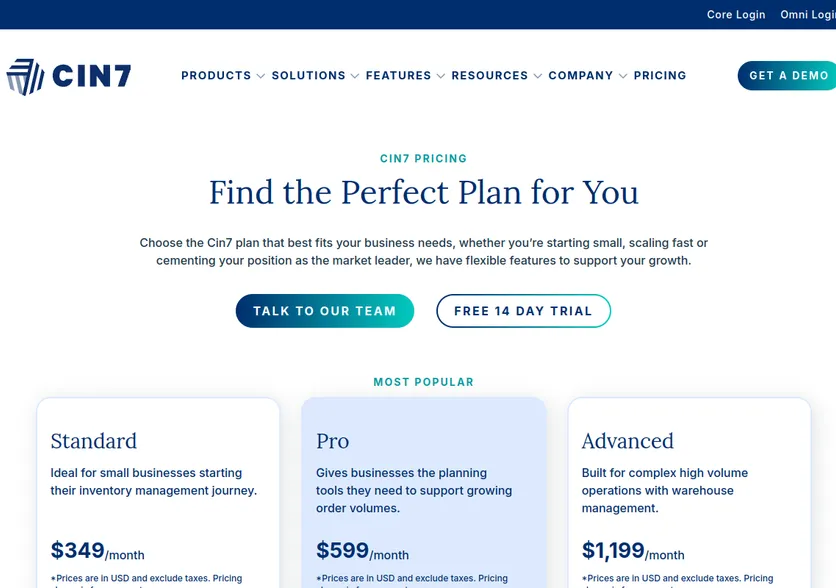
 Cin7 Core | Ecommerce brands selling on many channels that need stock and forecasting together | $349/month | Free 14-day trial; no free plan | Visit |
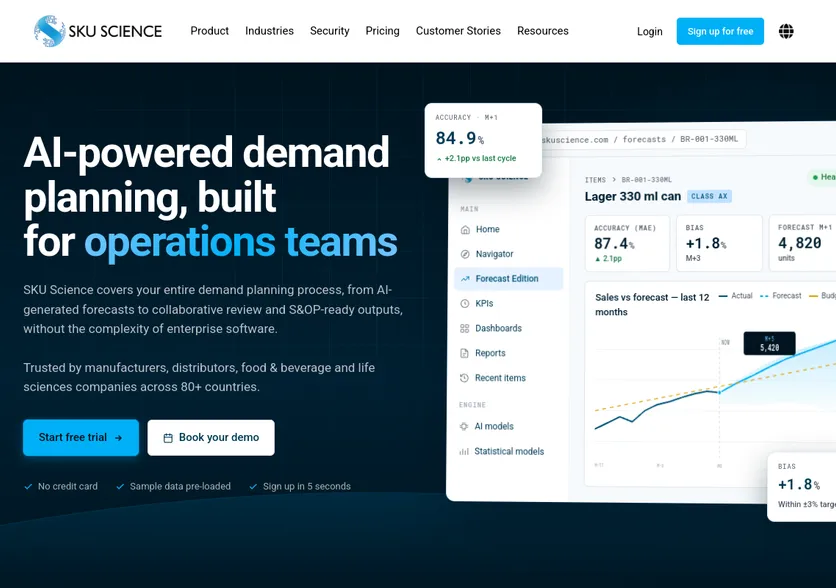
| SKU Science | Ecommerce brands that want statistical demand planning with ABC classification | $349/month | Free 15-day trial; no free plan | Visit |
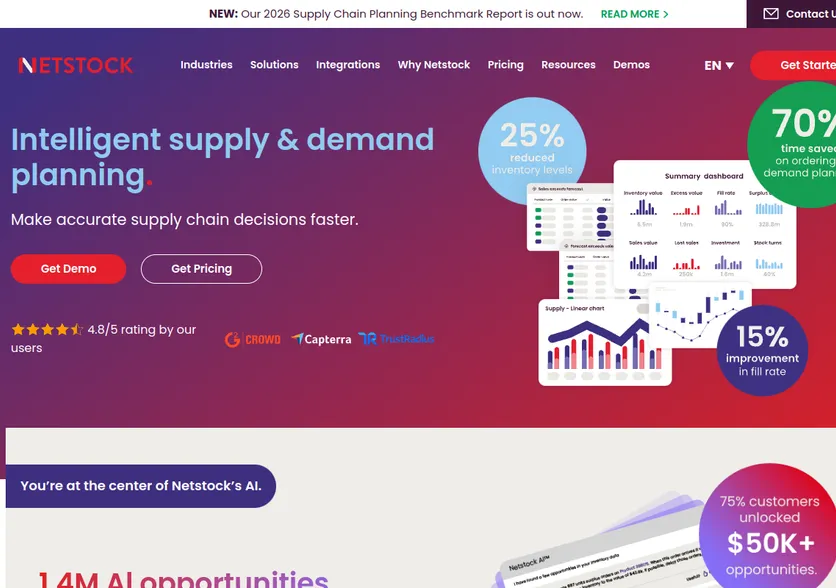
| Netstock | Larger ecommerce brands that want inventory optimization tied to their ERP | $900/month | Free demo; no free plan | Visit |
The inventory forecasting software for ecommerce brands, compared
1. Prediko
Best for: Ecommerce brands that want AI forecasts from Shopify sales data
Paid tool Starting price: $49/month · Forty-nine dollars per month for stores under one hundred thousand dollars in gross merchandise value, or forty-two dollars per month billed annually; higher GMV bands cost more, and a raw-materials and bills of materials add-on is twenty dollars per month
Free plan: Free 14-day trial; no free plan
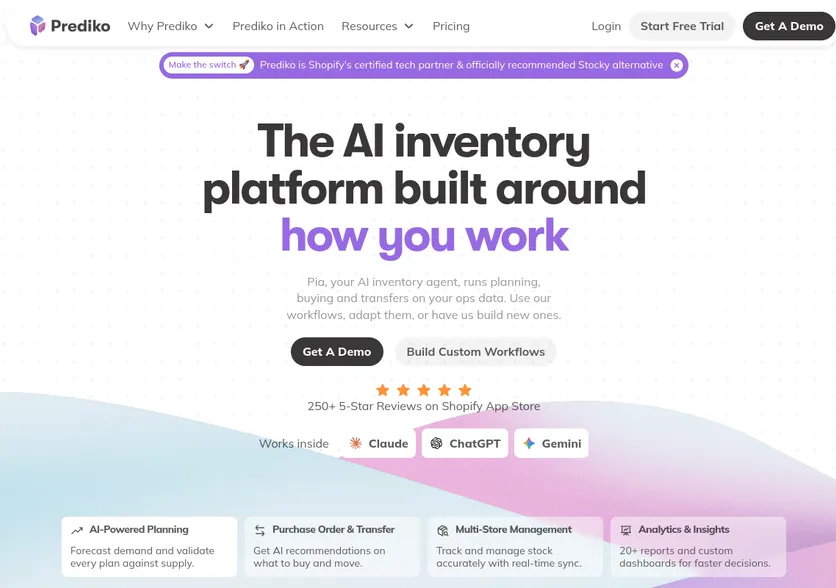
For an ecommerce brand that sells mainly through Shopify, Prediko is the cheapest dedicated forecaster here. This Prediko plan costs forty-nine dollars per month for stores under one hundred thousand dollars in gross merchandise value, and it turns Shopify sales history into demand forecasts, purchase recommendations and reorder alerts. It breaks forecasts down by variant, which matters when one size or colour sells out while the rest of a product sits. A raw-materials add-on covers components for brands that assemble their own goods.
What we like
- Variant-level forecasting included
- Purchase recommendations with reorder alerts
- Low forty-nine dollar entry price for small brands
Watch out for
- Price rises as your GMV band grows
- Shopify-first, so other channels need workarounds
How to try it
- Connect Shopify and let Prediko read your sales history
- Review the forecast by variant for each product
- Approve purchase recommendations and raise orders from them
2. StockTrim
Best for: Ecommerce brands that want simple revenue-based forecasting without per-user fees
Paid tool Starting price: $49/month · Forty-nine dollars per month billed annually for businesses under one hundred thousand dollars in annual revenue; monthly billing is sixty-seven dollars, and higher revenue bands cost more
Free plan: Free 14-day trial; no free plan
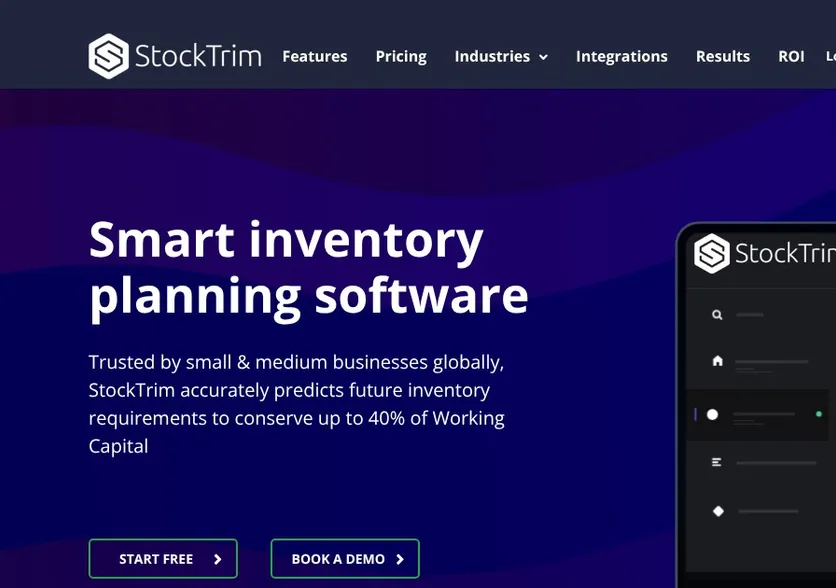
If you want forecasting without a planning team, StockTrim is the simplest route in this list. This StockTrim plan costs forty-nine dollars per month billed annually for businesses under one hundred thousand dollars in annual revenue, and it forecasts demand from sales history, then turns the forecast into suggested purchase orders. It suits ecommerce brands with a few hundred products that want a clear buy plan each month without paying for a planning department. Higher revenue bands cost more, so the price grows with the brand.
What we like
- Revenue-based pricing with no per-user fees
- Clear suggested orders each month
- Fast setup from sales history or a spreadsheet
Watch out for
- No dedicated raw-materials planning
- Price rises with the revenue band
How to try it
- Connect your store or upload sales history from a spreadsheet
- Check the forecast and suggested orders by product
- Approve the buy plan and send purchase orders to suppliers
3. Sumtracker
Best for: Ecommerce brands that want twelve-month forecasts with purchase orders
Paid tool Starting price: $119/month · One hundred and nineteen dollars per month for the Replenish plan, or one hundred dollars per month billed annually; Replenish adds purchase orders and twelve-month forecasting to the fifty-nine dollar Manage plan
Free plan: Free 14-day trial; no free plan
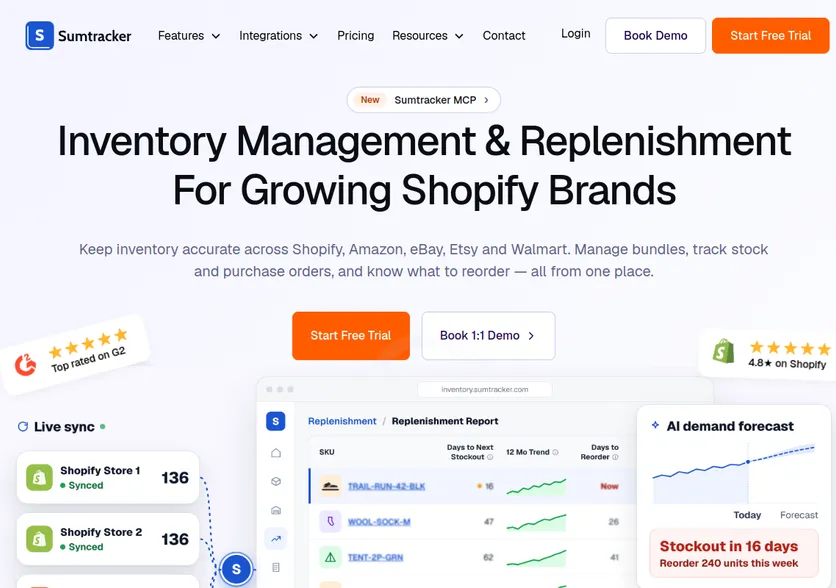
When next month is not far enough ahead, Sumtracker plans a full year. This Sumtracker plan costs one hundred and nineteen dollars per month for the Replenish plan, and it adds purchase orders and twelve-month forecasting to the basic stock sync. A brand can plan a whole quarter, raise orders against the forecast and watch stock move against it as the weeks pass. The cheaper Manage plan only syncs stock, so forecasting buyers need Replenish.
What we like
- Twelve-month forecasts with purchase orders
- Quarter planning in one view
- Priced by order volume, not by users
Watch out for
- Forecasting needs the Replenish plan, not Manage
- Multi-channel support is narrower than Cin7
How to try it
- Connect Shopify and sync stock across warehouses
- Open the twelve-month forecast for each product
- Raise purchase orders against the forecast and track them
4. Inventory Planner
Best for: Ecommerce brands on Shopify that want a proven forecasting tool with Sage backing
Paid tool Starting price: $119.99/month · One hundred and nineteen dollars and ninety-nine cents per thirty days for the Essentials tier on the Shopify App Store listing; the full Inventory Planner product is sold on a quoted basis, so confirm the current price before buying; the vendor's own homepage currently redirects to a domain-parking page, so Essentials is bought through its Shopify App Store listing
Free plan: Free 14-day trial; no free plan
For Shopify sellers who want the safest bet, Inventory Planner has the longest track record here. This Inventory Planner tier costs one hundred and nineteen dollars and ninety-nine cents per thirty days for the Essentials plan on the Shopify App Store, and it forecasts demand, suggests replenishment and automates purchase orders for Shopify stores. It is the most reviewed tool in this list, with one hundred and fifty-five Shopify reviews, and it is now owned by Sage. The full product is sold on a quoted basis.
What we like
- Most reviewed forecaster in this list
- Purchase order automation from forecasts
- Sage backing and long track record
Watch out for
- Full product is quote-based, not published
- Essentials tier is single warehouse only
How to try it
- Install the app from the Shopify App Store
- Let it build forecasts from your sales history
- Approve replenishment suggestions and automate purchase orders
5. Katana
Best for: Ecommerce brands that make products and need production in the forecast
Paid tool Starting price: $299/month · Two hundred and ninety-nine dollars per month for the Core plan; a free plan covers thirty SKUs, and Manufacturing, Traceability and Warehouse are paid add-ons
Free plan: Free plan for 30 SKUs
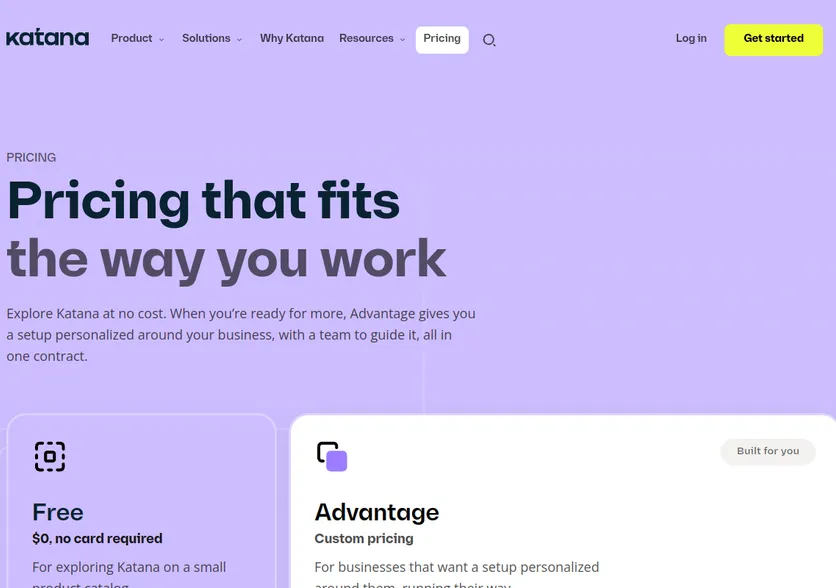
Katana is the pick here for brands that manufacture what they sell. This Katana plan costs two hundred and ninety-nine dollars per month, and it ties raw materials, production orders and finished stock together so a brand always knows what can be built today. It connects to Shopify, WooCommerce and QuickBooks, and the free plan covers thirty SKUs for a business testing the idea. Manufacturing, traceability and warehouse features are paid add-ons on top of the Core price.
What we like
- Raw materials and production in one view
- Strong Shopify and QuickBooks integrations
- Free plan for thirty SKUs to start
Watch out for
- Manufacturing features are paid add-ons
- Expensive if you only resell finished goods
How to try it
- Add products with bills of materials for everything you make
- Create production orders and allocate raw materials to them
- Track finished stock and sync sales to your store
6. Cin7 Core
Best for: Ecommerce brands selling on many channels that need stock and forecasting together
Paid tool Starting price: $349/month · Three hundred and forty-nine dollars per month on the Standard plan for five users and six thousand orders a year; Pro is five hundred and ninety-nine dollars, and ForesightAI forecasting is a paid add-on on every plan
Free plan: Free 14-day trial; no free plan
For an ecommerce brand selling on five channels at once, Cin7 Core is the multichannel workhorse in this list. This Cin7 Core plan costs three hundred and forty-nine dollars per month, and it holds stock, orders and accounting across Shopify, Amazon, eBay and wholesale channels in one system. Its ForesightAI forecasting is a paid add-on on every plan, which is the catch for buyers who want forecasting in the headline price. For a brand selling across five channels, the stock accuracy alone is worth the price.
What we like
- True multichannel stock in one system
- Accounting integrations included
- Handles wholesale alongside retail
Watch out for
- Forecasting is a paid add-on, not included
- Setup is heavier than a Shopify-only app
How to try it
- Connect every sales channel and warehouse to one stock view
- Turn on ForesightAI forecasting for the bestsellers
- Reorder from the forecast and sync stock everywhere
7. SKU Science
Best for: Ecommerce brands that want statistical demand planning with ABC classification
Paid tool Starting price: $349/month · Three hundred and forty-nine dollars per month billed annually on the Launch plan for one user and up to two thousand five hundred forecast units; Core is six hundred and twenty-five dollars per month and adds multi-user access and dashboards
Free plan: Free 15-day trial; no free plan
For an ecommerce brand with thousands of products, SKU Science brings statistical discipline to demand planning. This SKU Science plan costs three hundred and forty-nine dollars per month billed annually on the Launch plan, and it builds statistical forecasts from sales history with automatic ABC and XYZ classification. For an ecommerce brand with thousands of products, that classification shows which few items drive most of the profit and which can be cut. The Launch plan is limited to one user and two thousand five hundred forecast units.
What we like
- Statistical forecasts with ABC and XYZ classification
- Built for SKU-level planning, not generic stock
- Forecast accuracy tracking included
Watch out for
- Launch plan is single-user only
- No inventory or order management included
How to try it
- Upload sales history and map products to forecast units
- Review the ABC and XYZ classification for your range
- Approve the statistical forecast and export the buy plan
8. Netstock
Best for: Larger ecommerce brands that want inventory optimization tied to their ERP
Paid tool Starting price: $900/month · Nine hundred dollars per month for the Essentials plan on an annual term; Advanced starts at one thousand five hundred dollars and Commercial at two thousand dollars per month, with implementation taking six to ten weeks
Free plan: Free demo; no free plan
Ecommerce brands whose stock decisions run through an ERP will find Netstock at the enterprise end of this list. This Netstock plan costs nine hundred dollars per month for the Essentials plan on an annual term, and it optimizes inventory levels, safety stock and order timing from ERP data. It suits ecommerce brands with a warehouse and a planning team that need defensible numbers for every buy. Implementation takes six to ten weeks, so it is a commitment rather than a quick install.
What we like
- ERP-grade inventory optimization
- Safety stock and order timing built in
- Trusted by larger brands and distributors
Watch out for
- Nine hundred dollar starting price is high
- Six to ten week implementation
How to try it
- Connect Netstock to your ERP and import sales history
- Review the optimized stock and safety stock levels
- Approve order recommendations and track forecast accuracy
Prices above were checked on each vendor’s own website on Nov 28, 2026 and can change — the vendor’s page is the final word. Vendor links are editorial: nobody paid to be listed or ranked here. Vendors who want a featured listing can see how it works on our Get listed page.
How an ecommerce brand should forecast demand
Start with the last quarter, not the next one. Pull sales history by product and variant, and mark which variants sold out and which were left over, because the pattern repeats more than most buyers expect. Forecast variants separately, since demand for one size or colour can be double that of another, and build the buy plan from the forecast rather than from a gut feeling about the range. Leave ten to fifteen percent of the budget uncommitted for reorders, so a hit product can be topped up while it is still selling. Finally, review sell-through every week and move marketing spend toward the variants you actually hold, not the ones that already sold out.
Before you buy
- Check that forecasts cover every sales channel, not just your main store
- Confirm whether the tool plans raw materials alongside finished stock
- Ask how the forecast handles promotions, holidays and seasonal spikes
- Count the cost per forecast unit or GMV band so growth does not surprise you
- Run a trial on last quarter with your real sales history and compare the forecast to what sold
Official websites
Official websites of the products reviewed above. Features and prices were checked against these sites when this guide was written, and they can change, so confirm on the vendor site before you buy.
Frequently asked questions
What is inventory forecasting software for ecommerce brands?
It is software that predicts how much of each product will sell, then turns that prediction into a buy plan. The tools in this list use sales history to forecast demand, flag overstock and suggest purchase orders, so a brand orders what will sell instead of guessing. For ecommerce the forecast must cover every channel, since a product can sell out on Amazon while sitting on your own store.
How much does inventory forecasting software cost for ecommerce brands?
The tools in this list start at forty-nine dollars a month for Prediko and StockTrim, with Sumtracker at one hundred and nineteen dollars and Inventory Planner at one hundred and nineteen dollars and ninety-nine cents per thirty days. Katana costs two hundred and ninety-nine dollars, Cin7 Core and SKU Science cost three hundred and forty-nine dollars, and Netstock starts at nine hundred dollars a month.
What does Prediko cost for an ecommerce brand?
Prediko costs forty-nine dollars a month for stores under one hundred thousand dollars in gross merchandise value, or forty-two dollars a month billed annually. It forecasts demand from Shopify sales history, breaks forecasts down by variant, and raises purchase recommendations with reorder alerts. A raw-materials add-on for components costs twenty dollars a month.
How do I test a forecasting tool before buying it?
Start with last quarter. Feed a tool your real sales history for the quarter that just ended and compare its forecast with what actually sold, product by product. Prediko and StockTrim are the cheapest way to run that test, and both offer a fourteen-day trial. If the forecast misses your bestsellers by a wide margin, the tool is not reading your demand patterns well enough.
What mistakes do ecommerce brands make when forecasting inventory?
The two most common mistakes are forecasting at product level instead of variant level, and buying a full season of a new product before it has any sales history. Forecast variants separately, since demand varies sharply by size or colour, and treat a new product as a small test order until the first weeks of sales show whether it moves. Review sell-through weekly and reorder fast on the variants that sell.
Compare the eight tools above, then start with a free trial on the tool that matches how your brand sells online before you pay for a full year.
Browse Business Tools tools