On this page
A startup writes its documentation while it builds the product, and the docs have to keep up with a team that doubles every few months. The right tool is cheap to start, fast to write in, and able to grow from a founder's notes into a customer-facing help center. Notion leads this list because its $10-a-month Plus plan covers docs, wikis and project notes in one workspace, and the other eight tools are judged on the same practical test: how well they scale from three people to thirty without a rebuild.
How we researched this
We checked every price on the vendor pricing page on November 28, 2026, and only included tools with a published US dollar list price and a free trial or free plan. Two names in this category publish no prices any more, Document360 and Guru, so they are not in this list. Prices change, so confirm the current figure on the vendor site before you buy.
Compare the tools
| Name | Best for | Starting price | Free plan | |
|---|---|---|---|---|
 Notion | Startups that want docs, wikis and notes in one workspace | $10/member/month | Free plan | Visit |
 Nuclino | Startups that need a wiki today, with nothing to configure | $6/user/month | Free plan capped at 50 items | Visit |
 Slab | Startups that want a tidy internal wiki as the team grows | $6.67/user/month | Free plan for up to 10 users | Visit |
 Tettra | Startups that answer questions in Slack | $8/user/month | 30-day free trial | Visit |
 Slite | Startups that work async across time zones | $10/user/month | 14-day free trial; no free plan | Visit |
 Scribe | Startups onboarding their first hires with recorded procedures | $25/seat/month | Free Basic plan | Visit |
| Docsie | Startups that turn how-to videos into written documentation | $25/month | Free plan | Visit |
 Archbee | Startups that want customer-facing docs from day one | $49/month | 14-day free trial; no free plan | Visit |
 KnowledgeOwl | Startups with one person writing docs for everyone else | $100/month | 30-day free trial; no free plan | Visit |
The IT documentation software for startups, compared
1. Notion
Best for: Startups that want docs, wikis and notes in one workspace
Paid tool Starting price: $10/member/month · Plus $10 per member a month billed annually, or $12 on monthly billing; Business $20; Enterprise by quote; a free plan exists
Free plan: Free plan
A startup that lives in Notion can run its whole company on the $10-a-member-a-month Plus plan, with docs, wikis, databases and project notes in one workspace. Founders keep the roadmap, the handbook and the investor updates in the same place, and pages link together like a private website. The free plan covers a tiny team, and Plus adds the history and permissions that matter once hiring starts.

What we like
- Docs, wikis and databases share one workspace
- Flexible pages fit almost any startup workflow
- Free plan is generous for a tiny team
Watch out for
- Flexibility means the team must design its own structure
- Offline access is limited compared with desktop wikis
How to try it
- Set up a workspace with pages for the roadmap and handbook
- Link related pages together so the team can browse by topic
- Add databases for tracking projects, hires and customers
2. Nuclino
Best for: Startups that need a wiki today, with nothing to configure
Paid tool Starting price: $6/user/month · Starter $6 per user a month billed annually, or $8 on monthly billing; Business $10; a free plan is capped at 50 items
Free plan: Free plan capped at 50 items
For a startup that needs a wiki today, Nuclino is the fastest start at $6 per user a month billed annually. The clean editor and visual page graph mean the handbook is written in an afternoon, with nothing to configure and no structure to design first. The free plan caps at 50 items, which covers the earliest docs, and guests count as paid users once the team grows.

What we like
- Fastest start in this list, nothing to configure
- Visual graph shows how pages connect
- Cheap at $6 a user a month
Watch out for
- Guests and read-only members count as paid users
- Fewer integrations than the bigger wiki tools
How to try it
- Create collections for the handbook, product and procedures
- Write pages in the clean editor and link them together
- Use the visual graph to spot topics with no documentation
3. Slab
Best for: Startups that want a tidy internal wiki as the team grows
Paid tool Starting price: $6.67/user/month · Startup $6.67 per user a month billed annually; Business $12.50; Enterprise is custom with a 100-user minimum; free for up to 10 users
Free plan: Free plan for up to 10 users
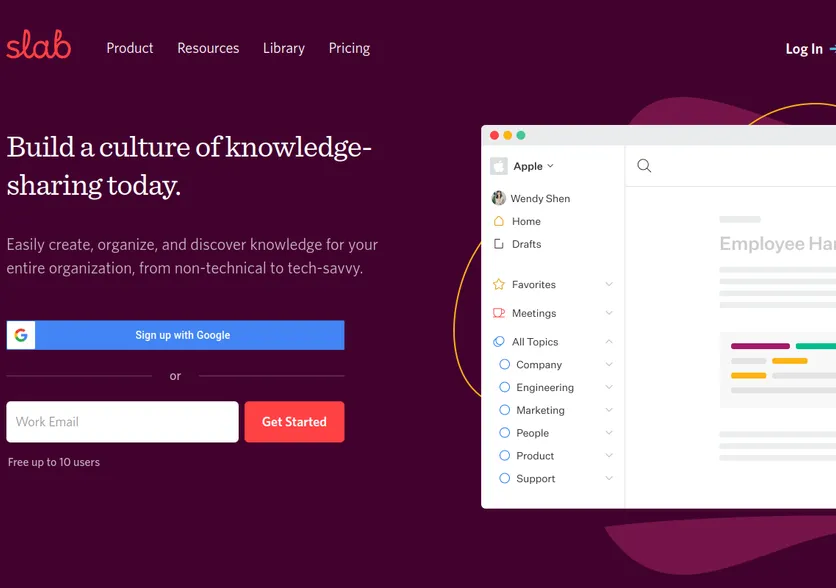
Slab suits a startup that wants its internal wiki to stay tidy as the team grows, at $6.67 per user a month billed annually. Topics organize the handbook and procedures, fast search finds answers without asking the founder, and integrations surface docs in Slack and other tools. The free plan covers up to 10 users, which carries a startup through its first hires.
What we like
- Clean design with fast, reliable search
- Topics keep the handbook organized
- Free plan covers up to 10 users
Watch out for
- Enterprise needs 100 users, so large teams pay custom prices
- Fewer templates than the biggest wiki tools
How to try it
- Organize the handbook and procedures into topics
- Connect integrations so docs surface in Slack and other tools
- Let new hires search the wiki before they ask questions
4. Tettra
Best for: Startups that answer questions in Slack
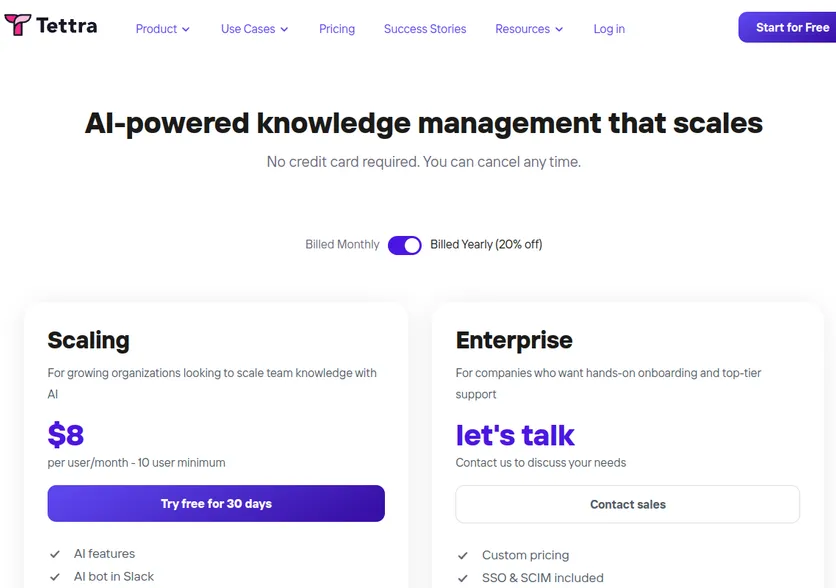
Paid tool Starting price: $8/user/month · Scaling $8 per user a month billed annually, or $10 on monthly billing, with a 10-user minimum; Enterprise by quote; 30-day free trial
Free plan: 30-day free trial
Tettra fits a startup that answers questions in Slack, at $8 per user a month billed annually. When a new hire asks how something works, Tettra suggests the documented answer, and the questions nobody can answer become the next pages to write. The 10-user minimum sets the floor at $80 a month, so it pays once the team is past the founding few.
What we like
- Answers surface inside Slack where questions happen
- Unanswered questions become a writing list
- Verification keeps pages trustworthy
Watch out for
- The 10-user minimum sets an $80 a month floor
- Slack is central, so teams off Slack get less value
How to try it
- Connect Tettra to Slack and import the existing docs
- Let it suggest answers when teammates ask questions
- Turn unanswered questions into new pages to write
5. Slite
Best for: Startups that work async across time zones
Paid tool Starting price: $10/user/month · Basic $10 per user a month billed annually; Pro $20; Enterprise by quote; no free plan, 14-day trial
Free plan: 14-day free trial; no free plan
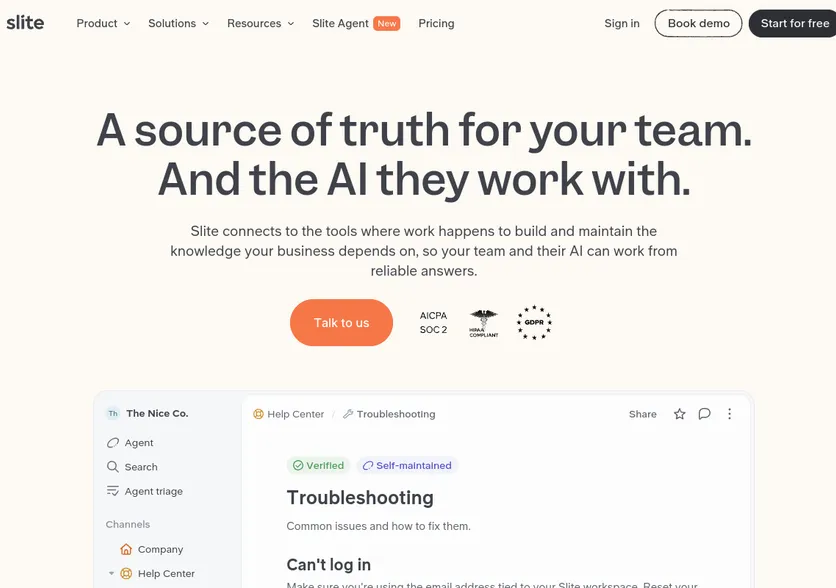
Slite is built for the async startup, at $10 per user a month billed annually. Docs carry verification dates, so a team spread across time zones knows which pages are still true, and AI helps draft and find pages fast. There is no free plan, only a 14-day trial, so use the trial to write the handbook and test the workflow for real.
What we like
- Verification dates flag stale pages automatically
- Built for async teams that rarely meet
- AI helps draft and find pages
Watch out for
- No free plan, only a 14-day trial
- Smaller integration list than the biggest wikis
How to try it
- Write the handbook and key procedures in Slite
- Set verification dates so stale pages get flagged
- Use AI search to find answers across all docs
6. Scribe
Best for: Startups onboarding their first hires with recorded procedures
Paid tool Starting price: $25/seat/month · Pro Personal $25 per seat a month billed annually, or $35 on monthly billing; Pro Team $13 per seat a month with a 5-seat minimum; Basic is free
Free plan: Free Basic plan
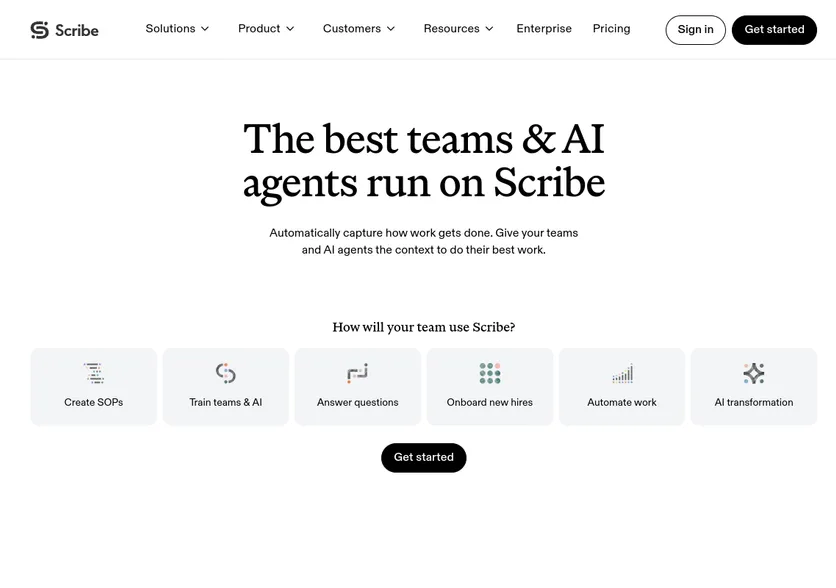
A startup onboarding its first hires can record each procedure once with Scribe and get a step-by-step guide for $25 per seat a month billed annually. The guide carries screenshots and the exact clicks, so a new hire follows it without pulling the founder away. Pro Team drops the rate to $13 a seat for five or more, and the free Basic plan covers web capture.
What we like
- Guides generate themselves from a recorded fix
- Screenshots and steps come out ready to share
- Free Basic plan covers web capture
Watch out for
- Pro Team needs at least five seats to get the low rate
- Desktop capture and exports need a paid plan
How to try it
- Record the procedure once while you do it for real
- Edit the generated guide and add notes where a step is tricky
- Share the guide with new hires during onboarding
7. Docsie
Best for: Startups that turn how-to videos into written documentation
Paid tool Starting price: $25/month · Hobby $25 a month billed annually, or $29 on monthly billing, for 1 seat; Starter $83 a month for 5 seats; Premium $170; a free plan exists
Free plan: Free plan
Docsie turns a startup's how-to videos into written documentation for $25 a month billed annually on the Hobby plan. Record the product walkthrough once and get a written guide for the knowledge base, instead of writing the same procedure twice. The free plan includes a knowledge base on your own domain, so a pre-revenue startup can publish before it pays.

What we like
- Video-to-docs saves writing time
- Knowledge base runs on your own domain
- Free plan lets a tiny team publish first
Watch out for
- Extra seats cost $10 each on the higher plans
- AI credits are metered, so heavy use costs more
How to try it
- Upload a how-to video and let Docsie draft the written guide
- Edit the draft and publish it to your knowledge base
- Import existing PDFs and websites to fill the gaps
8. Archbee
Best for: Startups that want customer-facing docs from day one
Paid tool Starting price: $49/month · Growing $49 a month billed annually, or $59 on monthly billing, with 1 team member included and extra members $5 a month; Scaling $199 a month; Enterprise by quote
Free plan: 14-day free trial; no free plan
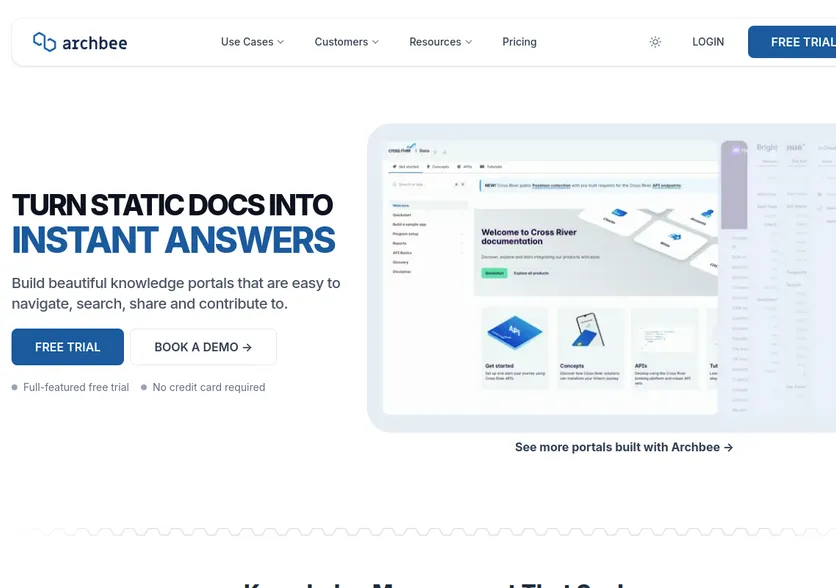
Archbee gives a startup customer-facing docs from day one for $49 a month billed annually on Growing. Product docs, API guides and changelogs publish on a custom domain with search and versioning, so the docs look serious before the company is big. Extra members cost $5 a month each, and AI capabilities are $49 a month add-ons on top of the plan.
What we like
- Docs-first editor built for customer-facing docs
- Custom domain, search and versioning included
- Extra members cost only $5 a month each
Watch out for
- No free plan, only a 14-day trial
- AI and other capabilities are paid add-ons
How to try it
- Set up the docs site with your domain and branding
- Write product docs, API guides and changelogs in the editor
- Publish versions and keep the changelog current
9. KnowledgeOwl
Best for: Startups with one person writing docs for everyone else
Paid tool Starting price: $100/month · Basic $100 a month for one author and one knowledge base; Pro $250; Business $500; Enterprise $1,250; extra authors $25 a month each
Free plan: 30-day free trial; no free plan
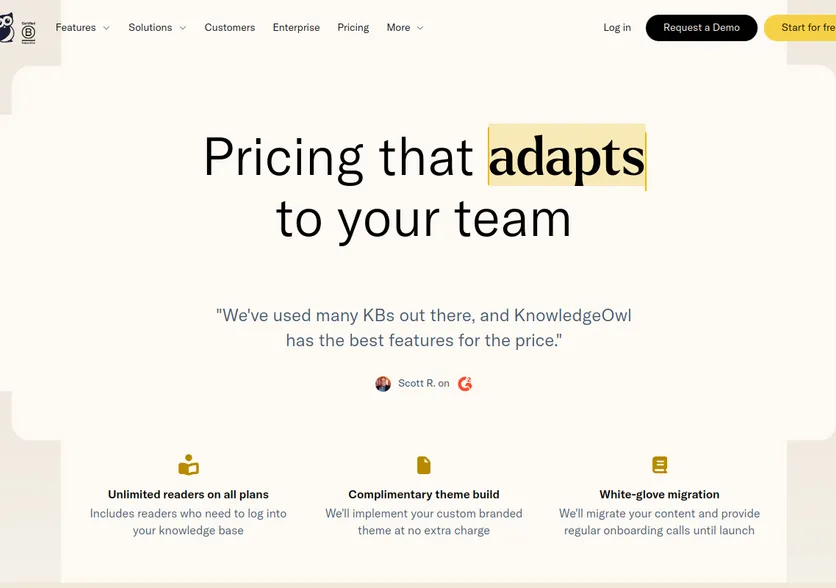
KnowledgeOwl fits a startup with one person writing docs for everyone else, at $100 a month for one author and unlimited readers. The knowledge base supports a custom domain, version control and AI search, and extra authors cost $25 a month each. The 30-day trial is the longest in this list, which gives a small team time to write a real help center before paying.
What we like
- Readers are free, you pay only for authors
- Custom domain and full branding control
- Version control keeps every article edit traceable
Watch out for
- No free plan, only a 30-day trial
- Single sign-on needs the Business plan
How to try it
- Set up the knowledge base with your domain and branding
- Write articles with version control so edits are easy to track
- Publish to unlimited readers and check search analytics monthly
Prices above were checked on each vendor’s own website on Nov 28, 2026 and can change — the vendor’s page is the final word. Vendor links are editorial: nobody paid to be listed or ranked here. Vendors who want a featured listing can see how it works on our Get listed page.
How a startup should run its documentation
Start with the onboarding docs, not the product manual. The first ten pages a startup needs are the ones a new hire reads in week one: how the product works, how the team ships, and who to ask about what. Keep one system as the home for all of it, because docs scattered across drives and chats are docs nobody can find when the team doubles. Write short pages with the exact steps, and give every page an owner, since a page nobody owns is a page nobody updates. Finally, publish the customer-facing docs early, because a help center that exists on day one saves the founders from answering the same five questions forever.
Before you buy
- Check that the free plan covers your founding team, not just one or two people
- Confirm how the price grows as the team doubles, including minimums and extra members
- Ask whether the tool can publish a public help center as well as an internal wiki
- Count the cost of AI features separately, since many vendors charge for them as add-ons
- Run a trial by onboarding one new hire using only the docs, and see where they get stuck
Official websites
Official websites of the products reviewed above. Features and prices were checked against these sites when this guide was written, and they can change, so confirm on the vendor site before you buy.
Frequently asked questions
What is IT documentation software for startups?
It is software that stores a startup's procedures, product notes and onboarding guides in one place the whole team can find. The tools in this list cover wikis, knowledge bases and auto-generated guides, from $6 a user a month to $100 a month flat. A startup needs it because the knowledge usually lives in the founders' heads, and the team cannot scale while every answer comes from one person.
How much does IT documentation software cost for a startup?
The tools in this list start at $6 a user a month for Nuclino Starter and $6.67 for Slab Startup, with free plans on both. Notion Plus costs $10 a member a month, Slite Basic $10 and Tettra Scaling $8, while Docsie Hobby is $25 a month flat, Archbee Growing $49 and KnowledgeOwl Basic $100. A team of ten pays roughly $60 to $100 a month on the cheapest plans.
Which tool is best for startup documentation?
Notion is the best overall pick, since its $10-a-month Plus plan covers docs, wikis and project notes in one workspace that scales with hiring. Slab is the cleanest internal wiki at $6.67 a user a month, with a free plan for up to 10 users. Scribe is the best pick for onboarding, since it turns a recorded procedure into a guide for $25 a seat a month.
When should a startup publish customer-facing docs?
From day one, or as soon as the first customer asks the same question twice. Archbee and Docsie publish a knowledge base on your own domain from $25 to $49 a month, and KnowledgeOwl does the same for $100. A public help center deflects support tickets before you hire a support team, and it makes a small startup look established. Keep internal procedures private and publish only what customers need.
How do I keep startup docs current as the team grows?
Give every page an owner and a date, and review the set once a month while the team is small. Slite builds this in with verification dates, while other tools need a simple routine: the page owner checks it when the procedure changes. Let the people doing the work write the docs, and keep pages short, since a startup changes fast and a stale page misleads a new hire.
Compare the nine tools above, then start with a free plan on the tool that matches how your team already works before you pay for anything.
Browse Business Tools tools