On this page
A team that cannot find its own answers wastes hours repeating work, and a knowledge base fixes that by putting docs, decisions and guides in one searchable place. The eight tools below run from a free plan to about two hundred fifty dollars a month, and every price was checked on the vendor site on November 26, 2026. Most include search, templates and access controls, so compare the whole package rather than the headline price alone. Confluence is our first pick — the most natural docs home for a team that plans in Jira.
How we researched this
We started with the knowledge base tools teams actually buy, then read each price on the vendor pricing page on November 26, 2026 and noted the free trial each plan carries. We judged them for a team that needs shared docs, wikis and help centers in one place, with search and access controls included, and we kept only tools with a published price. We dropped Document360 and Guru because neither publishes a price.
Compare the tools
| Name | Best for | Starting price | Free plan | |
|---|---|---|---|---|
 Confluence | Teams that already use Atlassian tools and want docs next to their projects | $7.15/user/month | Free plan for up to 10 users | Visit |
 Notion | Teams that want docs, wikis and databases in one flexible workspace | $10/user/month | Free plan for individuals and small teams | Visit |
 Help Scout | Teams that want a shared inbox and a help center from one vendor | $25/user/month | Free plan for up to 5 users and 1 Docs site; 15-day free trial, no card required | Visit |
 Helpjuice | Teams that expect heavy support traffic and want a flat price with no per-author math | $249/month | No free plan; 14-day free trial, no card required | Visit |
 KnowledgeOwl | Teams that want a no-nonsense knowledge base with strong access controls | $100/month | No free plan; free trial available | Visit |
 GitBook | Teams that want beautiful public docs with a strong editor and version control | $65/site/month | Free plan for individuals; 14-day free trial | Visit |
 Slab | Teams that want a simple wiki with a generous free tier | $6.67/user/month | Free plan for up to 10 users | Visit |
 Tettra | Teams that want internal docs with Slack answers and simple upkeep | $8/user/month | No free plan; 30-day free trial, no card required | Visit |
The knowledge base software for teams, compared
1. Confluence
Best for: Teams that already use Atlassian tools and want docs next to their projects
Paid tool Starting price: $7.15/user/month · Standard plan, about seven dollars a user a month on monthly billing; Premium about fourteen dollars; free plan for up to 10 users
Free plan: Free plan for up to 10 users
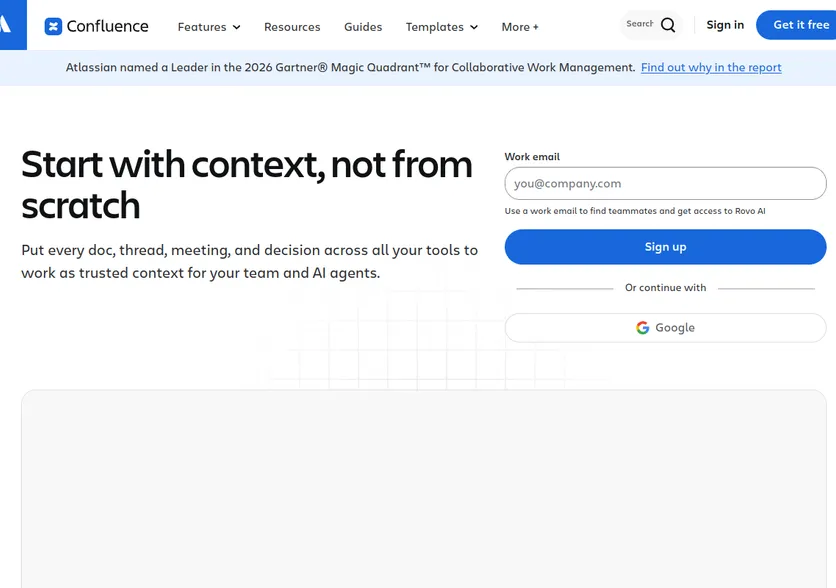
Confluence is the team workspace from Atlassian, where docs, meeting notes and project pages live next to Jira tickets. This Confluence Standard plan costs about seven dollars a user a month on monthly billing, and the free plan covers up to ten users. A team that already plans work in Jira will find Confluence the natural home for its docs.
What we like
- Sits next to Jira for planning teams
- Free plan for up to ten users
- Page templates speed up meeting notes and plans
Watch out for
- Per-user pricing climbs with a big team
- Feels heavy for teams that only need simple help docs
How to try it
- Claim the Confluence free plan for your team
- Create a space for your team and add your first pages
- Link pages to Jira tickets and set up templates
2. Notion
Best for: Teams that want docs, wikis and databases in one flexible workspace
Paid tool Starting price: $10/user/month · Plus plan, $10 a user a month billed annually or $12 billed monthly; Business $20 a user a month billed annually
Free plan: Free plan for individuals and small teams
Notion is the flexible workspace where a team can run a wiki, a project tracker and a database without switching apps. This Notion Plus plan costs ten dollars a user a month on annual billing, and the free plan suits a small team getting started. A team that likes shaping its own system will find Notion hard to outgrow.

What we like
- Docs, wikis and databases in one place
- Flexible blocks the team can shape freely
- Free plan for small teams
Watch out for
- Flexibility means setup time before it feels organized
- Search can feel slow in very large workspaces
How to try it
- Start the Notion free plan and build a team wiki
- Add a database for projects and link it to your docs
- Invite the team and set up templates for repeat pages
3. Help Scout
Best for: Teams that want a shared inbox and a help center from one vendor
Paid tool Starting price: $25/user/month · Standard plan, $25 a user a month billed annually or $30 billed monthly; Plus $45 and Pro $75 a user a month
Free plan: Free plan for up to 5 users and 1 Docs site; 15-day free trial, no card required
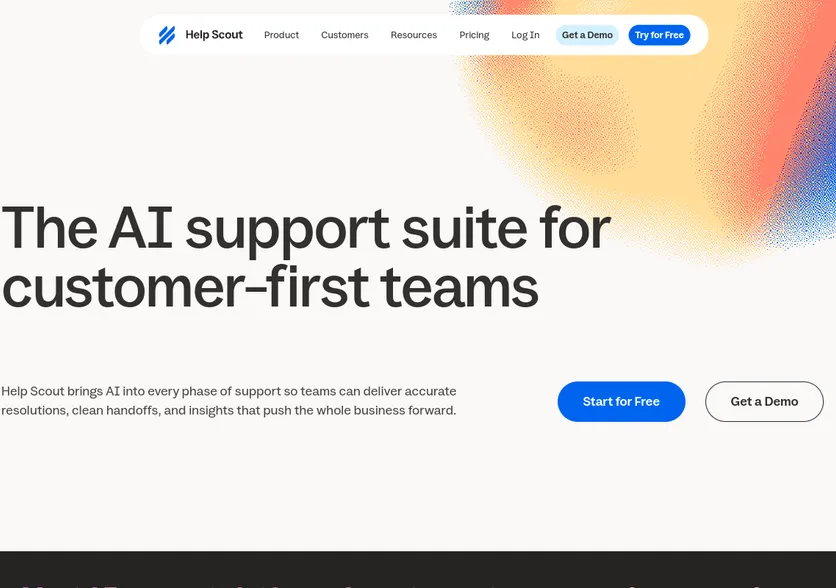
Help Scout pairs a shared inbox with Docs, so the same team that answers email also writes the help articles. This Help Scout Standard plan costs twenty-five dollars a user a month on annual billing, and the free plan covers up to five users and one Docs site. A team that wants support and docs in one login will save time switching less.
What we like
- Shared inbox and help center in one login
- Free plan for up to five users
- Docs site looks clean and professional
Watch out for
- Docs is a side product, not the whole focus
- Per-user pricing adds up with a big support team
How to try it
- Claim the Help Scout free plan and set up your inbox
- Publish your first Docs site with ten articles
- Link Docs articles into your email replies
4. Helpjuice
Best for: Teams that expect heavy support traffic and want a flat price with no per-author math
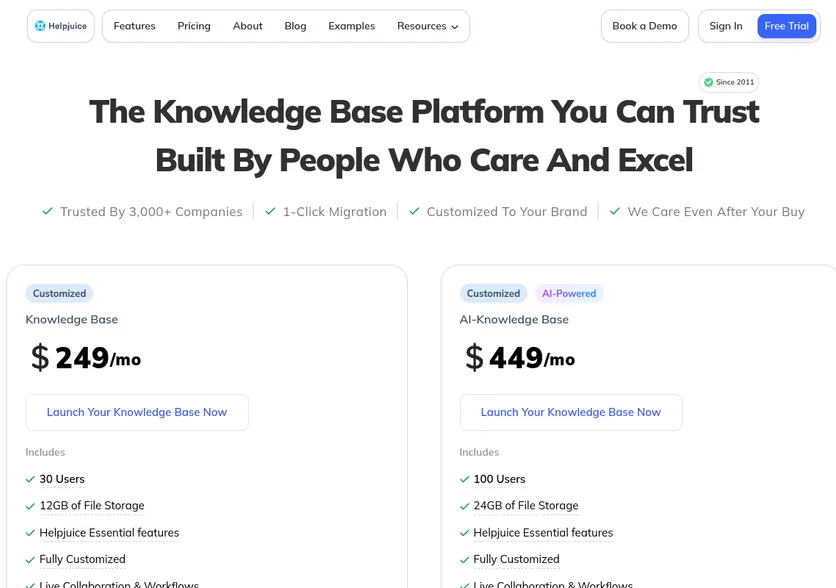
Paid tool Starting price: $249/month · Knowledge Base plan, $249 a month flat for 30 users and 12 GB of storage; AI-KB $449 and Unlimited $799 a month
Free plan: No free plan; 14-day free trial, no card required
For a team drowning in repeat support tickets, Helpjuice offers a dedicated knowledge base with analytics that show which articles actually deflect tickets. This Helpjuice Knowledge Base plan costs two hundred forty-nine dollars a month flat for thirty users, so a growing team pays the same as a small one. A support team that measures deflection will find the analytics worth the flat fee.
What we like
- Flat price with thirty users included
- Analytics show which articles deflect tickets
- Fast search tuned for support teams
Watch out for
- Two hundred forty-nine dollars is steep for a small team
- No free plan, so the trial is the only test
How to try it
- Start the Helpjuice 14-day trial
- Import your support articles and set up categories
- Review the deflection analytics after two weeks
5. KnowledgeOwl
Best for: Teams that want a no-nonsense knowledge base with strong access controls
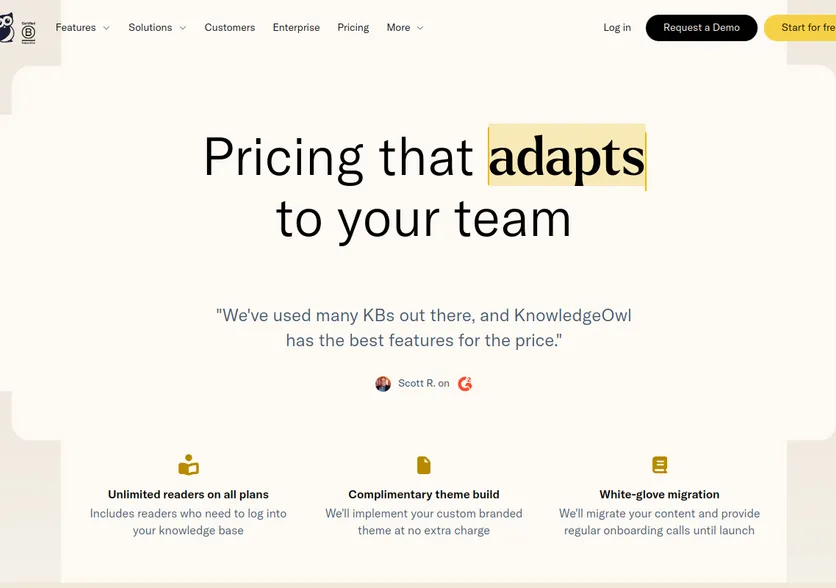
Paid tool Starting price: $100/month · Basic plan, $100 a month; Pro $250 and Business $500 a month; extra authors $25 each and extra knowledge bases $50 each
Free plan: No free plan; free trial available
KnowledgeOwl suits a team that needs both public help and private staff docs, with access controls that keep the two apart. This KnowledgeOwl Basic plan costs one hundred dollars a month flat, with extra authors at twenty-five dollars each. A team with internal procedures and customer help to run will like the clean split.
What we like
- Public and private docs in one account
- Flat price with no per-author surprises on Basic
- Access controls keep staff docs private
Watch out for
- One hundred dollars is a lot for a small team
- Interface feels plainer than newer rivals
How to try it
- Open the KnowledgeOwl pricing page and start a trial
- Build a public help center and a private staff space
- Set access rules and publish your first articles
6. GitBook
Best for: Teams that want beautiful public docs with a strong editor and version control
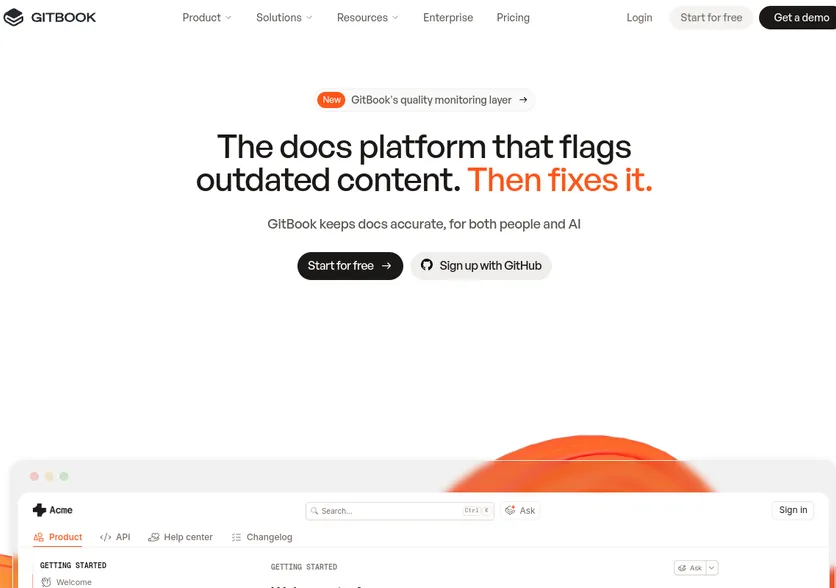
Paid tool Starting price: $65/site/month · Essential plan, $65 a site a month billed annually or $79 billed monthly, plus $12 a user a month; Ultimate $249 a site a month
Free plan: Free plan for individuals; 14-day free trial
GitBook gives a team beautiful public documentation with version history and a modern block editor. This GitBook Essential plan starts at sixty-five dollars a site a month on annual billing, plus a per-user fee, and the free plan suits a solo founder. A team that ships docs alongside its product will like how polished the result looks.
What we like
- Beautiful docs with a modern block editor
- Version history keeps every change safe
- Free plan for a solo founder
Watch out for
- Per-site plus per-user pricing needs a calculator
- Costs climb once the whole team needs seats
How to try it
- Start the GitBook free plan and create a team space
- Write your onboarding guide with the block editor
- Publish the docs and link them from your product
7. Slab
Best for: Teams that want a simple wiki with a generous free tier
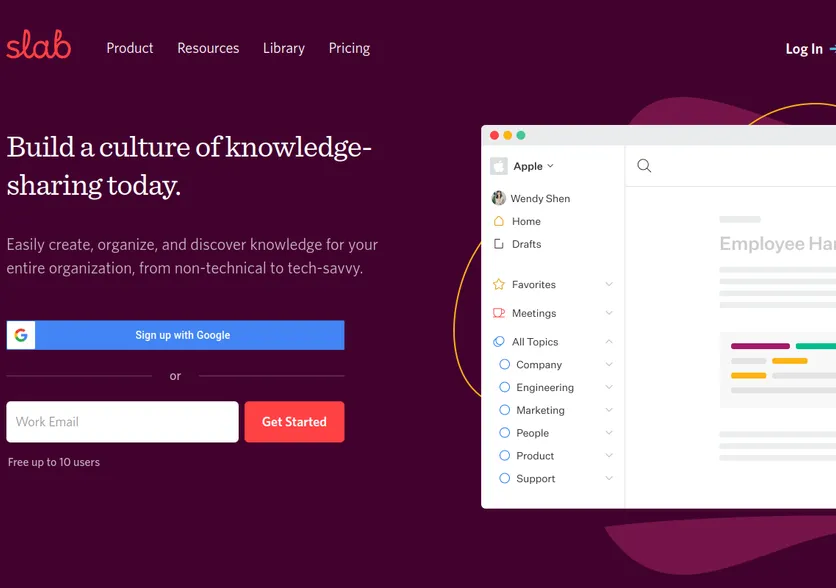
Paid tool Starting price: $6.67/user/month · Startup plan, about seven dollars a user a month billed annually or eight dollars billed monthly; Business about thirteen dollars a user a month billed annually
Free plan: Free plan for up to 10 users
Slab keeps a team's product docs, onboarding guides and meeting notes in one fast, searchable wiki. This Slab Startup plan costs about seven dollars a user a month on annual billing, with the free plan covering up to ten users. A team that opens docs all day will notice how quick Slab feels next to heavier wikis.
What we like
- Generous free plan for up to ten users
- Fast editor the whole team learns quickly
- Search finds pages across every topic
Watch out for
- Per-user pricing climbs as the team grows
- Fewer support features than dedicated help tools
How to try it
- Claim the Slab free plan for your team
- Create topics for product, onboarding and support
- Move your scattered docs into Slab and invite the team
8. Tettra
Best for: Teams that want internal docs with Slack answers and simple upkeep
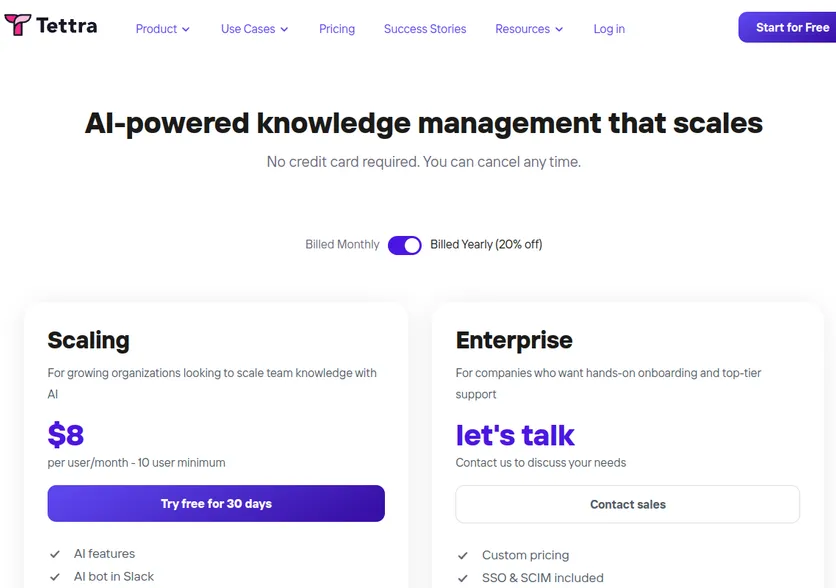
Paid tool Starting price: $8/user/month · Scaling plan, $8 a user a month billed annually or $10 billed monthly, with a ten-user minimum; 30-day free trial, no card required
Free plan: No free plan; 30-day free trial, no card required
Tettra brings internal answers into Slack, so a team finds what it needs without leaving chat. This Tettra Scaling plan costs eight dollars a user a month on annual billing, with a ten-user minimum that sets the floor at eighty dollars a month. A team that lives in Slack will get more answers from Tettra than from a wiki nobody opens.
What we like
- Answers surface right inside Slack
- Verification reminders keep docs fresh
- Thirty-day trial with no card required
Watch out for
- Ten-user minimum sets an eighty-dollar floor
- Built for internal docs, not public help
How to try it
- Start the Tettra 30-day trial and connect Slack
- Write answers to the ten questions your team asks most
- Ask in Slack and watch Tettra surface the answers
Prices above were checked on each vendor’s own website on Nov 26, 2026 and can change — the vendor’s page is the final word. Vendor links are editorial: nobody paid to be listed or ranked here. Vendors who want a featured listing can see how it works on our Get listed page.
What knowledge base software costs for a team in 2026
Most teams pay per user, so the headline price is only part of the budget here, and this list runs from free to about two hundred fifty dollars a month. A ten-person team on a per-user plan pays ten times the sticker price, while a flat-fee tool like Helpjuice costs the same for thirty users. The headline plan each vendor shows on its own pricing page is the number in the table above, checked on November 26, 2026.
Start with the free trial on two tools and move ten real team docs into each one, from meeting notes to help articles. Compare how fast the search finds them, how easy it is to set permissions, and whether the editor feels quick. Pick the tool your team actually opens every day, because a wiki nobody visits is money wasted.
Before you buy
- Count the seats first, because per-user pricing multiplies the bill across the whole team.
- Check the free plan limits, because some free plans cap users at five or ten.
- Test the search with real questions, because a wiki that cannot find answers is useless.
- Confirm who can see what, because private staff docs need real access controls.
- Compare annual and monthly billing, because most tools here cut the price by a fifth on annual plans.
Official websites
Official websites of the products reviewed above. Features and prices were checked against these sites when this guide was written, and they can change, so confirm on the vendor site before you buy.
Frequently asked questions
Which knowledge base software is best for teams in 2026?
Confluence, at about seven dollars a user a month, is the safest default for a team that already plans work in Jira, with a free plan for up to ten users. Notion wins on flexibility, combining docs, wikis and databases in one workspace. Help Scout is the best pick when the same team answers email and writes help articles.
How much does knowledge base software cost for a team?
Most tools in this list cost between free and about two hundred fifty dollars a month, with annual billing cutting the monthly rate by roughly a fifth. Per-user tools like Notion start at ten dollars a user a month, so a ten-person team pays about a hundred dollars a month. Flat-fee tools like Helpjuice cost two hundred forty-nine dollars a month for thirty users.
Is there a free knowledge base for teams?
Confluence, Notion, Slab and Help Scout all offer free plans, with user caps from five to ten. GitBook offers a free plan for individuals, while Helpjuice, KnowledgeOwl and Tettra offer free trials of fourteen to thirty days instead. A free plan is enough to test the editor and the search with real team docs.
Can one tool cover internal docs and public help?
Yes, several tools here cover both in one account. KnowledgeOwl runs public help and private staff docs side by side, Confluence handles team spaces with permissions, and GitBook publishes public docs while keeping drafts private. Pick one tool that handles both, rather than paying for two systems.
What should a team look for in a knowledge base?
Look for search that finds answers fast, permissions that keep private docs private, and templates that speed up repeat pages. Check the per-user cost at your real team size, and test the editor with the people who will write most. The best knowledge base is the one your team actually opens every day.
Need everyday business help too? Try Toolsvine's free business tools for teams right in your browser.
Browse Business Tools tools