On this page
Enterprise quoting breaks when product options, discount rules, and approval chains outgrow spreadsheets, and a wrong quote can cost more than the software that would have prevented it. The tools below range from full CPQ platforms to document-based systems that move quotes through legal and finance without leaving one workflow. Salesforce CPQ leads the list as the enterprise standard, but the right pick depends on whether your quotes need guided configuration or simply consistent, approved documents.
How we researched this
We read each vendor's own pricing page in November 2026 and kept only enterprise-capable tools with a published price, including Salesforce CPQ at its widely reported list figure. Quote-only platforms such as Conga, Tacton, Configit, Epicor, and DealHub were left out because no buyer can verify their price. We weighed configuration depth, approval workflows, and CRM fit over headline price alone.
Compare the tools
| Name | Best for | Starting price | Free plan | |
|---|---|---|---|---|
| Salesforce CPQ | Enterprises already running Salesforce that need guided, error-free quoting | $75/user/month | No free plan; demo by request | Visit |
| servicePath CPQ+ | Mid-market and enterprise teams that need CPQ without Salesforce lock-in | $75/user/month | No free plan; free trial available | Visit |
 PandaDoc | Enterprises that want quotes, contracts, and signatures in one document flow | $49/user/month | Free eSign plan (limited documents) | Visit |
| QuoteWerks | Enterprises that quote from distributor catalogs with live pricing | $49/user/month | No free plan; free trial available | Visit |
 Proposify | Enterprise sales teams that need proposals that track, sign, and close | $39/user/month | Free plan (1 active proposal) | Visit |
 DocuSign | Enterprises that need binding signatures and agreement workflows on quotes | $25/user/month | No free plan; 30-day free trial | Visit |
 HubSpot Sales Hub | Enterprises that want quoting inside the CRM their reps already use | $20/seat/month | Free CRM for up to 2 users | Visit |
The quote management software for enterprise, compared
1. Salesforce CPQ
Best for: Enterprises already running Salesforce that need guided, error-free quoting
Paid tool Starting price: $75/user/month · Salesforce does not publish CPQ pricing on its own pricing page; seventy-five dollars a user a month is the widely reported list figure, with CPQ Plus at one hundred fifty dollars.
Free plan: No free plan; demo by request
Seventy-five dollars a user a month is the widely reported list price for Salesforce CPQ, the default choice for enterprises that already live in Salesforce. It guides reps through product configuration, applies pricing rules and approvals automatically, and keeps every quote tied to the opportunity it came from. The catch is that Salesforce does not publish CPQ pricing on its own pricing page, so the seventy-five-dollar figure comes from third-party reports and should be confirmed with a Salesforce quote.
What we like
- Native to Salesforce, so quotes stay tied to opportunities
- Guided selling prevents configuration mistakes
- Approval workflows enforce discount policy automatically
Watch out for
- Pricing is not published, so the real quote may differ
- Needs Salesforce expertise to configure properly
How to try it
- Audit your product catalog and discount rules before configuration
- Build guided selling flows for your most complex product lines
- Test the approval chain with a real multi-line quote
2. servicePath CPQ+
Best for: Mid-market and enterprise teams that need CPQ without Salesforce lock-in
Paid tool Starting price: $75/user/month · Professional plan billed annually, in US dollars. Enterprise is one hundred twenty-five dollars a user a month; a free trial is available.
Free plan: No free plan; free trial available
servicePath CPQ+ Professional costs seventy-five dollars a user a month on annual billing, and it brings enterprise-grade configuration and pricing to teams that do not want to be tied to one CRM. It handles complex product rules, approval chains, and quote generation, with a free trial that lets a team test the configuration engine before committing. For companies whose products are hard to configure but whose CRM is not Salesforce, it is a credible alternative at the same price point.
What we like
- Works with your existing CRM instead of forcing a switch
- Free trial lets you test configuration before buying
- Approval chains built for enterprise discount policy
Watch out for
- Smaller ecosystem than Salesforce CPQ
- Implementation help may be needed for complex catalogs
How to try it
- Document your product configuration rules and dependencies
- Set up approval thresholds for discounts and custom pricing
- Run a pilot with one product line before rolling out company-wide
3. PandaDoc
Best for: Enterprises that want quotes, contracts, and signatures in one document flow
Paid tool Starting price: $49/user/month · Business plan billed annually. Starter is nineteen dollars a user a month.
Free plan: Free eSign plan (limited documents)
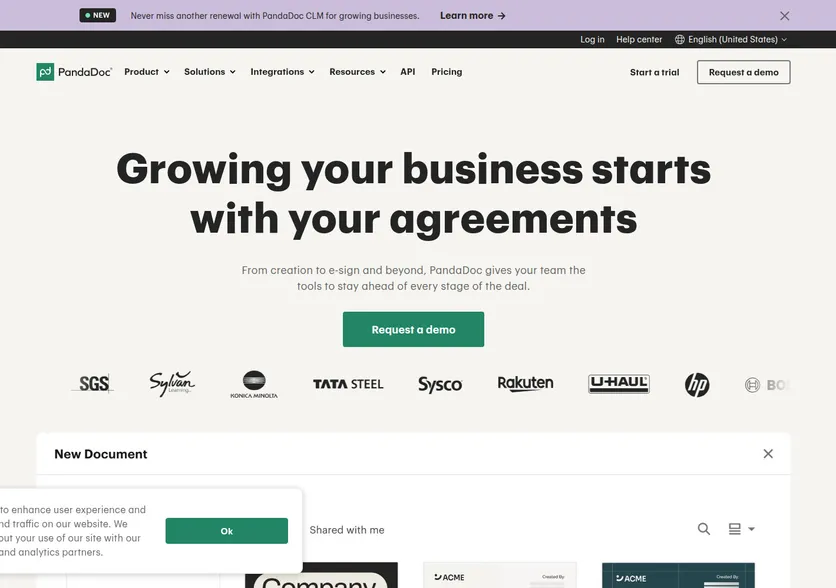
At forty-nine dollars a user a month, PandaDoc Business is the document platform of choice for enterprises that need proposals, quotes, and contracts to move through approvals without leaving one tool. It adds approval workflows, a content library, and deeper CRM integrations on top of the Starter plan, so legal and finance can review a quote before it goes out. For enterprises that value speed over deep product configuration, it is often the faster buy than a full CPQ suite.
What we like
- Approval workflows keep quotes compliant before sending
- Contracts and signatures included, not bolted on
- Content library keeps every team on approved language
Watch out for
- Not a true configurator for complex product rules
- Business tier is needed for approvals and advanced reporting
How to try it
- Set up approval workflows for quotes above your discount threshold
- Build a content library of approved clauses and pricing tables
- Connect your CRM so quotes inherit opportunity data
4. QuoteWerks
Best for: Enterprises that quote from distributor catalogs with live pricing
Paid tool Starting price: $49/user/month · Essential plan for concurrent users on monthly billing (about forty-five dollars on annual billing). Balanced is seventy-nine dollars and Pinnacle is ninety-nine dollars.
Free plan: No free plan; free trial available
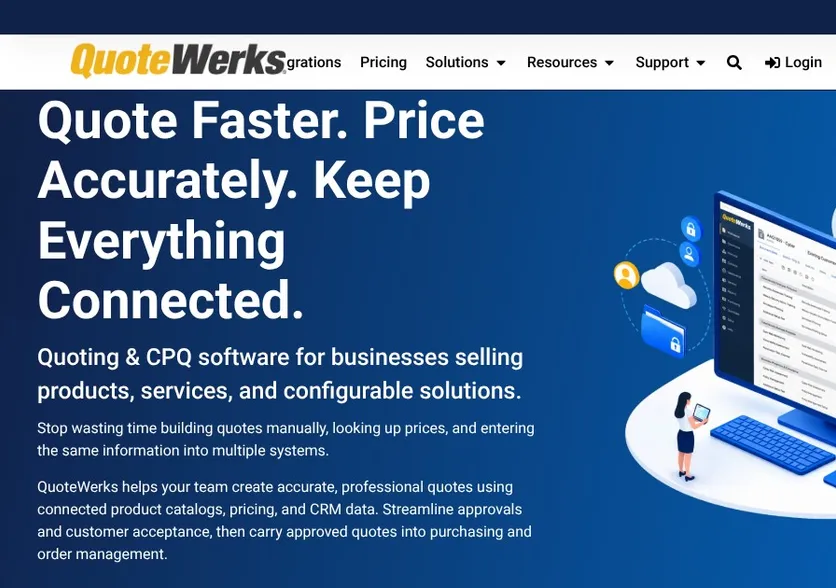
Forty-nine dollars a concurrent user a month buys QuoteWerks Essential, and its concurrent-user model is unusually generous for an enterprise: anyone can hold an account, and you pay only for the people quoting at the same moment. It pulls live pricing from distributors, applies taxes and discounts, and converts approved quotes into orders without retyping. For companies whose quoting is catalog-driven rather than configuration-driven, it does the job at a fraction of CPQ prices.
What we like
- Concurrent-user pricing keeps large teams affordable
- Live distributor pricing prevents stale quotes
- Quote-to-order flow removes manual re-entry
Watch out for
- Not built for guided product configuration
- Interface feels older than modern CPQ tools
How to try it
- Import distributor catalogs and keep price lists current
- Define approval rules for discounts above your threshold
- Train the team on quote-to-order conversion before go-live
5. Proposify
Best for: Enterprise sales teams that need proposals that track, sign, and close
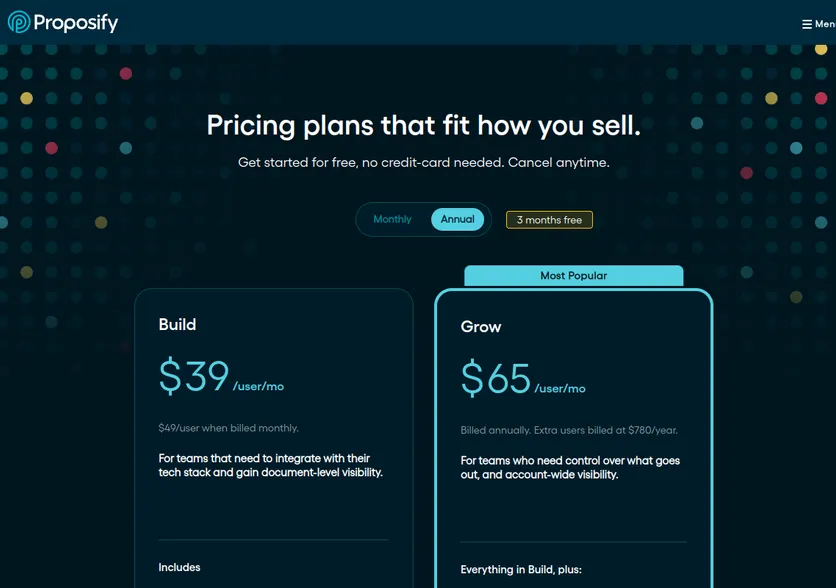
Paid tool Starting price: $39/user/month · Build plan billed annually (forty-nine dollars on monthly billing). Grow is sixty-five dollars and Scale is one hundred seven dollars a user a month.
Free plan: Free plan (1 active proposal)
Proposify Build is thirty-nine dollars a user a month on annual billing, and it earns its place in an enterprise stack by making proposal quality consistent across dozens of reps. Templates lock in branding and approved pricing language, while open tracking and e-signatures show managers exactly where each deal stands. It is not a configurator, but for enterprises whose quotes are proposal-shaped rather than catalog-shaped, it is the most practical tool here.
What we like
- Templates keep dozens of reps on brand and on price
- Open tracking shows managers where deals actually stand
- E-signatures close the loop inside the proposal
Watch out for
- No product configuration engine for complex catalogs
- Per-user pricing adds up across a large sales org
How to try it
- Lock down templates with approved pricing and legal language
- Set up roles so managers approve proposals before sending
- Use open analytics to coach reps on follow-up timing
6. DocuSign
Best for: Enterprises that need binding signatures and agreement workflows on quotes
Paid tool Starting price: $25/user/month · Standard plan billed annually and paid upfront (thirty dollars a month on monthly billing). Personal is ten dollars and Business Pro is forty dollars.
Free plan: No free plan; 30-day free trial
Twenty-five dollars a user a month buys DocuSign Standard on annual billing paid upfront, and it remains the signature standard that enterprise legal teams already trust. Quotes become binding agreements with an audit trail, conditional fields handle complex terms, and integrations connect it to Salesforce, HubSpot, and the proposal tools above. Enterprises usually pair it with a CPQ or proposal tool rather than using it alone, but nothing in this guide signs a deal more reliably.
What we like
- The e-signature standard enterprise legal teams accept
- Audit trails on every signed document
- Deep integrations with CRM and proposal tools
Watch out for
- Annual billing must be paid upfront
- It signs agreements; it does not configure products
How to try it
- Create agreement templates with conditional terms and fields
- Connect DocuSign to your CRM so signed quotes update opportunities
- Set up bulk send for high-volume agreement runs
7. HubSpot Sales Hub
Best for: Enterprises that want quoting inside the CRM their reps already use
Paid tool Starting price: $20/seat/month · Starter list price; new-customer promotions show seven dollars a seat a month on annual billing, which is not the list price. Professional is one hundred dollars and Enterprise is one hundred fifty dollars.
Free plan: Free CRM for up to 2 users
Twenty dollars a seat a month is the list price for HubSpot Sales Hub Starter, the cheapest entry here for enterprises that want quotes generated inside their CRM. Reps build quotes from deal data without switching tools, and the free CRM tier underneath means small teams can start without paying at all. Starter is deliberately limited, and enterprises that need advanced quoting will climb to Professional at one hundred dollars a seat, but the path from free to full-featured is the smoothest in this guide.
What we like
- Quotes live inside the CRM reps already use
- Free CRM tier lets teams start without paying
- Smooth upgrade path from Starter to Enterprise
Watch out for
- Starter is limited; serious quoting needs the Professional tier
- Per-seat pricing climbs steeply at the higher tiers
How to try it
- Set up products and price lists in the HubSpot product library
- Build a quote template that pulls deal data automatically
- Test the quote-to-payment flow before rolling out to reps
Prices above were checked on each vendor’s own website on Nov 28, 2026 and can change — the vendor’s page is the final word. Vendor links are editorial: nobody paid to be listed or ranked here. Vendors who want a featured listing can see how it works on our Get listed page.
How to choose enterprise quote management software
Start by naming the failure you are fixing. If reps misconfigure products or misprice complex deals, you need a CPQ engine such as Salesforce CPQ or servicePath, and you should budget months for implementation. If the problem is quotes that stall in legal and finance, a document platform with approvals, such as PandaDoc Business, fixes it faster and cheaper. If quotes come from a distributor catalog, QuoteWerks covers the job for far less than either. Whichever you choose, pilot with one product line and one approval chain, and measure quote turnaround time before and after.
Before you buy
- Confirm the price covers your whole quoting team, since per-user CPQ pricing scales fast at enterprise headcount
- Ask whether product rules and approval workflows are included, or sold as a separate module
- Check how the tool handles multi-currency and multi-entity pricing if you sell across regions
- Trial the approval flow with a real discount request, because slow approvals kill enterprise deals
- Confirm the CRM integration is native and bidirectional, not a sync that runs once a day
Official websites
Official websites of the products reviewed above. Features and prices were checked against these sites when this guide was written, and they can change, so confirm on the vendor site before you buy.
Frequently asked questions
What is the best quote management software for enterprise teams?
Salesforce CPQ is the most common enterprise choice, especially for companies already on Salesforce, at a widely reported seventy-five dollars a user a month. servicePath CPQ+ matches that price without requiring Salesforce, while PandaDoc Business is the pragmatic pick when quotes are documents rather than configurations. The right choice depends on whether your products need guided configuration or simply consistent, approved quotes.
How much does enterprise quote management software cost?
Most enterprises pay seventy-five dollars a user a month for a CPQ platform, or forty-nine dollars for a document-based tool like PandaDoc Business or QuoteWerks. A fifty-person quoting team should budget roughly two thousand four hundred to three thousand seven hundred fifty dollars a month, plus implementation, which vendors often charge separately. Implementation and configuration commonly cost as much as the first year of licenses.
What does CPQ software do that proposal software does not?
CPQ, or configure price quote, software guides reps through product options, applies pricing rules, and generates an accurate quote automatically. It exists for companies whose products have options, dependencies, and discount rules that a human cannot reliably hold in their head. A simple proposal tool is enough when every quote is a flat price and a few line items.
Should enterprise quote software include approval workflows?
Yes, and most large deals should. Discount approval, legal review, and finance sign-off are where enterprise quotes usually stall, and a tool without approval workflows pushes that work into email and spreadsheets. Look for configurable approval chains with thresholds, so small discounts pass automatically and large ones reach the right manager fast.
How long does enterprise quote software take to implement?
Two to four months is typical for a CPQ rollout, because the real work is modelling your product catalog, pricing rules, and approval chains, not installing software. Document-based tools like PandaDoc can go live in weeks. Budget a quarter for CPQ, including training and a pilot with one product line before company-wide rollout.
Compare the seven tools above, then start a demo on the one that matches your CRM and product complexity before paying for a full year.
Browse Business Tools tools