On this page
A startup collects customer data from its first day, and a single leak can end the company before it grows. The eight tools below run from four dollars per feature a month to fifteen thousand dollars a year, and every price was checked on the vendor site on November 28, 2026. Nightfall AI leads because it finds sensitive data in cloud apps for four dollars per feature a month, and the rest are ranked on how quickly they map data and prove compliance.
How we researched this
We checked every price on the vendor pricing page on November 28, 2026, and only included tools with a published US dollar list price. The enterprise platforms that sell by quote only, including BigID, OneTrust, Varonis, Securiti, DataGrail and Privacera, publish no prices, so they are not in this list. Prices change, so confirm the current figure on the vendor site before you buy.
Compare the tools
| Name | Best for | Starting price | Free plan | |
|---|---|---|---|---|
| Nightfall AI | Startups that want to find sensitive data in cloud apps | $4/feature/month | No free plan; free trial available | Visit |
| Ketch | Startups that need consent and subject rights handled | $150/month | No free plan; free trial available | Visit |
 Osano | Startups that need consent banners plus privacy templates | $199/month | Free tier for 1 domain and 5,000 visitors a month | Visit |
| 6clicks | Startups that want risk, audit and compliance in one place | $4,800/year | No free plan; free trial available | Visit |
 Secureframe | Startups preparing for their first SOC 2 audit | $7,500/year | No free plan; demo available | Visit |
 Sprinto | Startups that need SOC 2 or ISO 27001 fast | $9,500/year | No free plan; demo available | Visit |
 Vanta | Startups that want compliance automated end to end | $14,000/year | No free plan; demo available | Visit |
 Drata | Startups that want continuous control monitoring | $15,000/year | No free plan; demo available | Visit |
The sensitive data discovery software for startups, compared
1. Nightfall AI
Best for: Startups that want to find sensitive data in cloud apps
Paid tool Starting price: $4/feature/month · Four dollars per feature per month for the Basic plan, as published on the vendor pricing page; larger plans are quoted; a free trial is available
Free plan: No free plan; free trial available
For a startup whose sensitive data lives in Slack, GitHub and Google Drive, this Nightfall AI Basic plan costs four dollars per feature per month, and it scans cloud apps for personal data, secrets and credentials. More than one hundred and fifty pre-built detectors flag PII, PHI and PCI, and automated workflows quarantine, redact or alert on exposure without a security analyst. It is the cheapest way onto real data discovery in this list, and the only tool here a startup can try for free.
What we like
- Automated PII discovery across cloud apps
- Lowest entry price in this comparison
- Detection that covers files, messages and code
Watch out for
- Pricing is per feature, so the total varies
- Larger plans are quoted, not published
How to try it
- Open the Nightfall AI site and start a free trial
- Connect your cloud apps
- Run a first scan and review the findings
2. Ketch
Best for: Startups that need consent and subject rights handled
Paid tool Starting price: $150/month · One hundred and fifty dollars a month billed monthly for the Starter plan, up to thirty thousand visitors; Plus starts from four hundred and ninety-nine dollars a month billed annually
Free plan: No free plan; free trial available
For a startup that needs consent and subject rights handled properly, this Ketch Starter plan costs one hundred and fifty dollars a month billed monthly for up to thirty thousand visitors, and it automates consent, data subject requests and permissioning. The platform maps where personal data lives, honours opt-outs across systems, and keeps an audit trail that proves what happened to each request. It suits a startup that collects customer data from day one and wants the paperwork right.
What we like
- Data permissioning with automated rights handling
- Consent and data maps in one platform
- Low entry price for a privacy tool
Watch out for
- Starter caps at thirty thousand visitors a month
- Advanced automation needs the Plus plan
How to try it
- Open the Ketch site and start a free trial
- Map your data and set up consent
- Test a subject rights request and check the audit log
3. Osano
Best for: Startups that need consent banners plus privacy templates
Paid tool Starting price: $199/month · One hundred and ninety-nine dollars a month for the Plus plan, covering three domains and thirty thousand monthly visitors; the free tier covers one domain and five thousand visitors; subject rights and data mapping sit behind custom-quoted tiers
Free plan: Free tier for 1 domain and 5,000 visitors a month
For a startup that needs cookie consent plus privacy templates, this Osano Plus plan costs one hundred and ninety-nine dollars a month for three domains and thirty thousand monthly visitors, and it manages consent, privacy templates and vendor risk in one dashboard. The free tier covers one domain, and the Plus plan adds UK and GDPR representative services for teams selling into Europe. It suits a startup with a public website that must show compliant banners without hiring a privacy lawyer.
What we like
- Consent and subject rights in one platform
- Data map that shows what personal data exists
- Vendor risk tracking included
Watch out for
- Plus covers only one domain
- Breach assessment needs a higher plan
How to try it
- Open the Osano site and start the free tier
- Map your data and vendors
- Test a subject rights request end to end
4. 6clicks
Best for: Startups that want risk, audit and compliance in one place
Paid tool Starting price: $4,800/year · Four thousand eight hundred dollars a year for the Startup plan with one power user; Growth costs eighteen thousand dollars a year and Enterprise is quoted
Free plan: No free plan; free trial available
For a startup that wants risk, audit and compliance in one workspace, this 6clicks Startup plan costs four thousand eight hundred dollars a year with one power user, and it brings risk registers, assessments and audits together. The platform maps controls to frameworks, tracks evidence, and runs vendor risk reviews beside the internal audit work. It suits a startup that wants one compliance workspace instead of a pile of spreadsheets.
What we like
- Risk, audit and vendor management in one workspace
- Unlimited read-only users on every plan
- Lowest entry price among the GRC platforms here
Watch out for
- Startup covers only one power user
- Advanced automation needs the Growth plan
How to try it
- Open the 6clicks site and start a free trial
- Build your risk register and control library
- Run a first assessment and check the reporting
5. Secureframe
Best for: Startups preparing for their first SOC 2 audit
Paid tool Starting price: $7,500/year · Seven thousand five hundred dollars a year for the entry plan, as published on the AWS Marketplace; higher plans are quoted on the vendor site
Free plan: No free plan; demo available
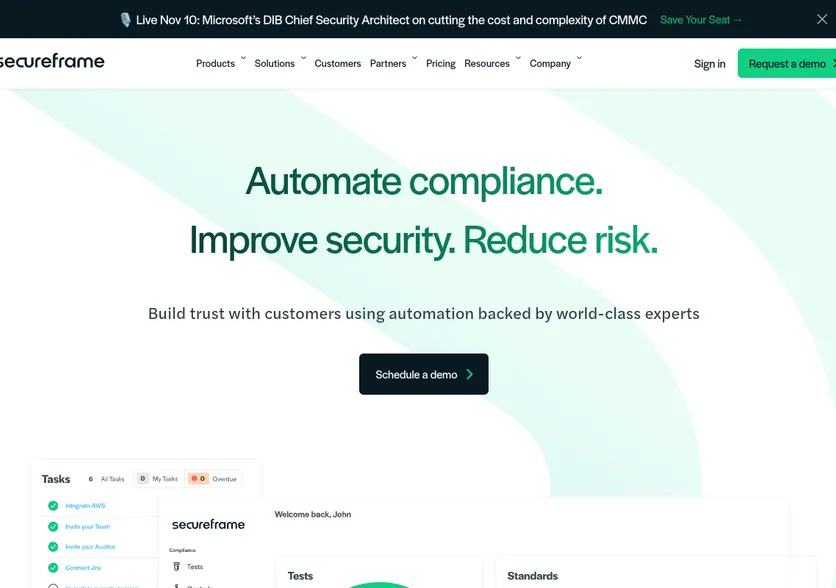
For a startup preparing for its first SOC 2 audit, this Secureframe entry plan costs seven thousand five hundred dollars a year, and it watches controls day and night while gathering the proof an auditor asks for. Automated evidence collection, integrations with the tools a startup already runs, and guided onboarding shorten the road to audit readiness. It suits a startup whose customers now ask for SOC 2 before signing.
What we like
- Continuous monitoring of controls and vendors
- A library of frameworks including SOC 2 and ISO 27001
- Audit evidence collected automatically
Watch out for
- Seven thousand five hundred dollars a year is a real commitment
- The vendor site does not publish plan details
How to try it
- Open the Secureframe site and book a demo
- Connect your cloud and HR systems
- Run a readiness check against your target framework
6. Sprinto
Best for: Startups that need SOC 2 or ISO 27001 fast
Paid tool Starting price: $9,500/year · Nine thousand five hundred dollars a year as listed on the AWS Marketplace, covering the platform and the first framework; direct quotes reportedly start lower, so confirm the current figure before you buy
Free plan: No free plan; demo available
For a startup that needs SOC 2 or ISO 27001 fast, this Sprinto entry plan costs nine thousand five hundred dollars a year, and it automates control monitoring, evidence collection and audit preparation. The platform maps controls across frameworks, flags gaps before the auditor does, and runs on the AWS Marketplace list price. It suits a startup on a deadline, where the audit date is already set.
What we like
- Automates control monitoring and evidence collection
- Maps controls across SOC 2, ISO 27001 and more
- Flags compliance gaps before the auditor does
Watch out for
- The marketplace list price is higher than direct quotes reportedly run
- The entry plan covers the first framework only
How to try it
- Connect the tools the startup already runs
- Pick the framework and let Sprinto map the controls
- Work through the flagged gaps, then invite the auditor in
7. Vanta
Best for: Startups that want compliance automated end to end
Paid tool Starting price: $14,000/year · Fourteen thousand dollars a year for the entry plan, as published on the AWS Marketplace; higher plans are quoted on the vendor site
Free plan: No free plan; demo available
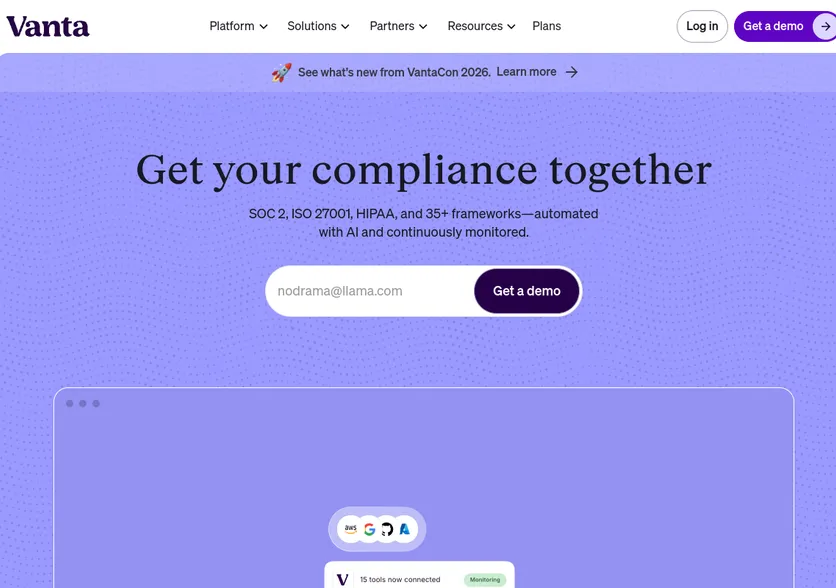
For a startup that wants compliance automated end to end, this Vanta entry plan costs fourteen thousand dollars a year, and it automates compliance, vendor risk and trust reporting from one platform. Continuous monitoring, automated evidence and a trust centre that customers can check themselves cut the manual work to a fraction. It is the most polished option here, and the best pick for a startup selling to security-conscious buyers.
What we like
- The most widely adopted compliance platform here
- Automated tests that run around the clock
- Vendor risk management included
Watch out for
- Fourteen thousand dollars a year is the second-highest price here
- The vendor site does not publish plan details
How to try it
- Open the Vanta site and book a demo
- Connect your cloud and HR systems
- Run a readiness check against your target framework
8. Drata
Best for: Startups that want continuous control monitoring
Paid tool Starting price: $15,000/year · Fifteen thousand dollars a year for the entry plan, covering one to fifty full-time staff and one framework; the one hundred full-time staff SOC 2 total is thirty-two thousand five hundred dollars, so confirm the scope before you buy
Free plan: No free plan; demo available
For a startup that wants continuous control monitoring with audit evidence gathered automatically, this Drata entry plan costs fifteen thousand dollars a year for one to fifty full-time staff and one framework, and it monitors controls around the clock. Evidence arrives without manual screenshots, the platform tracks framework coverage in real time, and auditors work directly in the same system. It suits a startup that wants the strongest monitoring in this list and can pay for it.
What we like
- Continuous control monitoring with evidence collection
- A library of frameworks including SOC 2 and ISO 27001
- Integrations across cloud, HR and ticketing
Watch out for
- Fifteen thousand dollars a year is the highest price here
- The vendor site does not publish plan details
How to try it
- Open the Drata site and book a demo
- Connect your cloud and HR systems
- Run a readiness check against your target framework
Prices above were checked on each vendor’s own website on Nov 28, 2026 and can change — the vendor’s page is the final word. Vendor links are editorial: nobody paid to be listed or ranked here. Vendors who want a featured listing can see how it works on our Get listed page.
How a startup finds its sensitive data before an auditor does
Start with a scan of the places data actually lives, not the places it should live: shared drives, chat apps, code repositories and the CRM. Classify what the scan finds into customer data, payment data and secrets, and delete the copies nobody needs, because data you do not hold cannot leak. Put the findings on a map the whole team can read, with an owner for each store, and set a rule that new stores get added to the map on day one. Run the scan on a schedule, not once, since new data arrives every week. Finally, keep the audit trail with the map, because the auditor will ask what was found, what was fixed and when.
Before you buy
- Check which systems the tool actually scans, since some cover cloud apps only and miss databases and endpoints
- Confirm whether data mapping and subject rights are included or sold behind a custom quote
- Ask how the tool handles false positives, because a detector that cries wolf gets ignored
- Make sure the audit trail proves what was found, fixed and when, in a form an auditor accepts
- Test the tool on the startup's real data stores before paying, including the messiest shared drive
Official websites
Official websites of the products reviewed above. Features and prices were checked against these sites when this guide was written, and they can change, so confirm on the vendor site before you buy.
Frequently asked questions
What is sensitive data discovery software?
It is software that scans a company's systems to find where sensitive data lives, such as customer names, payment cards, passwords and health records. For a startup it answers the basic question of what data exists and where, which is the first step toward privacy compliance and breach prevention.
How much does Nightfall AI cost?
Nightfall AI Basic costs four dollars per feature per month, as published on the vendor pricing page. Larger plans are quoted, and a free trial is available, so a startup can test the detection on its own cloud apps before paying. The per-feature model means the bill grows with the features used, not the headcount.
Can a startup afford compliance software?
Yes, because Nightfall AI starts at four dollars per feature a month, Ketch at one hundred and fifty dollars a month and Osano at one hundred and ninety-nine dollars. The five-figure platforms in this list suit funded startups facing an audit, while an early startup can start with the cheap tools and upgrade when customers demand SOC 2.
Do I need SOC 2 as a startup?
Not on day one, but enterprise customers increasingly ask for it before signing, and the audit takes months. A startup should start with data discovery and basic controls early, then buy a compliance platform such as Secureframe, Sprinto, Vanta or Drata once the first big customer asks for a SOC 2 report.
Which tool is best for a startup on a tight budget?
Nightfall AI is the best pick for a startup on a tight budget, because it starts at four dollars per feature a month with a free trial and scans the cloud apps a startup already uses. Ketch suits teams that need subject rights handled, and Osano suits teams that need consent banners. Start with the trial before paying.
Compare the eight tools above, then scan the startup's real data stores with the free trial on the tool that matches the team's budget before paying for a full year.
Browse Security & Privacy tools