On this page
An ecommerce brand spends everywhere at once: ads, freight, packaging, influencers, software, and the warehouse coffee nobody budgets for. The eight tools below put cards, expenses and supplier bills under one set of controls, so the marketing team cannot quietly double the ad budget. Ramp leads because its core platform costs nothing and its paid tier starts at fifteen dollars per user a month, and the rest are ranked on how well they fit a brand that sells online.
How we researched this
We checked every price on the vendor pricing page on November 29, 2026, and only included tools with a published US dollar list price. The enterprise suites that sell by quote, including Coupa, Airbase and Spendesk, publish no prices, so they are not in this list. Prices change, so confirm the current figure on the vendor site before you buy.
Compare the tools
| Name | Best for | Starting price | Free plan | |
|---|---|---|---|---|
 Ramp | Ecommerce brands that want free cards per channel | $15/user/month | Free plan | Visit |
 Brex | Brands buying ads and stock across borders | $12/active user/month | Free plan (Essentials) | Visit |
 Expensify | Brands whose teams file receipts from everywhere | $5/member/month | Free plan (Submit) | Visit |
 Zoho Expense | Brands already running on Zoho tools | $5/active user/month | Free plan (up to 3 users) | Visit |
 Sage Expense Management | Brands keeping the corporate cards they already have | $11.99/active user/month | No free plan; free trial | Visit |
 Spendwise | Small brands that want cheap purchase control | $9/user/month | No free plan; free trial | Visit |
 Tradogram | Small brands that need purchase orders first | $99/month | Free plan (5 transactions a month) | Visit |
 Precoro | Brands whose buying has outgrown spreadsheets | $499/month | No free plan; free trial | Visit |
The spend management software for ecommerce brands, compared
1. Ramp
Best for: Ecommerce brands that want free cards per channel
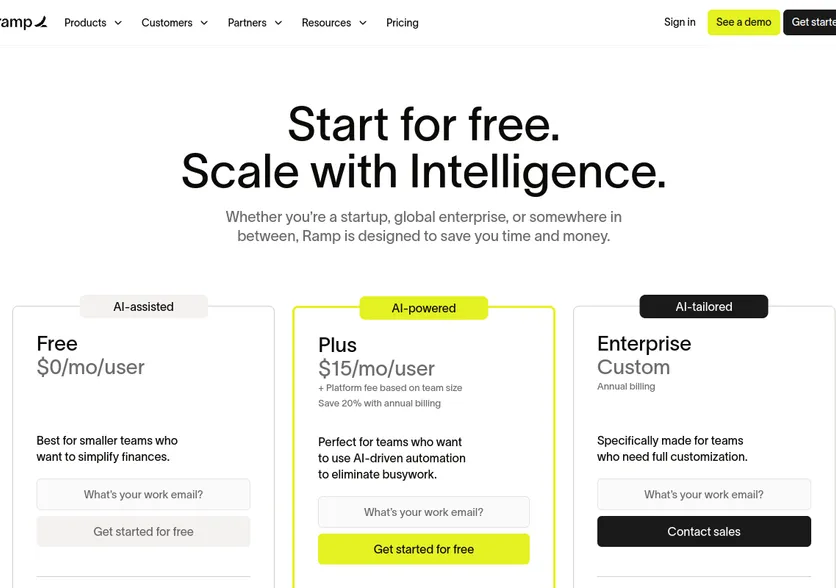
Paid tool Starting price: $15/user/month · Fifteen dollars per user a month on Plus, plus an unpublished platform fee based on team size, so fifteen dollars is the floor, not the full bill; twenty percent off with annual billing; the Free plan costs nothing; Enterprise is quoted
Free plan: Free plan
An ecommerce brand that pays suppliers and influencers from the same pot gets a free core here, since this Ramp plan costs fifteen dollars per user a month on Plus. The free tier includes unlimited virtual and physical cards, bill pay and AI reporting, so the brand can give every channel its own card with its own limit and see the spend the next morning. Plus adds NetSuite and Sage Intacct sync for the brands that outgrow QuickBooks or Xero.
What we like
- Free core with unlimited cards and bill pay
- A card per channel with its own spend limit
- Price intelligence flags overpriced vendors automatically
Watch out for
- Plus adds an unpublished platform fee on top of the seat price
- NetSuite and Sage Intacct sync need the Plus tier
How to try it
- Give each channel its own virtual card with a limit
- Set approval rules for supplier and influencer payments
- Review the AI spend reports each month
2. Brex
Best for: Brands buying ads and stock across borders
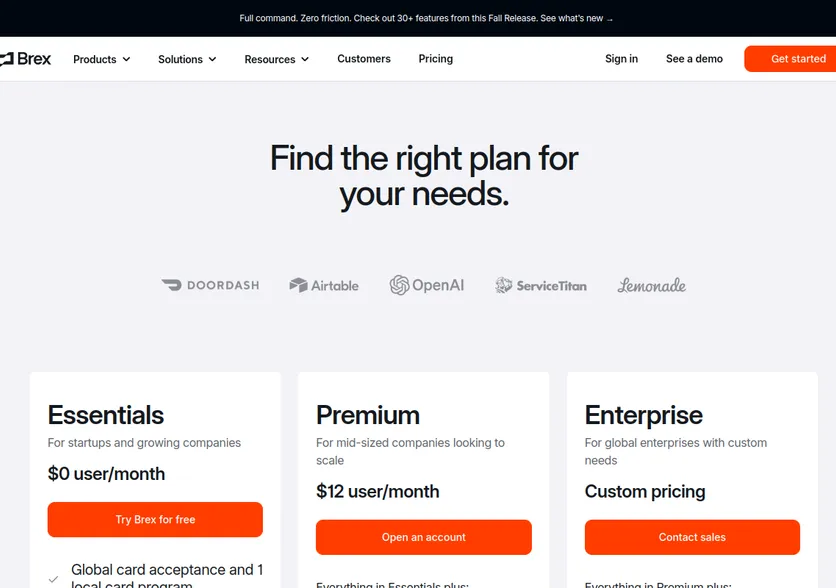
Paid tool Starting price: $12/active user/month · Twelve dollars per active user a month on Premium; Essentials costs nothing per user for eligible companies; Enterprise and Smart Card are quoted; foreign-currency card spend carries an exchange markup of up to three percent
Free plan: Free plan (Essentials)
An ecommerce brand buying ads and stock across borders will find this Brex plan costs twelve dollars per active user a month on Premium. Essentials costs nothing and already includes cards in more than two hundred countries, bill pay, reimbursements and travel booking, so a small brand can run its whole spend on the free tier. Premium adds multiple expense policies and live budgets for the brands whose spend needs more than one rulebook.
What we like
- Free Essentials tier with cards, bill pay and travel
- Cards accepted in more than two hundred countries
- Premium adds multi-entity controls and live budgets
Watch out for
- Foreign-currency card spend carries a markup up to three percent
- Enterprise and Smart Card tiers are quoted, not published
How to try it
- Issue cards with limits set by channel
- Add expense policies for each team on Premium
- Review live budgets against actual spend weekly
3. Expensify
Best for: Brands whose teams file receipts from everywhere
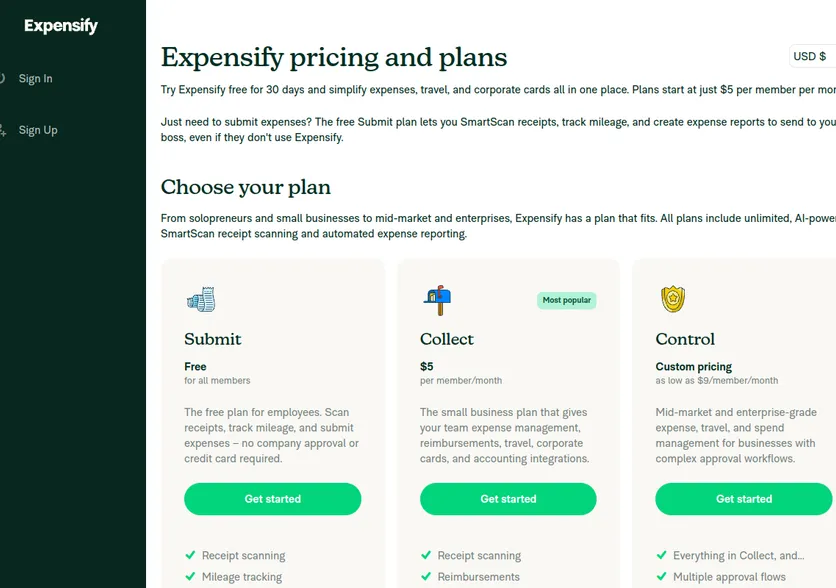
Paid tool Starting price: $5/member/month · Five dollars per unique member a month on Collect; Control is nine dollars per active member a month on an annual plan when the Expensify Card covers half or more of settled US spend, eighteen dollars without the card, or thirty-six dollars pay per use
Free plan: Free plan (Submit)
An ecommerce brand whose team files receipts from trade shows, shoots and supplier visits will find this Expensify plan costs five dollars per member a month on Collect. SmartScan reads every receipt, mileage tracking is built in, and approvals run through the app, so the finance person stops chasing paper from the warehouse. Control adds NetSuite and Sage Intacct sync with multiple approval flows for the brands that need them.
What we like
- SmartScan receipt capture with automatic coding
- Bills only active members on Control, not every seat
- Mileage tracking built in for supplier visits
Watch out for
- Control pricing swings from nine to thirty-six dollars by card use
- Collect bills every member, active or not
How to try it
- Set up a workspace for the whole brand
- Turn on SmartScan and mileage tracking for staff
- Move to Control when ERP sync and multi-step approvals matter
4. Zoho Expense
Best for: Brands already running on Zoho tools
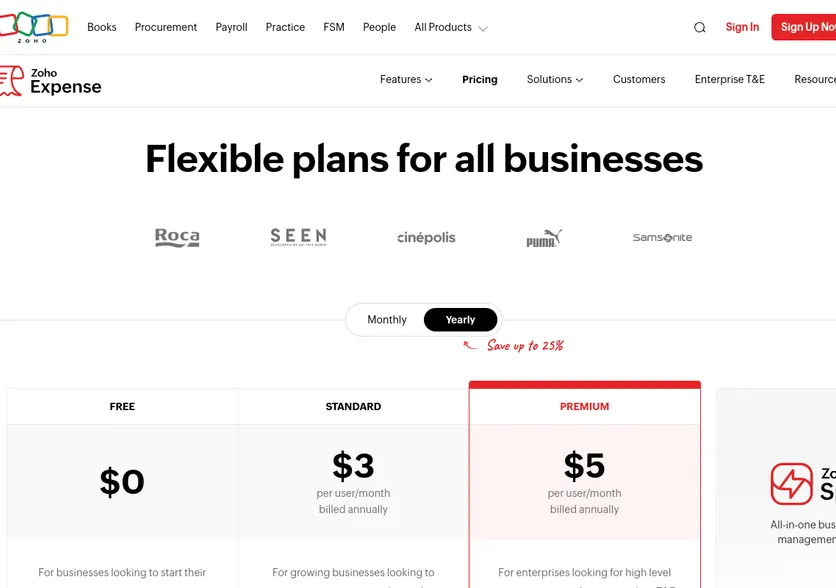
Paid tool Starting price: $5/active user/month · Five dollars per active user a month on Standard, or forty-eight dollars per active user a year; Premium is nine dollars a month or eighty-four dollars a year; Custom is quoted above one hundred users
Free plan: Free plan (up to 3 users)
An ecommerce brand that already runs on Zoho will find this Zoho Expense plan costs five dollars per active user a month on Standard. It covers receipt scanning, approvals and spend visibility, and Premium adds travel booking with an inbuilt travel desk for the brands whose buyers fly to suppliers. The free plan covers up to three users, so a tiny brand can run its expenses for nothing until the team grows.
What we like
- Free plan covers up to three users
- Receipt scanning with approvals and spend visibility
- Premium adds travel booking and a travel desk
Watch out for
- Deepest value sits inside the wider Zoho suite
- Custom tier above one hundred users is quoted
How to try it
- Connect Zoho Expense to the brand ledger
- Set approval rules for each spend category
- Add travel booking on Premium when buyers start flying
5. Sage Expense Management
Best for: Brands keeping the corporate cards they already have
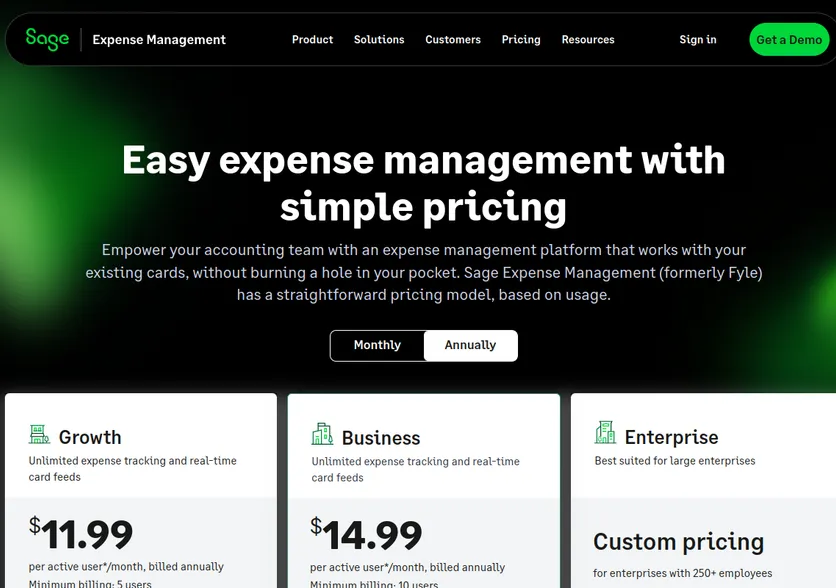
Paid tool Starting price: $11.99/active user/month · Eleven dollars and ninety-nine cents per active user a month billed annually on Growth, with a five-user minimum; Business is fourteen dollars and ninety-nine cents per active user a month billed annually with a ten-user minimum; Enterprise is quoted; formerly sold as Fyle
Free plan: No free plan; free trial
An ecommerce brand that already carries corporate cards and refuses to switch banks will find this Sage Expense Management plan costs eleven dollars and ninety-nine cents per active user a month billed annually. It reads transactions from the cards you already have through real-time feeds, then texts the cardholder for the receipt seconds after the swipe, which suits a team that buys stock on the move. Growth needs a five-user minimum.
What we like
- Works with the Visa and Mastercard cards you already carry
- Real-time feeds with instant receipt requests by text
- Billed only for active users, not every seat
Watch out for
- Growth carries a five-user minimum
- Sage Intacct and NetSuite integrations need a paid tier
How to try it
- Connect your existing corporate card feeds
- Set approval rules for ad spend and stock buying
- Review the real-time spend dashboard weekly
6. Spendwise
Best for: Small brands that want cheap purchase control
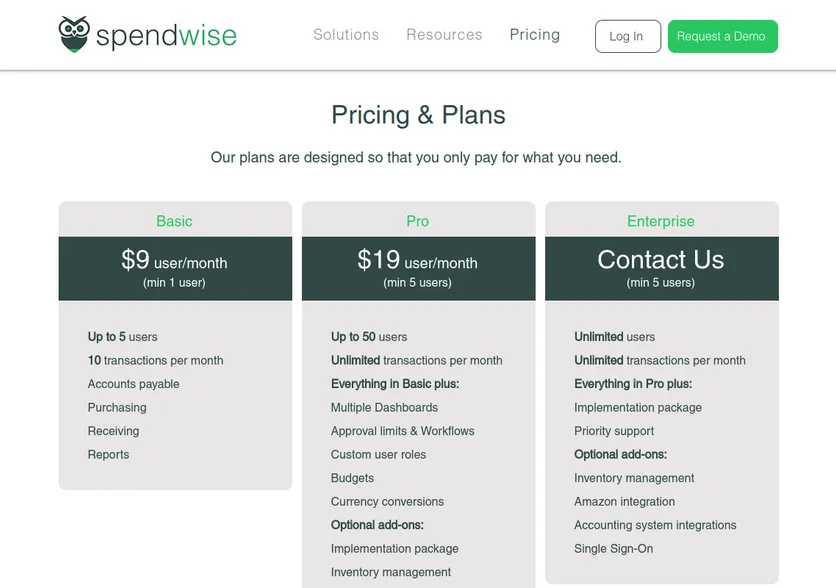
Paid tool Starting price: $9/user/month · Nine dollars per user a month on Basic for up to five users and ten transactions a month; Pro is nineteen dollars per user a month for five to fifty users with unlimited transactions; Enterprise is quoted
Free plan: No free plan; free trial
An ecommerce brand that only needs simple purchase control at a low per-user price will find this Spendwise plan costs nine dollars per user a month. Basic covers purchase requisitions, purchase orders, approvals, receiving and invoice matching, which is enough for a brand buying packaging and stock from a handful of suppliers. The limits are tight, with Basic capped at five users and ten transactions a month, so a busy brand will land on Pro at nineteen dollars.
What we like
- Cheapest per-user procurement in this list
- Three-way invoice matching included from Basic
- Simple setup with no consultant needed
Watch out for
- Basic caps at five users and ten transactions a month
- Pro caps at fifty users, so a big brand needs Enterprise
How to try it
- Set up purchase requisitions for stock and packaging
- Add approval limits and workflows on Pro
- Track budgets against actual purchase orders
7. Tradogram
Best for: Small brands that need purchase orders first
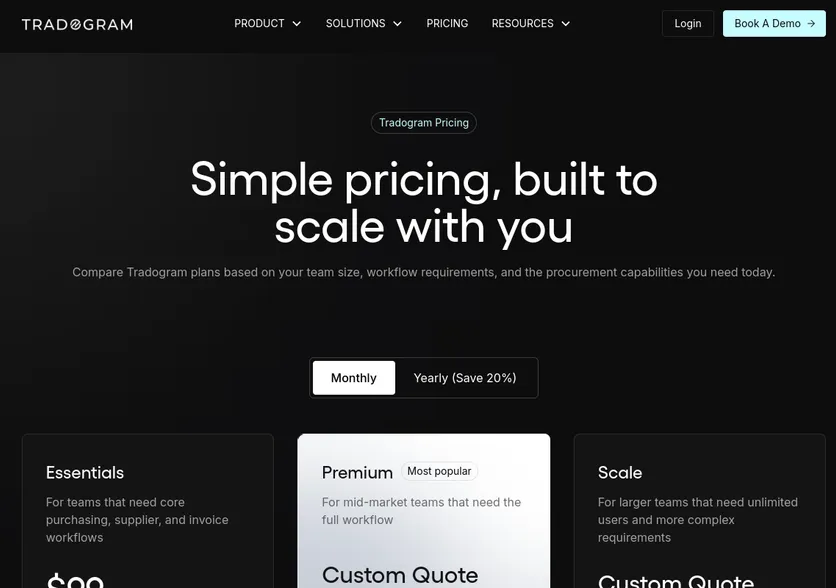
Paid tool Starting price: $99/month · Ninety-nine dollars a month on Essentials, or nine hundred and fifty dollars and forty cents a year billed annually; Premium is listed at one hundred and sixty-eight dollars a month in some reads and one hundred and ninety-five dollars in others, so confirm the tier at checkout
Free plan: Free plan (5 transactions a month)
An ecommerce brand that needs purchase orders first and procurement second will find this Tradogram plan costs ninety-nine dollars a month. Essentials covers purchase orders, supplier management, AP invoices, payments and AI scanning from a single user, so a small brand can run its whole buying cycle for one flat fee. The free plan covers five transactions a month, which is enough to test the workflow on a real supplier order.
What we like
- Flat monthly price from a single user
- Purchase orders, suppliers and payments in one place
- Free plan covers five transactions a month
Watch out for
- Premium pricing reads differ, so confirm the tier at checkout
- Extra users cost more on top of the flat rate
How to try it
- Add suppliers and your first purchase order
- Set approval routing for orders above a threshold
- Pay suppliers through the built-in payment tool
8. Precoro
Best for: Brands whose buying has outgrown spreadsheets
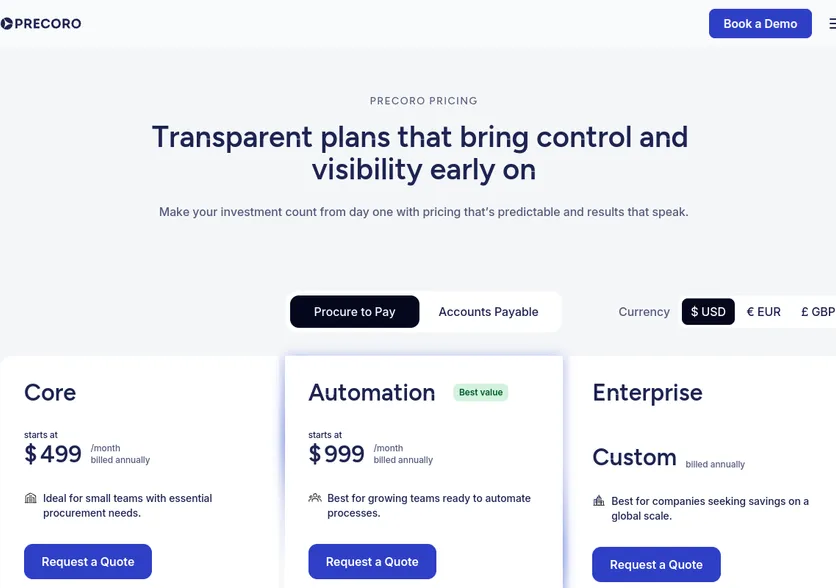
Paid tool Starting price: $499/month · Four hundred and ninety-nine dollars a month billed annually on Core; Automation is nine hundred and ninety-nine dollars a month; Enterprise is quoted; the older thirty-five dollar per-user figure no longer matches the vendor page
Free plan: No free plan; free trial
An ecommerce brand whose buying has outgrown spreadsheets will find this Precoro plan costs four hundred and ninety-nine dollars a month billed annually. Core covers purchase orders, budgets, automated approvals and three-way matching at a flat rate, so the brand can see spend by channel and supplier without counting seats. Automation adds real-time budgets and AI agents at nine hundred and ninety-nine dollars a month for the brands that need them.
What we like
- Flat monthly price with no per-user maths
- Budgets, approvals and three-way matching included
- Integrations with QuickBooks, NetSuite, Sage Intacct and Xero
Watch out for
- Annual billing only, so the minimum commitment is near six thousand a year
- Real-time budget tracking waits for Automation
How to try it
- Set budgets for each channel and supplier
- Route every purchase through a purchase order
- Review spend by channel and supplier monthly
Prices above were checked on each vendor’s own website on Nov 29, 2026 and can change — the vendor’s page is the final word. Vendor links are editorial: nobody paid to be listed or ranked here. Vendors who want a featured listing can see how it works on our Get listed page.
How to stop ad spend eating the margin
Give every channel its own card with its own limit, because a shared card hides which channel overspent. Set a daily cap on ad platforms, a weekly cap on influencer payments, and a hard approval rule for any supplier order above your threshold, then check the totals every Monday before the week runs away. The brands that keep their margin are not the ones that spend least, they are the ones that know where every dollar went before the month ends.
Before you buy
- Check whether the tool issues virtual cards per channel, or only one shared card
- Confirm the tool handles supplier bills and expenses, not just one of them
- Ask if approval rules cover ad platforms and influencer payments, or only office spend
- Make sure the price is a list price, not a first-year discount or a quote
- Test the tool on a month of real ad and supplier spend before signing up
Official websites
Official websites of the products reviewed above. Features and prices were checked against these sites when this guide was written, and they can change, so confirm on the vendor site before you buy.
Frequently asked questions
What is spend management software for ecommerce brands?
It is software that controls how an ecommerce brand spends money, from ad platforms to suppliers to packaging, using cards with limits, approval rules and bill pay in one place. Good tools give each channel its own card, flag overspend before it happens, and show where the money went by channel and supplier. The goal is to keep the margin, not just to record the spend after it is gone.
How much does Ramp cost for an ecommerce brand?
Ramp costs nothing per user a month on its Free plan, which already includes unlimited cards, bill pay and AI reporting. Plus costs fifteen dollars per user a month, plus an unpublished platform fee based on team size, so fifteen dollars is the floor rather than the full bill, with twenty percent off on annual billing. Enterprise is quoted, and the free tier is funded by card interchange rather than software fees.
Which tool is best for controlling ad spend?
Ramp is the best pick for ad spend control, with a free core that issues a virtual card per channel with its own limit and price intelligence that flags overpriced vendors. Brex is the best free alternative, with Essentials costing nothing and cards in more than two hundred countries. Both let the brand cap each channel separately instead of sharing one card across all of them.
Do any of these tools have a free plan?
Yes. Ramp has a free plan with unlimited cards and bill pay, Brex Essentials costs nothing per user, and Expensify has a free Submit tier for individuals. Zoho Expense is free for up to three users, and Tradogram has a free plan covering five transactions a month. Fyle, Spendwise and Precoro offer free trials instead of a permanent free tier.
Should an ecommerce brand buy per-user or flat-rate spend software?
Per-user pricing wins for a small team, since Ramp and Brex start free and the paid tiers scale with headcount. Flat-rate pricing wins when many people raise purchases, since Precoro and Tradogram charge for the platform, not the headcount. Count the people who will spend, approve and analyse, then price both models at your real numbers before choosing.
Compare the eight tools above, then start with a free trial or the free plan on the tool that matches how the brand already spends before paying for a full year.
Browse Business Tools tools