On this page
A healthcare practice buys medical supplies, lab services, cleaning and equipment from dozens of vendors, and every order needs a budget check and an audit trail. The eight tools below bring that buying under control without adding a layer of admin the front desk cannot handle. Precoro leads because it checks every request against its budget before approval for four hundred and ninety-nine dollars a month, and the rest are ranked on how safely they handle the steady flow of clinical and office purchasing.
How we researched this
We checked every price on the vendor pricing page on November 29, 2026, and only included tools with a published US dollar list price. The big enterprise suites that sell by quote, including Coupa, Ivalua, Certa, Vendorful and Zip, publish no prices, so they are not in this list. Prices change, so confirm the current figure on the vendor site before you buy.
Compare the tools
| Name | Best for | Starting price | Free plan | |
|---|---|---|---|---|
 Precoro | Mid-size teams that want spend control before payment | $499/month | No free plan; 14-day free trial | Visit |
 Tradogram | Very small teams that want supplier payments included | $99/month | Free plan capped at 5 transactions a month | Visit |
 Spendwise | Tiny teams that want the cheapest per-user purchasing | $9/user/month | No free plan; free trial available | Visit |
 Tipalti | Teams that pay vendors across borders | $99/month | No free plan; demo available | Visit |
 BILL | Finance teams drowning in vendor bills | $49/user/month | Free trial available; no free plan on paid tiers | Visit |
 Gatekeeper | Teams that want vendor and contract records in one place | $1,125/month | No free plan; free trial available | Visit |
 Zoho Inventory | Small teams that track stock beside vendor orders | $29/month | Free plan with 50 orders a month and 1 user; 14-day trial | Visit |
 Airtable | Teams that want a vendor database that looks like a spreadsheet | $20/user/month | Free plan | Visit |
The vendor management software for healthcare practices, compared
1. Precoro
Best for: Mid-size teams that want spend control before payment
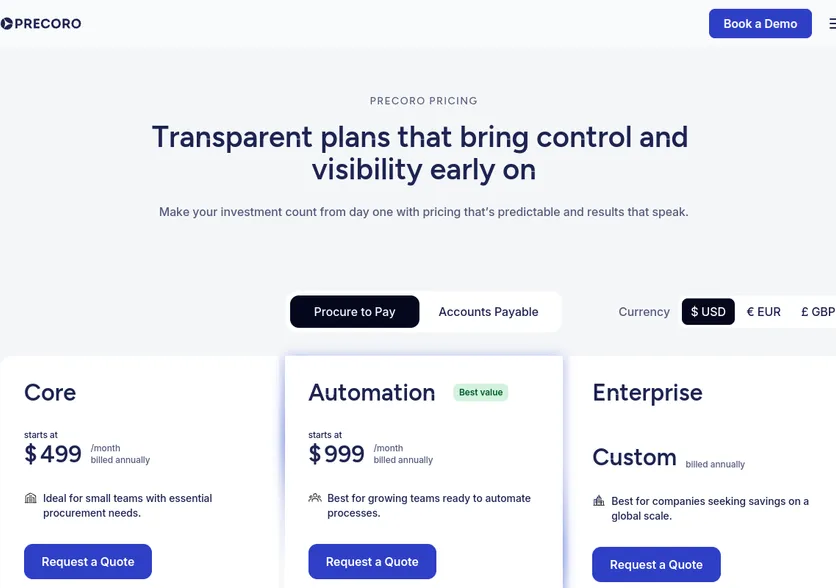
Paid tool Starting price: $499/month · Core plan, $499 a month billed annually; Automation $999 a month; Enterprise is quoted; no free plan
Free plan: No free plan; 14-day free trial
For healthcare practices, this Precoro plan costs four hundred and ninety-nine dollars a month billed annually, and it puts budgets, approvals and purchase orders in one place before money leaves the business. Requests, purchase orders, receipts and invoices share one workflow, so nothing gets bought without an approval attached to it. Vendor records and contract dates sit beside the budget, and the platform connects with QuickBooks Online, Xero and NetSuite for the ledger side.
What we like
- Budgets are checked before any purchase is approved
- Two-way and three-way invoice matching catches overbilling
- Connects with QuickBooks Online, Xero and NetSuite
Watch out for
- No free plan, so every seat starts on the paid ladder
- Automation features such as PunchOut and RFPs need the dearer tier
How to try it
- Create a purchase request and attach the vendor quote
- Route the request through the approval chain for its budget
- Convert the approved request into a purchase order and match the invoice on arrival
2. Tradogram
Best for: Very small teams that want supplier payments included
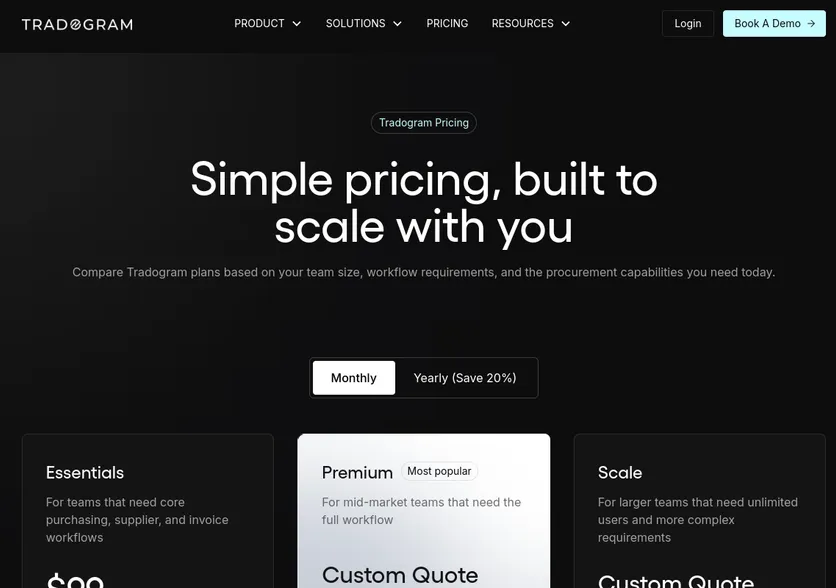
Paid tool Starting price: $99/month · Essentials plan, $99 a month for 1 user or $950.40 a year billed annually; Premium and Scale are custom-quoted; one directory lists Premium from $425 a month, which the vendor page does not confirm
Free plan: Free plan capped at 5 transactions a month
When healthcare practices need a low entry price with supplier payments included, this Tradogram plan costs ninety-nine dollars a month, and it covers purchase orders, suppliers, invoices and payments at the lowest entry price in this list. Sourcing events let a team compare supplier quotes side by side before awarding the order, and the built-in payment tool settles with suppliers in more than one hundred and fifty countries. Budgets are checked against each request, and the free plan covers five transactions a month for a team that wants to test the workflow first.
What we like
- Lowest published entry price in this list
- Supplier payments to more than 150 countries are built in
- Free plan covers five transactions a month
Watch out for
- Requisitions and receiving are paid add-ons on Essentials
- Each extra user carries an additional fee the vendor does not publish
How to try it
- Add the supplier and invite a quote through a sourcing event
- Compare the quotes and raise a purchase order from the winner
- Approve the invoice against the order and pay through TradoPay
3. Spendwise
Best for: Tiny teams that want the cheapest per-user purchasing
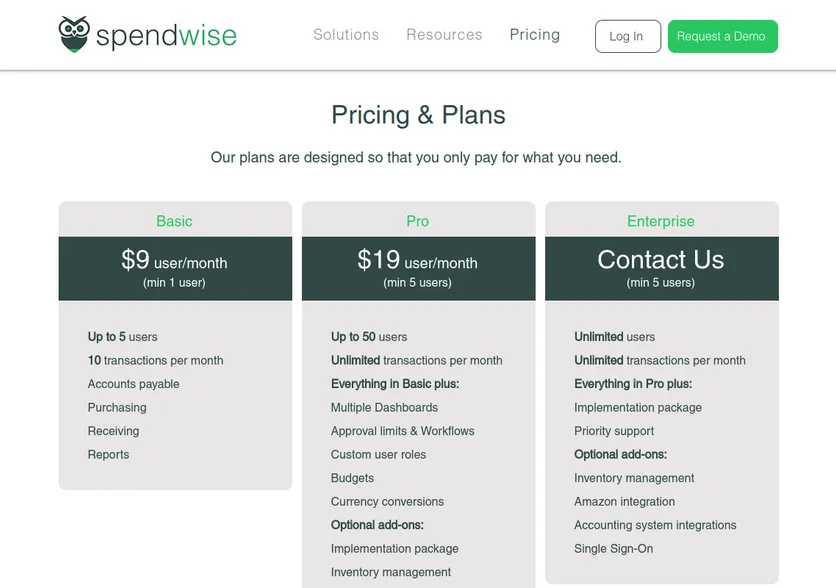
Paid tool Starting price: $9/user/month · Basic plan, $9 a user a month for up to 5 users and 10 transactions a month; Pro $19 a user a month for 5 to 50 users with unlimited transactions; Enterprise is quoted
Free plan: No free plan; free trial available
For healthcare practices, this Spendwise plan costs nine dollars per user a month, and it is the cheapest per-user option here and it still covers requests, purchase orders and receiving. A request becomes a purchase order in seconds, and approvals, receiving and invoice matching all run in the same small app. Accounting integrations and inventory are sold as add-ons, so the base price stays low for a team that only needs the core buying workflow.
What we like
- Cheapest per-user price in this list
- Purchase orders and receiving in a simple self-serve app
- Free trial lets a small team test it on real orders
Watch out for
- Basic stops at 5 users and 10 transactions a month
- Budgets and approval limits need the Pro plan
How to try it
- Raise a purchase request and send it for approval
- Turn the approved request into a purchase order
- Record the delivery and match the invoice before paying
4. Tipalti
Best for: Teams that pay vendors across borders
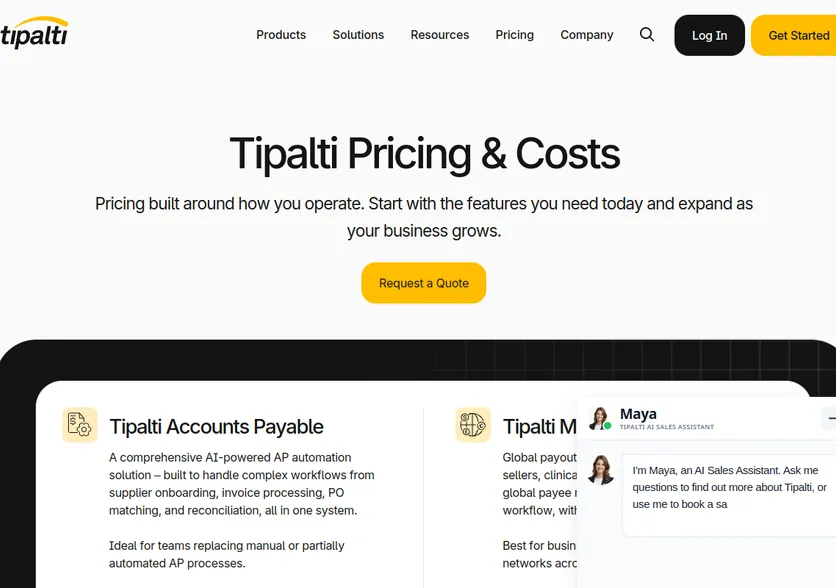
Paid tool Starting price: $99/month · Accounts Payable plan, $99 a month platform fee with unlimited users; transaction fees per invoice and payment are charged on top and are not published; Mass Payments starts at $249 a month
Free plan: No free plan; demo available
When healthcare practices need supplier onboarding and global payments in one place, this Tipalti plan costs ninety-nine dollars a month as a platform fee, and it handles supplier onboarding, tax forms and global payments in one platform. Suppliers onboard themselves through a portal, tax forms are collected automatically, and payments run to more than two hundred countries in over one hundred currencies. The platform fee covers unlimited users and approvers, so a team with many occasional approvers never pays per seat for them.
What we like
- Pays vendors in more than 200 countries and 120 currencies
- Supplier onboarding and tax forms handled in the portal
- Unlimited users with no per-approver fee
Watch out for
- Transaction fees sit on top of the $99 platform fee
- The real monthly cost rises with payment volume and entities
How to try it
- Invite suppliers to onboard through the self-service portal
- Route each invoice through approval and match it to the order
- Pay approved invoices in the supplier currency and collect the tax forms
5. BILL
Best for: Finance teams drowning in vendor bills
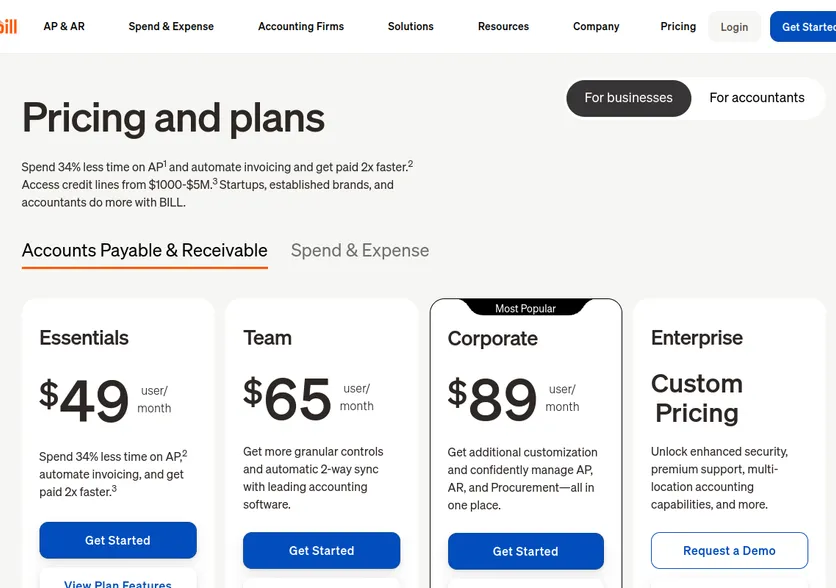
Paid tool Starting price: $49/user/month · Essentials plan per user; Team is sixty-five dollars a user a month and Corporate is eighty-nine dollars; Enterprise is quoted; payment fees sit on top of the seat price
Free plan: Free trial available; no free plan on paid tiers
For healthcare practices, this BILL plan costs forty-nine dollars per user a month, and it automates accounts payable from bill entry to payment, with approvals and matching built in. Bills arrive in a central inbox, get coded by the platform, route for approval and then pay by bank transfer, card, check or international wire. Two-way sync with QuickBooks Online and Xero starts on the Team plan, while Essentials relies on manual file import and export.
What we like
- Automated bill coding with two-way and three-way matching
- Pays vendors by bank transfer, card, check or wire
- Published per-user pricing with no sales call needed
Watch out for
- Automatic ledger sync needs the Team plan, not Essentials
- Payment fees sit on top of the per-user price
How to try it
- Send vendor bills to the central bill inbox
- Route each bill through the approval policy
- Pay the approved bill and sync the entry to the ledger
6. Gatekeeper
Best for: Teams that want vendor and contract records in one place
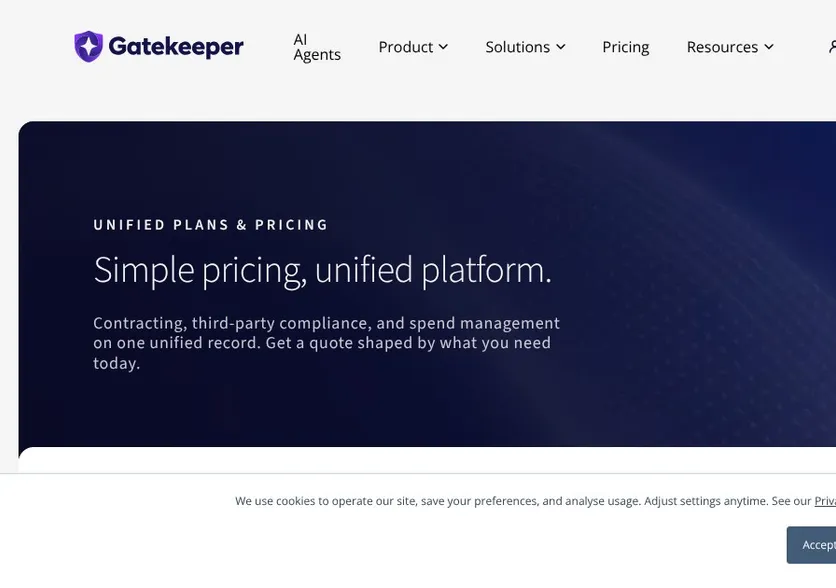
Paid tool Starting price: $1,125/month · Essentials plan, $1,125 a month billed annually for 150 contracts and suppliers; Pro $2,715 and Enterprise $4,815 a month; last-published figure, since the vendor pricing page no longer shows dollar figures in some reads
Free plan: No free plan; free trial available
When healthcare practices need vendor and contract records in one place, this Gatekeeper plan costs one thousand one hundred and twenty-five dollars a month billed annually, and it tracks renewals, obligations and supplier performance beside the contracts themselves. A central repository holds every supplier record and contract, with renewal alerts and obligation tracking that flag what needs attention before it expires. Unlimited users and electronic signature licences come with every plan, so the whole team can work in the same vendor file.
What we like
- Vendor and contract records in one repository
- Renewal alerts and obligation tracking included
- Unlimited users and e-signature licences on every plan
Watch out for
- No free plan, and the entry price is high for small teams
- AI extraction and advanced analytics need higher tiers
How to try it
- Import contracts and supplier records into the repository
- Set renewal alerts and assign owners to each obligation
- Review supplier performance and risk scores each quarter
7. Zoho Inventory
Best for: Small teams that track stock beside vendor orders
Paid tool Starting price: $29/month · Standard is $29 per organization a month billed annually ($39 monthly). Premium is $79 and Plus is $129 a month billed annually. Prices exclude local taxes. Extra users are $7.50 a month each.
Free plan: Free plan with 50 orders a month and 1 user; 14-day trial
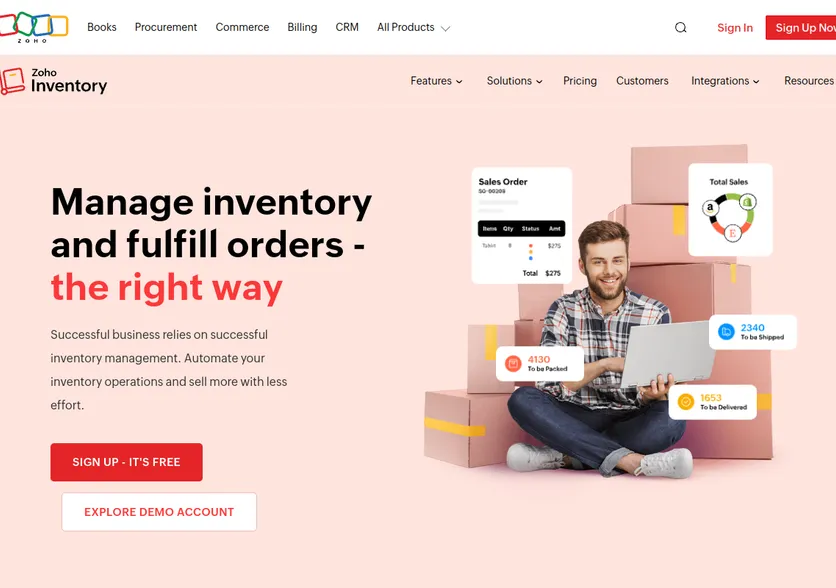
For healthcare practices, this Zoho Inventory plan costs twenty-nine dollars a month billed annually, and it tracks inventory, purchase orders and vendor records together, with a free plan a real business can run on. Purchase orders, reorder points and multiple warehouses sit in one app, with native links to Shopify, Amazon and other sales channels. The free plan covers fifty orders a month for one user, so a small team can run real stock on it before paying anything.
What we like
- Free plan covers 50 orders a month for one user
- Purchase orders and reorder points in the same app
- Native links to Shopify, Amazon and other sales channels
Watch out for
- Standard caps at 500 orders a month
- Bins and batch tracking need the Premium plan
How to try it
- Add vendors and set reorder points for each stocked item
- Raise a purchase order when stock hits the reorder point
- Receive the delivery and update stock across warehouses
8. Airtable
Best for: Teams that want a vendor database that looks like a spreadsheet
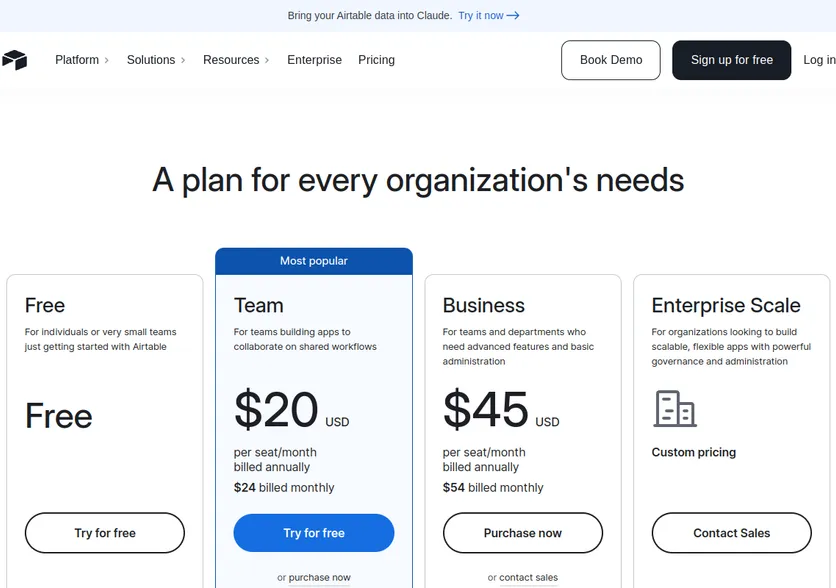
Paid tool Starting price: $20/user/month · Team $20 per user a month billed annually ($24 monthly); Business $45 a month; Enterprise by quote; only editors are charged, read-only collaborators are free
Free plan: Free plan
When healthcare practices need a vendor database that looks like a spreadsheet, this Airtable plan costs twenty dollars per user a month billed annually, and it looks like a spreadsheet and behaves like a database, with linked records that tie vendors to orders and renewals. Calendar, gallery and kanban views turn vendor rows into something a non-technical user can actually use, and interfaces hide the complexity from occasional users. Only editors are charged, so read-only collaborators can follow vendor work for free on every plan.
What we like
- Spreadsheet look with real database relations
- Only editors are charged, viewers are free
- Interfaces hide complexity from occasional users
Watch out for
- Team caps at 50,000 records per base
- Business costs more than double the Team rate
How to try it
- Create a base with linked tables for vendors, orders and renewals
- Build an interface that shows each vendor's open orders
- Set automations to flag renewals before they expire
Prices above were checked on each vendor’s own website on Nov 29, 2026 and can change — the vendor’s page is the final word. Vendor links are editorial: nobody paid to be listed or ranked here. Vendors who want a featured listing can see how it works on our Get listed page.
How a healthcare practice should keep vendor buying audit-ready
Keep a separate budget for each department or cost centre, and block any order that would push it over budget until a manager approves it, because audit trails matter more in healthcare than in most businesses. Record every supplier agreement, licence and insurance certificate beside the vendor record, and set renewal alerts so nothing lapses unnoticed. Match each invoice to its purchase order and delivery note before paying, and keep the approval record with the payment for the auditor. Review suppliers twice a year for price, reliability and compliance, and replace any vendor that cannot prove its paperwork.
Before you buy
- Confirm the tool keeps an audit trail on every approval, invoice and payment
- Check whether supplier records hold licences, insurance and compliance certificates
- Ask if budgets can be set per department, cost centre or facility
- Make sure the tool flags renewals before they lapse, not after
- Test the tool on a real supply order, including a delivery that needs checking
Official websites
Official websites of the products reviewed above. Features and prices were checked against these sites when this guide was written, and they can change, so confirm on the vendor site before you buy.
Frequently asked questions
What is vendor management software for healthcare practices?
Vendor management software for healthcare practices is a single place to keep supplier records, agreements, purchase orders and renewal dates, so nothing is tracked in scattered spreadsheets or email threads. It routes each purchase through approval, matches invoices to orders before payment, and flags renewals before they expire. For healthcare practices, that means fewer missed deadlines, cleaner audits and a vendor list the whole team can trust.
How much does Precoro cost?
Precoro Core costs four hundred and ninety-nine dollars a month billed annually, and Automation costs nine hundred and ninety-nine dollars a month. Enterprise is quoted, and there is no free plan, though a fourteen-day trial is available. The flat monthly rate covers unlimited users on the published tiers, so the price does not rise as approvers join.
Can healthcare practices manage vendors for free?
Yes, with limits. Airtable has a free plan with unlimited bases, and Tradogram offers a free plan capped at five transactions a month. Zoho Inventory also offers a free plan covering fifty orders a month for one user. Most free plans cap users, orders or transactions, so a busy team outgrows them quickly. The free tiers are still the cheapest way to test a workflow on real orders before paying.
Which tool is best for a small healthcare practice?
Spendwise suits a small practice best, at nine dollars per user a month for purchase orders, approvals and receiving. The Basic plan stops at five users and ten transactions a month, so a busier practice moves to Pro at nineteen dollars a user. Tradogram at ninety-nine dollars a month adds supplier payments for practices that pay many small vendors.
What should healthcare practices check before buying vendor management software?
Check three things before paying. First, whether the entry plan covers the work the team actually does, since several tools here keep purchase orders, budgets or receiving on higher tiers. Second, how the price grows, because per-user billing, spend caps and vendor caps all change the real monthly cost. Third, whether suppliers need an account, since a portal nobody uses is worse than no portal at all.
Compare the eight tools above, then start with a free trial or the free Airtable plan on the tool that matches how the practice already buys before paying for a full year.
Browse Business Tools tools