On this page
How we researched this
We compared eight acceleration platforms that publish a real USD price and can serve an enterprise site worldwide. We checked each vendor pricing page in November 2026, weighed per-gigabyte costs, edge features and security, and dropped quote-only CDNs and tools priced only in euros.
Compare the tools
| Name | Best for | Starting price | Free plan | |
|---|---|---|---|---|
 Cloudflare | Teams that want a CDN, DNS and security in one account | $20/month | Free plan | Visit |
 Fastly | Teams that need instant cache purging and edge logic | $0.12/GB | Free plan (100 GB a month) | Visit |
 Amazon CloudFront | Teams already running on AWS | $15/month | Free plan (1 TB a month) | Visit |
 Google Cloud CDN | Teams already hosting on Google Cloud | $0.08/GiB | No free plan; pay as you go | Visit |
 Azure Front Door | Enterprises already on Microsoft Azure | $35/month | No free plan; 30-day free trial | Visit |
 BunnyCDN | Small teams that want the cheapest per-gigabyte CDN | $1/month | No free plan; 14-day free trial | Visit |
 KeyCDN | Teams that want simple pay-as-you-go with no request fees | $0.04/GB | No free plan; pay as you go | Visit |
 Sucuri | Teams that need a CDN plus a website firewall and cleanup | $229/year | No free plan; 30-day money-back guarantee | Visit |
The 8 best web server accelerators for enterprise
1. Cloudflare
Best for: Teams that want a CDN, DNS and security in one account
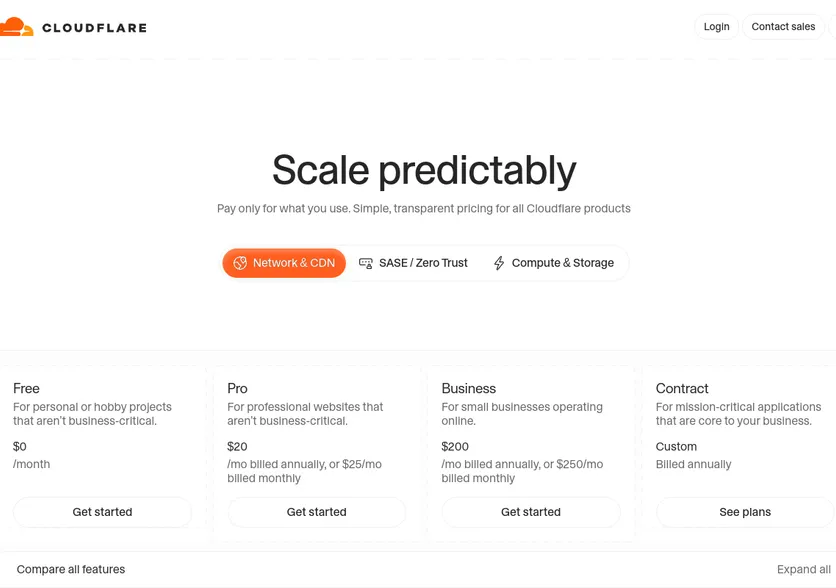
Paid tool Starting price: $20/month · $20 a month per domain for Pro, billed annually ($25 billed monthly); Business is $200 a month and Enterprise is priced by quote; the Free plan covers basic CDN and security.
Free plan: Free plan
An enterprise that wants its CDN, DNS and security under one roof gets the simplest answer here, since this Cloudflare Pro plan costs twenty dollars a month per domain billed annually. The global network is one of the largest on the internet, so content sits close to visitors in almost every market. A managed web application firewall and image optimization come with the plan instead of costing extra.
What we like
- Huge global network with free tier included
- WAF, image optimization and rules on the Pro plan
- Simple dashboard and fast DNS propagation
Watch out for
- Per-domain pricing adds up across many sites
- Advanced caching controls need the Business tier
How to try it
- Add your domain to Cloudflare and update its nameservers
- Turn on the CDN and pick the Pro plan
- Set a page rule to cache your static assets
2. Fastly
Best for: Teams that need instant cache purging and edge logic
Paid tool Starting price: $0.12/GB · $0.12 per GB in North America and Europe after the first 100 GB a month free, plus $0.01 per 10,000 requests; fixed Network Services packages start at $1,500 a month; older accounts may carry a $50 monthly minimum.
Free plan: Free plan (100 GB a month)
An enterprise that needs cache purges in milliseconds rather than minutes will value the edge control here, since this Fastly usage plan costs twelve cents per gigabyte in North America and Europe. The first one hundred gigabytes a month are free, so testing costs nothing at low volume. Edge compute runs custom logic close to visitors, which suits personalized enterprise sites.
What we like
- Edge compute runs code close to visitors
- Cache purges in about one hundred and fifty milliseconds
- Real-time analytics with no delay
Watch out for
- Usage pricing is hard to forecast without traffic data
- Support and fixed packages get expensive fast
How to try it
- Create a Fastly account and add your origin server
- Point your DNS at the Fastly hostname
- Set cache rules and test a purge on one asset
3. Amazon CloudFront
Best for: Teams already running on AWS
Paid tool Starting price: $15/month · $15 a month for the Pro flat-rate plan (50 TB transfer and 10 million requests); pay as you go is $0.085 per GB in the US and Europe after the first 1 TB free; Business is $200 a month.
Free plan: Free plan (1 TB a month)
An enterprise already running on Amazon Web Services keeps everything in one bill here, since this Amazon CloudFront Pro flat-rate plan costs fifteen dollars a month. It integrates deeply with S3 storage, so origin setup is mostly a few clicks. The flat-rate option makes heavy traffic predictable instead of a monthly surprise.
What we like
- Deep integration with S3 and AWS services
- Free tier covers one terabyte a month for a year
- Flat-rate plans make heavy traffic predictable
Watch out for
- The console is complex for first-time users
- Regional pricing differences can surprise new accounts
How to try it
- Open the CloudFront console in your AWS account
- Create a distribution pointing at your origin
- Update your DNS records to the distribution domain
4. Google Cloud CDN
Best for: Teams already hosting on Google Cloud
Paid tool Starting price: $0.08/GiB · $0.08 per GiB of cache egress in North America and Europe for the first 10 TiB, plus $0.01 per GiB cache fill and $0.0075 per 10,000 cache lookups; there is no fixed monthly fee and no free tier; prices are per gibibyte, not gigabyte.
Free plan: No free plan; pay as you go
An enterprise already hosting on Google Cloud gets the shortest path here, since this Google Cloud CDN plan costs eight cents per gibibyte of cache egress in North America and Europe. There is no fixed monthly fee, so quiet months cost almost nothing. The anycast network rides the Google backbone, which keeps latency low worldwide.
What we like
- Anycast network with Google backbone performance
- Seamless fit with Cloud Load Balancing
- Pay-as-you-go with no fixed monthly fee
Watch out for
- No free tier and no fixed-price option
- Pricing is per gibibyte, so bills read higher than gigabyte rivals
How to try it
- Enable Cloud CDN in your Google Cloud project
- Attach it to a load balancer backend
- Set cache policies and check the first egress report
5. Azure Front Door
Best for: Enterprises already on Microsoft Azure
Paid tool Starting price: $35/month · $35 a month base fee for Standard per profile, plus $0.0825 per GB egress in Zone 1 and $0.009 per 10,000 requests; Premium is $330 a month and adds managed WAF rules and bot protection.
Free plan: No free plan; 30-day free trial
An enterprise already on Microsoft Azure gets native global routing here, since this Azure Front Door Standard profile costs thirty-five dollars a month before traffic charges. It pairs cleanly with Azure app services and storage, so origins stay inside one cloud. The Premium tier adds managed firewall rules and bot protection for sites that need them.
What we like
- Global routing with Microsoft backbone latency
- Premium tier adds managed WAF and bot protection
- Strong fit with Azure app services and storage
Watch out for
- Premium costs nearly ten times Standard
- Egress and request charges add to the base fee
How to try it
- Create a Front Door profile in the Azure portal
- Add your origin and a routing rule
- Point your domain at the Front Door endpoint
6. BunnyCDN
Best for: Small teams that want the cheapest per-gigabyte CDN
Paid tool Starting price: $1/month · $1 a month minimum, then $0.01 per GB on the Standard network in North America and Europe ($0.03 in Asia and Oceania, $0.045 in South America, $0.06 in the Middle East and Africa); the Volume network starts at $0.005 per GB; there are no request fees.
Free plan: No free plan; 14-day free trial
An enterprise watching every gigabyte will like the arithmetic here, since this BunnyCDN plan starts at one dollar a month plus one cent per gigabyte on the Standard network. There are no per-request fees, so busy sites avoid the hidden charges other CDNs add. Free SSL and simple pull zones mean a new site can be live in minutes.
What we like
- Lowest per-gigabyte pricing in this roundup
- No per-request fees at any tier
- Free SSL and simple pull-zone setup
Watch out for
- Regional pricing varies sharply outside North America
- No enterprise support on the standard plans
How to try it
- Create a bunny.net account and add a pull zone
- Point your site assets at the pull-zone URL
- Turn on free SSL and test a cached image
7. KeyCDN
Best for: Teams that want simple pay-as-you-go with no request fees
Paid tool Starting price: $0.04/GB · $0.04 per GB in North America and Europe for the first 10 TB, falling to $0.01 above 100 TB; $4 a month minimum usage; note the $49 minimum payment for top-ups; the first three zones are free, then $1 a month each.
Free plan: No free plan; pay as you go
An enterprise that wants pay-as-you-go billing without per-request fees gets a clean model here, since this KeyCDN plan costs four cents per gigabyte in North America and Europe. Rates fall as volume grows, dropping to one cent per gigabyte above one hundred terabytes. Zone setup takes minutes and there are no contracts to sign.
What we like
- No per-request fees on any traffic
- Per-gigabyte rates fall as volume grows
- Zone setup takes minutes with no contracts
Watch out for
- Payments are in forty-nine-dollar top-up blocks
- No free tier for testing at zero cost
How to try it
- Open a KeyCDN account and create a zone
- Add your origin and set the zone URL
- Update your site links and check the traffic report
8. Sucuri
Best for: Teams that need a CDN plus a website firewall and cleanup
Paid tool Starting price: $229/year · $229 a year for Basic Platform on one site; Pro is $339 and Business is $549 a year; firewall-only plans start at $9.99 a month; older $199.99 listings are stale.
Free plan: No free plan; 30-day money-back guarantee
An enterprise that wants a CDN plus a website firewall in one subscription gets both here, since this Sucuri Basic Platform plan costs two hundred and twenty-nine dollars a year for one site. Malware cleanup and removal are included, so a hacked page does not become a separate invoice. Per-site pricing with no traffic charges makes the yearly bill easy to forecast.
What we like
- Bundles a CDN with a website firewall
- Malware cleanup and removal included
- Clear per-site pricing with no traffic charges
Watch out for
- Cleanup response takes up to thirty hours on Basic
- Scans run every twelve hours, not continuously
How to try it
- Buy a Sucuri plan and add your site
- Point your DNS at the Sucuri firewall
- Run a first malware scan and review the report
Prices above were checked on each vendor’s own website on Nov 29, 2026 and can change — the vendor’s page is the final word. Vendor links are editorial: nobody paid to be listed or ranked here. Vendors who want a featured listing can see how it works on our Get listed page.
How to pick an accelerator for an enterprise site
Start by listing where your visitors actually are, because the right network depends on their geography. A global edge network matters more than a low headline price when most traffic comes from three continents. Check the pricing model next: flat-rate plans suit steady heavy traffic, while pay-as-you-go suits spiky or seasonal loads.
Then test cache purging and security together. A purge that takes minutes can leave a wrong price live, and a missing firewall can cost far more than any CDN bill. Finally, confirm support hours and response times, because an enterprise site cannot wait until Monday for a fix.
Before you buy
- Map where your visitors are, because the right network depends on their geography
- Compare flat-rate and pay-as-you-go pricing against your actual traffic pattern
- Test cache purge speed, because a slow purge leaves wrong content live for hours
- Check what security is included, since a firewall and bot protection may cost extra
- Confirm support hours and response times before an outage happens
Official websites
Official websites of the products reviewed above. Features and prices were checked against these sites when this guide was written, and they can change, so confirm on the vendor site before you buy.
Frequently asked questions
What is the cheapest web server accelerator for enterprise?
BunnyCDN is the cheapest per gigabyte here, starting at one dollar a month plus one cent per gigabyte on its Standard network, with no request fees. KeyCDN costs four cents per gigabyte in North America and Europe, and Cloudflare Pro costs twenty dollars a month per domain with a free plan below it. The cheapest choice depends on traffic volume, because a flat monthly fee can beat usage pricing once traffic grows large.
How much does a CDN cost for an enterprise site?
Enterprise CDN pricing in this roundup ranges from twelve cents per gigabyte on Fastly to a twenty-dollar monthly flat fee on Cloudflare Pro. Amazon CloudFront offers a fifteen-dollar monthly flat-rate plan, while Azure Front Door starts at thirty-five dollars a month plus traffic charges. Large enterprises usually pay hundreds to thousands a month once support, security and fixed packages are included, so compare the full bill, not just the headline rate.
Is Cloudflare Pro enough for an enterprise site?
Cloudflare Pro suits many enterprise sites, because it bundles a global CDN, DNS, a web application firewall and image optimization for twenty dollars a month per domain. Sites that need advanced caching rules, faster support or custom contracts should look at the Business plan at two hundred dollars a month or the quoted Enterprise plan. Check whether per-domain pricing still makes sense once you count every site you run.
What is the difference between Fastly and Cloudflare?
Fastly focuses on edge compute and near-instant cache purges, which suits teams that deploy often and need custom logic close to visitors. Cloudflare bundles CDN, DNS and security in one account with a simpler dashboard and a free tier, which suits teams that want everything in one place. Fastly charges per gigabyte and per request, while Cloudflare Pro is a flat monthly fee per domain, so the cheaper option depends on your traffic pattern.
Do I need a CDN if my site is already fast?
A fast origin server still benefits from a CDN, because visitors far from your server get content from a nearby edge location instead of crossing continents. A CDN also absorbs traffic spikes, blocks attacks before they reach your server and speeds up images and static files. If your audience is local and traffic is light, the gain is small, but a global audience will notice the difference immediately.
Start with a free tier, measure the speed gain and scale up from there.
Browse Business Tools tools