On this page
A large enterprise runs the same approval across five departments and three systems, and every handoff is a delay, a duplicate or a lost request waiting to happen. The eight tools below connect those systems, so a request moves from one team to the next without anyone retyping it. Microsoft Power Automate leads because most large enterprises already pay for Microsoft 365 and the Premium plan costs fifteen dollars per user a month billed annually, and the rest are ranked on how well they scale across departments.
How we researched this
Prices below were checked on the vendor pricing page on November 29, 2026, and only tools with a published US dollar list price are included. The big enterprise platforms that sell by quote, including Workato, Tray and Boomi, publish no prices, so they are not in this list. Prices change, so confirm the current figure on the vendor site before you buy.
Compare the tools
| Name | Best for | Starting price | Free plan | |
|---|---|---|---|---|
 Microsoft Power Automate | Microsoft shops that automate deeply | $15/user/month | Free with most Microsoft 365 plans; 30-day trial | Visit |
 Zapier | Teams that want the widest app library | $19.99/month | Free plan (100 tasks a month) | Visit |
 Make | Builders who want visual branching cheaply | $9/month | Free plan (1,000 credits a month) | Visit |
 n8n | Technical teams that want self-hosting | $20/month | Free self-hosted Community edition; cloud trial | Visit |
 ClickUp | Teams that want tasks and automation together | $9/user/month | Free plan (unlimited tasks) | Visit |
 Asana | Teams that plan work on timelines | $10.99/user/month | Free plan (Personal, up to 2 users) | Visit |
 monday.com | Teams that want boards with automation | $12/user/month | Free plan (up to 2 seats) | Visit |
 Smartsheet | Teams that run work on sheets | $9/member/month | Free plan (2 sheets, 100 automation runs) | Visit |
The workflow automation software for large enterprises, compared
1. Microsoft Power Automate
Best for: Microsoft shops that automate deeply
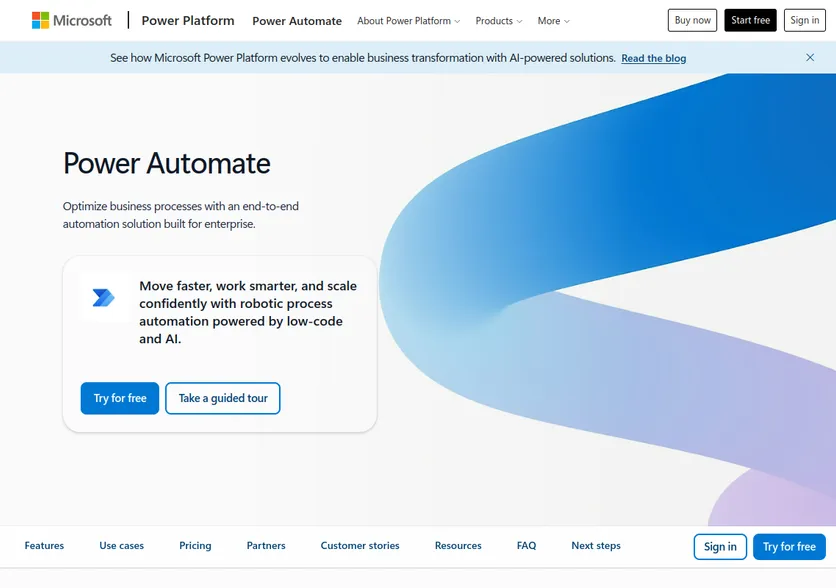
Paid tool Starting price: $15/user/month · Fifteen dollars per user a month on Premium, billed annually only; Process is $150 per bot a month and Hosted Process is $215 per bot a month; a free licence with standard connectors is included in most Microsoft 365 plans
Free plan: Free with most Microsoft 365 plans; 30-day trial
A large enterprise that runs the same approval across five departments and three systems can automate inside the Microsoft tools they already use with this Microsoft Power Automate plan, which costs fifteen dollars per user a month, billed annually. Premium connectors cover more than six hundred apps, and attended desktop flows automate the legacy software that has no API. The catch is licensing: the free Microsoft 365 licence covers standard connectors only.
What we like
- Premium connectors cover more than six hundred apps
- Attended desktop automation is included in Premium
- Flows run inside the Microsoft 365 admin the team already has
Watch out for
- Premium connectors need the paid licence, not the free one
- Unattended bots cost $150 a month each
How to try it
- Open Power Automate and choose a cloud flow template
- Connect the apps and set the trigger and actions
- Run the flow once, then share it with the team
2. Zapier
Best for: Teams that want the widest app library
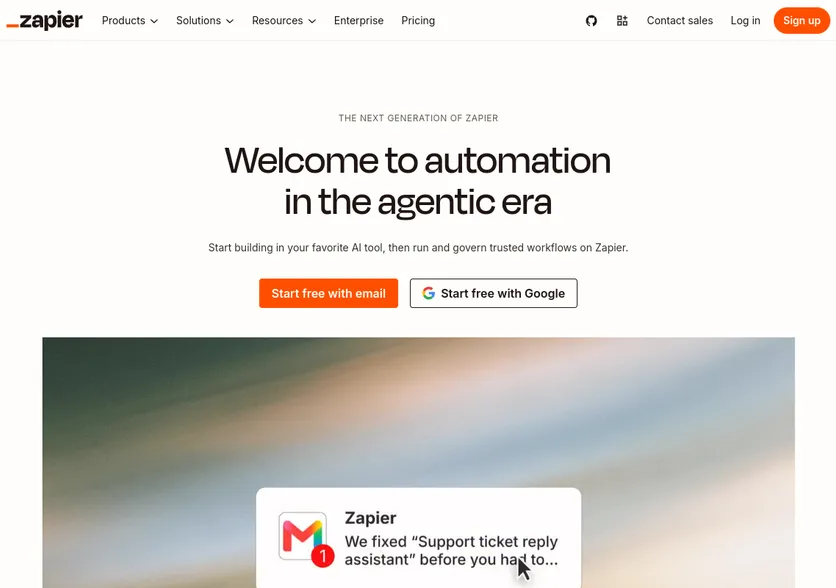
Paid tool Starting price: $19.99/month · Nineteen dollars and ninety-nine cents a month on Starter billed annually ($29.99 billed monthly); Professional is $49 a month billed annually and Team is $69; some October 2026 reads show the entry paid tier labelled Professional at the same $19.99 figure
Free plan: Free plan (100 tasks a month)
A large enterprise that runs the same approval across five departments and three systems will stop retyping the same details between apps with this Zapier plan, which costs nineteen dollars and ninety-nine cents a month billed annually. It connects more than seven thousand apps, so bookings, payments and follow-ups move between tools without retyping. The free plan covers a hundred tasks a month, which is enough to prove the first workflow before paying.
What we like
- Connects more than seven thousand apps
- Visual builder needs no code at all
- Multi-step Zaps with filters on the Starter plan
Watch out for
- Costs rise with task volume, so busy months cost more
- Premium apps need a paid plan to run
How to try it
- Pick a trigger app and the event that starts the workflow
- Add the action steps and map the fields between apps
- Test the Zap on a real record, then switch it on and watch the first runs
3. Make
Best for: Builders who want visual branching cheaply
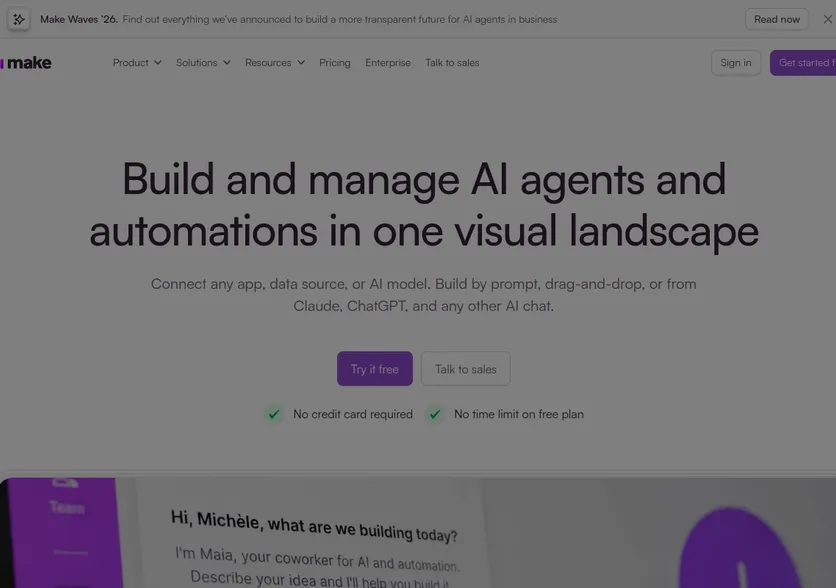
Paid tool Starting price: $9/month · Nine dollars a month on Core billed annually ($10.59 billed monthly) for 10,000 credits; Pro is $16 a month billed annually and Teams is $29; Make cut the Core annual rate from $12 in late October 2026, so older listings still show $12
Free plan: Free plan (1,000 credits a month)
A large enterprise that runs the same approval across five departments and three systems will get the cheapest serious automation here with this Make plan, which costs nine dollars a month billed annually. The visual canvas shows every branch, filter and error path, so a long workflow stays readable. Ten thousand credits a month cover most small teams, and unlimited scenarios mean no workflow has to wait for a higher tier.
What we like
- Visual canvas shows every branch and filter clearly
- Ten thousand credits a month for nine dollars billed annually
- Unlimited active scenarios on the Core plan
Watch out for
- Each module step spends a credit, so long flows burn fast
- Error handling takes practice for a first-time builder
How to try it
- Create a scenario and pick the trigger module
- Add modules for each step and link them on the canvas
- Schedule the scenario and check the run history after the first day
4. n8n
Best for: Technical teams that want self-hosting
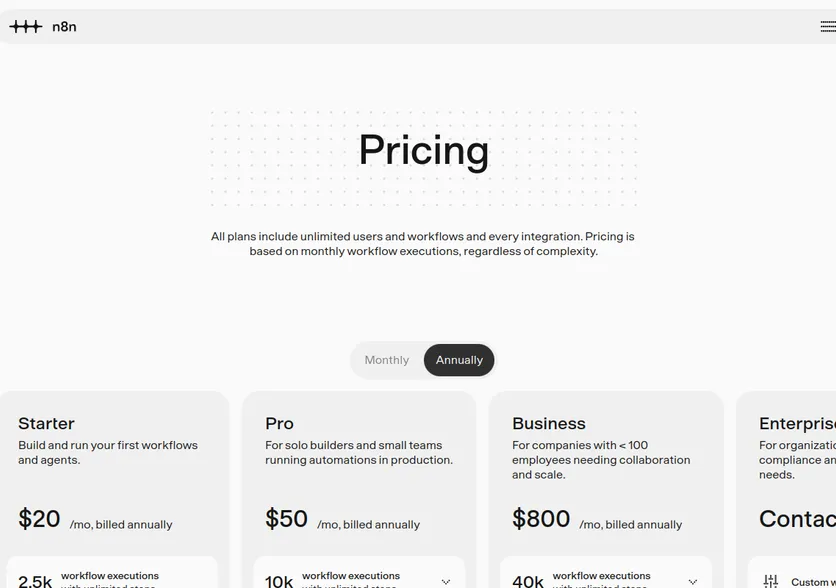
Paid tool Starting price: $20/month · Twenty dollars a month on Starter billed annually ($24 billed monthly) for 2,500 executions; Pro is $50 a month billed annually for 10,000 executions; the self-hosted Community edition is free
Free plan: Free self-hosted Community edition; cloud trial
A large enterprise that runs the same approval across five departments and three systems can automate without per-seat billing with this n8n plan, which costs twenty dollars a month billed annually. One execution covers a whole workflow however many steps it has, which keeps the bill predictable as flows grow. The free self-hosted edition suits a team with a server to spare, while the cloud plan removes the maintenance burden.
What we like
- One execution covers a whole workflow however many steps
- Self-hosted edition is free with unlimited executions
- AI nodes and agents are included on every plan
Watch out for
- Starter caps at five active workflows and five concurrent runs
- Self-hosting means owning updates and uptime
How to try it
- Open the canvas and add a trigger node
- Connect the app nodes in order and set each field
- Run the workflow once by hand, then activate it on a schedule
5. ClickUp
Best for: Teams that want tasks and automation together
Paid tool Starting price: $9/user/month · Nine dollars per user a month on Core billed annually ($12 billed monthly); Business is $17 a user a month billed annually
Free plan: Free plan (unlimited tasks)
A large enterprise that runs the same approval across five departments and three systems will keep tasks and automation in one place with this ClickUp plan, which costs nine dollars per user a month billed annually. Tasks, docs and goals sit beside the automations, so the team works in one place instead of four. The free plan covers unlimited tasks, and the paid plans add the automation runs a busy team needs.

What we like
- Unlimited tasks and members on the free plan
- Automations live beside the work, not in a separate app
- A hundred-plus native integrations cover the common tools
Watch out for
- Automation runs are capped on the lower plans
- The interface packs in a lot and takes a week to learn
How to try it
- Create a list for the work the automation should handle
- Add an automation with a trigger and an action
- Test it on one task, then roll it out to the whole list
6. Asana
Best for: Teams that plan work on timelines
Paid tool Starting price: $10.99/user/month · Ten dollars and ninety-nine cents per user a month on Starter billed annually ($13.49 billed monthly); Advanced is $24.99 a user a month billed annually
Free plan: Free plan (Personal, up to 2 users)
A large enterprise that runs the same approval across five departments and three systems will plan the work and automate the handoffs together with this Asana plan, which costs ten dollars and ninety-nine cents per user a month billed annually. Timeline and Gantt views come with the entry plan, so deadlines stay visible while rules move the work along. Guests are free, which means clients and contractors can follow progress without a paid seat.

What we like
- Unlimited automations on the Starter plan
- Timeline and Gantt views come with the entry plan
- Guests are free, so clients can follow along
Watch out for
- Seats are sold in blocks, so small teams may overpay
- Advanced reporting needs the Advanced plan
How to try it
- Build a project with sections for each stage of the work
- Add a rule that moves tasks when their status changes
- Invite the team and check the rule fires on real tasks
7. monday.com
Best for: Teams that want boards with automation
Paid tool Starting price: $12/user/month · Twelve dollars per user a month on Standard billed annually ($14 billed monthly); Basic is $9 but has no automations, and Pro is $19 a user a month billed annually; seats are sold in bundles with a 3-seat minimum
Free plan: Free plan (up to 2 seats)
A large enterprise that runs the same approval across five departments and three systems will run boards that move themselves with this monday.com plan, which costs twelve dollars per user a month billed annually. Boards flex to almost any process, and Standard adds two hundred and fifty automations and two hundred and fifty integrations a month. The trade-off is the bundle pricing: seats come in groups, and a small team still pays for three.

What we like
- Boards flex to almost any workflow shape
- Standard adds 250 automations a month
- Templates cover most common team processes
Watch out for
- Basic has no automations, so Standard is the real entry price
- Seats are sold in bundles with a three-seat minimum
How to try it
- Create a board with columns for each stage
- Add an automation recipe that moves items when a status changes
- Invite the team and test the recipe on a live item
8. Smartsheet
Best for: Teams that run work on sheets
Paid tool Starting price: $9/member/month · Nine dollars per member a month on Pro billed annually ($12 billed monthly); Business is $19 a member a month billed annually; Pro caps at 10 members
Free plan: Free plan (2 sheets, 100 automation runs)
A large enterprise that runs the same approval across five departments and three systems will run its work on sheets that update themselves with this Smartsheet plan, which costs nine dollars per member a month billed annually. Gantt, grid, board and calendar views cover most ways a team likes to see work, and two hundred and fifty automations a month handle the routine moves. The hard limit is ten members on Pro, so a growing team should budget for Business.

What we like
- 250 automations a month on Pro
- Gantt, grid, board and calendar views in one plan
- Unlimited free viewers keep stakeholders in the loop
Watch out for
- Pro caps at ten members, so growth forces Business
- Automation runs are capped, unlike some rivals
How to try it
- Create a sheet with columns for each stage
- Add an automation that alerts or moves rows on change
- Share the sheet and check the automation fires on real rows
Prices above were checked on each vendor’s own website on Nov 29, 2026 and can change — the vendor’s page is the final word. Vendor links are editorial: nobody paid to be listed or ranked here. Vendors who want a featured listing can see how it works on our Get listed page.
How to roll out automation across departments without breaking anything
Start with one department and one workflow, because an enterprise-wide rollout that fails in week one is hard to restart. Pick a process with a clear owner and a measurable result, such as invoice approvals, and prove the time saved before asking the next department to join. Set governance early: who can build a flow, who approves it, and where the data is allowed to go. Review the automation estate every quarter, since a flow built for one team can quietly become a dependency for five others.
Before you buy
- Check whether the tool offers single sign-on and audit logs, since IT will ask before approving it
- Confirm the plan covers enough runs for every department, not just the pilot team
- Ask how the price grows with volume, since enterprise usage can multiply in a quarter
- Make sure data stays in the region your compliance team requires
- Test one full workflow end to end with real users before rolling it out company-wide
Official websites
Official websites of the products reviewed above. Features and prices were checked against these sites when this guide was written, and they can change, so confirm on the vendor site before you buy.
Frequently asked questions
What is workflow automation software for large enterprises?
It is software that connects the systems a large company uses, so a request moves from one department to the next without manual work. A team sets the flow up once, and every approval, invoice or ticket follows the same path. Without it, the same details get retyped into five systems, and requests stall between departments.
How much does Microsoft Power Automate cost for an enterprise?
Microsoft Power Automate costs fifteen dollars per user a month on Premium, billed annually only, and it covers premium connectors, attended desktop flows and process mining. Process is a hundred and fifty dollars per bot a month for unattended work. A free licence with standard connectors is included in most Microsoft 365 plans.
Can a large enterprise automate for free?
Yes, in part: Microsoft Power Automate includes a free licence with standard connectors in most Microsoft 365 plans, and Zapier and Make both offer free plans. Smartsheet also has a free plan. None of these cover enterprise needs on their own, though, so a large company should compare the paid plans above and budget for governance and support.
Which automation tool is best for a large enterprise?
Microsoft Power Automate is the best overall for a large enterprise already on Microsoft 365, since its Premium plan starts at fifteen dollars a user a month. Zapier is the best pick for the widest app library, and Smartsheet suits teams that run work on sheets. Workato and Boomi are quote-only, so they are not in this list.
What should an enterprise automate first?
Automate one department's approval flow first, such as invoice approvals, because it has a clear owner and a measurable result. Prove the time saved, then roll the pattern out to the next department. Set governance early, since a flow built for one team can quietly become a dependency for five others.
Compare the eight tools above, then pilot Microsoft Power Automate or Zapier on one department's approval flow before rolling it out company-wide.
Browse Productivity Tools tools