
Need to turn millimeters into inches? This free millimeter to inch converts instantly in your browser. Type a value in either box and the other side updates at once, using the exact factor 25.4 mm = 1 in. There is no sign-up, no file to upload and nothing to install — the math runs on your device.
It is handy for workshop parts, bolts, drill bits and 3D printing, where metric parts meet US hardware. A 10 mm bolt is 0.3937 inches across — just under 0.4 inches. For more units, try the Length Converter (All Units), and for everyday math the Percentage Calculator is close at hand.
How to use
- Type a value in the millimeter box — or in the inch box to convert the other way.
- The result appears instantly, rounded to a sensible number of decimal places.
- Use the swap button to flip the direction without retyping.
- Copy the result, or check the table below for the most common values.
Why use Toolsvine
Converting millimeters to inches is a two-second job when the factor is right, and this page uses the definition itself: 25.4 mm = 1 in exactly. Most converters on the web send your numbers to a server or bury the answer under ads. This one does the arithmetic locally, shows the exact factor it used, and gives you a table of common millimeter-to-inch values so you can double-check at a glance — free, with no account and no tracking.
What is the millimeter to inch formula?
Divide the millimeter value by 25.4 to get inches: inches = millimeters ÷ 25.4. The factor is exact because the inch is defined as 25.4 millimeters, so there is no rounding in the definition itself — only in how many decimal places you choose to show in the answer.
Millimeters are the workshop unit for small parts, while inches rule in US hardware stores, so a 10 mm bolt is just under 0.4 inches across. The exact factor is 1 ÷ 25.4, shown rounded to seven decimal places (0.0393701) only when a decimal is needed.
Common millimeter to inch values
| Millimeters (mm) | Inches (in) |
|---|---|
| 1 mm | 0.03937 in |
| 10 mm | 0.3937 in |
| 25.4 mm | 1 in |
| 50 mm | 1.9685 in |
| 100 mm | 3.9370 in |
| 254 mm | 10 in |
Results are rounded to a few decimal places in the table so they stay readable; the converter itself keeps more precision and only rounds what it shows. If you need more digits, copy the full result and round it to whatever your project demands.
Worked example: what size is a 19 mm wrench in inches?
A 19 mm wrench is 0.748 inches across — just under 3/4 of an inch. Divide 19 by 25.4 to get 0.74803 inches, and 3/4 of an inch is 0.75, so the two sizes are almost identical. That near-match is why metric and imperial sockets so often sit side by side in the same toolbox.
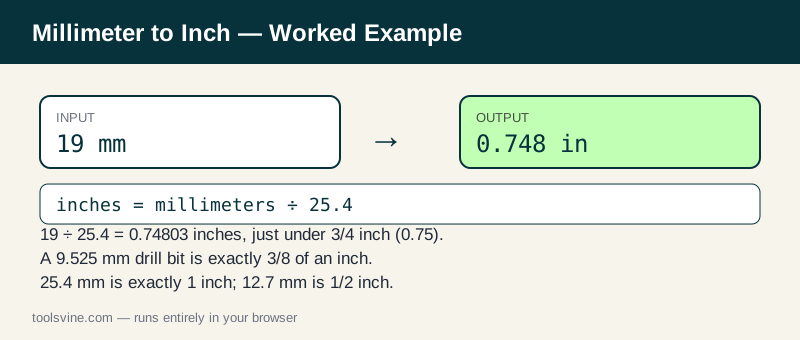
Try a drill bit: a 9.525 mm bit is exactly 3/8 of an inch (9.525 ÷ 25.4 = 0.375). Drill bits, screws and bolts are the classic case — US hardware stores label them in fractions of an inch while the parts themselves are made to metric sizes, and a small conversion error means a bit that does not fit.
How do I convert millimeters to fractions of an inch?
Convert to a decimal first, then match it to the nearest common fraction. For example, 0.748 inches is 3/4 inch (0.75), and 0.3937 inches is close to 13/32 inch (0.406). Hardware stores sell bits and wrenches in 1/16-inch steps, so round to the nearest 1/16 when you are matching a physical tool.
A quick anchor: 25.4 mm is exactly 1 inch, so 12.7 mm is 1/2 inch and 6.35 mm is 1/4 inch. For the reverse direction, the Centimeter to Inch converter covers the next unit up.
Frequently asked questions
What is the exact millimeter to inch conversion factor?
Divide by 25.4. That comes from the definition 25.4 mm = 1 in, so the factor is exact — any small difference you see between converters is just rounding of the displayed result. Converters that use 0.039 instead of the exact factor will drift on large values, which is why this tool uses the definition itself.
How many inches is 10 mm?
10 mm is 0.3937 in (10 ÷ 25.4). You can see more round numbers in the table above, or type 10 into the converter for the full-precision answer. For a quick estimate, 10 mm is just under 0.4 inches — about the width of a standard pencil.
What size is a 19 mm socket in inches?
A 19 mm socket is 0.748 inches, which is just under 3/4 of an inch (0.75). In practice, a 3/4-inch socket will usually fit a 19 mm bolt head, and mechanics keep both in the same drawer. For a tight fit, use the exact metric socket rather than the near-match.
Can I convert back from inch to millimeter?
Yes — type in the inch box and the millimeter value updates automatically, or press the swap button to flip the direction. The reverse uses the same exact factor, multiplied instead of divided, so a 3/8-inch drill bit converts back to exactly 9.525 mm.
Is this converter free, and is my data uploaded?
Yes, it is completely free, and nothing is uploaded. The conversion runs in JavaScript in your browser, so your numbers never leave your device and the tool works offline once the page has loaded. There is no account to create and no limit on how many values you convert.