
Did your rent go up, your salary rise, or a product price drop? This free percentage increase/decrease calculator finds the change between two numbers — as a percent, as a dollar amount, and with the full working shown — so you can check a raise, a price hike, or a sale in seconds.
Type the old value and the new value, and the tool tells you whether it went up or down, and by exactly how much. For comparing two values where neither is the “before,” use the Percentage Difference Calculator. For a single percent of a number, the Percentage Calculator is the faster tool.
How to use
- Type the old (starting) value into the first field.
- Type the new (ending) value into the second field.
- Click Calculate. The percent change appears with the working.
- Use Clear to compare another pair of values.
Why use Toolsvine
Price hikes and pay raises are always quoted in percentages, and the base matters more than the headline number: a $150 rent rise on $1,200 is 12.5%, but the same $150 on $800 is 18.75%. This calculator shows the change in dollars and the percent side by side, with the division written out, so you can see exactly which base was used and catch a misleading quote.
How do I calculate a percentage increase or decrease?
Take the new value minus the old value, divide the change by the old value, and multiply by 100. The old value is always the base — the number you started from — and the sign of the answer tells you the direction: a positive result is an increase, a negative result is a decrease.
The formula, written out
| Step | Formula | Example: $40 → $50 |
|---|---|---|
| 1. Find the change | New − Old | $50 − $40 = $10 |
| 2. Divide by the old value | Change ÷ Old | $10 ÷ $40 = 0.25 |
| 3. Multiply by 100 | 0.25 × 100 | 25% increase |
The base is the old value, never the new one — that is the rule that trips people up. A price that rises from $40 to $50 is a 25% increase, because the $10 change is measured against the $40 starting price. If you divided by $50 instead, you would get 20% and the wrong answer.
Increase and decrease are not symmetric
A 20% rise followed by a 20% fall does not return to the start. A $100 item rises 20% to $120, then falls 20% of $120 — which is $24 — leaving $96. You need a 25% rise to get from $96 back to $120, because the base changed. Whenever you see a “20% off, then 20% back on” offer, remember the second 20% is charged on a different number.
What is a worked percentage change example?
Here is the full working for a rent increase, the case most people check with this tool. A landlord raises the rent from $1,200 to $1,350 a month — is that a fair rise or a steep one? The math takes three steps, and the answer is the same formula whether the numbers are rent, salary, or sales.
Worked example: rent rises from $1,200 to $1,350
| Step | Working | Result |
|---|---|---|
| 1. Change | $1,350 − $1,200 | $150 more per month |
| 2. Divide by the old rent | $150 ÷ $1,200 | 0.125 |
| 3. As a percent | 0.125 × 100 | 12.5% increase |
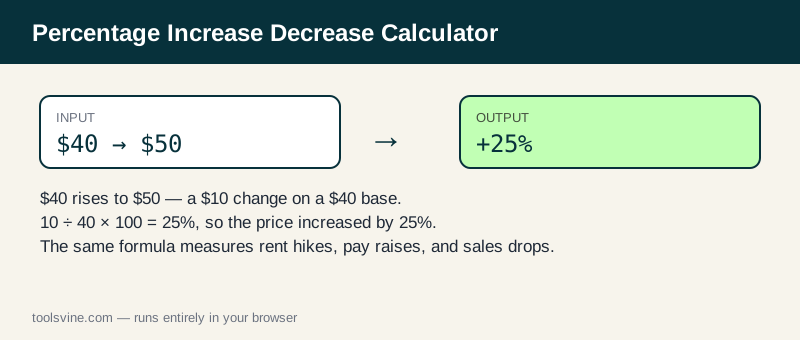
The same method checks a price cut: an $80 jacket marked down to $64 is a $16 change on an $80 base, which is 16 ÷ 80 × 100 = 20% off. And a $40 item rising to $50 is a $10 change on $40 — 25%. Try your own numbers in the tool above and watch the sign flip: a new value below the old one always produces a negative percent, which the tool reports as a decrease.
How big is a “normal” increase?
Context matters more than the number alone. A 3% pay raise roughly matches US inflation in a typical year, so it keeps your buying power flat. A 12.5% rent rise is steep — US landlords in most states can raise rent freely between lease terms, but a rise that large is worth negotiating or comparing against similar homes in Austin or Dallas. A 25% jump in a product price usually signals a new version or a pricing change, not ordinary inflation.
Frequently asked questions
How do I calculate a percentage increase?
Subtract the old value from the new value, divide the change by the old value, and multiply by 100. If a price rises from $40 to $50, the change is $10, and 10 ÷ 40 × 100 = 25%. The old value is always the base — dividing by the new value gives the wrong answer. The calculator above shows all three steps, so you can check the working.
How do I calculate a percentage decrease?
Use the same formula: new minus old, divided by old, times 100. If an $80 jacket drops to $64, the change is −$16, and 16 ÷ 80 × 100 = 20% off. A negative answer means a decrease, and the tool reports it as one. The most common mistake is dividing by the new value instead of the old one — always divide by the number you started from.
Why doesn't a 20% rise and a 20% fall cancel out?
Because the base changes. A $100 item rises 20% to $120, then falls 20% — but 20% of $120 is $24, not $20, so you land at $96. To get back to $120 from $96 you need a 25% rise. Whenever the base moves, the same percentage means a different dollar amount, which is why the order of the changes matters.
What is percent change vs percentage difference?
Percent change measures a move from a starting value to a new value, using the old value as the base — it has a direction, up or down. Percentage difference compares two values with no before and after, using their average as the base, and it is always positive. Use percent change for raises, price hikes, and growth; use percentage difference to compare two prices or two measurements.
Is a 12.5% rent increase a lot?
Yes — it is steep compared with typical US inflation, which usually runs around 2–3% a year, and with most annual rent rises of 3–5%. A $1,200 rent rising to $1,350 costs an extra $1,800 a year, which is worth negotiating or comparing against similar homes in your city. Some cities cap increases, so check your local rules before accepting a large rise.