
Turn 12/16 into 3/4, or 84/126 into 2/3 — this free fraction simplifier reduces any fraction to lowest terms and shows the greatest common factor it divided by, so you can follow the math or check homework.
Type a fraction and the tool gives you the simplest form instantly, with the divisor shown. To work with two fractions at once, the Fraction Calculator adds, subtracts, multiplies, and divides them. To see a simplified fraction as a decimal, use the Fraction to Decimal tool.
How to use
- Type the fraction you want to simplify, such as 12/16.
- Click Simplify. The tool finds the greatest common factor.
- Read the simplest form with the divisor shown.
- Use Clear to simplify another fraction.
Why use Toolsvine
A fraction is only finished when it is in lowest terms, and students lose marks for stopping at 6/12 instead of 1/2 — not because the answer is wrong, but because it is unfinished. This simplifier shows the greatest common factor it divided by, so you can see exactly why 12/16 becomes 3/4 and learn the pattern instead of memorizing one answer.
How do I simplify a fraction?
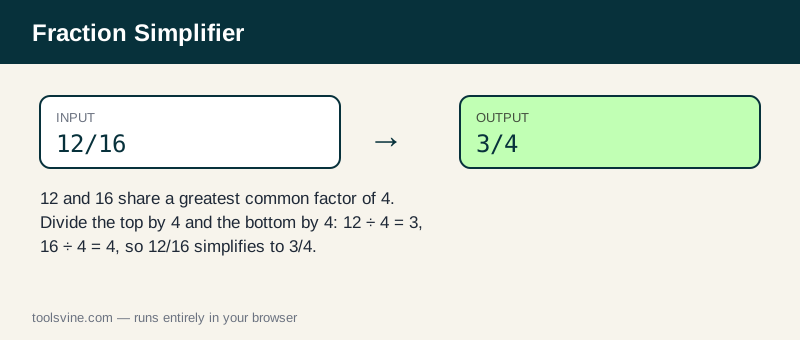
Divide the numerator and the denominator by their greatest common factor — the largest number that divides both evenly. For 12/16, that factor is 4: 12 ÷ 4 = 3 and 16 ÷ 4 = 4, so 12/16 simplifies to 3/4. A fraction is in lowest terms when the numerator and denominator share no factor other than 1.
Finding the greatest common factor
List the factors of each number and take the largest one they share, or use Euclid's method: divide the larger number by the smaller, replace the larger with the remainder, and repeat until the remainder is zero — the last divisor is the greatest common factor. For 84 and 126: 126 ÷ 84 leaves 42, 84 ÷ 42 leaves 0, so the greatest common factor is 42, and 84/126 simplifies to 2/3.
Simplification examples
| Fraction | Greatest common factor | Simplest form |
|---|---|---|
| 12/16 | 4 | 3/4 |
| 84/126 | 42 | 2/3 |
| 45/60 | 15 | 3/4 |
| 100/250 | 50 | 2/5 |
| 7/11 | 1 | 7/11 (already simplest) |
Notice that 45/60 and 12/16 both simplify to 3/4 even though they started from different numbers — fractions that look different can represent the same value. And 7/11 cannot be simplified at all, because 7 and 11 are both prime and share no factor.
Why does simplifying matter?
Simplest form is the standard way fractions are written in school, in recipes, and in engineering — it makes comparison easy, keeps numbers small, and shows the true ratio at a glance. A recipe that calls for 12/16 cup of sugar is asking for 3/4 cup, and a test answer of 6/12 is marked wrong because it is unfinished.
Worked example: simplifying 84/126
| Step | Working | Result |
|---|---|---|
| 1. Find the greatest common factor | Factors of 84 and 126 share 42 | GCF = 42 |
| 2. Divide the numerator | 84 ÷ 42 | 2 |
| 3. Divide the denominator | 126 ÷ 42 | 3 |
| Answer | 84/126 | 2/3 |
Euclid's method is the reliable way to find the factor without listing every number: 126 ÷ 84 leaves a remainder of 42, and 84 ÷ 42 leaves 0, so 42 is the greatest common factor. Try 100/250 in the tool above — it divides by 50 to give 2/5 — and try 7/11 to see what happens when a fraction is already in lowest terms.
What about negative fractions?
The sign stays with the fraction as a whole: −12/16 simplifies to −3/4, and 12/−16 is the same value written differently. This tool keeps the minus sign on the numerator, which is the standard form, and simplifies the size exactly the same way. A negative fraction is in lowest terms when its size is, regardless of where the sign sits.
Frequently asked questions
How do I simplify a fraction?
Divide the numerator and denominator by their greatest common factor — the largest number that divides both evenly. For 12/16 the factor is 4, so 12 ÷ 4 = 3 and 16 ÷ 4 = 4, giving 3/4. A fraction is finished when the top and bottom share no factor other than 1. The tool above shows the factor it divided by, so you can follow the working.
What is the greatest common factor?
The largest number that divides two numbers evenly. For 84 and 126 it is 42: both 84 ÷ 42 = 2 and 126 ÷ 42 = 3 are whole numbers, and no larger number divides both. Euclid's method finds it fast — divide the larger by the smaller, replace the larger with the remainder, and repeat until the remainder is zero; the last divisor is the factor.
How do I know when a fraction is fully simplified?
When the numerator and denominator share no common factor other than 1. For 3/4, the factors of 3 are 1 and 3, and the factors of 4 are 1, 2, and 4 — they share only 1, so 3/4 is finished. If you tried to divide 7/11, you would find 7 and 11 are both prime and share nothing, so 7/11 is already in lowest terms.
Can I simplify a fraction with a large numerator?
Yes — type any size numbers into the tool, and it finds the greatest common factor with Euclid's method, which is fast even for very large numbers. For example, 1,250/2,000 simplifies by 250 to 5/8. If you are simplifying by hand, start by dividing both numbers by 2 or 5 as many times as you can, then check the smaller factors that remain.
Why is 6/12 marked wrong when it equals 1/2?
Because it is not finished. In school math, an answer must be in lowest terms — 6/12 is correct as a value but incomplete as an answer, and teachers mark it down for exactly that reason. The same rule applies to recipes and measurements: 12/16 cup is written as 3/4 cup, because simplest form is the form everyone else will recognize and use.