
What is 7/8 as a decimal? This free fraction to decimal converter divides the numerator by the denominator and shows the result — exact when it terminates, rounded when it repeats — so you can use a fraction in a calculator, a spreadsheet, or a measurement.
Type any fraction and the tool gives you the decimal with the working shown. To go the other way, the Decimal to Fraction tool turns 0.75 back into 3/4. For full fraction arithmetic, the Fraction Calculator handles addition, subtraction, multiplication, and division.
How to use
- Type the fraction, such as 7/8 or 2/3.
- Click Convert. The tool divides the numerator by the denominator.
- Read the decimal result with the working shown.
- Use Clear to convert another fraction.
Why use Toolsvine
Calculators and spreadsheets speak decimals, but recipes, tape measures, and school problems speak fractions — and the gap between 0.875 and 7/8 is where most conversion mistakes happen. This converter shows the division itself, marks repeating decimals clearly, and tells you whether the result is exact or rounded, so you know when 0.667 is a rounded 2/3 and not a different number.
How do I convert a fraction to a decimal?
Divide the numerator by the denominator. For 7/8, that is 7 ÷ 8 = 0.875, an exact decimal that terminates. Whether the decimal ends or repeats forever depends on the denominator: if its only prime factors are 2 and 5, the decimal terminates; if it has any other prime factor, the decimal repeats and must be rounded.
Terminating vs repeating decimals
| Fraction | Decimal | Type | Why |
|---|---|---|---|
| 7/8 | 0.875 | Terminating | 8 = 2 × 2 × 2 |
| 13/20 | 0.65 | Terminating | 20 = 2 × 2 × 5 |
| 5/16 | 0.3125 | Terminating | 16 = 2 × 2 × 2 × 2 |
| 2/3 | 0.6667 | Repeating | 3 is not 2 or 5 |
| 1/7 | 0.142857… | Repeating | 7 is not 2 or 5 |
The rule is simple and exact: a fraction in lowest terms terminates only when the denominator's prime factors are 2s and 5s. Everything else repeats. That is why 7/8 is a clean 0.875 while 2/3 becomes 0.6666… forever, and why the tool rounds repeating decimals to four places and marks them as rounded.
Long division, the way the tool does it
Converting 7/8 by hand means dividing 7.000 by 8: 8 goes into 70 eight times (64), leaving 6; bring down a 0, 8 goes into 60 seven times (56), leaving 4; bring down a 0, 8 goes into 40 five times exactly. The digits 8, 7, and 5 are the decimal places — 0.875. The same process on 2/3 repeats the digit 6 forever, because 3 never divides 20 evenly.
Where do fraction decimals show up?
Everywhere measurements meet calculators: a recipe calling for 7/8 cup, a tape measure reading 5/16 inch, a grade of 13/20, or a discount of 1/3 off. In each case the decimal form is what a calculator or a spreadsheet needs — and knowing whether it is exact or rounded tells you how much to trust the last digit.
Worked example: 7/8 = 0.875
| Step | Working | Result |
|---|---|---|
| 1. Set up the division | 7 ÷ 8 | 7.000 ÷ 8 |
| 2. First decimal digit | 70 ÷ 8 = 8, remainder 6 | 0.8 |
| 3. Second decimal digit | 60 ÷ 8 = 7, remainder 4 | 0.87 |
| 4. Third decimal digit | 40 ÷ 8 = 5, remainder 0 | 0.875 |
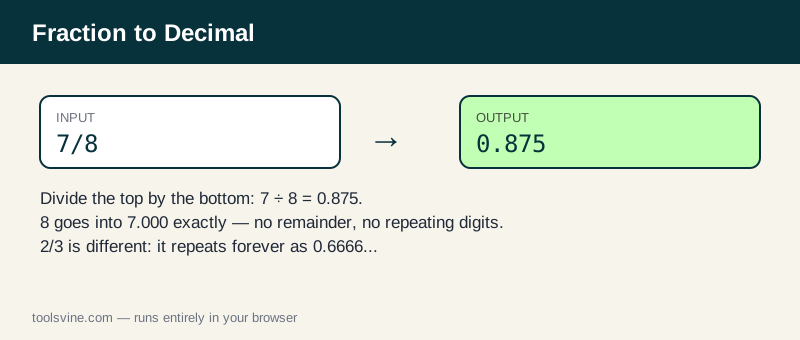
Because the remainder reaches zero, 0.875 is exact — not rounded, not approximate. Compare 2/3: the division is 2 ÷ 3, the digit 6 repeats forever, and the tool shows 0.6667 as a four-place rounding, marked as such. Try 13/20 in the tool to see another exact case (0.65), and 1/7 to see a six-digit repeating cycle (0.142857…).
How many decimal places should I use?
Four places is the honest default for repeating decimals — 0.6667 for 2/3 — because it is accurate to about one part in ten thousand, which is more than enough for homework, recipes, and most money math. For exact decimals like 0.875, use all the digits: dropping the 5 changes the value. In a spreadsheet, keep the fraction in a note and the full decimal in the cell, so the rounding is visible, not hidden.
Frequently asked questions
How do I convert a fraction to a decimal?
Divide the numerator by the denominator. For 7/8, that is 7 ÷ 8 = 0.875. The tool above shows the long division step by step, so you can see exactly where each digit comes from. If the division never reaches a zero remainder, the decimal repeats — 2/3 becomes 0.6666 forever — and the tool rounds it to four places and marks it as rounded.
Why does 2/3 never end as a decimal?
Because its denominator, 3, is not made of only 2s and 5s. A fraction in lowest terms gives a terminating decimal only when the denominator's prime factors are 2 and 5 — like 8, 20, or 16. A denominator with a 3, a 7, or an 11 in it produces a repeating decimal, so 2/3 is 0.6666 forever and 1/7 repeats the six digits 142857.
What is 7/8 as a decimal?
0.875, exactly. Divide 7 by 8: 8 goes into 70 eight times (64), leaving 6; into 60 seven times (56), leaving 4; into 40 five times, leaving 0. Because the remainder reaches zero, the decimal terminates — it is not rounded or approximate. You will meet 0.875 in recipes for 7/8 cup and in tape measurements of 7/8 inch.
How many decimal places should I round to?
Four places is the standard for repeating decimals: 2/3 becomes 0.6667, which is accurate to about one part in ten thousand — plenty for homework, recipes, and most money math. For exact decimals like 0.875, keep every digit, because dropping one changes the value. In money, round to two places only at the final step, never in the middle of a calculation.
Can I convert a mixed number to a decimal?
Yes — convert the fraction part first, then add the whole number. For 3 5/8, the fraction 5/8 is 0.625, so the mixed number is 3.625. The same method works for any mixed number: 2 1/2 is 2.5, and 1 3/4 is 1.75. The calculator accepts mixed numbers directly, so you can type 3 5/8 and get 3.625 with the working shown.