
Turn 0.75 into 3/4, or 0.6 into 3/5 — this free decimal to fraction converter finds the simplest fraction for any decimal, with the working shown. It is built for homework, recipes, and measurements where a fraction is the right answer.
Type a decimal and the tool gives you the fraction in lowest terms, plus the mixed-number form when the value is over one. To go the other way, the Fraction to Decimal tool turns 7/8 into 0.875. For full fraction arithmetic, use the Fraction Calculator.
How to use
- Type the decimal, such as 0.75 or 3.625.
- Click Convert. The tool writes it over a power of 10.
- Read the simplified fraction with the divisor shown.
- Use Clear to convert another decimal.
Why use Toolsvine
Decimals are what calculators produce, but fractions are what recipes, rulers, and school answers demand — and the step between them is where most people get stuck. This converter shows the power of 10 it starts from and the greatest common factor it divides by, so 0.75 becomes 75/100 and then 3/4 in front of your eyes, instead of appearing as a magic answer.
How do I convert a decimal to a fraction?
Write the decimal over a power of 10 based on its decimal places, then simplify by dividing the top and bottom by their greatest common factor. For 0.75: it has two decimal places, so it is 75/100, and 75 and 100 share a greatest common factor of 25, so dividing both by 25 gives 3/4.
Decimals to fractions at a glance
| Decimal | Over a power of 10 | Greatest common factor | Simplest fraction |
|---|---|---|---|
| 0.75 | 75/100 | 25 | 3/4 |
| 0.6 | 6/10 | 2 | 3/5 |
| 0.125 | 125/1000 | 125 | 1/8 |
| 0.2 | 2/10 | 2 | 1/5 |
| 3.75 | 375/100 | 25 | 3 3/4 |
The pattern is always the same: count the decimal places for the power of 10, write the fraction, then simplify. A decimal with one place uses 10, two places uses 100, three places uses 1,000 — and the simplification step is where the recognizable fraction appears.
What about repeating decimals?
A repeating decimal like 0.3333… is really 1/3, and 0.1666… is 1/6, but a calculator only ever shows a rounded version — 0.3333, not the true repeating value. This tool converts the number you typed, so 0.3333 becomes 3333/10000, not 1/3. For exact fractions, type more digits (0.333333) and the tool's closest-fraction mode finds 1/3 — or type 1/3 into the fraction calculator instead.
Where do decimal fractions show up?
Everywhere a measurement meets a calculator: a tape measure reading 0.75 inch is 3/4 inch, a recipe amount of 0.125 cup is 1/8 cup, and a gas price of $3.75 a gallon is $3 3/4. Fractions are the form school answers demand — a test that asks for a fraction will mark 0.75 wrong even though it equals 3/4.
Worked example: 0.75 = 3/4
| Step | Working | Result |
|---|---|---|
| 1. Count decimal places | 0.75 has two places | Denominator 100 |
| 2. Write as a fraction | 75/100 | 75/100 |
| 3. Greatest common factor | 75 and 100 share 25 | GCF = 25 |
| 4. Simplify | 75 ÷ 25 = 3, 100 ÷ 25 = 4 | 3/4 |
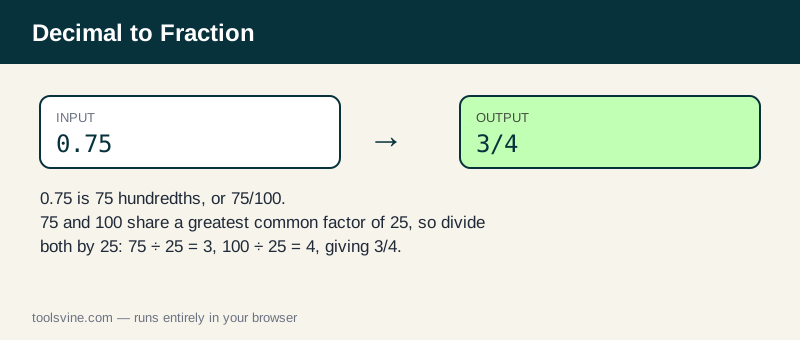
The same four steps handle decimals over one: 3.75 has two decimal places, so it is 375/100, which divides by 25 to give 15/4, written as the mixed number 3 3/4. And 0.6 is 6/10, which divides by 2 to give 3/5. Try 0.125 in the tool to see a three-place decimal become 1/8, and 0.2 to see the shortest path of all — 2/10 divided by 2 is 1/5.
Reading a tape measure
A tape measure marked in sixteenths reads 12/16 as 3/4, and a digital caliper showing 0.75 inch means the same thing in decimal form. The conversion runs both ways: if a blueprint says 3/4 inch and your caliper shows decimals, you are looking for 0.75. Keeping both forms in mind saves a conversion every time you switch tools.
Frequently asked questions
How do I convert a decimal to a fraction?
Write the decimal over a power of 10, then simplify. For 0.75, two decimal places means hundredths, so it is 75/100; 75 and 100 share a greatest common factor of 25, so dividing both by 25 gives 3/4. One decimal place uses 10, two use 100, three use 1,000 — and the simplification step is where the familiar fraction appears.
What is 0.75 as a fraction?
3/4. Write 0.75 as 75/100, since it has two decimal places, then divide the top and bottom by 25 — their greatest common factor — to get 3/4. You will meet this conversion constantly: 0.75 inch on a caliper is 3/4 inch on a tape measure, and 0.75 cup in a metric recipe is 3/4 cup in a US one.
How do I convert 0.3333 to a fraction?
The tool converts the number you typed: 0.3333 is 3333/10000, which cannot be simplified further. But 0.3333 is a rounded version of the repeating decimal 0.3333…, which is exactly 1/3. For the true fraction, type more digits — 0.333333 — and the closest-fraction mode finds 1/3, which is the answer a math class expects.
What is 3.75 as a fraction?
3 3/4, or 15/4 as an improper fraction. Two decimal places means 3.75 is 375/100, and dividing top and bottom by 25 gives 15/4. Written as a mixed number, that is 3 3/4 — the whole number 3 plus the fraction 3/4. You will see 3.75 as $3.75 a gallon for gas, which is $3 and three quarters.
Can I convert a decimal with many places, like 0.142857?
Yes — and that one is famous: 0.142857 is 1/7, rounded to six places. The tool writes it as 142857/1000000 and simplifies it to 1/7, because 142857 and 1000000 share a greatest common factor of 142857. Six-digit repeating cycles like this one appear for sevenths, and the tool's closest-fraction mode catches most of them automatically.