
Add, subtract, multiply, or divide fractions — with mixed numbers too — and see every step. This free fraction calculator works out the answer, simplifies it to lowest terms, and shows the working, so you can follow the math or check homework without guessing.
Type two fractions, pick an operation, and the tool gives you the answer as a fraction, a mixed number, and a decimal. To simplify a single fraction, use the Fraction Simplifier. To turn a result into a decimal, the Fraction to Decimal tool shows the conversion.
How to use
- Type the first fraction, such as 1/2 or 2 1/3.
- Pick an operation: add, subtract, multiply, or divide.
- Type the second fraction and click Calculate.
- Read the simplified answer with each step shown.
Why use Toolsvine
Fraction apps that print only an answer leave students stuck at the first line of their homework — they cannot show their teacher where the answer came from. This calculator prints the common denominator, the converted fractions, the operation, and the simplification, so every step is visible and copyable. It handles mixed numbers and negative fractions too, which is where most hand calculation goes wrong.
How do I add or subtract fractions?
Adding or subtracting fractions needs a common denominator first: find the lowest number both denominators divide into, rewrite each fraction with that denominator, then add or subtract the numerators. The answer is simplified at the end by dividing the numerator and denominator by their greatest common factor.
The four operations, in one table
| Operation | Rule | Example |
|---|---|---|
| Add | Common denominator, add numerators | 1/2 + 1/3 = 5/6 |
| Subtract | Common denominator, subtract numerators | 5/6 − 1/4 = 7/12 |
| Multiply | Numerators × numerators, denominators × denominators | 3/4 × 2/3 = 1/2 |
| Divide | Flip the second fraction, then multiply | 2/3 ÷ 4/5 = 5/6 |
Addition is the only operation that needs the common denominator, which is why it trips up the most students. Multiplication looks harder but is simpler — you just multiply straight across and simplify at the end, and the numbers often cancel before you finish.
Why simplification always comes last
A fraction like 6/12 is correct but not finished: it should be written as 1/2, its lowest terms. The calculator divides the numerator and denominator by their greatest common factor — 6 in this case — and shows that step, so you can see why the answer changed form. Every answer this tool gives is already in lowest terms.
What is a worked fraction example?
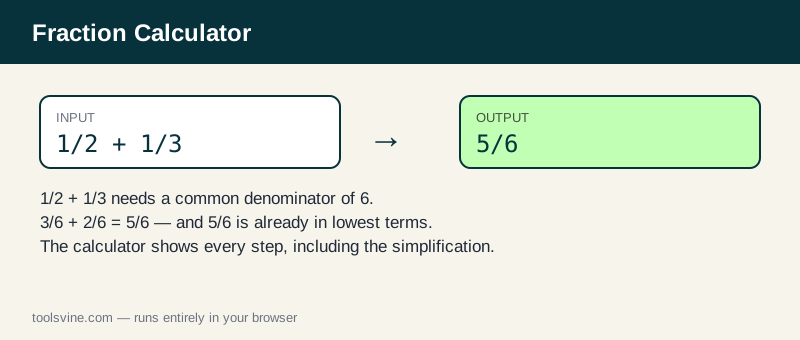
Here is the full working for 1/2 + 1/3, the textbook example that shows why a common denominator matters. Adding the numerators directly gives 2/5, which is wrong; adding the denominators is the classic beginner mistake. The right answer takes three steps and lands on 5/6.
Worked example: 1/2 + 1/3 = 5/6
| Step | Working | Result |
|---|---|---|
| 1. Common denominator | Lowest number 2 and 3 both divide into | 6 |
| 2. Rewrite both fractions | 1/2 = 3/6, 1/3 = 2/6 | 3/6 + 2/6 |
| 3. Add numerators | 3 + 2 = 5, denominator stays 6 | 5/6 |
| 4. Simplify | 5 and 6 share no factor but 1 | 5/6 (already simplest) |
The same method handles the other operations. Multiplying 3/4 × 2/3 gives 6/12, which simplifies by 6 to 1/2 — and you can cancel the 3s before multiplying, which is the shortcut the calculator's steps show. Dividing 2/3 ÷ 4/5 means flipping the second fraction to 5/4 and multiplying to get 10/12, which simplifies to 5/6.
How do mixed numbers work here?
Type a mixed number like 2 1/2 and the tool converts it to an improper fraction (5/2) before calculating, then converts the answer back. That is the rule for every operation: mixed numbers must become improper fractions first, because you cannot add the whole parts and the fraction parts separately and get the right answer when a carry crosses the whole-number boundary.
Frequently asked questions
How do I add fractions with different denominators?
Find a common denominator — the lowest number both denominators divide into — rewrite each fraction with it, then add the numerators. For 1/2 + 1/3 the common denominator is 6, so 1/2 becomes 3/6, 1/3 becomes 2/6, and 3 + 2 = 5, giving 5/6. Never add the numerators and denominators separately — that is the most common fraction mistake.
How do I divide fractions?
Flip the second fraction and multiply. For 2/3 ÷ 4/5, the second fraction becomes 5/4, so the problem is 2/3 × 5/4 = 10/12, which simplifies to 5/6. This works because division is the inverse of multiplication, and flipping the fraction — taking its reciprocal — turns the division into a multiplication.
What is a common denominator, and how do I find one?
A common denominator is a number that both denominators divide into evenly. The easiest one is the product of the two denominators, but the lowest common denominator keeps the numbers small — for 2 and 3 it is 6, because 6 is the first multiple of both. Multiply the numerator and denominator of each fraction by whatever turns its denominator into the common one.
How do I multiply fractions?
Multiply the numerators together and the denominators together, then simplify. For 3/4 × 2/3 that gives 6/12, which divides by 6 to give 1/2. A shortcut is to cancel common factors before multiplying — the 3 in 3/4 and the 3 in 2/3 cancel, leaving 1/4 × 2/1 = 2/4 = 1/2. The calculator shows the cancellation in its steps.
Can I use mixed numbers in this calculator?
Yes — type them as a whole number, a space, and a fraction, like 2 1/2. The tool converts each mixed number to an improper fraction before calculating (2 1/2 becomes 5/2), then converts the answer back to a mixed number. For 2 1/2 + 1 3/4 the answer is 4 1/4, shown with the improper-fraction steps so you can follow every move.