
Two prices, two measurements, two test scores — how different are they, really? This free percentage difference calculator compares any two values fairly, using their average as the base, and shows the full working. It is the right tool when neither value is the “before” and neither is the “after.”
Type both numbers and the tool gives you the difference as a percent and as a plain amount. If one value is a starting point and the other is the new value, the Percentage Increase/Decrease Calculator is the better fit. For a single percent of a number, use the Percentage Calculator.
How to use
- Type the first value into the first field.
- Type the second value into the second field.
- Click Calculate. The percentage difference appears with the working.
- Use Clear to compare another pair of values.
Why use Toolsvine
Comparing two prices by picking one as the base silently favors the other: 30 vs 45 is a 50% jump from 30, but only a 33% drop from 45 — same two numbers, two different stories. Percentage difference uses the average of both as the base, so the answer is identical whichever way round you enter the values, which is what makes it honest for price comparisons, lab results, and test scores.
How do I calculate percentage difference?
Take the absolute difference between the two values, divide it by their average, and multiply by 100. The formula is |V1 − V2| ÷ ((V1 + V2) ÷ 2) × 100, and the bars mean “ignore the sign” — the difference is always positive, because percentage difference measures how far apart two values are, not which one is bigger.
Why the average is the base
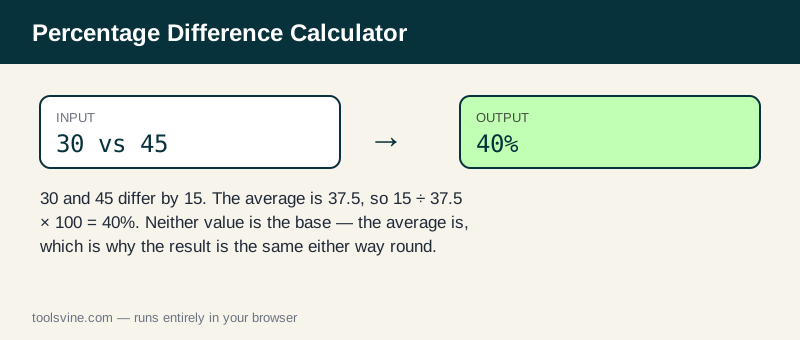
If you used the first value as the base, swapping the two numbers would change the answer — 30 vs 45 would be 50% one way and 33% the other, which cannot both be right. The average, (30 + 45) ÷ 2 = 37.5, sits exactly between them, so the difference of 15 measured against 37.5 gives 40% whichever order you enter the values. That symmetry is the whole point of the formula, and it is why scientists use it for experimental comparisons.
Percentage difference vs percent change
| Percentage difference | Percent change | |
|---|---|---|
| Base | Average of both values | The old (starting) value |
| Direction | None — always positive | Up or down |
| Swap the values | Same answer | Different answer |
| Use it for | Comparing prices, lab results | Raises, price hikes, growth |
Use percentage difference when the two values are peers — two store prices, two measurements, two test scores. Use percent change when one value is clearly the starting point and the other is the result, like a salary before and after a raise.
What is a worked percentage difference example?
Here is the full working for two product prices, the most common everyday use. One store lists a blender at $90 and another at $120 — how different are those prices, fairly measured? The answer is a single percent that does not depend on which store you start from, plus the plain $30 gap.
Worked example: 30 vs 45
| Step | Working | Result |
|---|---|---|
| 1. Difference | |45 − 30| | 15 |
| 2. Average | (45 + 30) ÷ 2 | 37.5 |
| 3. Divide and multiply | 15 ÷ 37.5 × 100 | 40% |
The $90 vs $120 blender pair works out the same way: the difference is $30, the average is $105, and 30 ÷ 105 × 100 = 28.57%. Try the same pair the other way round in the tool — 120 vs 90 — and you will get the same 28.57%, which is the symmetry check that proves the formula is working. A percent change on the same pair would give 33.33% one way and 25% the other.
When is a percentage difference meaningful?
In a lab, a difference under 5% usually means two measurements agree, while anything over 10% suggests a real difference or an error. In shopping, a 28.57% difference between two stores is worth the drive — on a $120 item that is $30 saved. For test scores, a small difference between two attempts often reflects normal variation, not a real change in ability.
Frequently asked questions
How do I calculate the percentage difference between two numbers?
Take the absolute difference, divide it by the average of the two numbers, and multiply by 100. For 30 and 45: the difference is 15, the average is 37.5, and 15 ÷ 37.5 × 100 = 40%. The average is the base, which is why the answer is the same whichever order you enter the values — try it in the calculator above and swap them.
What is the difference between percentage difference and percent change?
Percentage difference uses the average of both values as the base and has no direction — it answers “how far apart are these two?” Percent change uses the old value as the base and has a direction — it answers “how much did this go up or down?” Use difference for comparing two prices or measurements, and change for raises, price hikes, and growth over time.
Why is the answer the same if I swap the two numbers?
Because the formula uses the absolute difference and the average of both values, and neither one depends on the order. For 30 vs 45 and 45 vs 30, the difference is 15 and the average is 37.5 in both cases, so the result is 40% either way. That symmetry is the whole point of percentage difference — it treats both values as equals.
Can the percentage difference be negative?
No. Percentage difference is always zero or positive, because the formula takes the absolute value of the difference and ignores which number is bigger. If you need a direction — did the price go up or down, did the score improve or worsen — use the percent change calculator instead, which keeps the sign and reports an increase or a decrease.
What is a good percentage difference in a science experiment?
Under 5% usually means two measurements agree well, 5–10% is acceptable for most school and home experiments, and over 10% suggests a real difference or a measurement error worth investigating. For example, two timing measurements of 30 seconds and 45 seconds differ by 40%, which is far too large to be rounding — something in the method probably changed.