
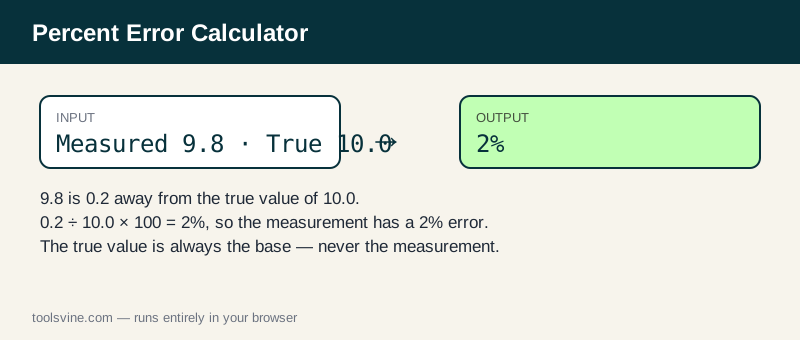
Measured 9.8 but the true value is 10.0 — how far off are you? This free percent error calculator finds the error between a measured value and the accepted value, as a percent and as a plain amount, with the full working shown. It is built for science labs, school experiments, and any measurement you need to check.
Type the value you measured and the true value, and the tool gives you the percent error instantly. For comparing two values where neither is the “true” one, the Percentage Difference Calculator is the fairer tool. For a single percent of a number, use the Percentage Calculator.
How to use
- Type the value you measured into the first field.
- Type the accepted (true) value into the second field.
- Click Calculate. The percent error appears with the working.
- Use Clear to check another measurement.
Why use Toolsvine
A lab report that says “the error was small” earns no marks — teachers and lab partners want a number, and they want the right base. Percent error divides by the true value, never by the measurement, and this calculator shows that division written out, so a student can copy the working into a report with confidence and a scientist can spot a swapped base at a glance.
How do I calculate percent error?
Take the absolute difference between your measured value and the true (accepted) value, divide that error by the true value, and multiply by 100. The formula is |Measured − True| ÷ True × 100, and the true value is always the base — because error is measured against reality, not against your own reading.
The formula, written out
| Step | Formula | Example: 9.8 vs 10.0 |
|---|---|---|
| 1. Find the error | |Measured − True| | |9.8 − 10.0| = 0.2 |
| 2. Divide by the true value | Error ÷ True | 0.2 ÷ 10.0 = 0.02 |
| 3. Multiply by 100 | 0.02 × 100 | 2% error |
The most common mistake is dividing by the measured value instead of the true one. For 9.8 vs 10.0 that gives 0.2 ÷ 9.8 = 2.04% — close, but wrong, and the gap grows as the error grows. Always divide by the accepted value: that is the standard your measurement is judged against.
Percent error vs accuracy and precision
Percent error measures accuracy — how close you were to the truth. Precision is different: it measures how close your repeated readings are to each other. You can be precise but inaccurate, hitting the same wrong value five times in a row, or accurate but imprecise, scattering readings around the true value. A good experiment needs both, and percent error only tells you about accuracy.
What is a worked percent error example?
Here is the full working for a classroom measurement, the case most students check with this tool. A student measures a 50-inch table and gets 48.5 inches — is that a good measurement or a sloppy one? The math takes three steps, and the answer is a single percent you can quote in a lab report.
Worked example: measuring a 50-inch table
| Step | Working | Result |
|---|---|---|
| 1. Error | |48.5 − 50| | 1.5 inches |
| 2. Divide by the true value | 1.5 ÷ 50 | 0.03 |
| 3. As a percent | 0.03 × 100 | 3% error |
A 3% error on a tape-measure reading is reasonable for a school lab — the tape may have started a half-inch off the edge, or the table may not be perfectly square. The same method checks a thermometer: a reading of 102°F against a true 100°F is a 2°F error, which is 2 ÷ 100 × 100 = 2%. Try your own numbers above and compare the plain error with the percent — a 1.5-inch error sounds large, but as 3% of 50 inches it is small.
What percent error is acceptable?
It depends on the instrument. A school ruler or kitchen scale at 2–5% is normal; a laboratory balance at 0.1% is expected; a bathroom scale that is 3% off shows about 5 pounds wrong on a 160-pound person, which is roughly the tolerance of a cheap scale. If your error is far outside what the instrument promises, check for a systematic problem — a zero that was not set, a unit that was misread, or a reading taken at an angle.
Frequently asked questions
How do I calculate percent error?
Take the absolute difference between your measured value and the true value, divide it by the true value, and multiply by 100. If you measured 9.8 and the true value is 10.0, the error is 0.2, and 0.2 ÷ 10.0 × 100 = 2%. The true value is always the base — dividing by your measurement gives the wrong answer, and the calculator above shows every step.
Can percent error be negative?
No — percent error is always zero or positive, because the formula takes the absolute value of the difference. It tells you how far off you were, not whether you were high or low. If you need the direction, look at the sign of the raw difference before taking the absolute value: a measurement above the true value is a positive error, and one below is negative.
What is a good percent error in a school lab?
Under 5% is usually considered good for a school experiment with a ruler, a stopwatch, or a kitchen scale, and under 1% is excellent. Over 10% suggests a systematic problem — a zero that was not set, a unit misread, or a reading taken at an angle. Always quote the percent error with the instrument you used, because what counts as good depends on how precise the tool is.
What is the difference between percent error and percentage difference?
Percent error compares a measurement against a known true value, dividing by that true value — it judges accuracy. Percentage difference compares two values with no true value, dividing by their average — it measures how far apart they are. Use percent error for lab work and quality checks, and percentage difference when you are comparing two measurements or two prices with no accepted answer.
What do I do if I don't know the true value?
Then you cannot calculate a percent error, because the formula needs the true value as its base. What you can do is calculate the percentage difference between your repeated measurements, which shows how consistent they are, or compare your result against a published reference value. If no reference exists, report the range of your readings instead of a percent error.