On this page
Large organisations translate constantly: product interfaces, help centres, legal documents and marketing campaigns, all in many languages at once. That volume needs more than a desktop tool — it needs shared memories, controlled terminology, vendor management and reporting that prove quality. We compared eight paid platforms on price, scale and governance, checking every price on the vendor site on November 27, 2026. Our top pick for enterprise teams is memoQ.
How we researched this
We started with the translation platforms enterprises actually buy, then read each price on the vendor pricing page on November 27, 2026 and noted the trial each plan carries. We judged them for a large organisation that translates in many languages, with many linguists and strict quality rules. We dropped quote-only suites that publish no price at all, because an enterprise buyer still needs a starting figure before a sales call.
Compare the tools
| Name | Best for | Starting price | Free plan | |
|---|---|---|---|---|
| memoQ | Enterprise translation teams that need a central server and vendor management | $3,025/year | No free plan; 45-day free trial | Visit |
 Phrase | Large organisations that want a cloud translation platform with strong integrations | $27/month | No free plan; 14-day free trial | Visit |
 Smartcat | Enterprises that combine AI translation with human review at scale | $100/month | No free plan; free trial available | Visit |
 Crowdin | Software companies that localise products continuously at enterprise scale | $75/month | Free plan for small projects; 14-day free trial on paid plans | Visit |
| Lokalise | Product teams that manage app and website strings across many languages | $149/month | No free plan; 14-day free trial | Visit |
| Transifex | Companies translating software, help centres and marketing sites at scale | $135/month | No free plan; 15-day free trial | Visit |
 Trados Studio | Professional translators who need a desktop workbench with deep file-format support | $408/year | No free plan; 30-day free trial | Visit |
| Wordfast Pro | Translators who want a one-time licence instead of a subscription | $480 one-time | No free plan; free trial available | Visit |
The computer assisted translation software for enterprise, compared
1. memoQ
Best for: Enterprise translation teams that need a central server and vendor management
Paid tool Starting price: $3,025/year · Three thousand twenty-five dollars a year for the memoQ TMS Starter plan; Translator Pro licences for individual translators start at four hundred thirty-six dollars a year.
Free plan: No free plan; 45-day free trial
Built for large translation operations, memoQ combines a desktop workbench with a central server that keeps every project, memory and termbase in one place. memoQ lets managers assign jobs, track progress and control who sees each file, which matters when dozens of linguists touch the same content. Its vendor portal, quality checks and reporting suit enterprises that translate in many languages at once.
What we like
- Central server keeps memories, termbases and projects in one governed place.
- Strong quality checks catch numbers, tags and terminology errors before delivery.
- Vendor portal makes assigning and tracking work across many linguists straightforward.
Watch out for
- The server edition is a serious investment and needs IT involvement to set up.
- The interface carries many options, so new users need training time.
How to try it
- Install memoQ on each translator workstation and connect it to the memoQ server.
- Import the source files, attach the translation memory and termbase, then assign the project to your linguists.
- Run quality checks, approve the reviewed translation and export the finished files in their original format.
2. Phrase
Best for: Large organisations that want a cloud translation platform with strong integrations
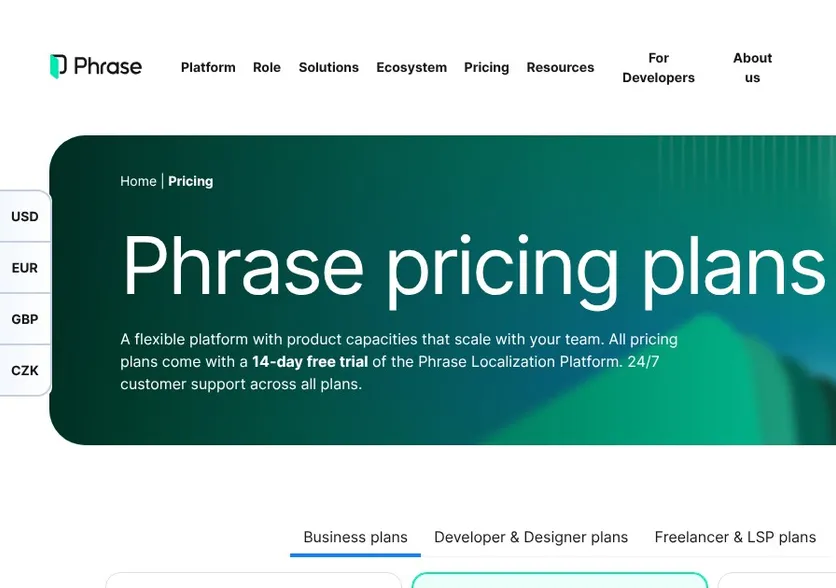
Paid tool Starting price: $27/month · Twenty-seven dollars a month for the Freelancer plan, billed annually; the Professional plan costs five hundred twenty-five dollars a month and Business plans are custom priced.
Free plan: No free plan; 14-day free trial
Phrase runs entirely in the browser, so an enterprise team can manage translation projects without installing or maintaining desktop software. Phrase connects with content systems, code repositories and design tools, pulling new strings in and pushing finished translations back automatically. Its workflow rules, quality gates and analytics give managers control over large, fast-moving localisation programmes.
What we like
- Cloud setup means no desktop installs and easy access for global teams.
- Deep integrations automate the flow of strings between product and translators.
- Workflow rules and quality gates keep large programmes consistent.
Watch out for
- The entry plan suits individuals, so enterprises need the higher tiers for team controls.
- Per-word and automation costs can grow as content volume rises.
How to try it
- Create a Phrase project and connect the content source or code repository it should watch.
- Invite translators and reviewers, set the workflow steps and assign the languages each person handles.
- Approve completed translations in the dashboard and let the integration sync them back to your product.
3. Smartcat
Best for: Enterprises that combine AI translation with human review at scale
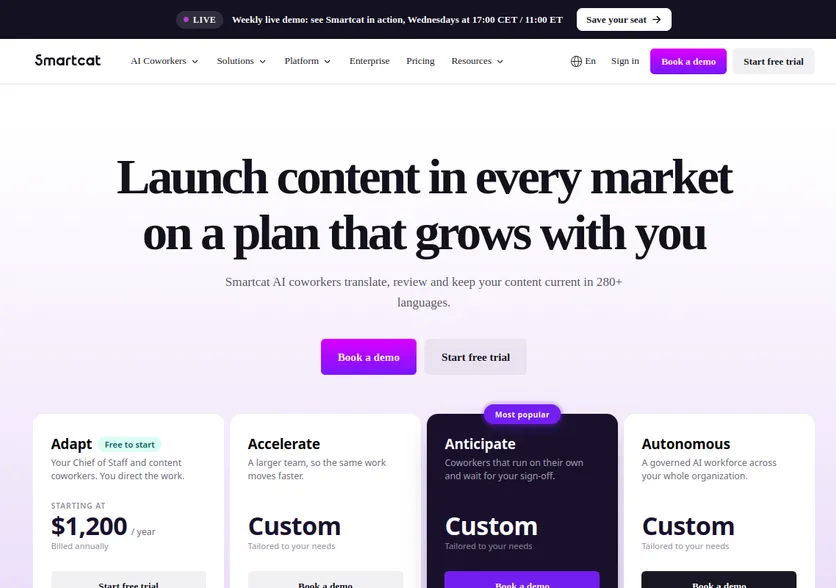
Paid tool Starting price: $100/month · One hundred dollars a month for the Adapt plan, billed annually; the Accelerate, Anticipate and Autonomous tiers are custom priced.
Free plan: No free plan; free trial available
Smartcat puts machine translation, human linguists and a built-in marketplace on one platform, which suits enterprises that translate high volumes in many languages. Smartcat routes content through AI first, then to reviewers, and keeps every memory and glossary shared across projects. Its analytics show cost per word and turnaround time, helping managers prove the value of the programme.
What we like
- AI-first workflow cuts turnaround on high-volume content.
- Built-in marketplace makes finding reviewers for rare languages easier.
- Shared memories and glossaries keep terminology consistent across teams.
Watch out for
- AI output still needs human review for legal, medical and brand-sensitive text.
- Higher tiers are custom priced, so budgeting needs a sales conversation.
How to try it
- Upload source files or connect a content system, then choose the languages and the AI engine.
- Let Smartcat translate first, then assign human reviewers to polish the result.
- Track cost and turnaround in the analytics dashboard and export the approved translations.
4. Crowdin
Best for: Software companies that localise products continuously at enterprise scale
Paid tool Starting price: $75/month · Seventy-five dollars a month for the Pro plan, billed annually; the monthly rate is higher when billed month to month.
Free plan: Free plan for small projects; 14-day free trial on paid plans
Crowdin is built around continuous localisation, watching code repositories for new strings and sending them to translators the moment they appear. Crowdin supports dozens of file formats and machine translation engines, and its in-context editor lets reviewers see exactly where each string appears. For enterprises shipping software weekly, that automation removes the manual handoffs that slow releases down.
What we like
- Continuous localisation keeps translations in step with weekly releases.
- In-context editing shows translators where each string appears in the product.
- Wide file-format support covers apps, docs and marketing content.
Watch out for
- The Pro plan caps some features, so large teams may need the Business tier.
- Setting up repository integrations takes care the first time.
How to try it
- Connect Crowdin to your code repository and choose the file formats it should watch.
- Set up translation memories, glossaries and machine translation, then invite your translators.
- Review translations in context and let Crowdin push the finished files back to the repository.
5. Lokalise
Best for: Product teams that manage app and website strings across many languages
Paid tool Starting price: $149/month · One hundred forty-nine dollars a month for the Start plan, billed annually; the Explorer plan costs one hundred sixty-nine dollars a month when billed monthly.
Free plan: No free plan; 14-day free trial
Lokalise focuses on the strings inside software products, giving product teams one place to manage keys, screenshots and translations together. Lokalise shows translators a screenshot of where each string appears, which cuts the guesswork that causes wrong translations. Its automation rules, quality checks and integrations with design and development tools suit enterprises that ship in many languages at once.
What we like
- Screenshots attached to keys stop translators guessing at context.
- Automation rules route new strings to the right people without manual work.
- Strong integrations with design and development workflows.
Watch out for
- Pricing climbs quickly as the number of keys and seats grows.
- It is built for software strings, not long-form documents.
How to try it
- Import your string files or connect a repository, then attach screenshots to the keys.
- Assign languages to translators and let quality checks flag missing or inconsistent strings.
- Export the finished files or sync them back to your product through the integration.
6. Transifex
Best for: Companies translating software, help centres and marketing sites at scale
Paid tool Starting price: $135/month · One hundred thirty-five dollars a month for the Starter plan, billed annually; the Growth plan costs two hundred dollars a month billed annually.
Free plan: No free plan; 15-day free trial
Transifex handles the full lifecycle of software localisation, from pulling strings out of code to publishing finished translations back into the product. Transifex combines translation memory, glossaries and machine translation with a review workflow that fits large teams. Its live preview and over-the-air updates let enterprises change text in a shipped app without a new release.
What we like
- Over-the-air updates change app text without a new release.
- Live preview shows translations in the real product before publishing.
- Mature review workflow suits large, distributed teams.
Watch out for
- The interface has a learning curve for teams new to localisation platforms.
- Some advanced features are reserved for the higher-priced Growth plan.
How to try it
- Connect Transifex to your repository or content system and upload the source strings.
- Set up memories, glossaries and machine translation, then assign reviewers per language.
- Publish translations live or sync them back into your product and track progress in the dashboard.
7. Trados Studio
Best for: Professional translators who need a desktop workbench with deep file-format support
Paid tool Starting price: $408/year · Four hundred eight dollars a year for the Trados Studio Freelance licence, which works out to thirty-four dollars a month.
Free plan: No free plan; 30-day free trial
Trados Studio is the long-established desktop workbench for professional translators, handling an unusually wide range of file formats from office documents to software packages. Trados Studio pairs translation memory with terminology management and quality checks, and it works with server-based projects when an enterprise needs central control. Its depth makes it the default choice for translators who live inside complex, formatted files all day.
What we like
- Excellent support for complex, heavily formatted file types.
- Mature translation memory and terminology tools built over many years.
- Works with server projects for enterprise-wide control.
Watch out for
- The desktop interface feels dense and takes time to learn.
- It is a single-user licence, so team features need server editions.
How to try it
- Install Trados Studio and open the source file or connect to a server project.
- Translate segment by segment, accepting memory matches and checking terminology as you go.
- Run quality checks, confirm the segments and export the file in its original format.
8. Wordfast Pro
Best for: Translators who want a one-time licence instead of a subscription
Paid tool Starting price: $480 one-time · Four hundred eighty dollars as a one-time payment for a three-year Wordfast Pro licence; a reduced rate of two hundred forty dollars applies in developing economies.
Free plan: No free plan; free trial available
Wordfast Pro takes a different approach from the subscription tools on this list: one payment buys a three-year licence with no monthly bill. Wordfast Pro covers translation memory, terminology and quality checks in a straightforward desktop package, and it handles the common file formats translators meet every day. For enterprises that prefer predictable, one-off spending, that model is easy to budget and easy to approve.
What we like
- One-time payment removes the monthly subscription from the budget.
- Straightforward interface that new translators pick up quickly.
- Reduced licence rate available in developing economies.
Watch out for
- Fewer integrations with code and content systems than cloud platforms.
- The licence covers three years, so renewal is a future budget line.
How to try it
- Download Wordfast Pro, buy the licence and activate it on the translator workstation.
- Open the source file, attach the translation memory and glossary, then translate segment by segment.
- Run the quality checks and export the finished file in its original format.
Prices above were checked on each vendor’s own website on Nov 27, 2026 and can change — the vendor’s page is the final word. Vendor links are editorial: nobody paid to be listed or ranked here. Vendors who want a featured listing can see how it works on our Get listed page.
What enterprise translation costs in 2026
Enterprise translation is priced by seats, volume and control, not by a single flat fee. A server licence costs a few thousand dollars a year before you add translators, while cloud plans charge per user per month and climb as the team grows. The cheapest headline price is rarely the cheapest total, because per-word machine translation and reviewer fees add up fast on high-volume programmes.
Start by listing what you translate most: software strings, documents or marketing copy. Then trial two platforms on a real project with real translators, and watch how long setup, review and export take. Pick the tool whose workflow your team actually follows, because the best-governed platform is useless if linguists work around it.
Before you buy
- Check that the server keeps translation memories and termbases in one place, because scattered files create inconsistent wording across languages.
- Confirm user roles and permissions, because an enterprise tool must stop freelancers seeing projects that are not theirs.
- Ask how the tool handles machine translation, because unmanaged engines can leak confidential source text to third parties.
- Test the reporting, because managers need to see throughput, costs and quality scores without exporting spreadsheets by hand.
- Check the vendor management features, because large programmes live or die on assigning, tracking and paying many linguists on time.
Official websites
Official websites of the products reviewed above. Features and prices were checked against these sites when this guide was written, and they can change, so confirm on the vendor site before you buy.
Frequently asked questions
What makes translation software enterprise-grade?
Enterprise translation software centralises translation memories, termbases and projects so many linguists can work on the same content without clashing. It adds user roles, vendor management, quality checks and reporting that a single-user tool cannot offer. That control is what separates an enterprise platform from a desktop workbench.
How much does enterprise translation software cost?
Most enterprise platforms charge per user or per project, so the total depends on team size and content volume. Starter server licences run from a few thousand dollars a year, while cloud plans for large teams can reach five figures annually. Always ask for a quote that matches your actual seat count and word volume.
Can enterprise tools combine machine translation with human review?
Yes, most of the tools here combine machine translation with human review. The machine engine produces a first draft and a human linguist polishes it, which cuts turnaround on high-volume content. Keep machine translation away from legal, medical and confidential text unless the vendor guarantees the data stays private.
What is a translation memory, and why does it matter?
A translation memory stores every translated sentence so it can be reused, which keeps wording consistent and cuts costs on repeated text. A termbase stores approved terms such as product names and legal phrases. Together they stop different translators choosing different words for the same concept.
Do these tools handle both software strings and documents?
Yes, all eight tools handle software strings, documents and web content, though their strengths differ. Crowdin, Lokalise and Transifex shine on software strings, while memoQ and Trados Studio handle complex formatted documents best. Pick the tool whose strength matches the content you translate most.
Need everyday text help too? Try Toolsvine's free text tools right in your browser.
Browse Text Tools tools