On this page
Engineering firms run on data that lives in different systems: CAD files on one server, project schedules in another tool, and finance data in the ERP. Moving that data by hand eats hours every week and leaves reports out of date. The eight tools below move project, design and finance data into one warehouse automatically, with prices checked on the vendor site on November 27, 2026. Fivetran is our first pick — the connector platform that moves engineering data into the warehouse without writing code.
How we researched this
We started with the integration tools engineering firms actually buy, then read each price on the vendor pricing page on November 27, 2026 and noted the free plan each one carries. We judged them for a firm that moves project, CAD and finance data into one warehouse without hiring a data engineer. We dropped Talend, Informatica, SnapLogic, Boomi, Workato, Jitterbit, Celigo, MuleSoft and Tray because none of them publishes a list price, so a buyer cannot compare them without a sales call.
Compare the tools
| Name | Best for | Starting price | Free plan | |
|---|---|---|---|---|
 Fivetran | Engineering firms that want reliable warehouse syncs with no pipeline code to maintain | $500/month | Free plan with 500,000 MAR a month | Visit |
 Airbyte | Engineering firms that want an open connector library and a free self-hosted start | $20/month | Free Core self-hosted edition | Visit |
 Hevo Data | Engineering firms that want ready-made pipelines running within days | $265/month | Free plan with 1 million events a month | Visit |
 Stitch | Engineering firms that want simple replication from databases and spreadsheets | $100/month | No free plan; 14-day free trial | Visit |
 Skyvia | Engineering firms that want cloud integration with nothing to install | $79/month | Free plan with 10,000 records a month | Visit |
 Portable | Engineering firms whose stack includes niche tools no other vendor covers | $500/month | No free plan; book a demo to start | Visit |
 Estuary | Engineering firms that need live project data in the warehouse, not daily batches | $0.50/GB | Free Developer tier with 10 GB a month and 2 connectors | Visit |
 Zapier | Engineering firms that need quick links between apps without a data project | $19.99/month | Free plan with 100 tasks a month | Visit |
The data integration software for engineering firms, compared
1. Fivetran
Best for: Engineering firms that want reliable warehouse syncs with no pipeline code to maintain
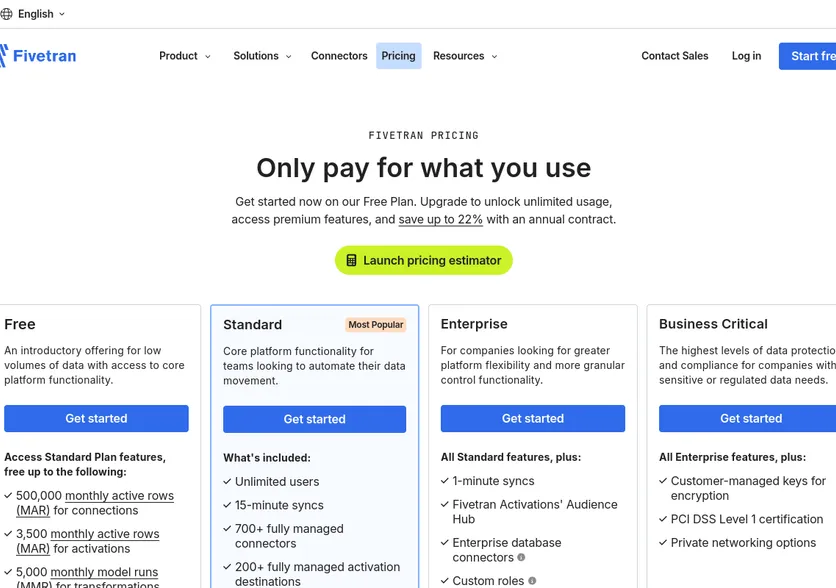
Paid tool Starting price: $500/month · Five hundred dollars a month for one million monthly active rows on the Standard plan, with a five hundred dollar base per connection; annual contracts start at twelve thousand dollars
Free plan: Free plan with 500,000 MAR a month
Fivetran pulls project, finance and operations data from engineering systems into the warehouse on a schedule the team sets once. This Fivetran Standard plan costs five hundred dollars a month for one million monthly active rows, with a five hundred dollar base per connection and annual contracts from twelve thousand dollars. A firm that already runs a warehouse gets reliable syncs and schema handling without building pipelines by hand.
What we like
- Hundreds of maintained connectors for common systems
- Automatic schema handling when source fields change
- Reliable scheduled syncs with clear run history
Watch out for
- The row-based meter grows fast once you sync large tables
- Annual contracts start high, so small firms should test the free plan first
How to try it
- Open the Fivetran site and start with the free plan
- Connect your project tracker and finance system first
- Set the sync schedule and check the first load in the warehouse
2. Airbyte
Best for: Engineering firms that want an open connector library and a free self-hosted start
Paid tool Starting price: $20/month · Twenty dollars a month for the Cloud Standard plan with five credits included and five dollars per extra credit; the self-hosted Core edition is free and Plus starts at one hundred and eighty-nine dollars a month
Free plan: Free Core self-hosted edition
Airbyte gives an engineering firm an open connector library that covers the databases and files a project team already uses. This Airbyte Cloud Standard plan costs twenty dollars a month with five credits included, and extra credits cost five dollars each, while the self-hosted Core edition is free. A team that wants to keep connector costs low can start on the free edition and move to the cloud plan when syncs grow.
What we like
- Large open connector library with community additions
- Free self-hosted edition for teams that run their own servers
- Simple credit model that scales with the syncs you run
Watch out for
- Credit costs climb when you sync large API volumes
- Self-hosted Core needs someone to run and update it
How to try it
- Open the Airbyte site and try the free Core edition
- Add a source connector for your project database
- Set the destination to your warehouse and run the first sync
3. Hevo Data
Best for: Engineering firms that want ready-made pipelines running within days
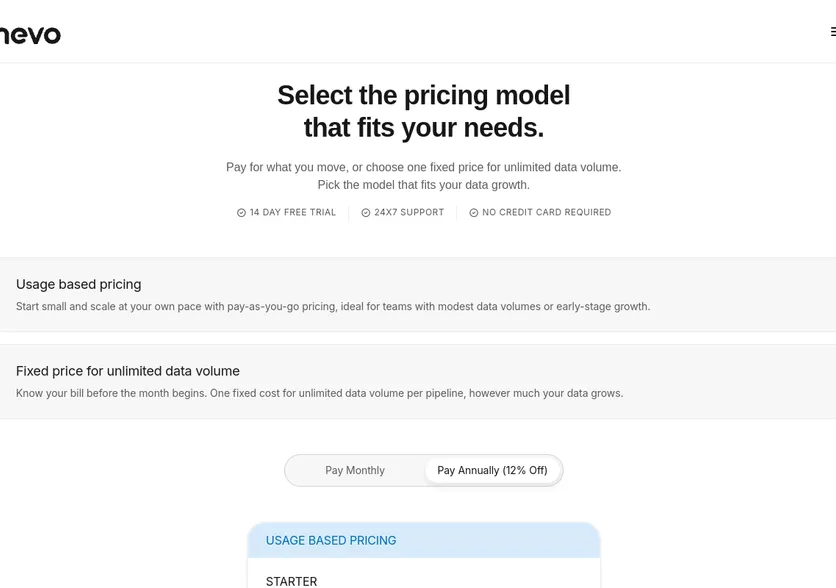
Paid tool Starting price: $265/month · Two hundred and sixty-five dollars a month billed annually for the Starter plan, or two hundred and ninety-nine dollars monthly, for five million events and up to ten users; Professional costs seven hundred and fifty dollars a month billed annually
Free plan: Free plan with 1 million events a month
Hevo Data moves engineering and finance records into the warehouse with ready-made pipelines that need no code. This Hevo Data Starter plan costs two hundred and sixty-five dollars a month billed annually, or two hundred and ninety-nine dollars monthly, for five million events and up to ten users. A firm that wants pipelines running this week gets a guided setup instead of a build project.
What we like
- Ready-made pipelines that start without code
- Guided setup that gets the first sync running fast
- Event-based pricing that fits steady monthly volumes
Watch out for
- The event meter means busy months cost more than quiet ones
- Advanced features need the Professional plan at a much higher price
How to try it
- Open the Hevo Data site and start the free plan
- Pick a pipeline template for your project system
- Map the fields to the warehouse and switch the pipeline on
4. Stitch
Best for: Engineering firms that want simple replication from databases and spreadsheets
Paid tool Starting price: $100/month · One hundred dollars a month for the Standard plan covering five million rows, scaling to three hundred million rows; Advanced costs one thousand five hundred dollars a month and Premium costs three thousand dollars a month billed annually
Free plan: No free plan; 14-day free trial
Stitch replicates engineering databases and spreadsheets into the warehouse on a fixed schedule with little setup. This Stitch Standard plan costs one hundred dollars a month for five million rows, while Advanced costs one thousand five hundred dollars a month. A firm that needs a simple replication tool gets dependable syncs without a data engineering team.
What we like
- Simple replication setup with no pipeline code
- Fixed schedule that keeps the warehouse current
- Long track record as a dependable replication tool
Watch out for
- No free plan, so the trial is the only way to test it
- The jump to Advanced is steep once you outgrow Standard
How to try it
- Open the Stitch site and start the 14-day trial
- Connect the database that holds your project records
- Choose the tables to replicate and set the sync schedule
5. Skyvia
Best for: Engineering firms that want cloud integration with nothing to install
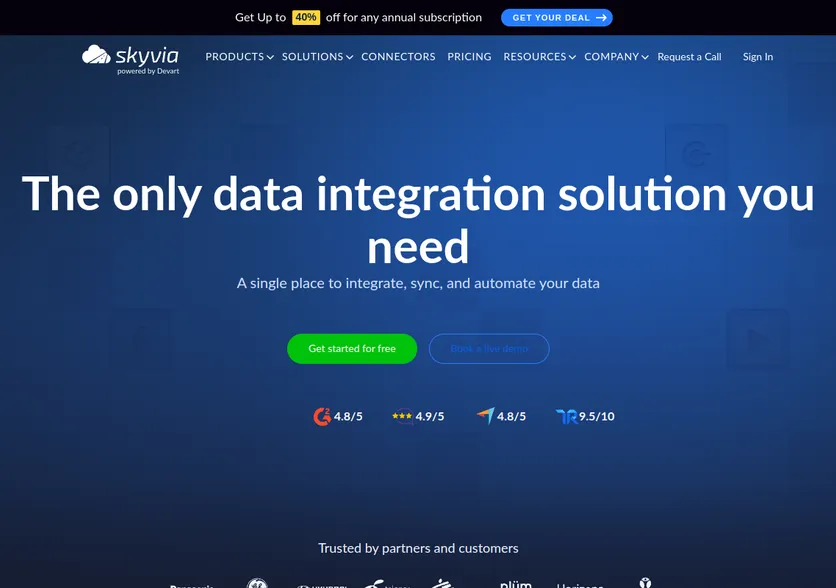
Paid tool Starting price: $79/month · Seventy-nine dollars a month billed annually for the Data Integration Basic plan, or ninety-nine dollars monthly, for five million records with daily runs; Standard costs one hundred and fifty-nine dollars and Professional costs three hundred and ninety-nine dollars a month billed annually
Free plan: Free plan with 10,000 records a month
Skyvia connects engineering tools to the warehouse through a browser, so no agent runs on office machines. This Skyvia Data Integration Basic plan costs seventy-nine dollars a month billed annually, or ninety-nine dollars monthly, for five million records with daily runs. A firm that wants integration without installing software gets a cloud tool that starts from a browser tab.
What we like
- Browser-based setup with nothing to install
- Free plan that covers small monthly volumes
- Daily runs that keep reporting data current
Watch out for
- Basic runs daily only, so same-day data needs a higher plan
- Record limits mean heavy months can force an upgrade
How to try it
- Open the Skyvia site and start the free plan
- Connect your cloud project tool as a source
- Build the first package and schedule a daily run
6. Portable
Best for: Engineering firms whose stack includes niche tools no other vendor covers
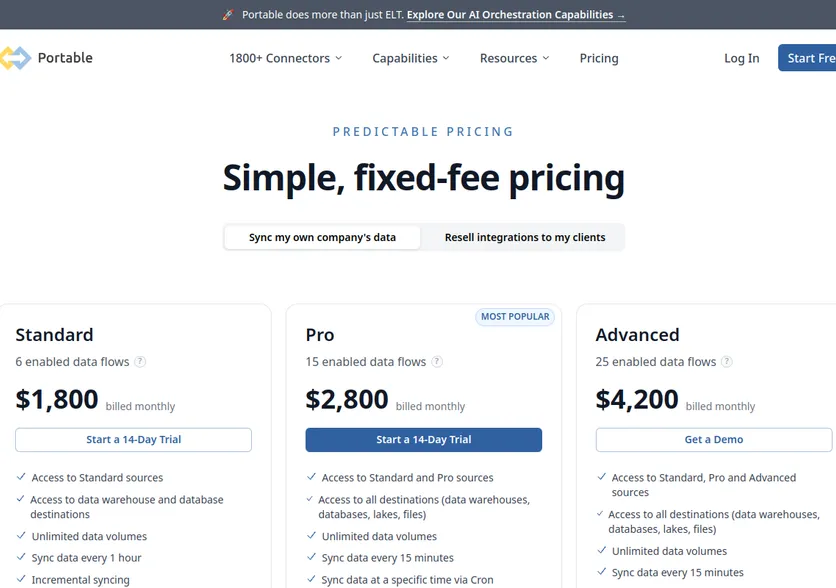
Paid tool Starting price: $500/month · Five hundred dollars a month for the Basic plan with one data flow and twenty-four hour syncs; Standard costs one thousand eight hundred dollars a month for six flows with hourly syncs, Pro costs two thousand eight hundred dollars and Advanced costs four thousand two hundred dollars a month billed annually
Free plan: No free plan; book a demo to start
Portable builds long-tail connectors for the niche tools engineering firms rely on, with a team that maintains each one. This Portable Basic plan costs five hundred dollars a month for one data flow with twenty-four hour syncs, while Standard costs one thousand eight hundred dollars a month. A firm whose stack includes an unusual project system gets a connector maintained by the vendor instead of an internal script.
What we like
- Long-tail connectors for niche engineering tools
- Vendor-maintained connectors, so updates are not your job
- Simple per-flow pricing that is easy to budget
Watch out for
- Basic covers only one data flow, so each extra system adds cost
- Twenty-four hour syncs on Basic leave reports a day behind
How to try it
- Open the Portable site and book a demo
- List the niche systems your firm needs connected
- Start with one data flow and check the sync quality
7. Estuary
Best for: Engineering firms that need live project data in the warehouse, not daily batches
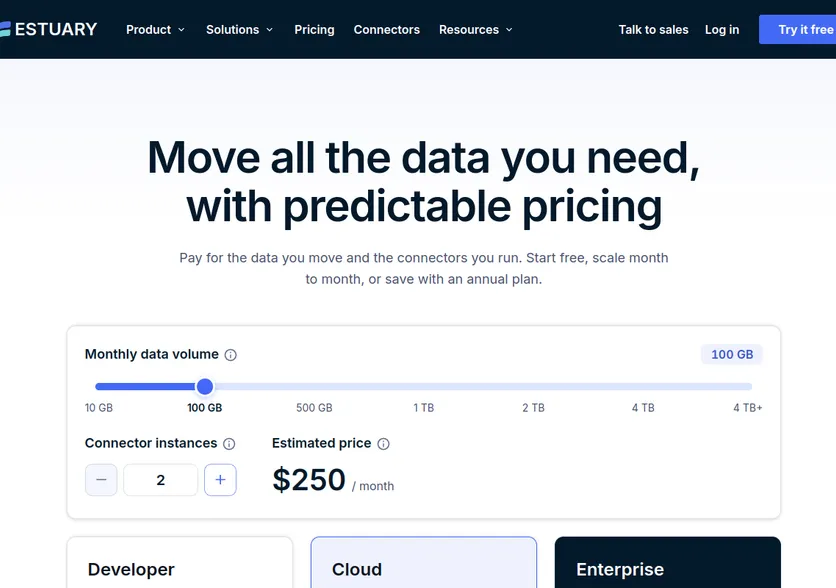
Paid tool Starting price: $0.50/GB · Fifty cents per gigabyte plus one hundred dollars a month per connector instance for the first six connectors, then fifty dollars after the sixth; the Developer tier is free with ten gigabytes a month and two connectors, and a thirty-day trial is included
Free plan: Free Developer tier with 10 GB a month and 2 connectors
Estuary streams engineering data into the warehouse in real time, so dashboards reflect the latest project state. This Estuary Cloud plan costs fifty cents per gigabyte plus one hundred dollars a month per connector instance, with a free Developer tier covering ten gigabytes a month and two connectors. A firm that needs fresh data for live project tracking gets streaming syncs without a fixed monthly fee for volume.
What we like
- Real-time streaming instead of daily batch loads
- Usage pricing that fits uneven monthly volumes
- Free Developer tier for testing live syncs
Watch out for
- Per-connector fees add up once you stream many sources
- Streaming setup takes more care than a simple scheduled sync
How to try it
- Open the Estuary site and start the free Developer tier
- Capture your project database as a live stream
- Materialize the stream into your warehouse and check the lag
8. Zapier
Best for: Engineering firms that need quick links between apps without a data project
Paid tool Starting price: $19.99/month · Nineteen dollars and ninety-nine cents a month billed annually for the Starter plan, or twenty-nine dollars and ninety-nine cents monthly, for seven hundred and fifty tasks a month; Professional costs forty-nine dollars and Team costs sixty-nine dollars a month billed annually
Free plan: Free plan with 100 tasks a month
Zapier connects engineering apps that have no native integration, moving data between them with simple automated workflows. This Zapier Starter plan costs nineteen dollars and ninety-nine cents a month billed annually, or twenty-nine dollars and ninety-nine cents monthly, for seven hundred and fifty tasks a month. A firm that needs quick links between tools gets automation running in an afternoon without code.
What we like
- Thousands of app connections with no code
- Workflows that start running the same afternoon
- Free plan that covers light automation
Watch out for
- Task limits mean busy months can stop workflows mid-month
- It moves records between apps, it does not replace a warehouse
How to try it
- Open the Zapier site and start the free plan
- Build a workflow that copies new project records to the finance tool
- Test the workflow on a few records, then switch it on
Prices above were checked on each vendor’s own website on Nov 27, 2026 and can change — the vendor’s page is the final word. Vendor links are editorial: nobody paid to be listed or ranked here. Vendors who want a featured listing can see how it works on our Get listed page.
What integration software costs an engineering firm
Integration pricing follows the data, not the headcount, so a firm should count its rows and connections before it compares plans. The cheapest paid plan here costs twenty dollars a month, while the most expensive costs five hundred dollars a month, and the gap comes from volume limits and connector counts. A firm with a few hundred thousand rows a month fits the low end, while a firm syncing millions of rows across dozens of systems needs a plan priced for that volume.
Start with a trial on two tools and connect the three systems that matter most: the project tracker, the finance system and the file store. Run the syncs for two weeks, then check whether every row arrived and how long a full refresh takes. Pick the tool whose syncs finish on time and whose connector list covers the next system you plan to add, because a cheap plan that misses a connector costs more than the plan above it.
Before you buy
- Count the rows you sync each month, because a plan priced by volume punishes growth you did not budget for.
- Check that every system in your stack has a connector, because one missing connector means a custom build.
- Ask how the tool handles schema changes, because a renamed field can break a sync overnight.
- Confirm the sync speed your reports need, because daily syncs leave dashboards a day behind the field.
- Test the free plan on real data first, because a trial with sample rows hides the problems your data carries.
Official websites
Official websites of the products reviewed above. Features and prices were checked against these sites when this guide was written, and they can change, so confirm on the vendor site before you buy.
Frequently asked questions
Which data integration software is best for engineering firms in 2026?
Fivetran is the best overall pick at five hundred dollars a month for one million monthly active rows, pairing hundreds of maintained connectors with automatic schema handling. Airbyte is the best budget pick at twenty dollars a month with a free self-hosted edition. Estuary is the best pick for live data, streaming changes into the warehouse as they happen instead of once a day.
How much does data integration software cost for an engineering firm?
Prices in this list run from twenty dollars a month for Airbyte to five hundred dollars a month for Fivetran and Portable, with most tools landing between seventy-nine and two hundred and sixty-five dollars a month. Row-based and event-based plans charge by volume, so a firm should count its monthly rows before comparing headline prices. Add connector fees and storage costs to the subscription before you compare totals.
Do engineering firms need real-time sync, or is daily enough?
Daily syncs suit most engineering reporting, because project schedules and finance figures change once a day at most. Real-time streaming matters when dashboards track live site activity or equipment sensors, where a day-old number is useless. A firm should buy real-time syncs only for the handful of sources where the delay changes a decision, and run the rest on a daily schedule.
Can a small engineering firm use these tools without a data engineer?
Yes, and most of the tools here are built for that buyer. Zapier and Make need no code at all, and Hevo Data and Skyvia ship ready-made pipelines that a project manager can set up. A firm without a data engineer should pick a tool with a free plan, connect two systems first, and only add the warehouse once the first syncs run cleanly.
What is the difference between an integration tool and an ETL tool?
An integration tool moves data between live systems and keeps them in sync, while an ETL tool extracts, transforms and loads data into a warehouse for analysis. The line blurs because most integration tools now load into warehouses too. A firm that only needs two apps to share records should buy an automation tool, while a firm building reports needs a tool that loads into a warehouse.
Need everyday business help too? Try Toolsvine's free business tools right in your browser.
Browse Business Tools tools