On this page
Startups lose hours to manual exports when the warehouse falls behind the product, and the fix is a replication tool that syncs data on its own. The seven tools below move data from SaaS apps and databases into the warehouse, with prices checked on each vendor site on November 27, 2026. The list runs from twenty dollars a month to one thousand nine hundred and ninety-nine dollars a month, and several tools offer a free plan or trial to start. Hevo Data is our first pick — the no-code replication tool with the fastest setup for a small team.
How we researched this
We started with the replication tools startups actually buy, then read each price on the vendor site on November 27, 2026 and noted the free plan or trial each one carries. We judged them for a small team with no data engineer, weighing setup speed, connector coverage and whether the bill stays predictable as volumes grow. We dropped Fivetran because its usage-based pricing has no single flat list price, and Rivery because its acquisition by Boomi moved pricing to a quote, so neither can be compared on a published figure.
Compare the tools
| Name | Best for | Starting price | Free plan | |
|---|---|---|---|---|
 Hevo Data | Startups that want no-code replication running the same day | $239/month | Free plan: 1M events/month | Visit |
 Airbyte | Startups that want open-source replication with a cheap managed option | from $20/month | Free self-hosted Core edition | Visit |
 Estuary | Startups that need real-time data instead of nightly batch jobs | $0.50/GB + $100/month | Free Developer tier: 10 GB/month, 2 connectors | Visit |
 Skyvia | Startups that want cloud integration with no servers to run | $79/month | Free plan: 10,000 records/month, 2 integrations | Visit |
| Dataddo | Lean teams that want managed connectors without maintenance | $99/month | No free plan; free trial available | Visit |
 Stitch | Startups with a handful of standard sources that want the simplest setup | from $100/month | No free plan; 14-day free trial | Visit |
 Integrate.io | Startups with heavy data volumes that want one flat bill | $1,999/month | No free plan; 14-day free trial | Visit |
The data replication software for startups, compared
1. Hevo Data
Best for: Startups that want no-code replication running the same day
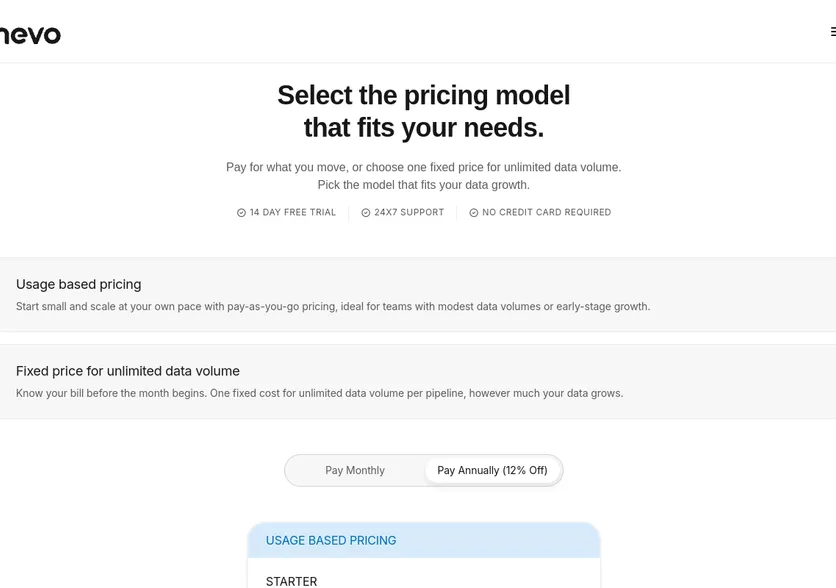
Paid tool Starting price: $239/month · Two hundred and thirty-nine dollars a month billed annually for the Starter plan, or two hundred and ninety-nine dollars a month billed monthly, with up to five million events; the free plan covers one million events a month
Free plan: Free plan: 1M events/month
Hevo Data is the no-code replication tool for startups that need data flowing into the warehouse today, with more than one hundred and fifty connectors and automatic schema handling. This Hevo Data Starter plan costs two hundred and thirty-nine dollars a month billed annually and covers up to five million events. A small team gets real-time sync, transformations and monitoring without writing pipeline code or hiring a data engineer.
What we like
- No-code setup that runs the same day
- More than one hundred and fifty connectors
- Automatic schema handling on source changes
Watch out for
- Event caps mean heavy volumes need a higher plan
- Monthly billing costs sixty dollars more than the annual rate
How to try it
- Open the Hevo Data site and start the free plan
- Connect a source app and pick the warehouse destination
- Turn on the pipeline and watch the first sync complete
2. Airbyte
Best for: Startups that want open-source replication with a cheap managed option
Paid tool Starting price: from $20/month · From twenty dollars a month for the Cloud Standard plan with five credits included and extra credits at five dollars each, while the Plus plan starts at one hundred and eighty-nine dollars a month; the self-hosted Core edition is free
Free plan: Free self-hosted Core edition
Airbyte is the open-source replication platform for startups that want to own their pipelines, with hundreds of connectors and a self-hosted edition that costs nothing to run. This Airbyte Cloud Standard plan starts at twenty dollars a month with five credits included and extra credits at five dollars each. A team that outgrows spreadsheets gets managed sync, schema changes handled automatically and the option to self-host when the bill matters.
What we like
- Self-hosted edition is free and open source
- Hundreds of connectors, many community built
- Managed cloud starts at twenty dollars a month
Watch out for
- Credit metering makes the bill move with data volume
- Self-hosting needs someone to run the infrastructure
How to try it
- Open the Airbyte site and try the free self-hosted Core edition
- Add a source connector and a warehouse destination
- Schedule the sync and check the first load in the warehouse
3. Estuary
Best for: Startups that need real-time data instead of nightly batch jobs
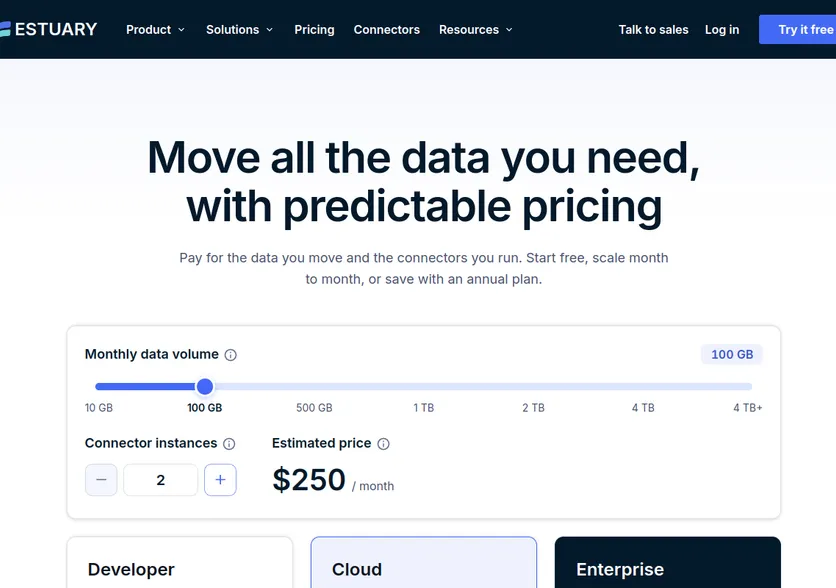
Paid tool Starting price: $0.50/GB + $100/month · Fifty cents per gigabyte plus one hundred dollars a month per connector instance, with the first six connector instances at that rate and the seventh onward at fifty dollars; the free Developer tier covers ten gigabytes a month with two connectors
Free plan: Free Developer tier: 10 GB/month, 2 connectors
Estuary is the real-time replication tool for startups that cannot wait for nightly batch jobs, capturing changes as they happen and materializing them into the warehouse. This Estuary Cloud plan costs fifty cents per gigabyte plus one hundred dollars a month per connector instance, with usage counted at capture and again at each materialization. A team with live dashboards gets millisecond-fresh data, exactly-once delivery and a free Developer tier to start.
What we like
- Real-time capture instead of nightly batches
- Exactly-once delivery without duplicates
- Free Developer tier covers ten gigabytes a month
Watch out for
- Gigabytes are counted at capture and again at each materialization
- Each connector instance adds a monthly charge
How to try it
- Open the Estuary site and start the free Developer tier
- Create a capture from a database and a materialization to the warehouse
- Watch changes flow in real time and check the usage meter
4. Skyvia
Best for: Startups that want cloud integration with no servers to run
Paid tool Starting price: $79/month · Seventy-nine dollars a month billed annually for the Basic plan, or ninety-nine dollars a month billed monthly; Standard costs one hundred and fifty-nine dollars a month billed annually and Professional costs three hundred and ninety-nine dollars; the free plan covers ten thousand records a month with two integrations
Free plan: Free plan: 10,000 records/month, 2 integrations
Skyvia is the cloud replication tool for startups that want integration without servers, connecting SaaS apps and databases to the warehouse from a browser. This Skyvia Basic plan costs seventy-nine dollars a month billed annually and covers data integration with scheduled sync. A small team gets a visual builder, backup and query tools in one login without installing anything.
What we like
- Runs fully in the browser with no install
- Visual builder with backup and query tools included
- Free plan covers ten thousand records a month
Watch out for
- Higher plans are needed for frequent sync schedules
- Monthly billing costs twenty dollars more than the annual rate
How to try it
- Open the Skyvia site and start the free plan
- Connect a source and a warehouse destination in the browser
- Schedule the sync and check the loaded rows
5. Dataddo
Best for: Lean teams that want managed connectors without maintenance
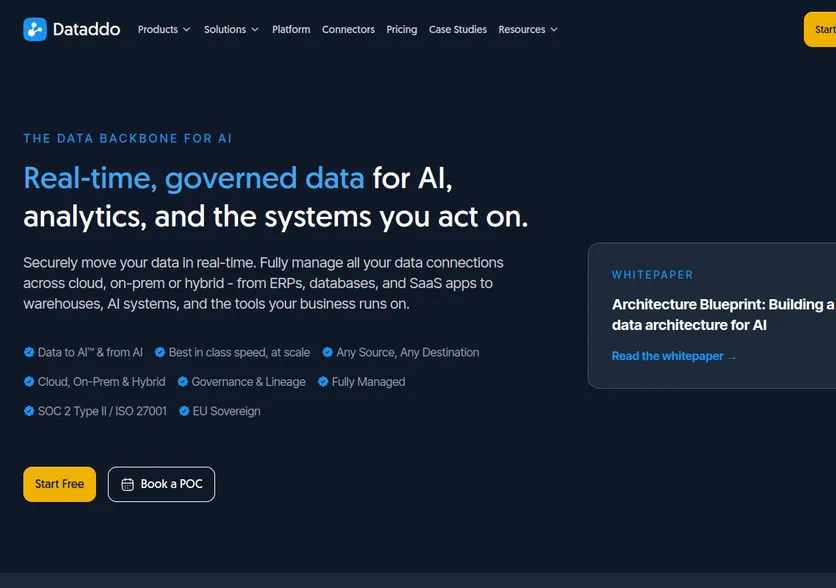
Paid tool Starting price: $99/month · Ninety-nine dollars a month for the Data Anywhere plan with three flows, while the Data to AI plan costs ten dollars and forty-nine cents a month per seat with a three-seat minimum
Free plan: No free plan; free trial available
Dataddo is the replication tool for startups that need data flowing into dashboards rather than a warehouse project, with managed connectors that stay up without maintenance. This Dataddo Data Anywhere plan costs ninety-nine dollars a month and covers three flows into the warehouse or a dashboard. A lean team gets stable sync from niche sources, a no-code setup and support that fixes broken connectors for them.
What we like
- Managed connectors stay up without maintenance
- Covers niche sources other tools skip
- No-code setup a non-engineer can run
Watch out for
- Only three flows on the entry plan
- No free plan, so the trial is the only test
How to try it
- Open the Dataddo site and start a free trial
- Pick a source and a dashboard or warehouse destination
- Turn on the flow and confirm the data lands on schedule
6. Stitch
Best for: Startups with a handful of standard sources that want the simplest setup
Paid tool Starting price: from $100/month · From one hundred dollars a month for the Standard plan with five million rows, one destination and five users, while Advanced costs one thousand five hundred dollars a month billed annually and Premium costs three thousand dollars; a fourteen-day free trial is included
Free plan: No free plan; 14-day free trial
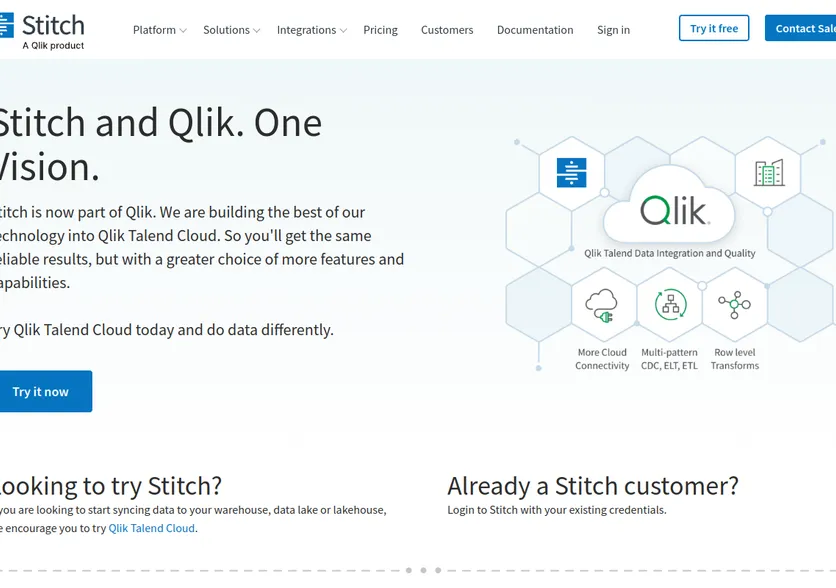
Stitch is the simplest replication tool in this list, moving data from standard sources into the warehouse on a fixed schedule with almost no setup. This Stitch Standard plan starts at one hundred dollars a month for five million rows, one destination and five users. A startup with a handful of sources gets reliable batch sync, automatic schema updates and a fourteen-day trial to test it.
What we like
- Simplest setup in this comparison
- Automatic schema updates on source changes
- Predictable row-based pricing for small volumes
Watch out for
- New buyers are now steered toward Qlik Talend Cloud
- Only one destination on the Standard plan
How to try it
- Open the Stitch site and start the fourteen-day trial
- Connect a standard source and pick the warehouse
- Schedule the replication and verify the rows arrive
7. Integrate.io
Best for: Startups with heavy data volumes that want one flat bill
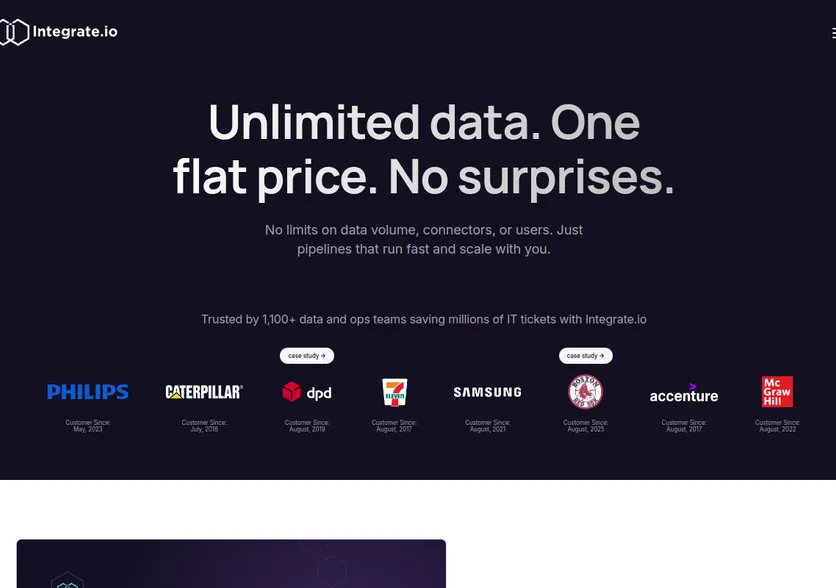
Paid tool Starting price: $1,999/month · One thousand nine hundred and ninety-nine dollars a month flat for unlimited data, with a fourteen-day free trial included
Free plan: No free plan; 14-day free trial
Integrate is the flat-rate replication platform for startups whose data volumes keep growing, charging one price no matter how much data moves. This Integrate.io plan costs one thousand nine hundred and ninety-nine dollars a month for unlimited data with no per-row metering. A team with heavy volumes gets ETL and ELT, reverse ETL and API generation on one bill that never surprises them.
What we like
- Flat monthly price with unlimited data
- ETL, ELT, reverse ETL and API generation in one tool
- No per-row metering to surprise the budget
Watch out for
- The flat price is steep for a team with light volumes
- No free plan, so the trial is the only test
How to try it
- Open the Integrate site and start the fourteen-day trial
- Connect the sources that carry the heaviest volumes
- Build a pipeline and check the flat monthly cost holds
Prices above were checked on each vendor’s own website on Nov 27, 2026 and can change — the vendor’s page is the final word. Vendor links are editorial: nobody paid to be listed or ranked here. Vendors who want a featured listing can see how it works on our Get listed page.
What data replication costs a startup in 2026
A replication tool charges by rows, events, gigabytes or a flat monthly fee, and the meter decides the bill more than the headline price. Airbyte starts at twenty dollars a month on credits, Hevo at two hundred and thirty-nine dollars a month on events, and Integrate.io at one thousand nine hundred and ninety-nine dollars a month flat with no meter at all. The cheapest entry price can become the most expensive tool once volumes grow, so price the plan against your real monthly rows.
Start with a trial on two tools and connect your busiest source first. Watch what happens when a column is added or renamed, then check the bill at the end of the trial week. Pick the tool whose sync stays up without attention, because a pipeline that needs babysitting costs more than its subscription.
Before you buy
- Count your sources before you buy, because a plan priced per connector punishes a team that adds apps every month.
- Check whether pricing follows rows, events or gigabytes, because the same data can cost ten times more on a different meter.
- Test a schema change on a trial, because a tool that breaks when a field is renamed costs engineering hours.
- Confirm the free tier covers your real volume, because a free plan capped at one million events ends fast in production.
- Ask who fixes a broken connector, because a managed connector that you must repair yourself is not managed.
Official websites
Official websites of the products reviewed above. Features and prices were checked against these sites when this guide was written, and they can change, so confirm on the vendor site before you buy.
Frequently asked questions
Which data replication software is best for startups in 2026?
Hevo Data is the best overall pick at two hundred and thirty-nine dollars a month, pairing no-code setup with more than one hundred and fifty connectors. Airbyte is the best budget pick from twenty dollars a month, with a free self-hosted edition for teams that run their own infrastructure. Estuary is the best pick for real-time data at fifty cents per gigabyte plus one hundred dollars a month per connector.
How much does data replication software cost for a startup?
Prices in this list run from twenty dollars a month for Airbyte Cloud Standard to one thousand nine hundred and ninety-nine dollars a month for Integrate.io, with most tools landing between seventy-nine and two hundred and thirty-nine dollars a month. Usage-based tools can cost more than the entry figure once volumes grow, while flat-rate tools cost the same every month. Check the meter before you compare totals.
Do startups need a data replication tool, or is manual export enough?
Yes, because replication replaces the manual export and spreadsheet habit that breaks the moment a column changes. A replication tool keeps the warehouse current on a schedule, handles schema changes and logs failures instead of failing silently. A startup with three or more sources already spends more time on manual sync than a basic plan costs.
What is the difference between real-time and batch replication?
Real-time replication captures database changes as they happen, so dashboards show minutes-old data instead of yesterday's snapshot. Batch replication runs on a schedule, often hourly or nightly, and costs less at low volumes. Choose real-time when decisions depend on fresh numbers, and batch when a daily refresh is enough for reporting.
What should a startup check before buying a replication tool?
Check the row or event cap first, because a free tier that ends at one million events lasts days in a busy product. Look at the connector list for your exact sources, because a missing connector means custom work. Test a schema change during the trial, because a tool that breaks when a field is renamed will cost engineering time every week.
Need everyday developer help too? Try Toolsvine's free developer tools right in your browser.
Browse Developer Tools tools