On this page
Law firms hold the data attackers want most: client names, case files, financial records and privileged communications, usually on laptops that travel between court, home and the office. One phishing email can lock the case management system, and one stolen laptop can expose every client on the matter list. We compared seven endpoint detection tools on published price, ease of setup and how well they protect client data. Microsoft Defender for Business is our first pick — the cheapest endpoint protection here, already inside Microsoft 365 Business Premium.
How we researched this
We started with endpoint tools a law firm can run without an IT department, then read each price on the vendor site on November 27, 2026 and noted the trial each plan carries. We judged them for a small firm that stores client files on office PCs, home laptops and phones, and that needs an audit trail for privileged material. We dropped quote-only endpoint platforms and consumer antivirus products because a firm needs a business licence, a central console and a published price it can budget around.
Compare the tools
| Name | Best for | Starting price | Free plan | |
|---|---|---|---|---|
| Microsoft Defender for Business | Law firms already paying for Microsoft 365 Business Premium | $3/user/month | No free plan; 30-day free trial | Visit |
 Bitdefender GravityZone | Law firms that want strong protection at a low per-device price | $38.50/device/year | No free plan; 30-day free trial | Visit |
| Webroot Business Endpoint Protection | Law firms with older office PCs and a tiny security budget | $30/endpoint/year | No free plan; 30-day free trial | Visit |
 Huntress Managed EDR | Law firms with fifty or more endpoints and no IT staff | $8.99/endpoint/month | No free plan; demo available | Visit |
 Kaspersky Small Office Security | Law firms with a file server and a mix of PCs and phones | $230/year | No free plan; 30-day free trial | Visit |
 Norton Small Business | Law firms that want one subscription for every device type | $99.99/year | No free plan; 60-day money-back guarantee | Visit |
 ESET PROTECT Core | Law firms that want layered protection with ransomware rollback | $54.90/device/year | No free plan; 30-day free trial | Visit |
The endpoint detection software for law firms, compared
1. Microsoft Defender for Business
Best for: Law firms already paying for Microsoft 365 Business Premium
Paid tool Starting price: $3/user/month · Three dollars per user a month billed annually for up to three hundred users, with five devices per user; included in Microsoft 365 Business Premium at twenty-two dollars per user a month; server protection costs three dollars per server
Free plan: No free plan; 30-day free trial
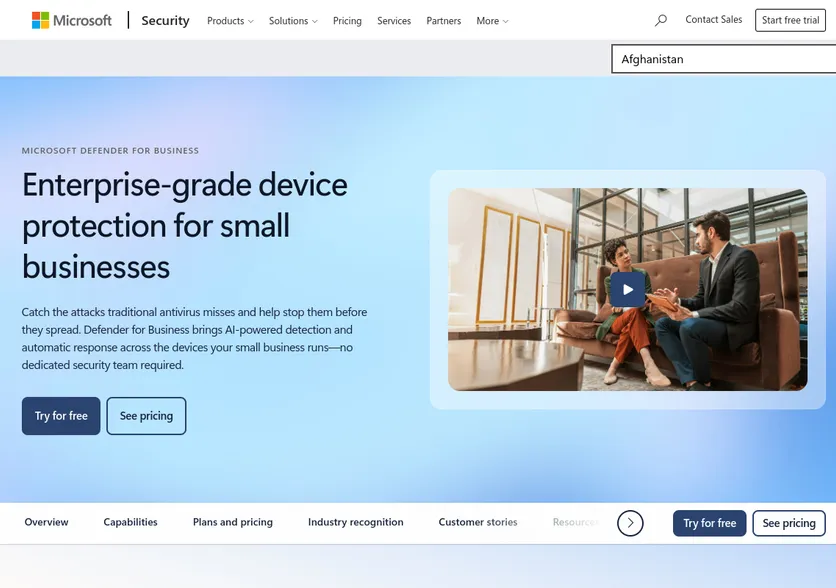
This Microsoft Defender for Business plan costs three dollars per user a month and is included free inside Microsoft 365 Business Premium, which many small firms already pay for. Automated investigation and response handles common threats without an analyst, so a firm with no IT staff still gets a response when a laptop is attacked. Each user covers five devices, which protects the office PCs, the home laptops and the phones that carry client email.
What we like
- Cheapest published endpoint price in this comparison
- Included free inside Microsoft 365 Business Premium
- Automated response with no analyst needed
Watch out for
- Capped at three hundred users before you must move up a tier
- Standalone purchase needs an eligible Microsoft 365 plan
How to try it
- Check whether your Microsoft 365 Business Premium plan already includes it
- Turn on Defender for Business from the Microsoft 365 admin centre
- Run the onboarding wizard on five devices before a full rollout
2. Bitdefender GravityZone
Best for: Law firms that want strong protection at a low per-device price
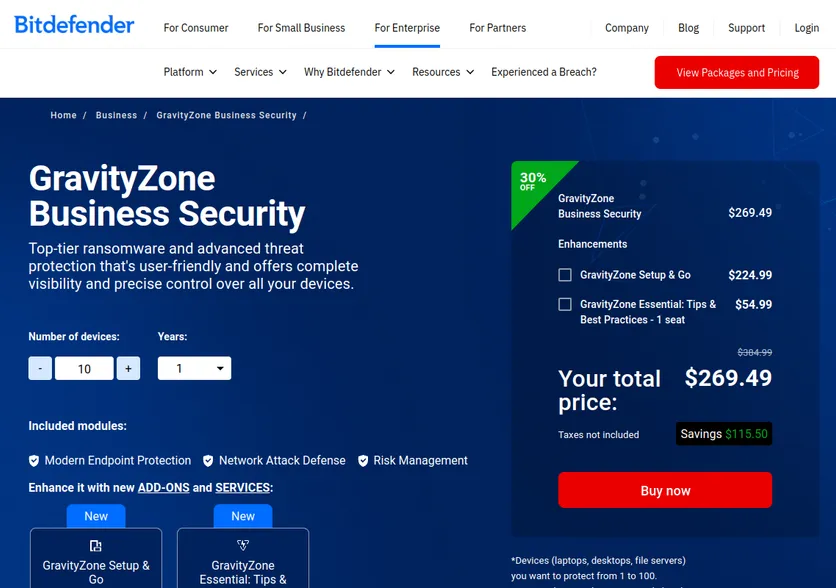
Paid tool Starting price: $38.50/device/year · Thirty-eight dollars and fifty cents per device a year for Business Security at the ten-device list price of three hundred and eighty-four dollars and ninety-nine cents a year; Small Business Security lists at thirty-two dollars and fifty cents per device a year and Business Security Premium at eighty-eight dollars; a thirty percent first-term promotion is shown on the vendor store
Free plan: No free plan; 30-day free trial
For a law firm counting the cost per device, Bitdefender GravityZone is the cheapest published option among the standalone endpoint vendors here, at thirty-eight dollars and fifty cents per device a year. A central cloud console lets the office manager set policies for every device from one screen, which matters when lawyers work from court, home and the office. Independent lab tests rate its detection highly, so a small firm gets enterprise-grade protection without an enterprise budget.
What we like
- Lowest published per-device price among the standalone vendors here
- Central cloud console with policy control for every device
- Strong detection record in independent lab tests
Watch out for
- Full detection and response needs the Premium tier
- Online purchase stops at one hundred devices
How to try it
- Open the Bitdefender business page and pick the ten-device pack
- Install the agent from the cloud console on a test machine
- Set web access and device control policies before you enrol the firm
3. Webroot Business Endpoint Protection
Best for: Law firms with older office PCs and a tiny security budget
Paid tool Starting price: $30/endpoint/year · Thirty dollars per endpoint a year billed annually, with a five-endpoint minimum that makes the smallest order one hundred and fifty dollars a year; now sold as OpenText Core Endpoint Protection
Free plan: No free plan; 30-day free trial
Small firms that still run second-hand office PCs will like the Webroot Business Endpoint Protection agent, which is built to run on older and low-spec machines without slowing them down. The price is a simple per-endpoint figure of thirty dollars a year with no tier maze, and the smallest order is five endpoints at one hundred and fifty dollars a year. A cloud console with policy and group controls lets the office manager watch the whole firm from one screen, and the agent is now sold as OpenText Core Endpoint Protection.
What we like
- Lightest agent here, built for older and low-spec machines
- Simple per-endpoint price with no tier maze
- Cloud console with policy and group controls
Watch out for
- No Linux or mobile device support
- Five-endpoint minimum even for a one-person firm
How to try it
- Open the Webroot business page and start the thirty-day trial
- Install the agent on your oldest Windows machine first
- Set the group policies in the web console before you enrol the rest
4. Huntress Managed EDR
Best for: Law firms with fifty or more endpoints and no IT staff
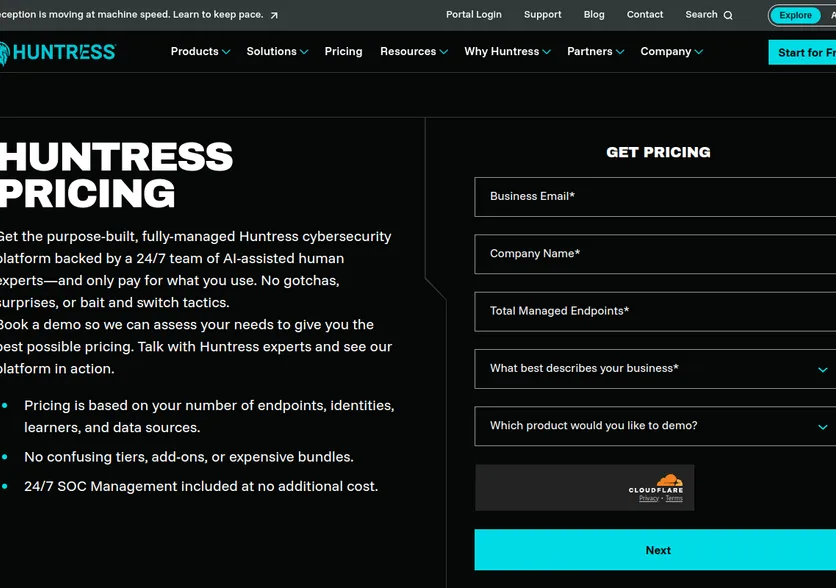
Paid tool Starting price: $8.99/endpoint/month · Eight dollars and ninety-nine cents per endpoint a month for Managed EDR at the fifty to ninety-nine endpoint band on a twelve-month term; the rate falls to seven dollars and ninety-nine cents at one hundred endpoints and five dollars and forty-nine cents at five hundred; direct buyers need a fifty-seat minimum per product
Free plan: No free plan; demo available
A small firm that cannot hire a security team gets the next best thing from Huntress Managed EDR, whose staffed security operations centre watches alerts around the clock. Managed Microsoft Defender antivirus is included at no extra cost, and ransomware canaries catch encryption before it spreads across the office. The direct purchase needs at least fifty endpoints per product, so this is the pick for a larger firm with many attorneys and support staff.
What we like
- A staffed operations centre watches alerts around the clock
- Managed Microsoft Defender antivirus is included at no extra cost
- Ransomware canaries catch encryption before it spreads
Watch out for
- Direct purchase needs at least fifty endpoints per product
- Identity and log monitoring are priced as separate products
How to try it
- Open the Huntress pricing page and check the band for your endpoint count
- Book a demo and ask how the operations centre handles a real alert
- Trial the agent on a small group of endpoints before you enrol the firm
5. Kaspersky Small Office Security
Best for: Law firms with a file server and a mix of PCs and phones
Paid tool Starting price: $230/year · Two hundred and thirty dollars a year for five users at the standard renewal rate, covering five computers, five mobile devices and one file server; the first year is two hundred and five dollars as an introductory price; larger packs cover up to forty-five users
Free plan: No free plan; 30-day free trial
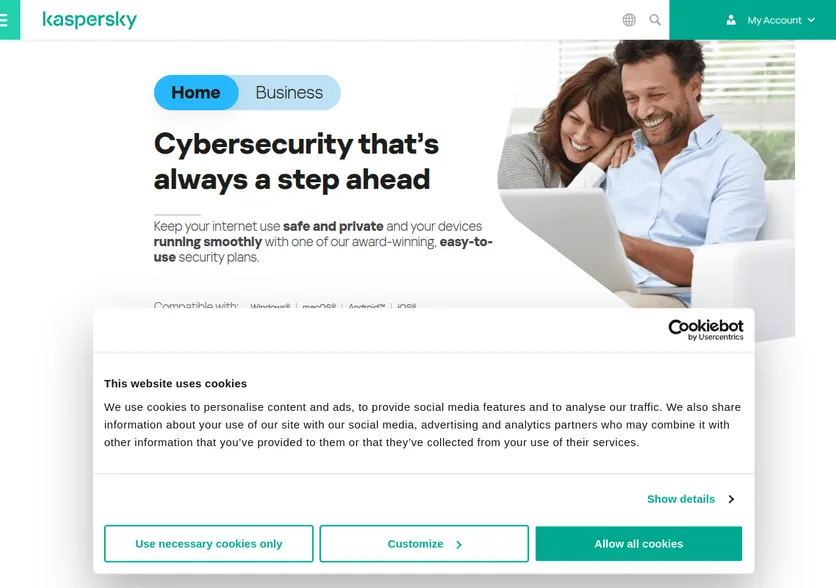
A firm that keeps case files on a small office server will find Kaspersky Small Office Security a natural fit, since one licence covers a Windows file server alongside five computers and five mobile devices. Ransomware rollback restores encrypted files automatically, and one web portal manages every device without an IT person. The renewal price is twenty-five dollars above the first year, so check the cart before the trial converts.
What we like
- Covers a Windows file server in the same licence
- Ransomware rollback restores encrypted files automatically
- One web portal manages every device without an IT person
Watch out for
- Renewal costs twenty-five dollars more than the first year
- No detection and response for teams that need to hunt threats
How to try it
- Open the Kaspersky Small Office Security page and start the trial
- Add your file server and five office computers to the portal
- Check the renewal price in the cart before the trial converts
6. Norton Small Business
Best for: Law firms that want one subscription for every device type
Paid tool Starting price: $99.99/year · Ninety-nine dollars and ninety-nine cents a year for five devices; ten devices cost one hundred and forty-nine dollars and ninety-nine cents a year and twenty devices cost two hundred and forty-nine dollars and ninety-nine cents a year
Free plan: No free plan; 60-day money-back guarantee
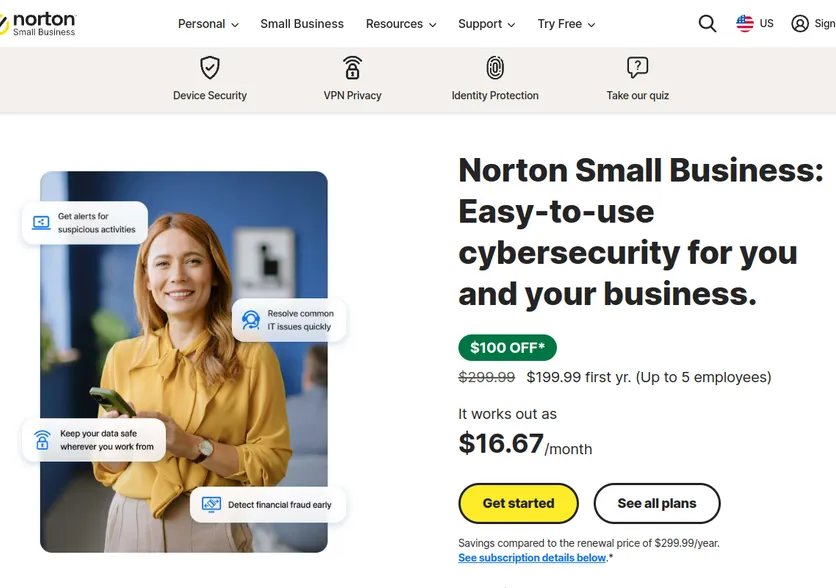
This Norton Small Business plan covers PCs, Macs, phones and tablets under one subscription, which suits a firm that mixes device types across attorneys and staff. The pricing is a simple device count with no per-user maths, starting at ninety-nine dollars and ninety-nine cents a year for five devices. A firewall and safe browsing are included on every device, so the phones that carry client email get the same protection as the office computer.
What we like
- One subscription covers PCs, Macs, phones and tablets
- Simple device-count pricing with no per-user maths
- Includes a firewall and safe browsing on every device
Watch out for
- No central admin console for managing staff devices
- Renewal pricing can rise above the first-year price
How to try it
- Open the Norton Small Business page and pick the five-device plan
- Install Norton on one device from each type your team uses
- Turn on the firewall and safe browsing before you add the rest
7. ESET PROTECT Core
Best for: Law firms that want layered protection with ransomware rollback
Paid tool Starting price: $54.90/device/year · Fifty-four dollars and ninety cents per device a year at the five to ten device band; the rate falls to forty-six dollars and seventy cents at eleven to twenty-five devices and thirty-eight dollars and forty cents at fifty to ninety-nine devices; Premium costs one hundred and three dollars per device a year
Free plan: No free plan; 30-day free trial
This ESET PROTECT Core plan protects endpoints with layered detection, ransomware rollback and device control, which fits a firm that handles sensitive client files on every machine. The price falls as the device count rises, from fifty-four dollars and ninety cents per device a year at five to ten devices down to thirty-eight dollars and forty cents at fifty to ninety-nine. A single cloud console manages policies, updates and alerts for the whole firm, so one person can watch every device.
What we like
- Layered detection with ransomware rollback built in
- Price falls as the device count rises
- Single cloud console for policies and alerts
Watch out for
- Full detection and response needs the Premium tier
- Console takes longer to learn than the simpler rivals here
How to try it
- Open the ESET business page and check the band for your device count
- Install the agent on a test machine and run a full scan
- Set device control policies before you enrol the rest of the firm
Prices above were checked on each vendor’s own website on Nov 27, 2026 and can change — the vendor’s page is the final word. Vendor links are editorial: nobody paid to be listed or ranked here. Vendors who want a featured listing can see how it works on our Get listed page.
How a law firm should protect its endpoints
Start with the devices that touch client data: the office computer that holds the case files, the laptops attorneys take to court and the phones that carry client email. Turn on protection on every device before you worry about advanced features, because an unprotected phone is a bigger risk than a missing firewall rule. A password manager is the second purchase, since shared logins for the case system and the billing app are the most common way a small firm gets compromised.
Keep the setup simple enough that a new hire can be protected in ten minutes. A central console that lets the office manager see every device at a glance beats a collection of per-device installs that nobody checks. When a tool asks for a minimum seat count, count the phones as well as the computers, and check whether the renewal price is higher than the first-year price before you commit.
Before you buy
- Count every device that touches client files, including phones and home laptops
- Check whether the plan covers the file server that holds case documents
- Make sure the tool logs who accessed which file and when
- Ask whether threat hunting is included or only automated alerts
- Check the renewal price before the trial converts, because it often rises
Official websites
Official websites of the products reviewed above. Features and prices were checked against these sites when this guide was written, and they can change, so confirm on the vendor site before you buy.
Frequently asked questions
What is the cheapest endpoint protection for a law firm?
Microsoft Defender for Business costs three dollars per user a month billed annually, and it is included free inside Microsoft 365 Business Premium, which many law firms already pay for. Webroot Business Endpoint Protection costs thirty dollars per endpoint a year, and Norton Small Business costs ninety-nine dollars and ninety-nine cents a year for five devices. A five-person firm can protect every device for under fifty dollars a month with Defender plus a password manager.
Do law firms really need endpoint detection software?
Yes, because law firms hold the exact data attackers want: client names, case details, financial records and privileged communications, usually on laptops that travel to court and home. A phishing email that locks the case files can cost a week of billable work, and a stolen laptop can expose every client on the matter list. Small firms are targeted precisely because attackers expect no IT staff and no detection in place.
Should we protect staff phones or just office computers?
Protect both, because the phones carry client email, the calendar and the case management app, and they travel to every court appearance. Most endpoint plans cover five devices per user or price per device, so a phone costs the same as a PC. Pick a tool that covers mobile devices in the same licence, such as Kaspersky or Norton, rather than a Windows-only product. Check the licence covers phones before you buy, because some business plans do not.
How do we prove client files were handled safely?
Use the audit log and the device controls in your endpoint tool to see who accessed which file and when, and to block USB drives and unapproved apps on firm machines. Bitdefender and ESET both offer device control and detailed logs in their business plans, which gives a firm the record it needs if a client asks how a file was handled. Review the log once a month and remove access for anyone who has left the firm.
What happens if ransomware locks our case files?
Ransomware encrypts your files and demands payment, and the only reliable recovery is a backup that the ransomware could not reach. Keep a copy of your case files and client list backed up off the device, and test restoring it before you need it. Kaspersky Small Office Security includes ransomware rollback that restores encrypted files automatically, which buys time while you restore. Never pay the ransom without professional advice, because payment does not guarantee recovery.
Compare the seven tools above, then trial your pick on the office PCs before you enrol every device in the firm.
Browse Security & Privacy tools