On this page
A startup cannot afford a sales-led identity contract or a verification flow that scares new users away. The right tool starts free or nearly free, publishes its per-check price, and plugs into your product in an afternoon. Didit leads this list because thirty-three cents a check and ten dollars of free monthly credit keep early verification costs near zero, and the other six tools are ranked on what a young company actually pays before it has volume to negotiate with.
How we researched this
We checked every price on the vendor pricing page on November 27, 2026, and only included tools with a published US dollar list price and a free trial or free plan. We ranked each tool on what a startup needs most: a low or zero starting cost, published per-check rates, a free tier or trial that covers a real pilot, and an API a small team can integrate without help. Tools with quote-only pricing were left out, so every price below can be verified on the vendor site.
Compare the tools
| Name | Best for | Starting price | Free plan | |
|---|---|---|---|---|
 Didit | Startups that want verification costs near zero at launch | $0.33/check | Free plan with $10 of monthly credit | Visit |
 Veriff | Startups that need automated decisions and a tiny minimum | $0.80/check | 15-day free trial with up to 50 sessions | Visit |
 Sumsub | Startups in regulated markets that need AML from day one | $1.35/check | 14-day free trial with 50 free checks | Visit |
 iDenfy | Startups that want white-label verification and flexible billing | $1.35/check | 14-day free trial with 10 free checks | Visit |
| Stripe Identity | Startups already building on Stripe | $1.50/check | First 50 verifications free | Visit |
| Shufti Pro | Startups hiring or selling across many countries | $1.50/check | Free Forever plan with 10 verifications a month | Visit |
 ComplyCube | Startups with developers who want a clean API and clear prices | $99/mo | 14-day free trial with 50 free checks | Visit |
The identity verification software for startups, compared
1. Didit
Best for: Startups that want verification costs near zero at launch
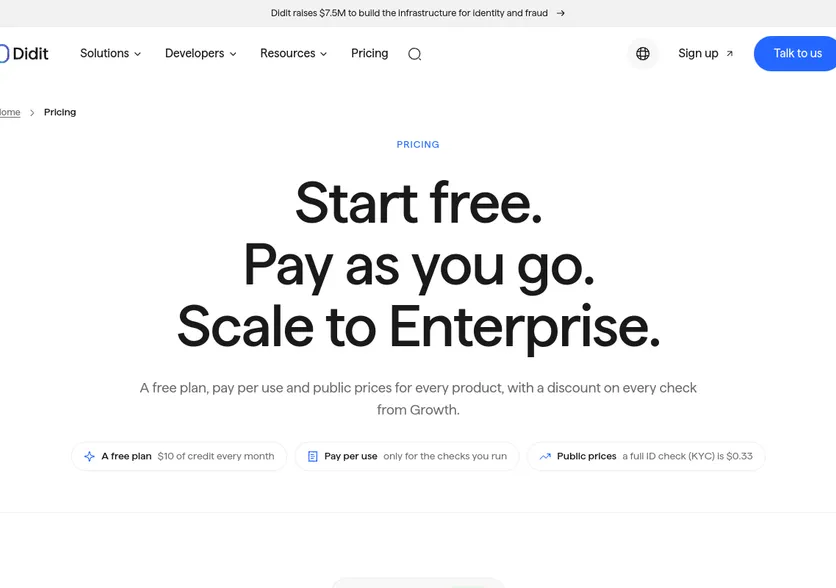
Paid tool Starting price: $0.33/check · Thirty-three cents per completed full KYC check at list price, covering ID document verification, passive liveness, face match and device analysis; AML screening adds twenty cents, the Free plan includes ten dollars of monthly credit, Growth is ninety-nine dollars a month and Scale is two hundred and ninety-nine dollars a month
Free plan: Free plan with $10 of monthly credit
Didit is built for the startup stage: a full KYC check costs thirty-three cents at list price, and the Free plan hands you ten dollars of credit every month, about thirty full checks, with no card and no sales call. You pay only for checks that finish with a result, and the sandbox is free, so a two-person team can ship verification in a day. Growth at ninety-nine dollars a month adds more credit and a four percent discount when sign-ups take off.
What we like
- Thirty-three cents per full KYC check
- Ten dollars of free credit every month
- No sales call, self-serve from day one
Watch out for
- AML screening adds twenty cents
- Enterprise starts at fifteen thousand a year
How to try it
- Sign up with a work email for the credit
- Ship the free sandbox first
- Top up credit when sign-ups grow
2. Veriff
Best for: Startups that need automated decisions and a tiny minimum
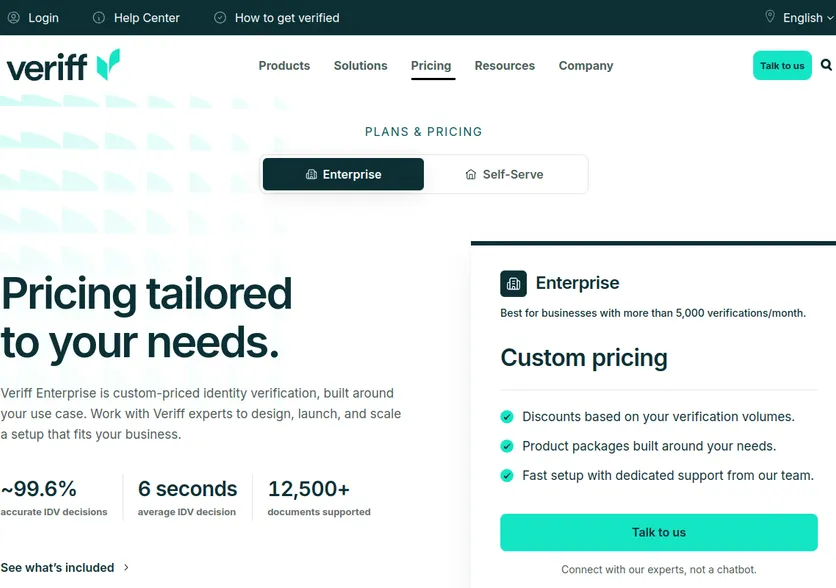
Paid tool Starting price: $0.80/check · Eighty cents per verification on the Essential plan with a forty-nine dollar monthly minimum; Plus is one dollar and thirty-nine cents with a ninety-nine dollar minimum and Premium is one dollar and eighty-nine cents with a two hundred and nine dollar minimum, and Enterprise above five thousand checks a month is quoted
Free plan: 15-day free trial with up to 50 sessions
Veriff Essential charges eighty cents per verification with a forty-nine dollar monthly minimum, the smallest minimum in this list, and decisions come back in seconds with no human in the loop. A fifteen-day trial covers fifty sessions, which is enough to measure your real pass rate before committing to anything. Plus at one dollar and thirty-nine cents adds human review for the cases automation cannot decide, which is worth it once false rejections start costing sign-ups.
What we like
- Eighty cents a check, automated
- Forty-nine dollar minimum is the smallest here
- Fifteen-day trial with fifty sessions
Watch out for
- Enterprise is quote-only
- PEP screening is a sixty-four cent add-on
How to try it
- Run the fifteen-day trial with real sign-ups
- Measure your pass rate before paying
- Switch to Plus if false rejections rise
3. Sumsub
Best for: Startups in regulated markets that need AML from day one
Paid tool Starting price: $1.35/check · One dollar and thirty-five cents per verification on the Basic plan with a one hundred and forty-nine dollar monthly minimum; Compliance is one dollar and eighty-five cents with a two hundred and ninety-nine dollar minimum and adds AML screening and monitoring, and only successful verifications are billed
Free plan: 14-day free trial with 50 free checks
Sumsub Basic costs one dollar and thirty-five cents per verification with a one hundred and forty-nine dollar monthly minimum, and it covers ID checks, liveness, face match and reusable KYC. Compliance at one dollar and eighty-five cents adds AML screening and ongoing monitoring, which a fintech startup needs before its first regulator conversation. Only successful verifications are billed, and a fourteen-day trial includes fifty free checks to prove the flow.
What we like
- Only successful verifications billed
- AML built into the Compliance tier
- Reusable KYC across products
Watch out for
- Minimums bite at very low volume
- KYB needs the quote-only custom plan
How to try it
- Start the fourteen-day trial
- Decide whether AML is needed now
- Budget the minimum, not just the per-check rate
4. iDenfy
Best for: Startups that want white-label verification and flexible billing
Paid tool Starting price: $1.35/check · One dollar and thirty-five cents per verification on the Basic plan with a one hundred and thirty-five dollar monthly minimum; Premium is one dollar and thirty cents with a three hundred and twenty-five dollar minimum, approved-only billing is a fifty cent add-on, and Enterprise volume rates fall toward fifty-five cents
Free plan: 14-day free trial with 10 free checks
iDenfy Basic is one dollar and thirty-five cents per verification with a one hundred and thirty-five dollar monthly minimum, and the flows run under your brand, which keeps a young product looking professional. The approved-only billing add-on costs fifty cents more per check and means you never pay for a rejected or abandoned attempt, a fair deal when early traffic is messy. A fourteen-day trial includes ten free checks to test the integration.
What we like
- White-label under your brand
- Approved-only billing option
- Fourteen-day trial with ten free checks
Watch out for
- Add-ons raise the real per-check cost
- Enterprise terms are negotiated
How to try it
- Trial with ten free checks
- Brand the flow to match your product
- Compare approved-only billing against your failure rate
5. Stripe Identity
Best for: Startups already building on Stripe
Paid tool Starting price: $1.50/check · One dollar and fifty cents per completed document and selfie verification with no monthly minimum and no subscription; the first fifty verifications are free, US ID number lookups cost fifty cents, and volumes above two thousand a month are priced by quote
Free plan: First 50 verifications free
Stripe Identity is the simplest option for a Stripe startup: one dollar and fifty cents per completed verification, no monthly minimum, no subscription, and the first fifty verifications free. It lives in the same dashboard as your payments, so there is no second vendor, no second invoice and no new integration to maintain. The scope is deliberately narrow, with document and selfie checks only, so plan a second vendor if you later need watchlists or business verification.
What we like
- First fifty verifications free
- No monthly minimum or subscription
- Zero new vendor to onboard
Watch out for
- No watchlist or business screening
- Custom pricing above two thousand a month
How to try it
- Enable Identity in your Stripe account
- Ship fifty free verifications as a pilot
- Plan the AML add-on before you need it
6. Shufti Pro
Best for: Startups hiring or selling across many countries
Paid tool Starting price: $1.50/check · One dollar and fifty cents per verification as the starting price on the Essentials plan, covering up to twenty thousand verifications with no monthly minimum; AML screening and address verification are add-ons without published prices, and Enterprise is quoted on request
Free plan: Free Forever plan with 10 verifications a month
Shufti Pro gives a startup ten free verifications every month forever, then charges from one dollar and fifty cents per verification with no monthly minimum, covering more than two hundred and forty countries. That combination suits a young company with global ambitions and irregular volume, since quiet months cost nothing. Its liveness check carries an iBeta Level 3 result, though AML screening is an unpriced add-on you must ask about before budgeting.
What we like
- Ten free verifications every month
- No monthly minimum
- Coverage across 240-plus countries
Watch out for
- AML add-on price is not published
- Highest entry rate in this list
How to try it
- Claim the ten free monthly checks
- Test your top hiring countries
- Ask for the AML add-on rate early
7. ComplyCube
Best for: Startups with developers who want a clean API and clear prices
Paid tool Starting price: $99/mo · Ninety-nine dollars a month for the Starter plan, credited against checks, with a document check at one dollar and five cents and photo liveness at thirty-five cents; Core is two hundred and ninety-nine dollars a month with lower per-check rates, and only successful verifications are charged
Free plan: 14-day free trial with 50 free checks
ComplyCube Starter is ninety-nine dollars a month credited against checks, with documents at one dollar and five cents and photo liveness at thirty-five cents, and only successful verifications are charged. The free sandbox and fourteen-day trial let a small team build and test the integration before spending anything, and the per-check prices are published, so a founder can budget without a sales call. Core at two hundred and ninety-nine dollars lowers rates when volume grows.
What we like
- Free sandbox for developers
- Published per-check prices
- Only successful verifications charged
Watch out for
- Ninety-nine dollars applies in quiet months
- Growth tier is quote-only
How to try it
- Build against the free sandbox
- Run the fourteen-day trial live
- Price your exact check mix first
Prices above were checked on each vendor’s own website on Nov 27, 2026 and can change — the vendor’s page is the final word. Vendor links are editorial: nobody paid to be listed or ranked here. Vendors who want a featured listing can see how it works on our Get listed page.
How a startup should pick identity verification software
Start with the free tier, not the sales deck: Didit's ten dollars of monthly credit, Shufti Pro's ten free checks and Stripe's first fifty free verifications are all enough to ship a real pilot. Price your first thousand verifications on each vendor, including minimums and add-ons, because a one dollar and thirty-five cent rate with a one hundred and forty-nine dollar minimum costs far more than thirty-three cents with no minimum at low volume. Integrate in the sandbox first, measure your pass rate with real users, and only sign an annual contract when volume is predictable enough to make the minimum a bargain instead of a burden.
Before you buy
- Ship a pilot on a free tier before talking to any sales team
- Price your first thousand verifications including minimums and add-ons
- Integrate in the sandbox and measure your real pass rate
- Check document coverage for the countries your users come from
- Avoid annual contracts until your volume is predictable
Official websites
Official websites of the products reviewed above. Features and prices were checked against these sites when this guide was written, and they can change, so confirm on the vendor site before you buy.
Frequently asked questions
What is the cheapest identity verification software for startups?
Didit is the cheapest at thirty-three cents per full KYC check, and its Free plan covers about thirty checks a month on ten dollars of credit, so a pre-launch startup can pay nothing. Veriff Essential at eighty cents with a forty-nine dollar minimum is next. Stripe Identity gives the first fifty verifications free and then charges one dollar and fifty cents with no minimum, which suits irregular early volume.
Can a startup use identity verification for free?
Yes, within limits. Didit gives ten dollars of credit every month, Shufti Pro gives ten free verifications every month, and Stripe Identity gives the first fifty verifications free. Veriff, Sumsub, iDenfy and ComplyCube offer free trials with fifty or fewer free checks. Free tiers cover a pilot, but a growing startup will outgrow them within months and should budget for the first paid tier.
How fast can a startup integrate identity verification?
Most vendors in this list offer a no-code flow or a hosted page that ships in a day, and a full API integration usually takes a few days for a small team. Didit, Stripe Identity and Veriff all provide sandboxes so you can test without paying. The slow part is usually not the code: it is deciding which checks you need, what counts as a pass, and how your support team handles the people who fail.
Do startups need AML screening as well as ID checks?
It depends on what you sell. A fintech, crypto or payments startup needs sanctions and PEP screening from day one, so Sumsub Compliance at one dollar and eighty-five cents or Didit with its twenty-cent AML add-on are the honest starting points. A marketplace or hiring tool usually needs only document and selfie checks to start, and can add AML later. Ask your lawyer before you launch, not after your first regulator letter.
What happens when a startup outgrows its IDV free tier?
You move to the first paid tier and start paying per check or per month. On Didit that means topping up credit at thirty-three cents a check, on Veriff it means the forty-nine dollar monthly minimum, and on ComplyCube the ninety-nine dollar Starter plan. Watch for the step where Enterprise pricing starts: Didit quotes Enterprise from fifteen thousand dollars a year, and several rivals switch to sales quotes above five thousand checks a month.
Compare the seven tools above, then ship a pilot on the free tier that fits your volume and measure your real pass rate before you pay.
Browse Security & Privacy tools