On this page
A marketing team without a resource system spends its week in status meetings and hunting for the latest version of a file. The tools below replace that chaos with one place for briefs, assets, deadlines, and approvals, so the team can see what is due and who owns it. Monday.com leads the list because it puts every campaign on one visual board that anyone can read at a glance, for nine dollars a seat a month. The other six tools are ranked on the same test: how well they keep a team’s work visible and on schedule for the price.
How we researched this
We checked every price on the vendor pricing page on November 28, 2026, and only included tools with a published US dollar list price. Bynder, Brandfolder, and Aprimo sell by quote, so they are not in this list even though they are popular for digital asset management. Prices change, so confirm the current figure on the vendor site before you buy.
Compare the tools
| Name | Best for | Starting price | Free plan | |
|---|---|---|---|---|
 Wrike | Marketing teams that run campaigns across many channels | $10/user/month | Free plan | Visit |
 Asana | Marketing teams that want timelines, dependencies and approvals | $10.99/user/month | Free Personal plan up to 2 users | Visit |
 Monday.com | Marketing teams that want every campaign on one visual board | $9/seat/month | Free plan up to 2 seats | Visit |
 Smartsheet | Marketing teams that think in spreadsheets but need approvals and tracking | $9/member/month | No free plan, 30-day free trial | Visit |
 ClickUp | Marketing teams that want docs, tasks, timelines and dashboards together | $9/user/month | Free plan | Visit |
 Airtable | Marketing teams that manage a large library of assets and campaigns | $20/seat/month | Free plan | Visit |
 Notion | Marketing teams that want plans, briefs and assets in one workspace | $10/member/month | Free plan | Visit |
The marketing resource management software for marketing teams, compared
1. Wrike
Best for: Marketing teams that run campaigns across many channels
Paid tool Starting price: $10/user/month · Ten dollars per user per month on the Team plan billed annually for two to fifteen users
Free plan: Free plan
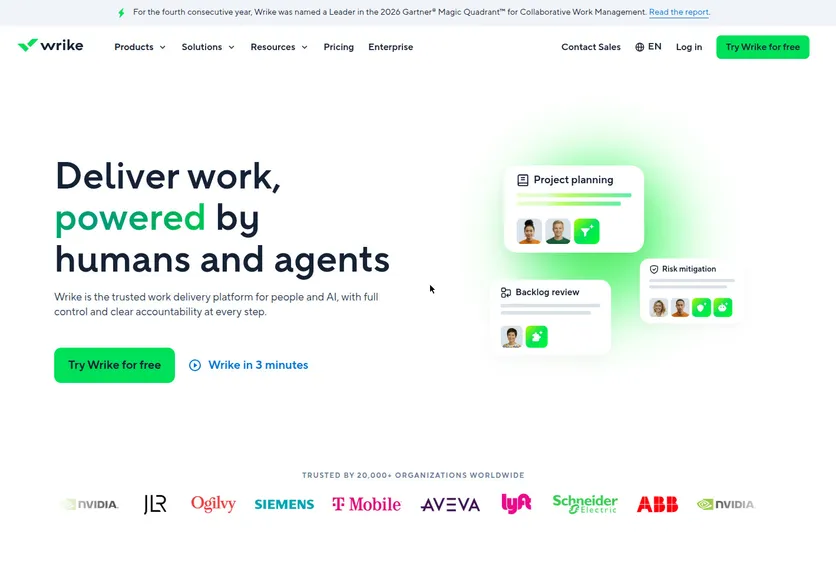
The Wrike Team plan costs ten dollars per user each month billed annually, and it is built for marketing teams that run campaigns across many channels and need one place to track every asset. A team can plan a launch, assign the brief, the design, and the copy, and watch the work move through approvals without a status meeting. The free plan covers basic task lists, but the Team plan is the first tier with the project views a marketing team actually needs.
What we like
- One place to track every asset across channels
- Approval workflows replace status meetings
- Strong reporting on campaign progress
Watch out for
- Team plan is the first tier with real project views
- Can feel heavy for a very small team
How to try it
- Set up a campaign project with brief, design and copy tasks
- Build an approval workflow for each asset
- Create a dashboard that shows every campaign status at a glance
2. Asana
Best for: Marketing teams that want timelines, dependencies and approvals
Paid tool Starting price: $10.99/user/month · Ten dollars and ninety-nine cents per user per month on the Starter plan billed annually; the monthly-billed rate is thirteen dollars and forty-nine cents
Free plan: Free Personal plan up to 2 users
At ten dollars and ninety-nine cents per user each month billed annually, Asana Starter gives a marketing team the timelines, boards, and approval workflows that keep campaigns on schedule. A team can plan a quarter of content, assign owners to each asset, and see at a glance which pieces are stuck in review. The free Personal plan covers up to two users, so a small team can test the platform before paying.

What we like
- Timelines and dependencies keep campaigns on schedule
- Approval workflows show what is stuck in review
- Free plan covers up to two users
Watch out for
- Starter is a step up in price from the cheapest tools here
- Reporting depth needs the higher tiers
How to try it
- Plan a quarter of content on a timeline
- Assign owners and deadlines to each asset
- Set up an approval workflow for design and copy
3. Monday.com
Best for: Marketing teams that want every campaign on one visual board
Paid tool Starting price: $9/seat/month · Nine dollars per seat per month on the Basic plan billed annually with a three-seat minimum; the monthly-billed rate is twelve dollars
Free plan: Free plan up to 2 seats
The Monday.com Basic plan costs nine dollars per seat each month billed annually, and it is the most visual tool on this list for a marketing team that wants to see every campaign on one board. A team can track assets from brief to publish, set deadlines, and automate status updates when a task moves. The three-seat minimum means a solo marketer pays for three seats, and the Basic plan lacks the automation depth of the higher tiers.

What we like
- Most visual board on this list
- Easy to read at a glance, even for non-marketers
- Automations keep statuses up to date
Watch out for
- Three-seat minimum means solo users overpay
- Basic plan lacks the automation depth of higher tiers
How to try it
- Build a board that tracks assets from brief to publish
- Set deadlines and owners for each campaign
- Turn on status automations for task moves
4. Smartsheet
Best for: Marketing teams that think in spreadsheets but need approvals and tracking
Paid tool Starting price: $9/member/month · Nine dollars per member per month on the Pro plan billed annually for one to ten members; the monthly-billed rate is twelve dollars
Free plan: No free plan, 30-day free trial
The Smartsheet Pro plan costs nine dollars per member each month billed annually, and it suits marketing teams that think in spreadsheets but need approvals, asset tracking, and reporting on top. A team can run a campaign calendar as a grid, attach creative files to each row, and route approvals without email chains. There is no free plan, only a thirty-day trial, and the interface feels like a spreadsheet, which some teams love and others do not.

What we like
- Spreadsheet feel that many teams already know
- Approvals and reporting on top of the grid
- Good fit for teams that plan in rows and columns
Watch out for
- No free plan, only a thirty-day trial
- Interface feels dated next to visual boards
How to try it
- Build a campaign calendar as a grid with owners and deadlines
- Attach creative files to each campaign row
- Set up an approval route for each asset
5. ClickUp
Best for: Marketing teams that want docs, tasks, timelines and dashboards together
Paid tool Starting price: $9/user/month · Nine dollars per user per month on the Core plan billed annually; the monthly-billed rate is twelve dollars
Free plan: Free plan
At nine dollars per user each month billed annually, ClickUp Core gives a marketing team docs, tasks, timelines, and dashboards in one place for the joint-lowest price on this list. A team can write the brief, assign the design, track the asset, and report on the campaign without leaving the platform. The free plan is generous, but the sheer number of features means a new team should expect a week of setup before the system feels natural.

What we like
- Docs, tasks, timelines and dashboards in one place
- Joint-lowest price on this list
- Generous free plan for small teams
Watch out for
- So many features that setup takes a week
- Interface can feel cluttered at first
How to try it
- Write the campaign brief as a doc in the same workspace
- Assign design and copy tasks with deadlines
- Build a dashboard that reports on every campaign
6. Airtable
Best for: Marketing teams that manage a large library of assets and campaigns
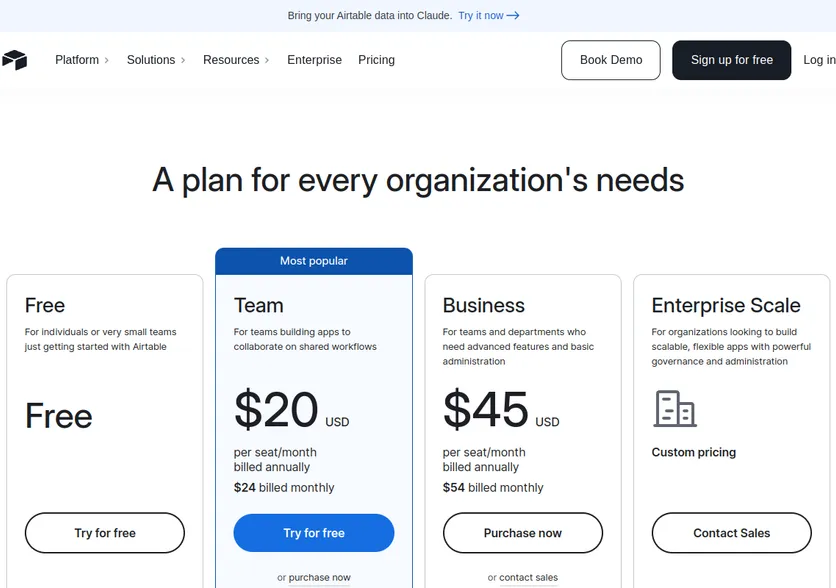
Paid tool Starting price: $20/seat/month · Twenty dollars per seat per month on the Team plan billed annually; the monthly-billed rate is twenty-four dollars
Free plan: Free plan
The Airtable Team plan costs twenty dollars per seat each month billed annually, and it is the most flexible tool on this list for a marketing team that manages a library of assets, campaigns, and channels. A team can build a content calendar as a grid, a kanban board, or a gallery, and link each asset to its campaign and owner. The price is the highest on this list, and the per-seat cost adds up fast for a large team.
What we like
- Most flexible views on this list
- Links assets to campaigns and owners
- Good fit for a large asset library
Watch out for
- Highest price on this list
- Per-seat cost adds up fast for a large team
How to try it
- Build a content calendar as a grid, board or gallery
- Link each asset to its campaign and owner
- Create filtered views for each channel and team
7. Notion
Best for: Marketing teams that want plans, briefs and assets in one workspace
Paid tool Starting price: $10/member/month · Ten dollars per member per month on the Plus plan billed annually; the monthly-billed rate is twelve dollars
Free plan: Free plan
The Notion Plus plan costs ten dollars per member each month billed annually, and it is the best choice on this list for a marketing team that wants its plans, briefs, and asset library in one flexible workspace. A team can write the campaign brief, track assets in a database, and publish the plan as a page the whole team can read. Full Notion AI is only on the Business plan, so a team that wants AI writing help should check that tier.

What we like
- Plans, briefs and assets in one flexible workspace
- Easy for the whole team to read and edit
- Free plan works for small teams
Watch out for
- Full AI features need the Business plan
- Needs setup to feel like a system, not a pile of pages
How to try it
- Write the campaign brief as a page the team can read
- Track assets in a database linked to each campaign
- Publish the plan so everyone sees the same version
Prices above were checked on each vendor’s own website on Nov 28, 2026 and can change — the vendor’s page is the final word. Vendor links are editorial: nobody paid to be listed or ranked here. Vendors who want a featured listing can see how it works on our Get listed page.
How a marketing team should set up resource management
Start with the brief, not the board. The highest-value habit for a marketing team is a single brief template that every campaign uses, with the goal, the audience, the owner, and the deadline in the same place. Next, build one asset library that everyone trusts, so nobody wastes an hour hunting for the latest logo or the approved product photo. Then set up an approval step that routes work to the right reviewer automatically, because email approvals are where campaigns stall. Track capacity honestly, so a team of four never plans six people’s worth of work in a week. Finally, review the board every Monday and close the loop on anything overdue, because a system nobody checks is just a prettier spreadsheet.
Before you buy
- Confirm the tool can track assets from brief to publish, not just tasks
- Check whether approvals route automatically to the right reviewer
- Make sure the price covers every seat, including occasional collaborators
- Ask if the tool has a real asset library or only file attachments
- Test the board view with a real campaign, because a demo board always looks tidy
Official websites
Official websites of the products reviewed above. Features and prices were checked against these sites when this guide was written, and they can change, so confirm on the vendor site before you buy.
Frequently asked questions
What is the best marketing resource management software for marketing teams?
Monday.com is the best overall choice for most marketing teams because it puts every campaign on one visual board that anyone can read at a glance, for nine dollars a seat a month billed annually. A team that wants deeper project tracking can choose Asana Starter at ten dollars and ninety-nine cents per user a month instead. The right pick depends on whether the team wants a visual board or a structured project system.
How much does marketing resource management software cost?
The tools in this list start at nine dollars per user a month for Monday.com Basic, Smartsheet Pro, and ClickUp Core. A mid-range setup costs ten dollars a month per user with Wrike Team or Notion Plus, or ten dollars and ninety-nine cents with Asana Starter. Airtable Team is the priciest at twenty dollars a seat a month, so a large team should price the full seat count before buying.
Do marketing teams need MRM software or just a project tool?
A project tool tracks tasks, but marketing resource management also tracks the assets, the approvals, and the capacity behind those tasks. A team that only tracks tasks still loses files, misses approvals, and overloads the same designer every week. The tools in this list combine both jobs, so the brief, the asset, and the deadline live in the same system.
Can MRM software stop campaigns from slipping?
Yes, and the biggest win is visibility: when every asset and its owner sit on one board, a stuck approval is obvious the day it stalls, not the week it misses the launch. A single brief template also stops the rework that comes from unclear goals. The key is discipline: the board only works if the team updates it every day, because a system nobody checks is just a prettier spreadsheet.
Is Monday.com or Asana better for a marketing team?
Monday.com is better for a team that wants a visual board anyone can read at a glance, with quick setup and colorful status tracking. Asana is better for a team that wants structured project timelines, dependencies, and approval workflows that scale across many campaigns. Monday.com Basic costs nine dollars a seat a month while Asana Starter costs ten dollars and ninety-nine cents per user a month, so Monday.com is the cheaper of the two.
Compare the seven tools above, then start with the free plan or trial on the one that matches how your team already plans campaigns before you pay for a full year.
Browse Marketing & Ads Calculators tools