On this page
Electronics brands live or die by their product data, because a wrong spec on one channel becomes a return on another. The seven tools below keep specs, images and prices consistent across stores, marketplaces and retailers. Plytix leads because its free Standard tier and visual product sheets make it the easiest place for an electronics brand to start at one hundred and forty-nine dollars a month for Pro, and the rest are ranked on catalogue depth, channel reach and value.
How we researched this
We checked every price against the vendor pricing page or a current November 2026 read on November 28, 2026, and only included tools with a published list price. Quote-only vendors, including Akeneo, Salsify, Stibo Systems and Informatica, publish no prices and are not in this list, and Struct PIM publishes euros only. Prices change, so confirm the current figure on the vendor site before you buy.
Compare the tools
| Name | Best for | Starting price | Free plan | |
|---|---|---|---|---|
| Plytix | Brands that want a friendly PIM with a free start | $149/month | Free plan (Standard, 100 SKUs) | Visit |
| Apimio | Brands that want a straightforward PIM with an API | $199/month | 14-day free trial | Visit |
| Pimcore | Brands that want an open-source PIM with enterprise depth | $9,900/year | Free plan (Community Edition) | Visit |
| Pimberly | Larger brands that need a proven enterprise PIM | $36,000/year | No free plan; free demo | Visit |
| JasperX PIM | Brands that want a guided PIM rollout | $999/month | 7-day free trial | Visit |
| KatanaPIM | Brands that want a focused PIM at a mid-range price | $399/month | No free trial | Visit |
| Sales Layer | Brands that want a PIM with strong channel syndication | $1,000/month | Demo on request | Visit |
The PIM software for electronics brands, compared
1. Plytix
Best for: Brands that want a friendly PIM with a free start
Paid tool Starting price: $149/month · One hundred and forty-nine dollars a month from for Pro; Standard starts free for up to one hundred SKUs and Enterprise starts at six hundred and ninety-nine dollars a month; the slider price rises with SKUs, with Pro at two hundred and sixty-nine dollars a month for two thousand SKUs; the Shopify connector and other modules are paid add-ons from forty-nine to three hundred and ninety-nine dollars; the Shopify App Store ladder disagrees, listing Pro at four hundred and ninety-nine dollars for fifty thousand SKUs, so confirm the SKU tier at checkout
Free plan: Free plan (Standard, 100 SKUs)
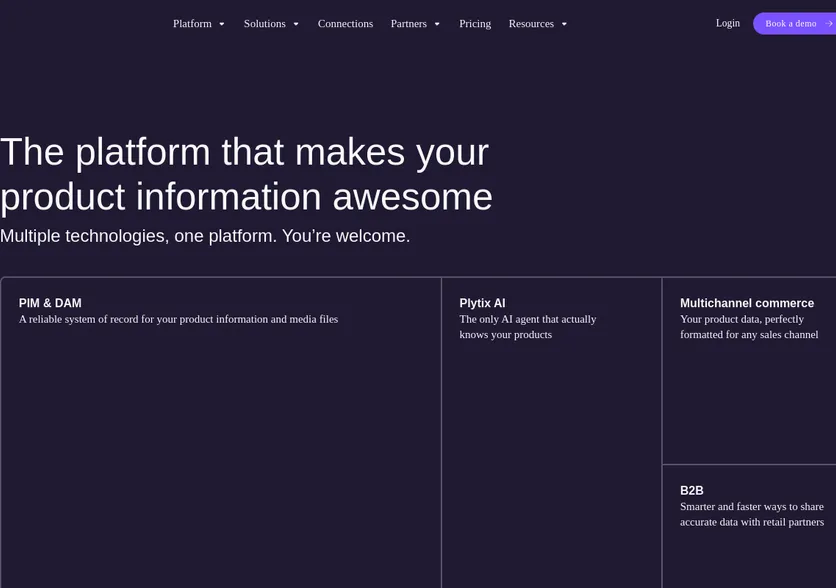
Electronics catalogues change fast, and this Plytix plan costs one hundred and forty-nine dollars a month from for Pro with a free Standard tier for small catalogues. Visual product sheets and digital asset management keep specs and images together. Channel feeds push the same data to every store and marketplace.
What we like
- Free Standard tier for small catalogues
- Visual product sheets and digital asset management built in
- Channel feeds for marketplaces and shops
Watch out for
- Price rises steeply with SKU count
- Shopify connector and key modules cost extra
How to try it
- Sign up for the free Standard plan and import the catalogue
- Enrich the products with attributes and images
- Connect the Shopify channel and publish the first feed
2. Apimio
Best for: Brands that want a straightforward PIM with an API
Paid tool Starting price: $199/month · One hundred and ninety-nine dollars a month for Basic PIM; Advanced is three hundred and ninety-nine dollars and Enterprise starts at nine hundred and ninety-nine dollars; Basic covers one store and ten thousand SKUs and Advanced covers fifty thousand SKUs with multi-store, feeds and API; one January 2026 Shopify review claims the listed prices are wrong, so confirm at checkout
Free plan: 14-day free trial
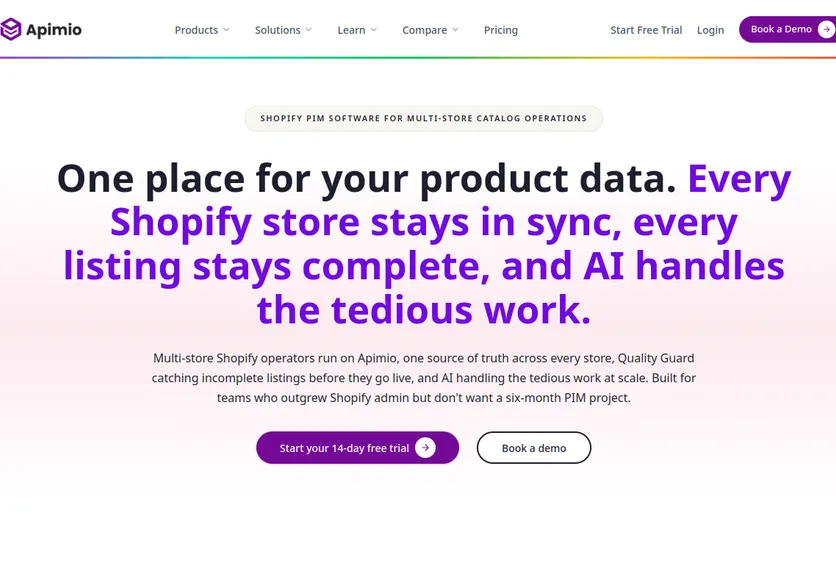
An electronics brand that sells through several channels needs one source of truth, and this Apimio plan costs one hundred and ninety-nine dollars a month for Basic PIM with one store and ten thousand SKUs. The API and channel feeds on Advanced cover multi-store selling. A fourteen-day free trial lets the team test the import first.
What we like
- Clear tiered pricing with a free trial
- API and channel feeds on the Advanced tier
- Multi-store support for growing brands
Watch out for
- Basic tier is limited to one store
- One review disputes the listed prices
How to try it
- Start the trial and import the product catalogue
- Set up the attributes and categories for each channel
- Connect the store and publish the first product feed
3. Pimcore
Best for: Brands that want an open-source PIM with enterprise depth
Paid tool Starting price: $9,900/year · Nine thousand nine hundred dollars a year for Professional; Enterprise is twenty-nine thousand nine hundred dollars a year and the platform-as-a-service option starts at thirty-nine thousand nine hundred dollars a year; the Community Edition is free and open source; the licence fee stays flat as the catalogue grows
Free plan: Free plan (Community Edition)
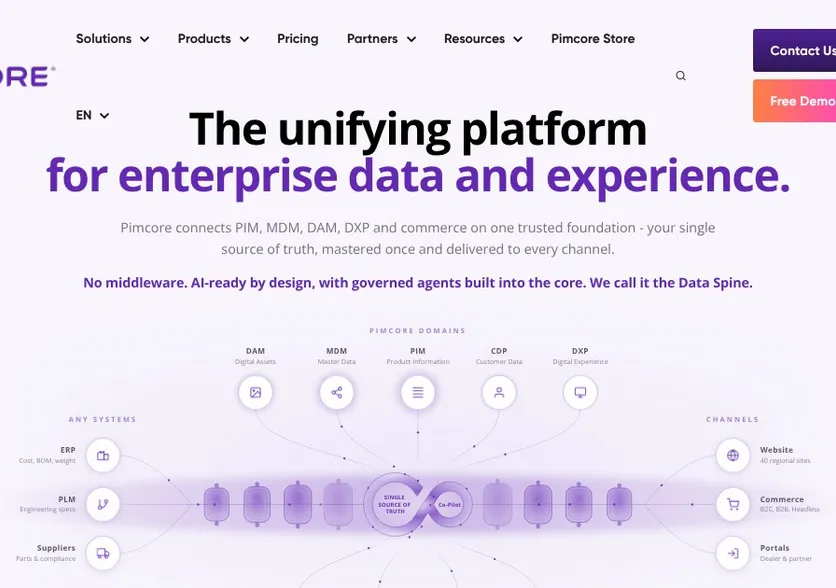
Electronics brands with big catalogues and developers on staff should look here, because this Pimcore plan costs nine thousand nine hundred dollars a year for Professional with PIM, DAM, CMS and commerce in one platform. The free Community Edition lets the team test the model before paying. The licence fee stays flat as the catalogue grows.
What we like
- Free Community Edition to start and test
- PIM, DAM, CMS and commerce in one platform
- Flat licence fee as the catalogue grows
Watch out for
- Needs developers to run well
- Enterprise pricing is a big jump from Community
How to try it
- Install the Community Edition and import the catalogue
- Model the product attributes and categories
- Connect the storefront and publish the enriched products
4. Pimberly
Best for: Larger brands that need a proven enterprise PIM
Paid tool Starting price: $36,000/year · Thirty-six thousand dollars a year for Regular, covering fifty thousand SKUs, twenty users and three terabytes with DAM included; Pro is sixty thousand dollars and Corporate is ninety thousand dollars a year and Enterprise is by quote; AI add-ons start at around seven thousand five hundred dollars a year
Free plan: No free plan; free demo
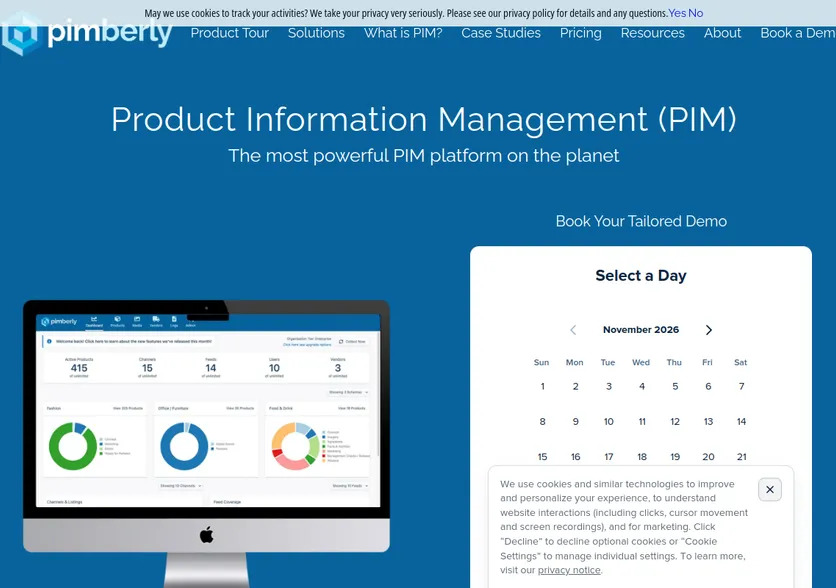
A large electronics brand needs a PIM that has done this before, and this Pimberly plan costs thirty-six thousand dollars a year for Regular covering fifty thousand SKUs, twenty users and three terabytes with DAM included. Workflow and approval tools keep big teams from publishing bad data. The onboarding team handles the migration.
What we like
- Built for large catalogues with DAM included
- Strong workflow and approval tools
- Experienced onboarding team for big migrations
Watch out for
- High entry price for smaller brands
- No free plan or trial
How to try it
- Book a demo and map the catalogue size to the Regular tier
- Plan the data migration with the onboarding team
- Set up the workflows and publish the first channel feed
5. JasperX PIM
Best for: Brands that want a guided PIM rollout
Paid tool Starting price: $999/month · Nine hundred and ninety-nine dollars a month for Growth with two sales channels and five hours of onboarding; Professional is one thousand nine hundred and ninety-nine dollars a month with eight channels and Enterprise is custom; Venzee bought the business on December 31, 2025 and the company is now JasperX
Free plan: 7-day free trial
A brand that wants help getting the PIM live will like this JasperX PIM plan, which costs nine hundred and ninety-nine dollars a month for Growth with two sales channels and five hours of onboarding. Multi-channel publishing runs from one catalogue. The company changed hands at the end of 2025 and is now JasperX.
What we like
- Onboarding hours included on every paid tier
- Multi-channel publishing from one catalogue
- Clear per-channel tier structure
Watch out for
- Growth tier covers only two channels
- Ownership change is recent, so the brand is in transition
How to try it
- Start the trial and import the product data
- Use the onboarding hours to model the catalogue
- Connect the first two channels and publish the products
6. KatanaPIM
Best for: Brands that want a focused PIM at a mid-range price
Paid tool Starting price: $399/month · Three hundred and ninety-nine dollars a month starting price, as listed by independent software directories including SourceForge and Slashdot; the vendor publishes no price on its own site, so confirm the figure with the vendor before buying
Free plan: No free trial
Mid-size electronics brands get a focused PIM here, since this KatanaPIM plan costs three hundred and ninety-nine dollars a month starting price as listed by independent software directories. Validation flags missing data before it reaches a channel. The vendor publishes no price itself, so confirm the figure before buying.
What we like
- Single source of truth for product data
- Channel-specific content for each sales channel
- Validation flags missing data before publishing
Watch out for
- Price is directory-reported, not vendor-published
- No free trial or free tier
How to try it
- Book a demo and import a sample of the catalogue
- Set up the attributes and validation rules
- Connect the first channel and publish the enriched products
7. Sales Layer
Best for: Brands that want a PIM with strong channel syndication
Paid tool Starting price: $1,000/month · One thousand dollars a month starting price, as listed by independent software directories including SourceForge; the vendor publishes no price on its own site and one comparison lists Sales Layer as quote-only, so confirm the figure with the vendor before buying
Free plan: Demo on request
Electronics brands that syndicate to many retailers need strong connectors, and this Sales Layer plan costs one thousand dollars a month starting price as listed by independent software directories. Workflow and approval tools suit large teams. The vendor publishes no price itself, so confirm the figure with the vendor.
What we like
- Strong connectors for marketplaces and retailers
- Workflow and approval tools for large teams
- Digital asset management included
Watch out for
- Price is directory-reported, not vendor-published
- Entry cost is high for smaller brands
How to try it
- Book a demo and map the channels the brand sells through
- Import the catalogue and set up the enrichment workflow
- Publish the first product feed to a marketplace or store
Prices above were checked on each vendor’s own website on Nov 28, 2026 and can change — the vendor’s page is the final word. Vendor links are editorial: nobody paid to be listed or ranked here. Vendors who want a featured listing can see how it works on our Get listed page.
How to choose a PIM for an electronics brand
Start with the catalogue, not the demo, because an electronics brand with ten thousand SKUs and a hundred attributes per product will break a tool built for simple shops. Map the attributes first, including the specs, the variants and the compliance fields, and check the tool can model them all. Count the channels, since every store, marketplace and retailer needs its own feed. Test the import with a real slice of the catalogue, including the messy rows. Check the price against the SKU tier, because the headline rate rarely covers a full catalogue.
Before you buy
- Confirm the tool can model the attributes, variants and specs your products actually have
- Check whether the price covers your SKU count or jumps sharply at the next tier
- Ask if the connectors you need are included or sold as paid modules
- Make sure the enrichment workflow flags missing data before it reaches a channel
- Test the import with a real slice of your catalogue, including the messy rows
Official websites
Official websites of the products reviewed above. Features and prices were checked against these sites when this guide was written, and they can change, so confirm on the vendor site before you buy.
Frequently asked questions
What is the best PIM software for electronics brands?
Plytix is the best overall pick for electronics brands, because its free Standard tier and visual product sheets make it the easiest place to start, with Pro from one hundred and forty-nine dollars a month. Apimio is the best value at one hundred and ninety-nine dollars a month with an API and channel feeds. Pimcore is the best open-source choice with a free Community Edition and Professional at nine thousand nine hundred dollars a year.
How much does PIM software cost for an electronics brand?
PIM prices in this list range from free to thirty-six thousand dollars a year. Plytix Pro starts at one hundred and forty-nine dollars a month, Apimio Basic costs one hundred and ninety-nine dollars a month, and KatanaPIM starts at three hundred and ninety-nine dollars a month. Enterprise options such as Pimcore Professional at nine thousand nine hundred dollars a year and Pimberly Regular at thirty-six thousand dollars a year suit larger catalogues.
Can electronics brands use a PIM for free?
Yes, with limits. Plytix Standard is free for up to one hundred SKUs, and Pimcore Community Edition is free and open source with no SKU cap. Both suit a small brand testing a PIM or a team proving the model before buying. A brand with thousands of SKUs will outgrow the free tiers quickly and should budget for a paid plan that covers the full catalogue.
What is the difference between Plytix and Pimcore?
Plytix is a hosted PIM with a free tier and a friendly interface, built for brands that want to start fast without developers. Pimcore is an open-source platform with PIM, DAM, CMS and commerce in one system, built for brands with developers and large catalogues. Plytix Pro starts at one hundred and forty-nine dollars a month, while Pimcore Professional costs nine thousand nine hundred dollars a year. Choose Plytix for speed and Pimcore for depth.
Why do electronics brands need a PIM?
Electronics brands sell the same product through many channels, and each channel needs the same specs, images and prices. A spreadsheet cannot keep that consistent, so a wrong spec on one channel becomes a return on another. A PIM holds the master data once and publishes it everywhere, with validation that flags missing fields before they reach a customer. The result is fewer returns, faster launches and cleaner listings.
Compare the seven tools above, then start with a free trial or the free Plytix plan on the tool that matches how the brand already manages product data before paying for a full year.
Browse Business Tools tools