On this page
Ecommerce brands pay sellers across channels, affiliates and marketplaces, and spreadsheets fall apart the moment plans get complicated. The eight tools below calculate commissions automatically, show sellers what they have earned and keep finance in control of payouts. Sales Cookie leads because it publishes its price, bills monthly with no contract and configures the first plan free at forty dollars per user a month, and the rest are ranked on price, transparency and fit for an online store.
How we researched this
We checked every price on the vendor pricing page or in multiple agreeing November 2026 reads, and only included tools with a published US dollar list price. The big enterprise platforms, including Xactly, Varicent, CaptivateIQ, Performio, Anaplan and Everstage, sell by quote only, so they are not in this list. Prices change, so confirm the current figure on the vendor site before you buy.
Compare the tools
| Name | Best for | Starting price | Free plan | |
|---|---|---|---|---|
 Sales Cookie | Small teams that want monthly billing and no contract | $40/user/month | 14-day free trial | Visit |
 QuotaPath | Mid-market teams that want transparent pricing | $35/user/month | 14-day free trial | Visit |
 QCommission | QuickBooks and Salesforce shops on a budget | $17/user/month | No free plan; free demo | Visit |
 Salesforce Spiff | Salesforce shops that want live earnings visibility | $75/user/month | Free trial | Visit |
 Core Commissions | Teams that want reporting first at a low per-payee rate | $10/payee/month | 30-day free trial | Visit |
| Kennect | Teams that want nudges and motivation built in | $20/user/month | Free demo | Visit |
| Palette | Transaction and usage-based businesses | $590/month | Free demo | Visit |
| Commissionly | Small teams that want flat monthly pricing | $75/month | Free trial | Visit |
The sales commission software for ecommerce brands, compared
1. Sales Cookie
Best for: Small teams that want monthly billing and no contract
Paid tool Starting price: $40/user/month · Forty dollars per user a month on Business, billed monthly with no contract; dashboard-disabled seats are $15 and Business+ is $60; volume discounts available; first plan configured free
Free plan: 14-day free trial
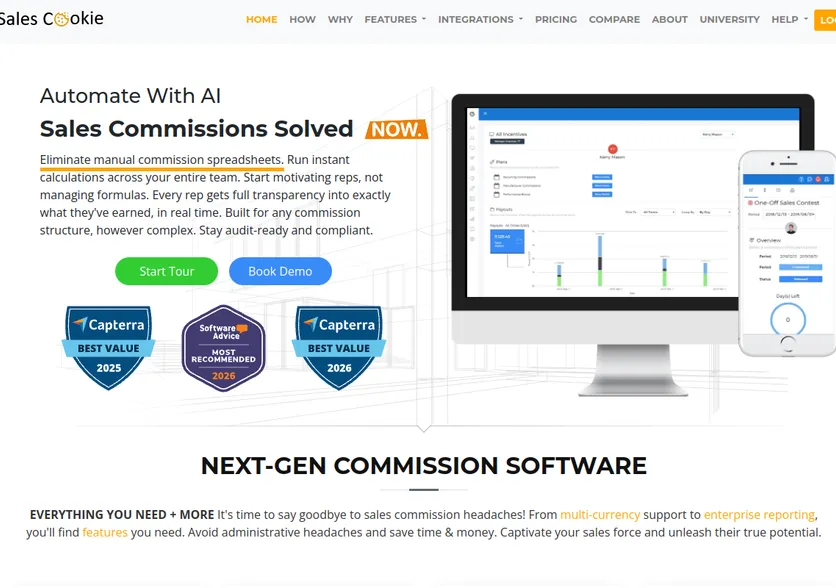
For an ecommerce brand that pays affiliates and marketplace sellers on different plans, this Sales Cookie plan costs forty dollars per user a month and bills monthly with no contract at all. It calculates tiered rates, splits and clawbacks across channels, then shows every seller a dashboard with the earnings they can trust. The vendor configures the first plan free, so the shop is not left guessing at the setup.
What we like
- Full price list published with no sales call needed
- Monthly billing with no long-term commitment
- First commission plan configured free by the vendor
Watch out for
- Business plan needs at least ten users for the free configuration hours
- AI assistants are a newer addition, so check them on the trial
How to try it
- Connect the CRM or upload the sales data
- Design the plan with the vendor's free first-plan setup
- Let reps check their own dashboards and statements
2. QuotaPath
Best for: Mid-market teams that want transparent pricing
Paid tool Starting price: $35/user/month · Thirty-five dollars per user a month on Growth plus a $525 a month platform fee that covers the first five users, billed annually; Premium is $50 a user a month plus an $800 platform fee; Strategic is quote-only
Free plan: 14-day free trial
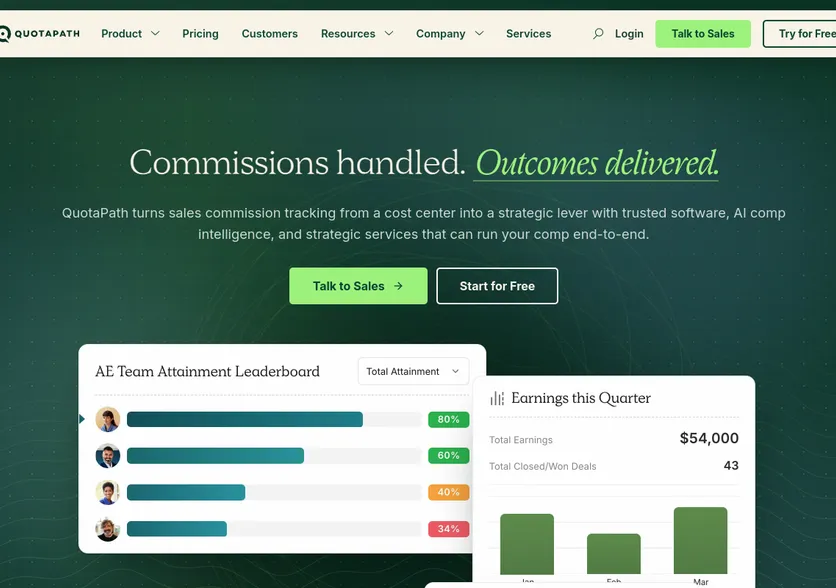
An ecommerce team that wants the price on the page before the sales call gets it here, since this QuotaPath plan costs thirty-five dollars per user a month plus a monthly platform fee. Growth covers unlimited plans, ASC 606 accounting and leaderboards, and the platform fee includes implementation and a dedicated account team. It is the most predictable bill in this guide for a brand scaling past spreadsheets.
What we like
- Only major commission vendor with a fully published rate card
- Plans are written so reps can actually read them
- Implementation and support are inside the platform fee
Watch out for
- The platform fee makes tiny teams pay more than the seat rate suggests
- Premium tier is sold through a sales conversation, not self-serve
How to try it
- Connect Salesforce or HubSpot and import the team
- Build the plan with the AI plan builder and sign-offs
- Run payouts and let reps track earnings in the app
3. QCommission
Best for: QuickBooks and Salesforce shops on a budget
Paid tool Starting price: $17/user/month · Seventeen dollars per payee a month on Pro (minimum $200 a month); Premier is $25 a payee a month and Enterprise is $39; older directory listings showing $45 or $50 a user a month conflict with the current vendor page
Free plan: No free plan; free demo
A brand watching every dollar of software spend finds the cheapest dedicated option here, because this QCommission plan costs seventeen dollars per payee a month on Pro. It handles flat, tiered and quota-based plans and plugs into Salesforce and QuickBooks, which covers most ecommerce stacks. The trade-off is a dated interface, so budget an afternoon to learn it.

What we like
- Lowest entry price of any dedicated commission tool here
- Handles flat, tiered, quota-based and split plans
- Long-running vendor with Salesforce and QuickBooks connectors
Watch out for
- Interface draws dated-UI comments from reviewers
- No free trial, so judge it from the demo
How to try it
- Import sales data from the CRM or accounting system
- Set up the plan rules for tiers, quotas and splits
- Run the calculation and send each rep a statement
4. Salesforce Spiff
Best for: Salesforce shops that want live earnings visibility
Paid tool Starting price: $75/user/month · Seventy-five dollars per user a month billed annually; connectors to systems outside Salesforce cost extra (about $250 a month each in vendor reads); Premium Support adds about 30 percent
Free plan: Free trial
For a brand already running on Salesforce, this Salesforce Spiff plan costs seventy-five dollars per user a month billed annually and puts earnings in front of every seller in real time. Plans handle splits, accelerators and approvals, and the audit trail keeps finance calm at payout time. It is the premium pick here, and the price shows it.
What we like
- Real-time earnings visibility keeps sellers motivated
- Plan builder handles complex, tiered commission rules
- Audit trails and approvals keep finance comfortable
Watch out for
- Deepest value inside the Salesforce ecosystem
- Outside connectors add a monthly fee per system
How to try it
- Connect Spiff to the CRM and import the sales data
- Build the commission plan with tiers, splits and accelerators
- Publish the plan so sellers see earnings update in real time
5. Core Commissions
Best for: Teams that want reporting first at a low per-payee rate
Paid tool Starting price: $10/payee/month · Ten dollars per payee a month on Reporter, billed annually in advance, with a 15-payee minimum; Launch is $20 and Enterprise is $35 per payee a month; Managed Services adds $5 per payee
Free plan: 30-day free trial
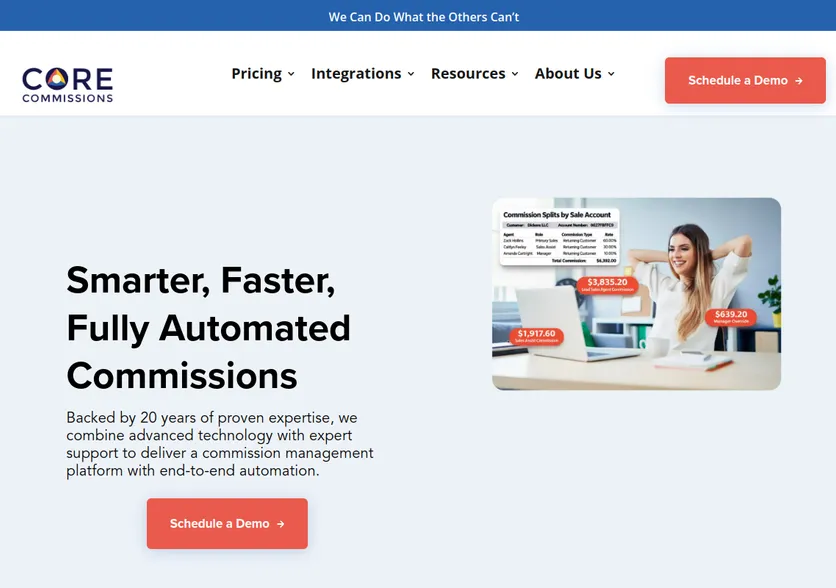
An ecommerce finance team that lives in reports will like this option, since this Core Commissions plan costs ten dollars per payee a month on Reporter billed annually. The drag-and-drop analytics drill from a payout total down to a single order in seconds, and each rep gets an emailed payment detail report. Watch the fifteen-payee minimum, which makes small teams pay for seats they do not use.
What we like
- Lowest per-payee list price in this comparison
- Drag-and-drop analytics with fast drill-downs
- Rep portal emails each person their own payment detail
Watch out for
- Every tier carries a 15-payee minimum, so small teams overpay
- Launch includes only five rules, then $0.50 per extra rule
How to try it
- Import transactions from the CRM or accounting system
- Design the rules in the self-setup rule designer
- Run the calculation and email statements to each payee
6. Kennect
Best for: Teams that want nudges and motivation built in
Paid tool Starting price: $20/user/month · Twenty dollars per user a month on Basic, billed annually; source-system integrations sit on the quote-only Enterprise tier, so CRM sync is not in the entry price
Free plan: Free demo
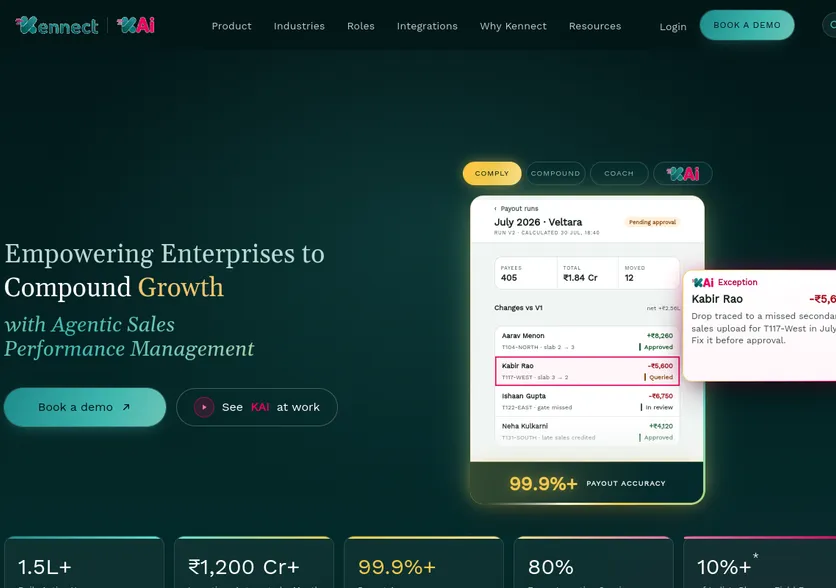
A growing ecommerce team that wants reps to stay motivated between payouts gets nudges here, because this Kennect plan costs twenty dollars per user a month on Basic. It builds and automates incentive plans, then sends intelligent nudges based on where each seller stands against target. The catch is that CRM integrations sit on the quote-only Enterprise tier.
What we like
- Intelligent nudges keep reps focused on the next deal
- Transparent per-user pricing with no platform fee
- Setup is quick for standard incentive plans
Watch out for
- CRM integrations need the quote-only Enterprise tier
- Fewer native connectors than the bigger platforms
How to try it
- Import the team and set up the incentive plans
- Turn on nudges for the behaviours the plan rewards
- Track attainment on the leaderboard and pay out monthly
7. Palette
Best for: Transaction and usage-based businesses
Paid tool Starting price: $590/month · Five hundred and ninety dollars a month on Starter for up to 15 seats, billed annually ($790 month to month); Scale is $1,110 a month for up to 30 seats; Enterprise is custom; implementation is quoted separately
Free plan: Free demo
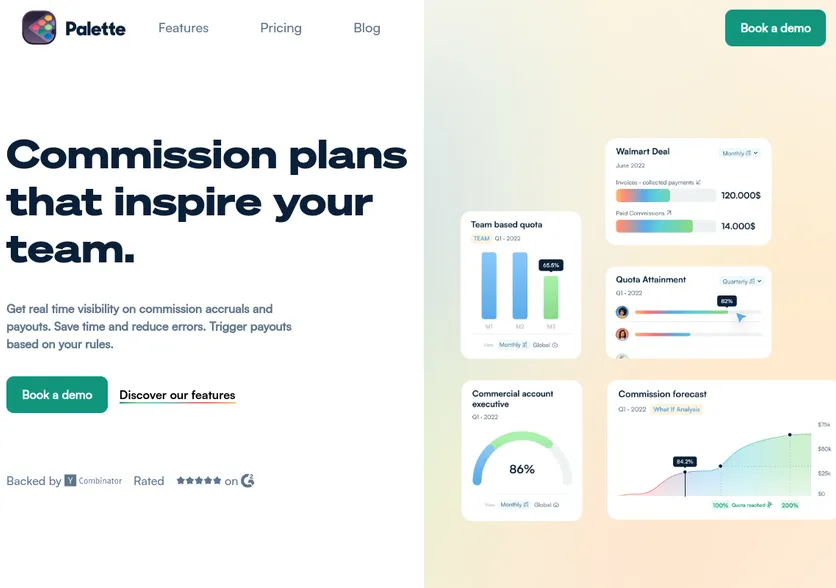
For an ecommerce brand paid per transaction rather than per seat, this Palette plan costs five hundred and ninety dollars a month on Starter for up to fifteen seats. It was built for transaction and usage-based models, so commissions accrue in real time as orders land and reps watch their own dashboards. Plan A/B testing lets finance compare two designs before committing to one.
What we like
- Built natively for transaction and usage-based models
- Real-time accruals show what is owed before payout
- Plan A/B testing compares compensation designs side by side
Watch out for
- Flat seat bands mean a ten-seat team pays for fifteen
- Scale caps at 30 seats, then the price is custom
How to try it
- Connect Stripe, Chargebee or the CRM as the source
- Design the plan and test it against past deals
- Publish dashboards so reps see earnings as they accrue
8. Commissionly
Best for: Small teams that want flat monthly pricing
Paid tool Starting price: $75/month · Seventy-five dollars a month on Individual for one user; Small Business is $200 a month for five users and Medium Business is $350 a month for ten users; directories quote $15 to $33 per user a month, which conflicts with the vendor flat tiers
Free plan: Free trial
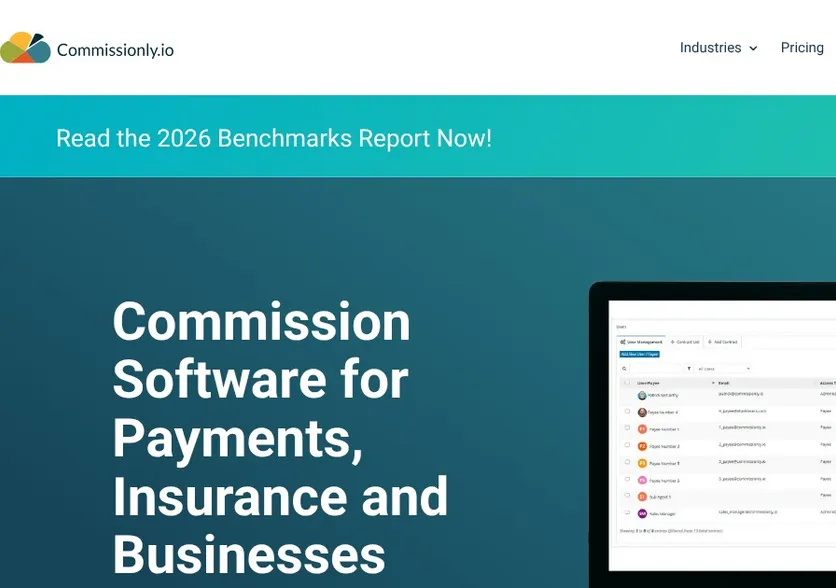
A small ecommerce team that wants a flat bill it can predict will find it here, since this Commissionly plan costs seventy-five dollars a month on Individual for one user. It automates calculations with a simple interface, supports stepped commissions and splits, and includes a report builder from the mid tier. The flat tiers mean a one-user shop still pays the full seventy-five dollars.
What we like
- Flat monthly tiers make the bill easy to predict
- Report builder and splits included from the mid tier
- Simple interface that small teams learn fast
Watch out for
- Flat tiers mean a one-user team still pays $75 a month
- HubSpot integration is CSV import only for now
How to try it
- Upload sales data manually or through the API
- Build the commission plan with tiers and bonus payments
- Generate statements and pay reps from the same screen
Prices above were checked on each vendor’s own website on Nov 28, 2026 and can change — the vendor’s page is the final word. Vendor links are editorial: nobody paid to be listed or ranked here. Vendors who want a featured listing can see how it works on our Get listed page.
How to move commissions off spreadsheets without breaking payouts
Start with one sales channel and one plan, not the whole business at once, because a single clean migration teaches the team more than a big-bang switch. Map every plan rule on paper first, including tiers, splits, clawbacks and draw, then build it in the tool and run last month's numbers through it side by side with the spreadsheet. Check that each seller's statement matches the old maths before anyone is paid from the new system, and keep the spreadsheet running for one more cycle as a safety net. Train sellers on their own dashboard early, since most disputes vanish when reps can see the calculation themselves.
Before you buy
- Confirm the tool handles the plan structures the store actually uses, including tiers, splits, clawbacks and multi-channel rates
- Check whether seller dashboards update in real time or only after a manual calculation run
- Ask if the price is per user, per payee or a flat monthly tier, and what the minimum seat count is
- Make sure the tool connects to the CRM and accounting system the store already runs on
- Test the tool on last month's real sales data before paying, and compare every statement with the spreadsheet
Official websites
Official websites of the products reviewed above. Features and prices were checked against these sites when this guide was written, and they can change, so confirm on the vendor site before you buy.
Frequently asked questions
What is sales commission software for ecommerce brands?
It is software that calculates what each seller, affiliate or channel partner has earned from online sales, then produces statements and payout files finance can trust. Good tools handle tiered rates, splits, clawbacks and multi-channel plans, and they give every seller a dashboard showing earnings in real time. The aim is to replace spreadsheets that break the moment a plan changes.
How much does Sales Cookie cost?
Sales Cookie costs forty dollars per user a month on Business, billed monthly with no contract. Dashboard-disabled seats cost fifteen dollars, and Business+ costs sixty dollars a month for larger teams. There is a fourteen-day free trial with all features, and the vendor configures the first commission plan free, which removes the usual setup cost.
Why do most commission tools not publish prices?
Most enterprise commission vendors sell by quote because the price depends on payee count, plan complexity and integrations, so a list price would mislead buyers. Only a handful, including QuotaPath, Sales Cookie, QCommission and Core Commissions, publish real rates. That is why this guide only lists tools with a price a buyer can actually read.
Can a small ecommerce brand use commission software?
Yes. QCommission costs seventeen dollars a payee a month and handles the flat and tiered plans a small brand uses, while Sales Cookie at forty dollars a user a month adds dashboards and monthly billing with no contract. Both are built for teams leaving spreadsheets, and neither needs a sales call to get started.
Which tool is best for an ecommerce brand on Salesforce?
Salesforce Spiff is the best pick for a Salesforce shop, at seventy-five dollars per user a month billed annually, because commissions calculate inside the CRM sellers already use and earnings update in real time. The trade-off is price plus extra fees for connectors outside Salesforce. A brand that is not on Salesforce should start with Sales Cookie or QuotaPath instead.
Compare the eight tools above, then start with a free trial on the one that matches how the store already sells before paying for a full year.
Browse Business Tools tools