On this page
An AI database has to store embeddings and answer similarity questions in milliseconds, which is a different job from a normal database. The eight tools below run from eight dollars a month for a small document cluster to a hundred and twenty-six dollars a month for a dedicated vector cluster, and every price was checked on the vendor site on November 26, 2026. Most charge by storage and queries rather than by seat, so the bill follows usage. Pinecone is our first pick — fully managed vector search from twenty dollars a month flat.
How we researched this
We started with the AI databases businesses actually run for search and retrieval features, then read each price on the vendor pricing page on November 26, 2026 and noted the free tier each one carries. We judged them for a team that needs vector search in production without hiring a database specialist. We kept only tools with a published price and dropped usage-only services with no flat entry price, plus quote-only enterprise database platforms.
Compare the tools
| Name | Best for | Starting price | Free plan | |
|---|---|---|---|---|
 Pinecone | Teams that want managed vector search with no servers to run | $20/month | Free Starter plan with 2 GB of storage | Visit |
 Weaviate | Teams that need keyword search and vector search in one store | $45/month | Free cloud plan with 100,000 objects | Visit |
 Qdrant | Teams that want an open source engine with a free managed cluster | $25/month | Free 1 GB cloud cluster | Visit |
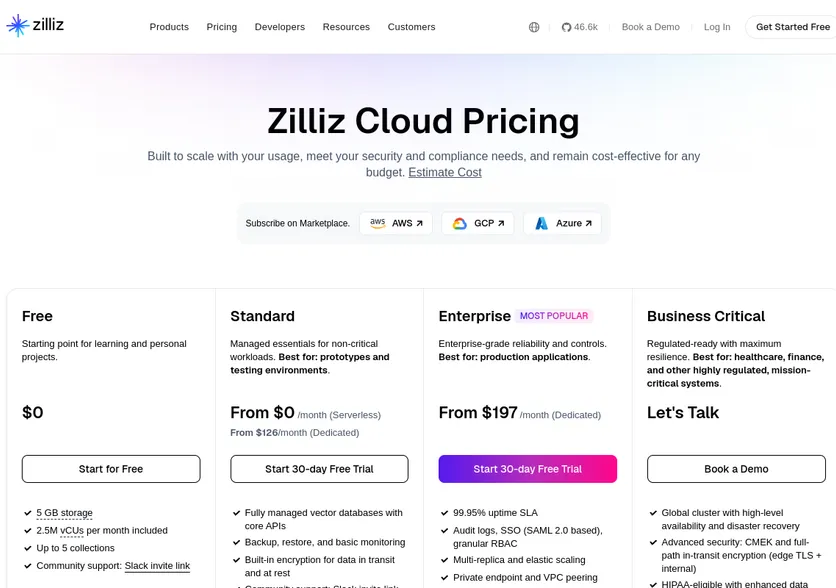
 Zilliz Cloud | Teams running Milvus at very large scale with billions of vectors | $126/month | Free serverless tier | Visit |
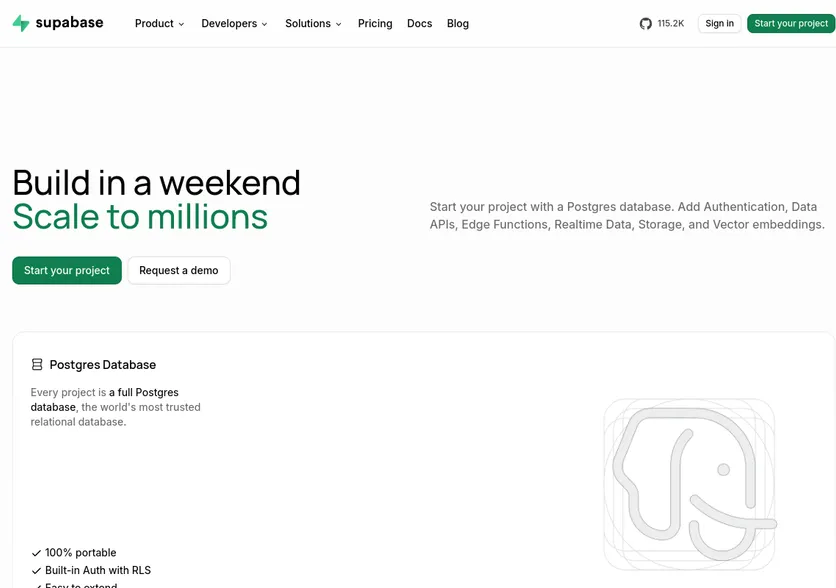
 Supabase | Teams whose data already lives in Postgres and need vector search inside it | $25/month | Free plan with 500 MB of storage | Visit |
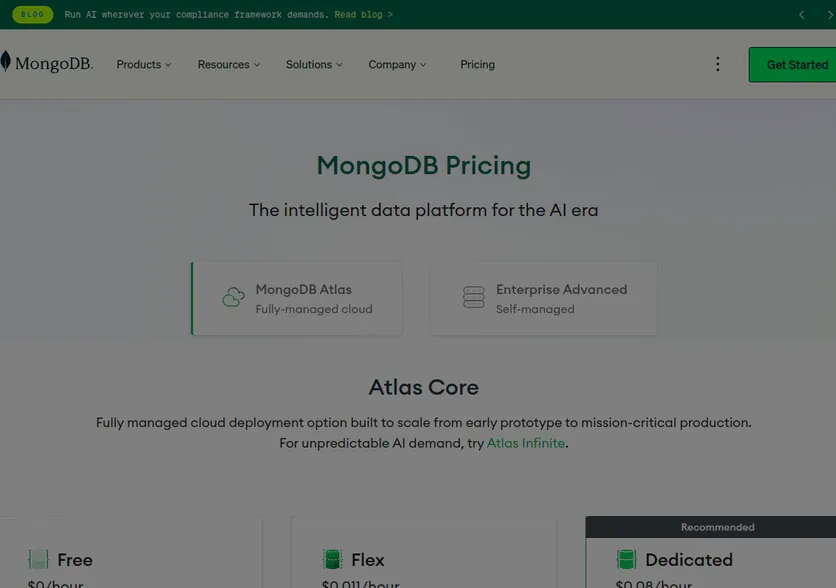
 MongoDB Atlas | Teams adding AI search to existing MongoDB workloads | $8/month | Free M0 cluster with 512 MB | Visit |
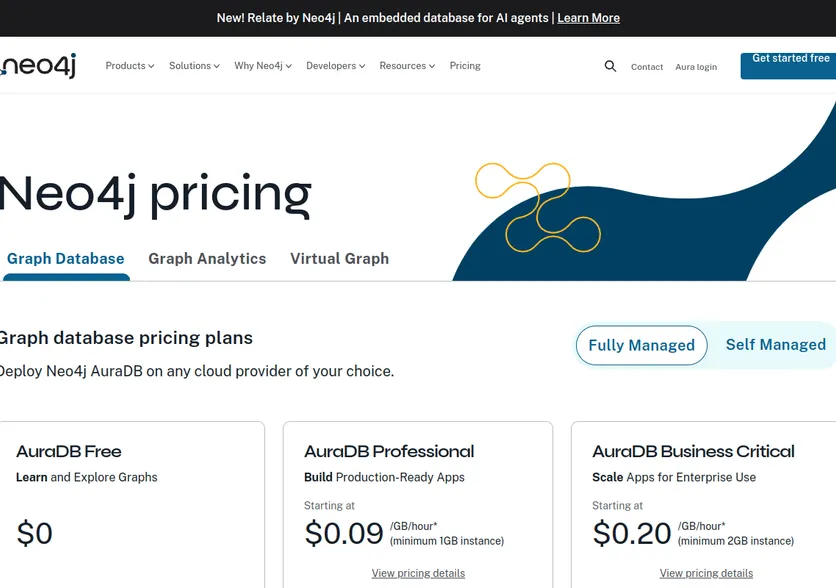
 Neo4j AuraDB | Teams building knowledge graphs where relationships matter as much as records | $65/month | Free tier with 200,000 nodes | Visit |
 Elastic Cloud | Teams that need full-text search, vector search and analytics in one platform | $99/month | 14-day free trial | Visit |
The AI databases for businesses, compared
1. Pinecone
Best for: Teams that want managed vector search with no servers to run
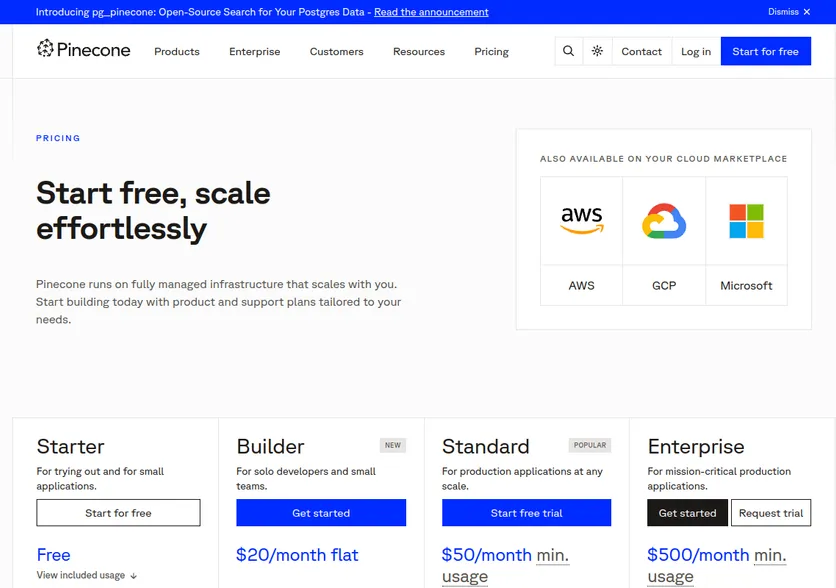
Paid tool Starting price: $20/month · Builder plan, $20 a month flat; free Starter plan covers 2 GB of storage; Standard has a $50 a month minimum and bills by usage
Free plan: Free Starter plan with 2 GB of storage
Pinecone is the managed-only vector database, so there is no cluster to size, patch or scale by hand. This Pinecone Builder plan gives a small app ten gigabytes of storage and a fixed monthly bill, while the free Starter plan covers two gigabytes for a prototype. A team shipping a search feature can index embeddings in an afternoon and never touch infrastructure.
What we like
- Fully managed with no servers to run
- Flat 20 dollar Builder plan for small apps
- Free Starter plan with 2 GB of storage
Watch out for
- Read-heavy apps pay more per million read units
- Standard plan bills by usage with a 50 dollar minimum
How to try it
- Open the Pinecone pricing page and create a free Starter account
- Create a serverless index and upload a sample embedding set
- Run similarity queries and watch the read and write usage
2. Weaviate
Best for: Teams that need keyword search and vector search in one store
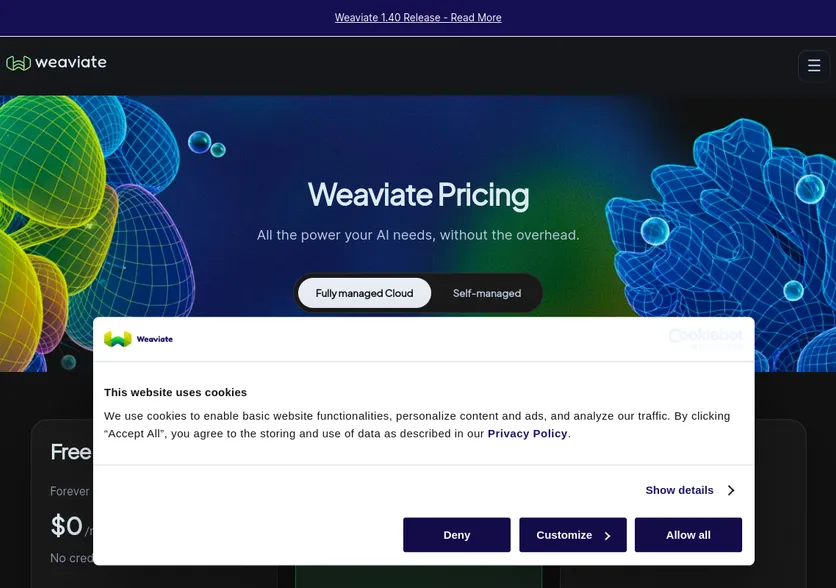
Paid tool Starting price: $45/month · Flex plan from $45 a month; free cloud plan covers 100,000 objects
Free plan: Free cloud plan with 100,000 objects
Weaviate stores objects and their embeddings together, so one query can mix keyword matching with vector similarity. This Weaviate Flex plan runs a managed cluster with hybrid search and built-in embedding modules, while the open source engine can be self-hosted free. A team building retrieval for support docs gets keyword and semantic results from a single store.
What we like
- Hybrid keyword plus vector search in one query
- Built-in embedding and reranker modules
- Open source engine can be self-hosted free
Watch out for
- Flex starts at 45 dollars a month
- Free cluster is capped at 100,000 objects
How to try it
- Open the Weaviate pricing page and start a free cloud cluster
- Import a sample collection with text and embeddings
- Run a hybrid query and compare it with a pure vector query
3. Qdrant
Best for: Teams that want an open source engine with a free managed cluster
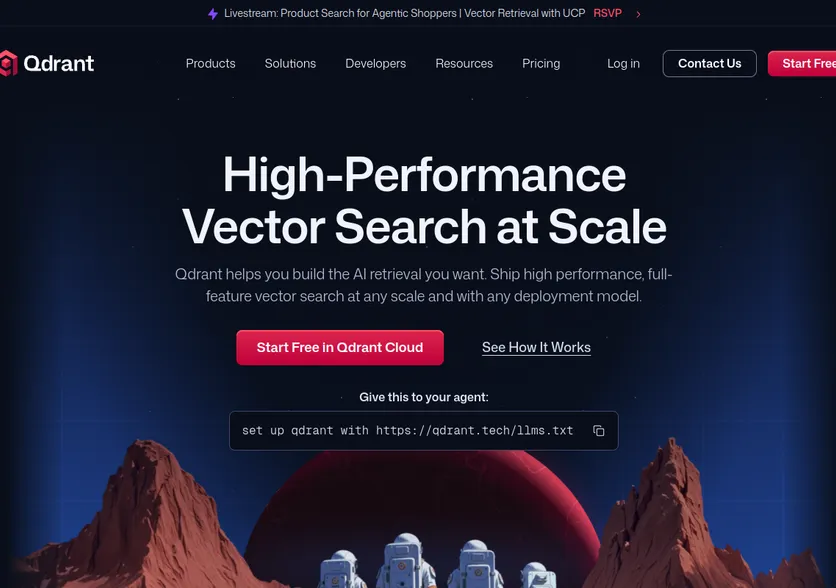
Paid tool Starting price: $25/month · Smallest paid cloud cluster from $25 a month; a free 1 GB cluster is available; larger clusters bill by RAM and usage
Free plan: Free 1 GB cloud cluster
Qdrant is a Rust vector engine built for low latency and precise filtering, and its cloud service starts with a genuinely free cluster. This Qdrant paid cloud plan adds a larger cluster with the same engine, plus quantization that shrinks storage without hurting recall much. A team that needs fast filtered search on millions of vectors gets strong recall per dollar here.
What we like
- Free 1 GB cloud cluster with no time limit
- Open source under Apache 2.0
- Quantization cuts storage costs sharply
Watch out for
- Paid clusters start at 25 dollars a month
- Managed pricing rises with RAM, not just vectors
How to try it
- Open the Qdrant pricing page and create a free cloud cluster
- Upload a sample vector set and test filtered queries
- Turn on quantization and compare recall against storage saved
4. Zilliz Cloud
Best for: Teams running Milvus at very large scale with billions of vectors
Paid tool Starting price: $126/month · Dedicated cluster from $126 a month; serverless is pay as you go from a free tier
Free plan: Free serverless tier
Zilliz Cloud is the managed home of Milvus, the open source vector database built for billion-scale collections. This Zilliz Cloud dedicated plan gives a team a private cluster with predictable performance, while the serverless tier bills only for what it uses. A company indexing a whole product catalog or document lake will not hit the ceiling quickly.
What we like
- Built for billions of vectors
- Managed Milvus with no operations work
- Free serverless tier for prototypes
Watch out for
- Dedicated clusters start at 126 dollars a month
- Serverless bills can surprise read-heavy apps
How to try it
- Open the Zilliz pricing page and start the free serverless tier
- Load a sample collection and test search latency
- Move to a dedicated cluster when usage turns steady
5. Supabase
Best for: Teams whose data already lives in Postgres and need vector search inside it
Paid tool Starting price: $25/month · Pro plan, $25 a month per project; free plan includes 500 MB of storage
Free plan: Free plan with 500 MB of storage
Supabase adds vector search to Postgres through the pgvector extension, so a team can keep its app data and its embeddings in one database. This Supabase Pro plan covers a project with eight gigabytes of storage, daily backups and no row limits, while the free plan handles a prototype. A startup already running on Postgres can add AI search without a second database.
What we like
- Vector search inside the Postgres you already run
- Pro plan is 25 dollars a month per project
- Auth, storage and realtime included in the same price
Watch out for
- Vector search is an extension, not a dedicated engine
- Heavy vector workloads may outgrow a shared project
How to try it
- Open the Supabase pricing page and create a free project
- Enable pgvector and create a vector column
- Index a sample embedding set and run a similarity query
6. MongoDB Atlas
Best for: Teams adding AI search to existing MongoDB workloads
Paid tool Starting price: $8/month · Flex cluster from $8 a month, capped at $30 a month; free M0 cluster with 512 MB of storage
Free plan: Free M0 cluster with 512 MB
MongoDB Atlas brings vector search into the document database many teams already run, so embeddings sit beside the documents they describe. This MongoDB Atlas Flex cluster starts at eight dollars a month and caps at thirty, which covers a small app without an open-ended bill. A team with MongoDB in production can add semantic search without learning a new database.
What we like
- Vector search inside the MongoDB you already run
- Flex caps at 30 dollars a month
- Free M0 cluster for prototypes
Watch out for
- Flex caps at 500 operations per second
- Vector search is newer than the dedicated engines
How to try it
- Open the MongoDB pricing page and create a free M0 cluster
- Add a vector search index to a sample collection
- Run a similarity query against your own documents
7. Neo4j AuraDB
Best for: Teams building knowledge graphs where relationships matter as much as records
Paid tool Starting price: $65/month · AuraDB Professional, $65 a month for a 1 GB cluster; free tier covers 200,000 nodes
Free plan: Free tier with 200,000 nodes
Neo4j AuraDB stores data as nodes and relationships, which is the natural model for fraud rings, recommendation engines and knowledge graphs. This Neo4j AuraDB Professional plan runs a managed one gigabyte cluster with daily backups, while the free tier covers two hundred thousand nodes. A team connecting customer, product and order records will find path queries far easier here than in a table.
What we like
- Native graph model for connected data
- Managed cloud with daily backups
- Free tier covers 200,000 nodes
Watch out for
- Professional starts at 65 dollars a month
- No uptime SLA on the Professional plan
How to try it
- Open the Neo4j pricing page and start a free AuraDB instance
- Load a sample graph of customers and orders
- Run a path query that joins three levels of relationships
8. Elastic Cloud
Best for: Teams that need full-text search, vector search and analytics in one platform
Paid tool Starting price: $99/month · Elastic Cloud from $99 a month; 14-day free trial; usage-based billing by compute, storage and transfer
Free plan: 14-day free trial
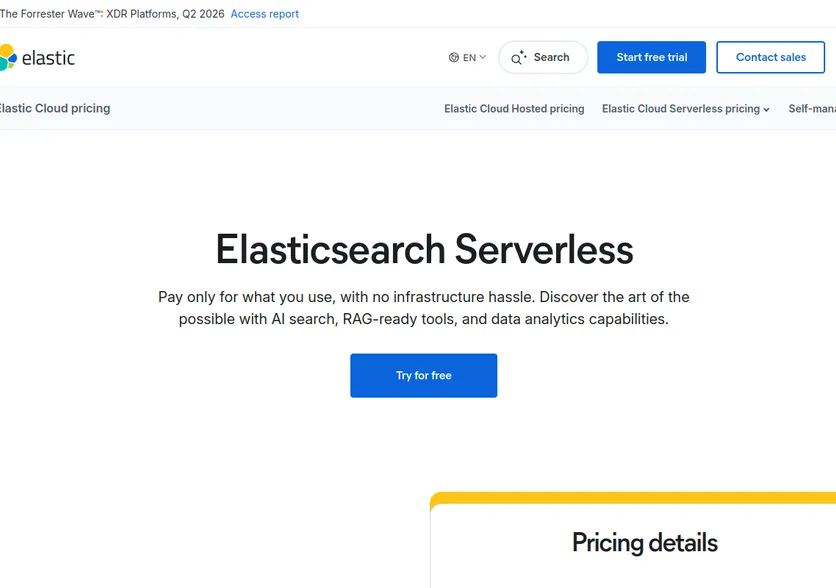
Elastic Cloud is the managed Elasticsearch service, and it suits marketers whose site already runs on the Elastic stack. This Elastic Cloud deployment starts at ninety-nine dollars a month, giving the marketing site the same cluster that powers internal search and analytics. A team that already pays for Elastic logging can add customer-facing search without onboarding a new vendor or learning a new query language.
What we like
- Text, vector and analytics search in one place
- Mature ecosystem of integrations
- Scales from a small cluster to enterprise size
Watch out for
- Starts at 99 dollars a month
- Usage billing can surprise heavy indexers
How to try it
- Open the Elastic pricing page and start the 14-day trial
- Deploy a small cloud cluster in your region
- Index a sample dataset and test both text and vector queries
Prices above were checked on each vendor’s own website on Nov 26, 2026 and can change — the vendor’s page is the final word. Vendor links are editorial: nobody paid to be listed or ranked here. Vendors who want a featured listing can see how it works on our Get listed page.
What AI databases cost in 2026
Most AI databases bill by storage and queries, not by seat, so the entry price is only the floor. Pinecone Builder is a flat twenty dollars a month, Weaviate Flex starts at forty-five, and Zilliz dedicated clusters start at a hundred and twenty-six, while Supabase and MongoDB Atlas stay under thirty dollars for small apps. Read-heavy workloads cost far more than storage-heavy ones on usage-priced plans, because reads are billed per million units.
Start with the free tier on two tools and index the same ten thousand vectors through both. Compare query latency, recall on your hardest questions and the monthly bill at your real query volume, then pick the engine your team will trust in production. The cheapest storage price means little if slow queries frustrate every user.
Before you buy
- Count your queries first, because usage-priced plans bill reads per million and read-heavy apps pay far more than storage.
- Check the free tier limits, because Pinecone gives 2 GB while Weaviate caps free clusters at 100,000 objects.
- Test recall on your own data first, because a demo dataset never shows how the engine handles your hardest questions.
- Ask whether you need a dedicated engine: Supabase and MongoDB Atlas add vectors to a database you already run.
- Watch the scaling step, because a flat 20 dollar plan can jump to usage billing once the free allowances end.
Official websites
Official websites of the products reviewed above. Features and prices were checked against these sites when this guide was written, and they can change, so confirm on the vendor site before you buy.
Frequently asked questions
Which AI database is best for a business in 2026?
Pinecone, at twenty dollars a month, is the safest default because it is fully managed and its flat Builder plan covers small apps without usage surprises. Weaviate is better when keyword and vector search must live in one store, since hybrid queries run natively. Supabase wins when your data already lives in Postgres, at twenty-five dollars a month per project.
What is the cheapest AI database for a small business?
MongoDB Atlas Flex, from eight dollars a month and capped at thirty, is the cheapest paid entry here for teams already on MongoDB. Pinecone Builder is twenty dollars a month flat, and Supabase Pro is twenty-five dollars a month per project. Qdrant and Weaviate both offer free cloud tiers, so a prototype can start at no cost.
Do I need a separate vector database for AI search?
Not always. Supabase adds vector search to Postgres and MongoDB Atlas adds it to MongoDB, so teams already running those databases can skip a second store. A dedicated engine such as Pinecone, Weaviate or Qdrant earns its place when search is core to the product and needs the lowest latency. Start inside your current database and move out only when it slows down.
Can I try an AI database for free?
Yes, most of them have free tiers. Pinecone gives two gigabytes of storage, Qdrant gives a one gigabyte cluster, Weaviate allows a hundred thousand objects, and Supabase gives five hundred megabytes. Neo4j covers two hundred thousand nodes free. Use the free tier to index real data and measure recall before paying.
Which AI database is best for knowledge graphs?
Neo4j AuraDB is the specialist pick, because it stores data as nodes and relationships and answers path queries that tables struggle with. Professional starts at sixty-five dollars a month for a one gigabyte cluster, with a free tier for learning. Use it when the connections between records matter as much as the records themselves.
Need everyday AI help too? Try Toolsvine's free AI tools for small teams right in your browser.
Browse AI Tools (In-Browser, No API) tools