On this page
Enterprise edge AI means running models where the data is made: on factory floors, in stores and on vehicles that cannot wait for a round trip to the cloud. The eight platforms below cover the whole job, from GPU inference to fleet management and computer vision, and every one of them publishes a price you can budget against. NVIDIA AI Enterprise is our first pick, the managed GPU stack for teams running serious models at the edge. Prices run from cents per device a month to thousands per GPU a year, so the right choice depends on your hardware.
How we researched this
We started with edge AI platforms that publish a real dollar price and run in production, not just in demos. We read each price on the vendor site or a corroborating listing on November 26, 2026 and judged them for an enterprise buyer who needs fleet management, security patching and support that answers the phone. We kept only platforms a team can buy without a sales call, and dropped a dozen well-known names, including ZEDEDA, Avassa and SiMa, because none of them publishes a price.
Compare the tools
| Name | Best for | Starting price | Free plan | |
|---|---|---|---|---|
| NVIDIA AI Enterprise | Enterprises running AI on NVIDIA GPUs at the edge | $4,500/GPU/year | 90-day evaluation licence | Visit |
| AWS IoT Greengrass | Enterprises with AWS infrastructure and fleets of connected devices | $0.16/device/month | First 3 Core devices free for 1 year | Visit |
| Azure IoT Hub | Enterprises standardised on Azure that need device twins and routing | $25/unit/month | Free tier (8,000 messages a day) | Visit |
| Losant | Enterprises that need a low-code platform for connected products | $250/month | Free Developer Sandbox (10 devices) | Visit |
| HiveMQ Cloud | Enterprises moving MQTT data between devices and the cloud | $0.34/hour | No free tier — Starter starts at $0.34 an hour | Visit |
| Roboflow | Enterprises adding computer vision to cameras and sensors | $39/month | Free tier (10 credits a month) | Visit |
| Latent AI | Enterprises compressing large models to run on small edge chips | $99/month | Free trial available | Visit |
| balenaCloud | Enterprises managing fleets of Linux edge devices | $159/month | Free tier for small fleets | Visit |
The edge AI platforms, compared
1. NVIDIA AI Enterprise
Best for: Enterprises running AI on NVIDIA GPUs at the edge
Paid tool Starting price: $4,500/GPU/year · 1-year subscription per GPU; 2-year is $9,000, 3-year $13,500, 5-year $18,000; education pricing is $1,125 per GPU
Free plan: 90-day evaluation licence
NVIDIA AI Enterprise is the full software stack for running large models on NVIDIA hardware at the edge, from inference servers to model management and security patching. This NVIDIA AI Enterprise licence covers the inference runtime, NIM microservices and enterprise support, so a hospital, factory or retailer can run a private model fleet without building the plumbing. It is the most expensive option here, but it is also the only one that treats GPU inference as a managed product.
What we like
- The standard stack for GPU inference at the edge
- NIM microservices deploy models in minutes
- Enterprise support and security patching included
Watch out for
- Per-GPU price adds up fast across a fleet
- Needs NVIDIA hardware, so it locks in the vendor
How to try it
- Pick the NVIDIA-certified systems that will host your models
- Install the AI Enterprise stack and deploy your first NIM microservice
- Set up model monitoring and a patching schedule with support
2. AWS IoT Greengrass
Best for: Enterprises with AWS infrastructure and fleets of connected devices
Paid tool Starting price: $0.16/device/month · Per active Core device per month, or $1.49 per device per year on annual billing; first 3 devices free for 1 year
Free plan: First 3 Core devices free for 1 year
AWS IoT Greengrass puts Lambda functions, machine learning inference and message routing directly on your edge devices, so a factory sensor or a retail camera keeps working when the internet drops. This AWS IoT Greengrass runtime bills per active Core device, which means a pilot of three devices costs nothing for a year and a fleet of thousands scales in small, predictable steps. Because it is part of AWS, it plugs straight into S3, SageMaker and CloudWatch without a second vendor.
What we like
- Runs offline, so devices survive network outages
- Bills per device, which keeps pilots cheap
- Deep integration with the rest of AWS
Watch out for
- Learning curve is steep for teams new to AWS
- Costs can creep up with message volume
How to try it
- Create a Greengrass Core device group in the AWS console
- Deploy your Lambda function or ML model to the group
- Monitor device health and logs in CloudWatch
3. Azure IoT Hub
Best for: Enterprises standardised on Azure that need device twins and routing
Paid tool Starting price: $25/unit/month · S1 tier per unit per month; Basic B1 is $10 a month and S3 is $2,500 a month
Free plan: Free tier (8,000 messages a day)
Azure IoT Hub is the control plane for millions of devices, with device twins, message routing and direct methods that let a central team command a fleet from one dashboard. This Azure IoT Hub S1 tier adds the throughput and features a production deployment needs, including cloud-to-device messaging and file upload from the edge. The runtime that runs on the device is free, so you pay for the hub capacity, not for every sensor you install.
What we like
- Device twins keep a live model of every device
- Message routing connects devices to any Azure service
- Edge runtime is free, you pay for hub units only
Watch out for
- Unit pricing is confusing until you model message volume
- Best value only inside a wider Azure estate
How to try it
- Create an IoT Hub and register your devices
- Set up message routing to your storage or analytics service
- Deploy edge modules to run inference on the device
4. Losant
Best for: Enterprises that need a low-code platform for connected products
Paid tool Starting price: $250/month · Launch plan with 100,000 payloads a month and 90-day retention; Growth is $1,000 a month and Enterprise is custom
Free plan: Free Developer Sandbox (10 devices)
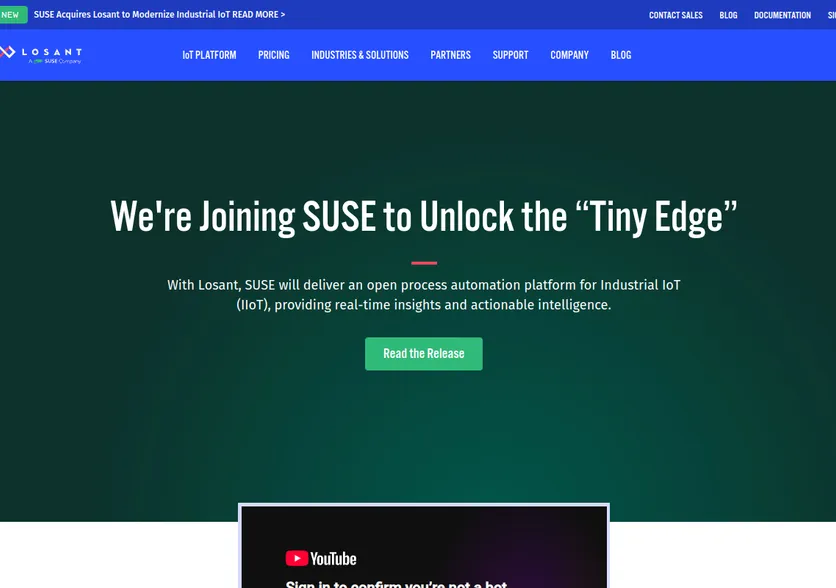
Losant is a low-code platform for building connected products, with drag-and-drop workflows that turn device data into alerts, dashboards and automated actions. This Losant Launch plan covers one hundred thousand payloads a month, which is enough for a serious pilot across several sites, and the visual workflow builder means product teams ship features without waiting for firmware releases. It suits enterprises that want a product team, not just an engineering team, to own the edge experience.
What we like
- Low-code workflows ship features without firmware work
- Payload pricing is easy to forecast
- Dashboards and alerts are built in, not add-ons
Watch out for
- Payload limits can bite as fleets grow
- Owned by SUSE since February 2026, so roadmap may shift
How to try it
- Connect your first devices to the Losant sandbox
- Build a workflow that turns sensor data into an alert
- Publish a dashboard for the operations team
5. HiveMQ Cloud
Best for: Enterprises moving MQTT data between devices and the cloud
Paid tool Starting price: $0.34/hour · Starter plan from $0.34 an hour, about $248 a month, plus $0.80 per million messages; self-managed Launch is $299 a month
Free plan: No free tier — Starter starts at $0.34 an hour
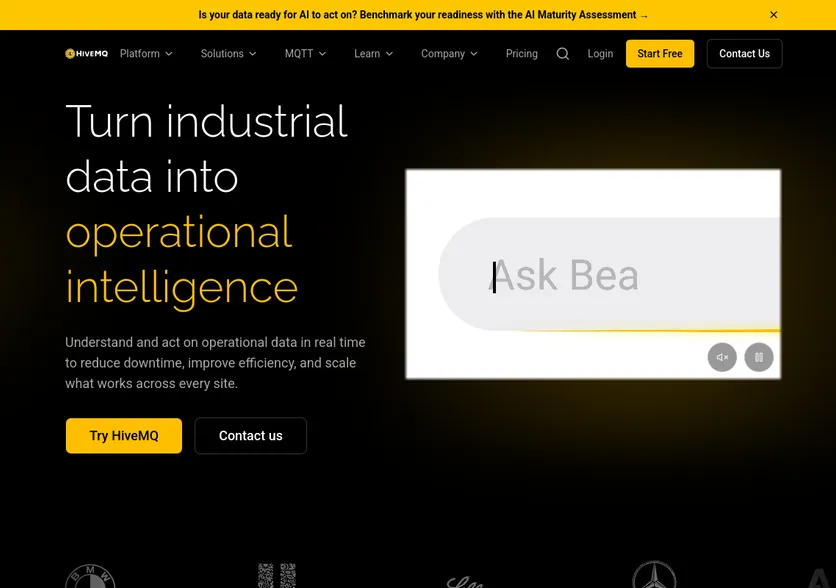
HiveMQ Cloud is a managed MQTT broker built for the message volumes an enterprise fleet produces, with clustering, persistence and security baked in. This HiveMQ Cloud Starter plan bills by the hour and by the message, so a deployment that spikes during the day and idles at night pays for what it uses. It is the plumbing layer: boring, reliable and exactly what you want carrying telemetry between thousands of devices and your cloud.
What we like
- Managed MQTT with clustering and persistence
- Hourly billing matches spiky traffic patterns
- Enterprise-grade security and extensions included
Watch out for
- Message charges add up on chatty fleets
- It is a broker, not a full application platform
How to try it
- Create a HiveMQ Cloud cluster and note the broker address
- Point your devices at the broker with TLS enabled
- Set up message persistence and monitoring alerts
6. Roboflow
Best for: Enterprises adding computer vision to cameras and sensors
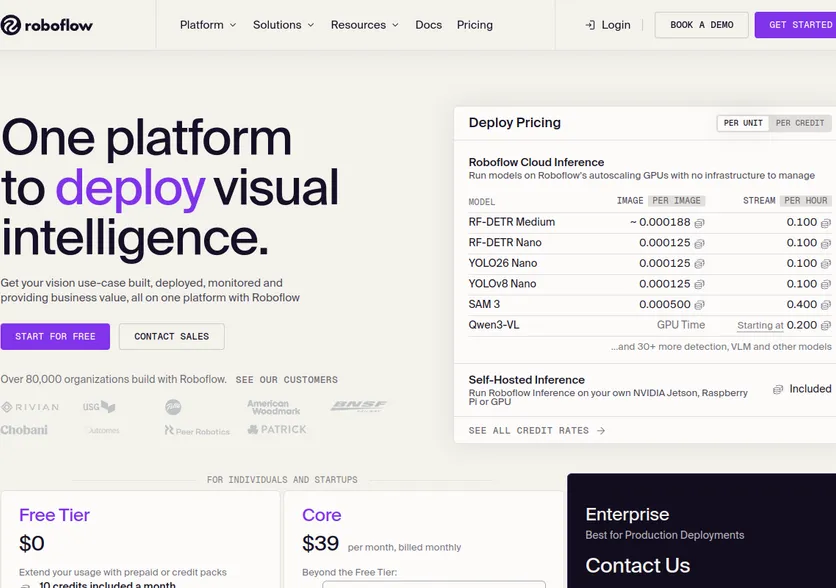
Paid tool Starting price: $39/month · Core plan billed monthly with 20 credits a month; annual billing lowers the per-month cost
Free plan: Free tier (10 credits a month)
Roboflow is the fastest route from a pile of images to a working vision model on an edge device, with labelling, training and deployment in one workflow. This Roboflow Core plan includes twenty credits a month for training and inference, which covers a pilot that inspects products on a line or counts vehicles at a gate. Models deploy to NVIDIA Jetson, Raspberry Pi and other edge hardware, so the camera keeps deciding even when the network does not.
What we like
- Labelling, training and deployment in one place
- Deploys to Jetson, Raspberry Pi and more
- Free tier is enough to prove a vision use case
Watch out for
- Credit limits can throttle a busy pilot
- Vision only — no general-purpose edge runtime
How to try it
- Upload and label your images in the Roboflow workspace
- Train a detection model and check its accuracy
- Deploy the model to your edge device with the SDK
7. Latent AI
Best for: Enterprises compressing large models to run on small edge chips
Paid tool Starting price: $99/month · Premium plan per developer per month
Free plan: Free trial available
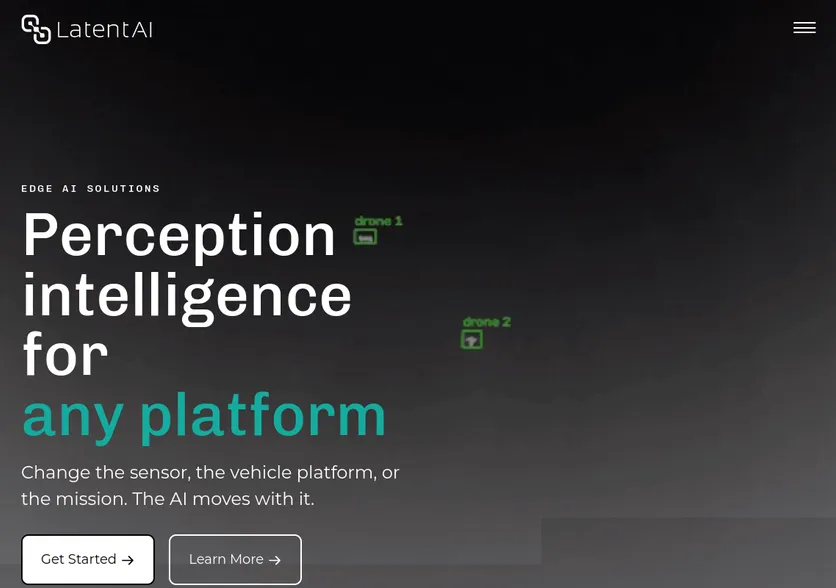
Latent AI compresses trained models so they run on the small, power-efficient chips inside cameras, drones and industrial controllers. This Latent AI Premium plan gives each developer the tooling to quantise and prune a model, then ship it to the edge with the runtime included. It fills the gap between a model that works in the lab and one that runs fast enough on a device with no fan and a small battery.
What we like
- Shrinks models to fit small edge chips
- Per-developer pricing is simple to budget
- Runtime is included, not a separate purchase
Watch out for
- Smaller vendor with a narrower ecosystem
- Price confirmed by third-party listings, not the vendor page
How to try it
- Import your trained model into the Latent AI workspace
- Compress and quantise it for your target chip
- Deploy the runtime to your edge devices
8. balenaCloud
Best for: Enterprises managing fleets of Linux edge devices
Paid tool Starting price: $159/month · Prototype plan for 30 devices; larger fleets move to custom pricing
Free plan: Free tier for small fleets
balenaCloud manages fleets of Linux devices, from Raspberry Pi boards to industrial gateways, with container-based updates that roll out or roll back across thousands of units. This balenaCloud Prototype plan covers thirty devices, which is enough for a multi-site pilot, and the dashboard shows the health, logs and software version of every unit. It is the operations layer for teams whose edge AI runs in containers and must update without a site visit.
What we like
- Container updates across thousands of devices
- Roll back a bad release fleet-wide in minutes
- Works on Pi boards and industrial gateways alike
Watch out for
- Price confirmed by third-party listings, not the vendor page
- Prototype tier caps at thirty devices
How to try it
- Flash balenaOS onto your devices and claim them
- Push your containerised AI app to the fleet
- Roll out updates in stages and watch the dashboard
Prices above were checked on each vendor’s own website on Nov 26, 2026 and can change — the vendor’s page is the final word. Vendor links are editorial: nobody paid to be listed or ranked here. Vendors who want a featured listing can see how it works on our Get listed page.
What enterprise edge AI costs in 2026
Price the whole deployment, not the licence. A GPU platform looks expensive per unit until you count the engineering time it saves, while a per-device platform looks cheap until the fleet passes ten thousand units. Model the message volume, the update frequency and the support level together, because the cheapest tier often excludes the SLA a production line needs. Run a pilot on real hardware with real data for at least a month, and measure accuracy, latency and cost per decision before you sign an annual contract.
Before you buy
- Check that the platform supports your exact edge hardware, from NVIDIA GPUs to ARM boards and industrial gateways
- Confirm fleet management covers remote updates, health checks and rollback without a site visit
- Verify how inference costs scale, per device, per GPU or per message, before you commit to a fleet
- Ask where model training happens and whether your data ever leaves your own network
- Read the support SLA and escalation path, because a stalled production line cannot wait for email support
Official websites
Official websites of the products reviewed above. Features and prices were checked against these sites when this guide was written, and they can change, so confirm on the vendor site before you buy.
Frequently asked questions
Which edge AI platform is best for a large enterprise?
NVIDIA AI Enterprise is the strongest choice at $4,500 per GPU per year, because it turns GPU inference into a managed product with support and patching. AWS IoT Greengrass and Azure IoT Hub are the right picks when the fleet is already inside AWS or Azure, since device management and cloud analytics come as one bill. Roboflow wins for computer vision pilots that need a model running on a camera within weeks.
Is GPU edge AI worth the cost for enterprises?
Yes, if the use case justifies it. A quality-inspection camera that catches defects on a line, or a retail camera that counts footfall, can pay back a GPU deployment in months. The mistake is buying GPUs before proving the model: start with a small pilot on Roboflow or Greengrass, measure the accuracy and the savings, then scale the hardware to match the proven return.
How do enterprises update AI models on thousands of edge devices?
Most platforms here support over-the-air updates, but balenaCloud is built for exactly that job: container updates roll out to thousands of Linux devices and roll back fleet-wide if a release misbehaves. AWS IoT Greengrass and Azure IoT Hub also deploy new models to devices remotely. Whatever you choose, test the update and rollback path on a small group before touching the whole fleet.
Do edge AI platforms need a constant internet connection?
No. Several platforms run inference on the device itself, so cameras and sensors keep deciding when the connection drops. AWS IoT Greengrass runs Lambda functions and models locally, balenaCloud devices run containers offline, and Roboflow models run on the camera. The cloud matters for management, training and dashboards, not for every single decision.
How should an enterprise budget for edge AI?
Start with the device count and the model type. Count every device, estimate messages per device per day, and check whether you need GPUs or will run on ARM boards. Then run a pilot on the cheapest tier that covers your hardware, measure accuracy and latency for a month, and only then negotiate an annual plan. A pilot that proves the model is worth more than any discount.
Put AI where your data is born — browse the full set of AI tools, free and running on your device.
Browse AI Tools (In-Browser, No API) tools