On this page
Small businesses do not need an enterprise edge AI budget to put intelligence on a camera, a sensor or a shop-floor device. The eight platforms below start from free tiers and a few dollars a month, and every one publishes a price you can check before spending. Roboflow is our first pick, the cheapest paid plan here and the fastest way to get computer vision working on hardware you already own. Prices run from pennies per device a month to thousands per GPU a year, so a small business can start tiny and grow only when the return proves itself.
How we researched this
We started with edge AI platforms that publish a real dollar price and work for a team of one or two, not a department. We read each price on the vendor site or a corroborating listing on November 26, 2026 and judged them for a small business owner who needs a predictable bill, hardware they already own and support without an enterprise contract. We kept only platforms a small business can buy without a sales call, and dropped a dozen well-known names, including ZEDEDA, Avassa and SiMa, because none of them publishes a price.
Compare the tools
| Name | Best for | Starting price | Free plan | |
|---|---|---|---|---|
| Roboflow | Small businesses adding computer vision on a budget | $39/month | Free tier (10 credits a month) | Visit |
| AWS IoT Greengrass | Small businesses already using AWS | $0.16/device/month | First 3 Core devices free for 1 year | Visit |
| Azure IoT Hub | Small businesses standardised on Microsoft 365 | $25/unit/month | Free tier (8,000 messages a day) | Visit |
| Losant | Small businesses that want connected products without firmware work | $250/month | Free Developer Sandbox (10 devices) | Visit |
| HiveMQ Cloud | Small businesses moving sensor data to the cloud | $0.34/hour | No free tier — Starter starts at $0.34 an hour | Visit |
| Latent AI | Small businesses shrinking models for cheap hardware | $99/month | Free trial available | Visit |
| balenaCloud | Small businesses managing a handful of Linux devices | $159/month | Free tier for small fleets | Visit |
| NVIDIA AI Enterprise | Small businesses with a GPU use case that justifies the spend | $4,500/GPU/year | 90-day evaluation licence | Visit |
The edge AI platforms, compared
1. Roboflow
Best for: Small businesses adding computer vision on a budget
Paid tool Starting price: $39/month · Core plan billed monthly with 20 credits a month; annual billing lowers the per-month cost
Free plan: Free tier (10 credits a month)
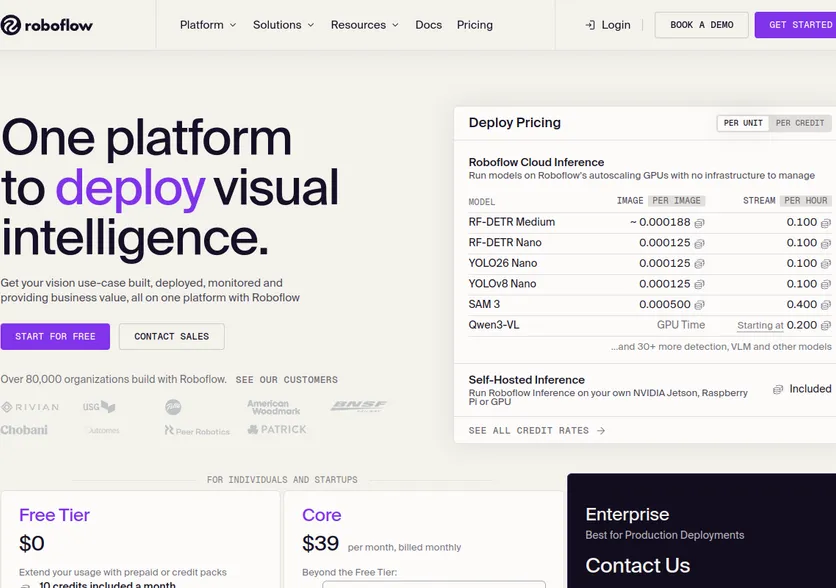
Roboflow is the cheapest way for a small business to put computer vision on a camera, with labelling, training and deployment in one workflow. This Roboflow Core plan costs less than a team lunch each month and includes twenty credits, enough to inspect products, count stock or watch a gate. Models run on a Raspberry Pi or a Jetson board you already own, so there is no expensive hardware to buy before the first result.
What we like
- Cheapest paid plan on this list
- Labelling, training and deployment in one place
- Runs on hardware a small business already owns
Watch out for
- Credit limits can throttle a busy pilot
- Vision only — no general-purpose edge runtime
How to try it
- Upload photos of what you want to detect
- Label them and train your first model
- Deploy the model to a Pi or Jetson at your site
2. AWS IoT Greengrass
Best for: Small businesses already using AWS
Paid tool Starting price: $0.16/device/month · Per active Core device per month, or $1.49 per device per year on annual billing; first 3 devices free for 1 year
Free plan: First 3 Core devices free for 1 year
AWS IoT Greengrass lets a small business run smart functions on a handful of devices for pennies, because billing is per active Core device and the first three are free for a year. This AWS IoT Greengrass runtime runs Lambda functions and machine learning models on the device, so a sensor keeps working when the shop internet drops. It is the practical pick for a business that already has an AWS account and wants edge features without a new vendor.
What we like
- First three devices free for a year
- Bills per device, so small fleets cost very little
- Devices keep working when the internet drops
Watch out for
- Learning curve is steep for teams new to AWS
- Costs can creep up with message volume
How to try it
- Create a Greengrass Core device group in the AWS console
- Deploy your function or model to the group
- Check device health in CloudWatch once a week
3. Azure IoT Hub
Best for: Small businesses standardised on Microsoft 365
Paid tool Starting price: $25/unit/month · S1 tier per unit per month; Basic B1 is $10 a month and S3 is $2,500 a month
Free plan: Free tier (8,000 messages a day)
Azure IoT Hub gives a small business the same device management the big companies use, starting from a free tier that covers eight thousand messages a day. This Azure IoT Hub S1 tier costs about the same as a software subscription and adds the throughput a growing deployment needs, with device twins that show the live state of every unit. If the business already pays for Microsoft 365, the hub slots neatly into the same account and the same billing.
What we like
- Free tier covers a genuine small deployment
- Device twins show live state from the office
- Fits the Microsoft account you already pay for
Watch out for
- Unit pricing is confusing until you model message volume
- Best value only inside a wider Azure estate
How to try it
- Create an IoT Hub and register your devices
- Set up message routing to your storage
- Use device twins to check each device from the office
4. Losant
Best for: Small businesses that want connected products without firmware work
Paid tool Starting price: $250/month · Launch plan with 100,000 payloads a month and 90-day retention; Growth is $1,000 a month and Enterprise is custom
Free plan: Free Developer Sandbox (10 devices)
Losant lets a small business build a connected product without hiring a firmware engineer, because its low-code workflows turn device data into alerts and dashboards. This Losant Launch plan covers one hundred thousand payloads a month, which is far more than a small fleet produces, and the free sandbox lets you prove the idea on ten devices first. It is the pick for a business owner who wants the product to work, not a second career in embedded systems.
What we like
- Low-code workflows need no firmware skills
- Free sandbox proves the idea on ten devices
- Payload pricing is easy to forecast
Watch out for
- Launch price is steep for a very small fleet
- Owned by SUSE since February 2026, so roadmap may shift
How to try it
- Connect up to ten devices to the free sandbox
- Build a workflow that alerts you when a sensor fails
- Upgrade to Launch when the fleet outgrows the sandbox
5. HiveMQ Cloud
Best for: Small businesses moving sensor data to the cloud
Paid tool Starting price: $0.34/hour · Starter plan from $0.34 an hour, about $248 a month, plus $0.80 per million messages; self-managed Launch is $299 a month
Free plan: No free tier — Starter starts at $0.34 an hour
HiveMQ Cloud is a managed MQTT broker, which is the reliable plumbing a small business needs to move sensor data without running a server. This HiveMQ Cloud Starter plan bills by the hour, so a deployment that reports a few times an hour costs a few dollars a month, not a flat enterprise fee. There is nothing to install and nothing to patch, which is exactly what a business with no IT staff needs.
What we like
- Hourly billing fits small, quiet fleets
- Nothing to install or patch yourself
- Managed broker with enterprise-grade security
Watch out for
- Message charges add up on chatty fleets
- It is a broker, not a full application platform
How to try it
- Create a HiveMQ Cloud cluster
- Point your sensors at the broker with TLS enabled
- Connect your cloud app to read the messages
6. Latent AI
Best for: Small businesses shrinking models for cheap hardware
Paid tool Starting price: $99/month · Premium plan per developer per month
Free plan: Free trial available
Latent AI compresses a trained model so it runs on the cheap, low-power chips inside a small business camera or controller. This Latent AI Premium plan gives one developer the tooling to quantise and prune a model, then ship it to the edge with the runtime included. It is a niche pick, but it is the one that lets a small business run a serious model on hardware that costs less than a hundred dollars.
What we like
- Runs serious models on cheap hardware
- Per-developer pricing is simple to budget
- Runtime is included, not a separate purchase
Watch out for
- Smaller vendor with a narrower ecosystem
- Price confirmed by third-party listings, not the vendor page
How to try it
- Import your trained model into the workspace
- Compress and quantise it for your target chip
- Deploy the runtime to your edge devices
7. balenaCloud
Best for: Small businesses managing a handful of Linux devices
Paid tool Starting price: $159/month · Prototype plan for 30 devices; larger fleets move to custom pricing
Free plan: Free tier for small fleets
balenaCloud manages Linux devices the way a small business needs: one dashboard, container updates, and rollback if a release breaks. This balenaCloud Prototype plan covers thirty devices for a flat monthly price, which is more than most small fleets will ever need. Flash the operating system onto a Pi board, push your app as a container, and update every device from the office without touching any of them.
What we like
- One dashboard for the whole small fleet
- Container updates with rollback built in
- Flat price covers thirty devices
Watch out for
- Price confirmed by third-party listings, not the vendor page
- Prototype tier caps at thirty devices
How to try it
- Flash balenaOS onto your Pi boards
- Push your containerised app to the fleet
- Update devices from the dashboard when you ship a fix
8. NVIDIA AI Enterprise
Best for: Small businesses with a GPU use case that justifies the spend
Paid tool Starting price: $4,500/GPU/year · 1-year subscription per GPU; 2-year is $9,000, 3-year $13,500, 5-year $18,000; education pricing is $1,125 per GPU
Free plan: 90-day evaluation licence
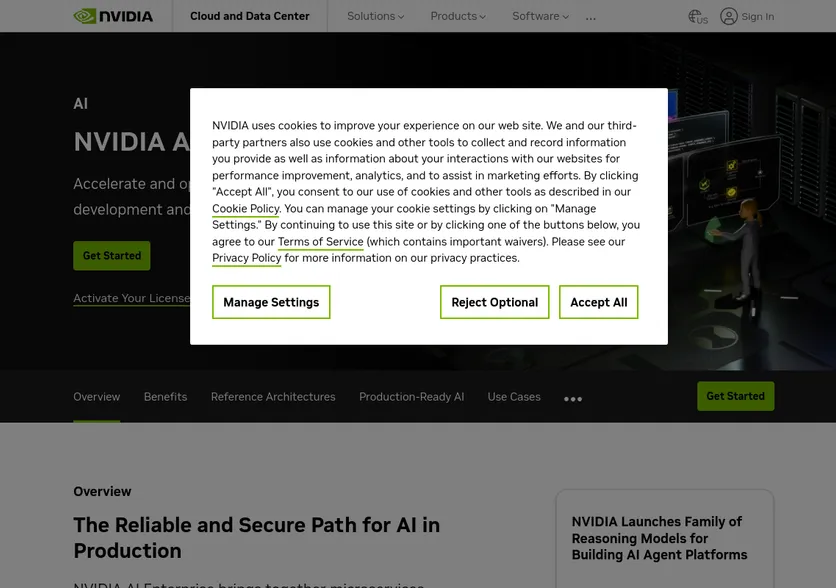
NVIDIA AI Enterprise is the dearest tool on this list, and most small businesses should not buy it, but it belongs here for the ones with a genuine GPU workload. This NVIDIA AI Enterprise licence covers the inference runtime, NIM microservices and enterprise support, so a small business running a private model on one GPU gets the same managed stack as a large company. The 90-day evaluation licence is the honest way to test whether the GPU earns its keep.
What we like
- Managed GPU stack with enterprise support
- NIM microservices deploy models in minutes
- 90-day evaluation before you commit
Watch out for
- Per-GPU price dwarfs every other tool here
- Needs NVIDIA hardware, so it locks in the vendor
How to try it
- Check whether your model truly needs a GPU
- Start the 90-day evaluation on your hardware
- Measure the return before paying for a year
Prices above were checked on each vendor’s own website on Nov 26, 2026 and can change — the vendor’s page is the final word. Vendor links are editorial: nobody paid to be listed or ranked here. Vendors who want a featured listing can see how it works on our Get listed page.
What small business edge AI costs in 2026
Start on a free tier and pay only after the pilot proves itself. The most common mistake is buying hardware before proving the model: a Raspberry Pi and a free tier will tell you whether the use case works, and a GPU can wait until the numbers say otherwise. Watch out for per-message billing that spikes without warning, and prefer flat monthly plans while the fleet is small. If one person manages the whole setup, pick the platform with the simplest dashboard, because the tool you can actually run beats the tool with the longest feature list.
Before you buy
- Start with the free tier or cheapest plan and prove the use case before spending more
- Check that the platform runs on hardware you already own, such as a Raspberry Pi or a spare PC
- Confirm the bill is predictable, with no per-message charges that spike without warning
- Ask whether one person can manage it, because a small business rarely has a dedicated edge team
- Read the support options, since a small business needs answers without an enterprise contract
Official websites
Official websites of the products reviewed above. Features and prices were checked against these sites when this guide was written, and they can change, so confirm on the vendor site before you buy.
Frequently asked questions
Which edge AI platform is best for a small business?
Roboflow is the best starting point at $39 a month, because it covers labelling, training and deployment for computer vision on hardware you already own. AWS IoT Greengrass is the cheapest per-device option, with three devices free for a year and pennies per device after that. Azure IoT Hub is the pick when the business already pays for Microsoft 365 and wants one bill.
Can a small business try edge AI for free?
Yes, and the free tiers here are genuinely useful. Greengrass gives you three devices free for a year, Azure IoT Hub has a free tier with eight thousand messages a day, Roboflow has a free tier with ten credits a month, and Losant has a free sandbox for ten devices. Run the pilot on a free tier, prove the return, and only then pay for a plan.
What hardware does a small business need for edge AI?
A Raspberry Pi or a Jetson board is enough for most small business pilots, and Roboflow and balenaCloud both target exactly that hardware. You only need a GPU when the model is large or the latency budget is tight, and NVIDIA offers a 90-day evaluation licence to test that question honestly. Start cheap, measure the result, and buy the GPU only if the numbers say so.
Do small business edge devices need constant internet?
No. Most platforms here run inference on the device, so a camera or sensor keeps working when the shop internet drops and syncs its results later. Greengrass runs Lambda functions locally, Roboflow models run on the camera, and balenaCloud devices run containers offline. The cloud matters for management and dashboards, not for every decision the device makes.
How should a small business budget for edge AI?
Add up devices, messages per device per day, and the cost of the person who manages it. Pick the platform whose free tier covers your pilot, run it for a month, and read the real bill before committing. Avoid per-message pricing that can spike, and check whether annual billing actually saves money at your volume. The cheapest plan that proves the return is the right one.
Give your small business an AI edge without an enterprise bill — browse the full set of AI tools, free and running on your device.
Browse AI Tools (In-Browser, No API) tools