On this page
A campus rota runs on semesters: term time needs the full team, exam weeks need late cover, and vacation weeks need almost no one. We compared eight tools on published price, shift cover and how they handle swaps and time off. Deputy is our first pick — labor-law warnings, auto-scheduling and a thirty-day trial from five dollars per user a month.
How we researched this
We started with scheduling tools that publish a real price and can run a campus rota, then read each price on the vendor site on November 27, 2026 and noted the trial each plan carries. We judged them for universities that roster library, dining hall, facilities and front-desk staff across term time, exams and vacations. We dropped quote-only workforce suites and enterprise campus systems because a department needs a price it can budget around and a trial it can test.
Compare the tools
| Name | Best for | Starting price | Free plan | |
|---|---|---|---|---|
 Deputy | Universities that need labor-law compliance and auto-scheduling | $5/user/month | No free plan; 30-day free trial | Visit |
| When I Work | Campus teams that want auto-scheduling at the lowest per-seat price | $2.50/user/month | No free plan; 14-day free trial | Visit |
 Connecteam | Campus departments that want scheduling, time clock and chat free up to ten users | $29/month | Free plan for up to 10 users; 14-day free trial on paid plans | Visit |
 Homebase | Campus teams that want a flat per-location price as headcount grows | $24/location/month | Free Basic plan for 1 location and up to 10 employees | Visit |
 Sling | Campus teams that want a free plan that covers scheduling for up to thirty staff | $1.70/user/month | Free plan for up to 30 users; 15-day free trial on paid plans | Visit |
 ZoomShift | Small campus teams that want scheduling, time clock and time off free up to twenty users | $2/user/month | Free Essentials plan for up to 20 users at 1 location; 14-day free trial | Visit |
 Findmyshift | Campus teams that want a flat per-team price with a long free trial | $25/team/month | Free plan for up to 5 team members; 3-month free trial | Visit |
 Hubstaff | Universities that want scheduling tied to attendance and payroll | $10/user/month | No free plan; 14-day free trial | Visit |
The employee scheduling software for universities, compared
1. Deputy
Best for: Universities that need labor-law compliance and auto-scheduling
Paid tool Starting price: $5/user/month · Five dollars per user a month billed annually on Lite, or five dollars fifty cents billed monthly; Core is six dollars fifty cents annual and Pro nine dollars; monthly plans carry a thirty-dollar minimum spend per invoice
Free plan: No free plan; 30-day free trial
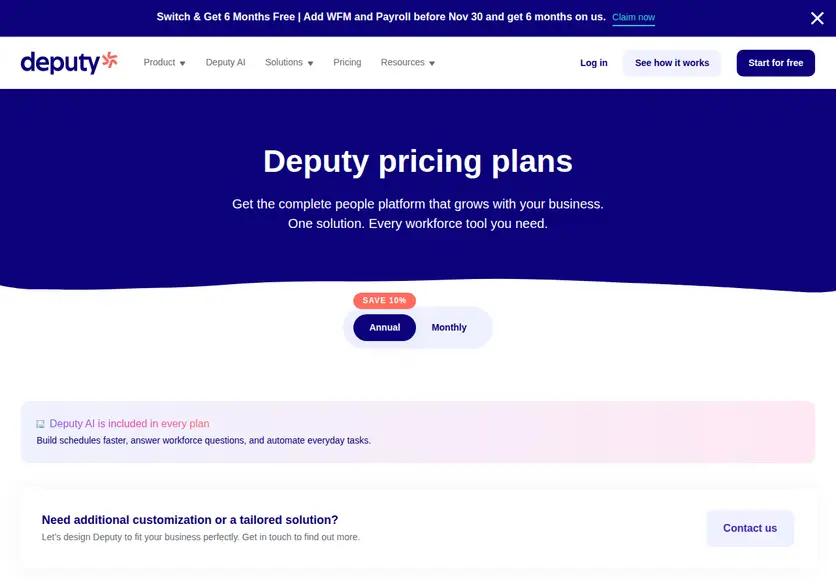
This Deputy plan is the compliance pick for campus work, with labor-law warnings, shift swaps and leave management from five dollars per user a month. Lite covers basic scheduling, timesheets and a time clock, while Core adds auto-scheduling, demand forecasting and wage budgets. Per-user billing means a large student workforce costs more, and monthly plans carry a thirty-dollar minimum spend per invoice.
What we like
- Labor-law compliance warnings built into the rota
- Auto-scheduling and demand forecasting from the Core plan
- Clear per-user pricing with a thirty-day trial
Watch out for
- Per-user billing gets expensive with a large student workforce
- Monthly plans carry a thirty-dollar minimum spend per invoice
How to try it
- Open the Deputy pricing page and start the thirty-day trial
- Set your labor rules and build a week of campus rosters
- Test auto-scheduling on Core before you commit to a plan
2. When I Work
Best for: Campus teams that want auto-scheduling at the lowest per-seat price
Paid tool Starting price: $2.50/user/month · Two dollars and fifty cents per user a month on Essentials for single-location teams; Pro is five dollars and Premium eight dollars; the vendor FAQ prices multi-location teams at five dollars per user a month; time tracking is a separate add-on
Free plan: No free plan; 14-day free trial
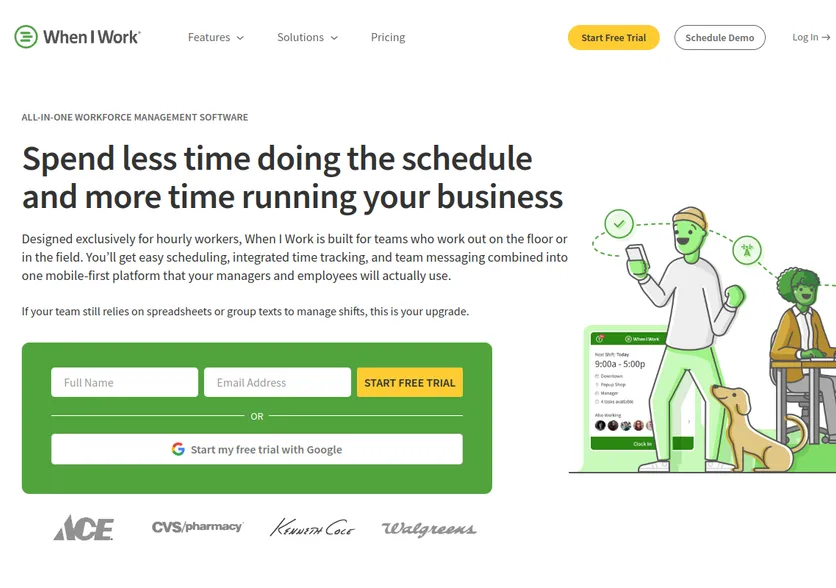
Campus teams get auto-scheduling and forecast tools on this When I Work plan, the cheapest per-seat plan in this comparison at two dollars and fifty cents a month. Essentials covers multi-week schedules, templates, open shifts, shift swapping and team messaging for two dollars and fifty cents per user a month. Time tracking is a paid add-on, and multi-department teams pay five dollars per user a month according to the vendor FAQ.
What we like
- Auto-scheduling and forecast tools on the cheapest plan
- Clean, fast scheduling interface with shift swaps built in
- No minimum seat count and no free-plan limits to outgrow
Watch out for
- Time tracking is a paid add-on, not part of Essentials
- Multi-department teams pay double the single-location rate
How to try it
- Open the When I Work pricing page and start the fourteen-day trial
- Build a week of campus shifts with templates and auto-scheduling
- Check the time tracking add-on price before you budget
3. Connecteam
Best for: Campus departments that want scheduling, time clock and chat free up to ten users
Paid tool Starting price: $29/month · Twenty-nine dollars a month billed annually for the Operations hub on Basic, covering the first thirty users, or thirty-five dollars billed monthly; Advanced is forty-nine dollars and Expert ninety-nine; each hub is billed separately
Free plan: Free plan for up to 10 users; 14-day free trial on paid plans
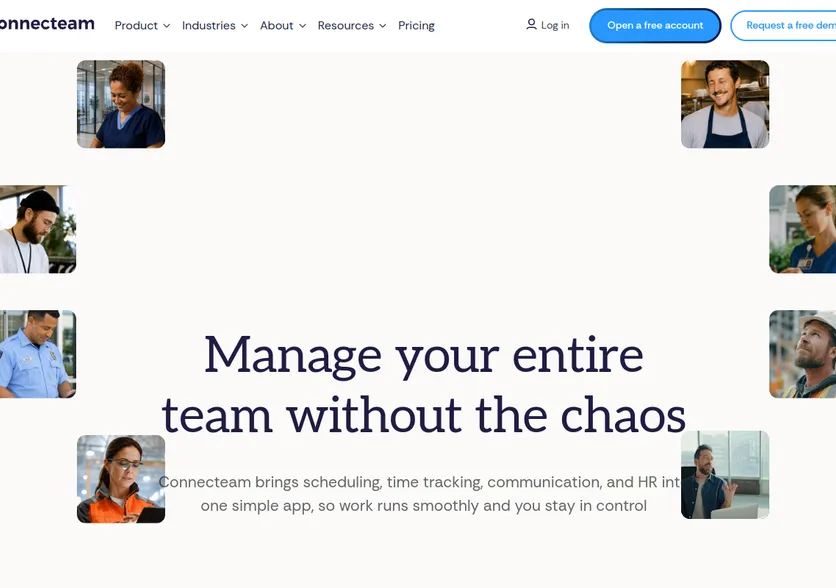
This Connecteam plan gives a campus department the full product free for up to ten users, with scheduling, time clock, chat and HR in one mobile app. The Operations hub on Basic adds GPS clock-in, open shifts and payroll integration for twenty-nine dollars a month once the team grows past ten. Each hub is billed separately, so the full suite costs three times the entry price.
What we like
- Free for up to ten users with every hub and feature included
- One mobile app covers scheduling, clock-in, chat and HR
- Flat price for the first thirty users keeps small-team costs predictable
Watch out for
- Each hub is a separate subscription, so the full suite costs three times the entry price
- Advanced scheduling tools wait for the higher plans
How to try it
- Open the Connecteam pricing page and start with the free Small Business plan
- Build the campus rota in the Operations hub and add the time clock
- Check which hubs you actually need before you upgrade
4. Homebase
Best for: Campus teams that want a flat per-location price as headcount grows
Paid tool Starting price: $24/location/month · Twenty-four dollars per location a month billed annually on Essentials, or thirty dollars billed monthly, with unlimited employees; Plus is fifty-six dollars annual and All-in-One ninety-six dollars; free Basic plan covers one location and up to ten employees
Free plan: Free Basic plan for 1 location and up to 10 employees
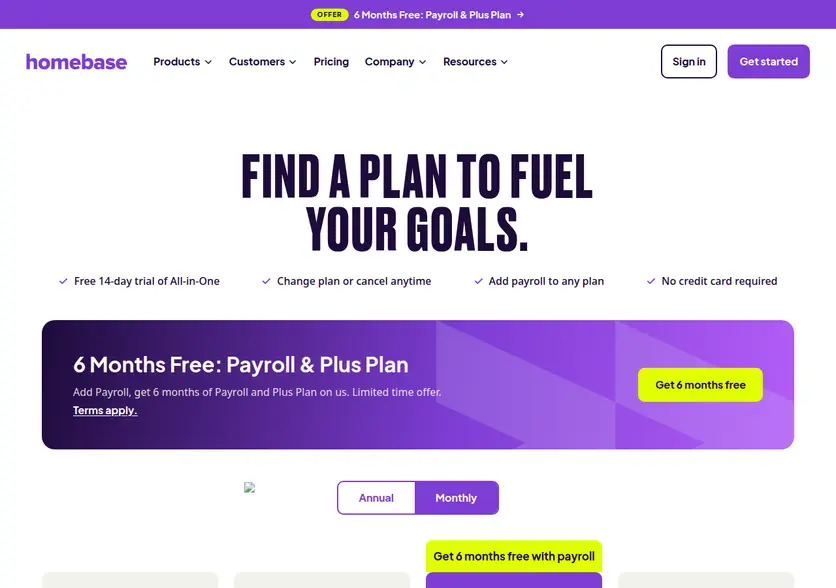
This Homebase plan charges per location with unlimited employees, so a campus team pays the same as student headcount rises. Essentials adds advanced scheduling, GPS clock-ins and late arrival alerts for twenty-four dollars per location a month billed annually. The free Basic plan covers one location and up to ten employees, which fits a single small department with no budget at all.
What we like
- Per-location pricing with unlimited employees on paid plans
- Free plan covers a single small department with no budget
- GPS clock-in and late arrival alerts on Essentials
Watch out for
- AI schedule building waits for the Plus plan
- Payroll is a separate add-on on every plan
How to try it
- Open the Homebase pricing page and start with the free Basic plan
- Add your campus staff and build a week of shifts
- Upgrade to Essentials when you need GPS clock-ins and alerts
5. Sling
Best for: Campus teams that want a free plan that covers scheduling for up to thirty staff
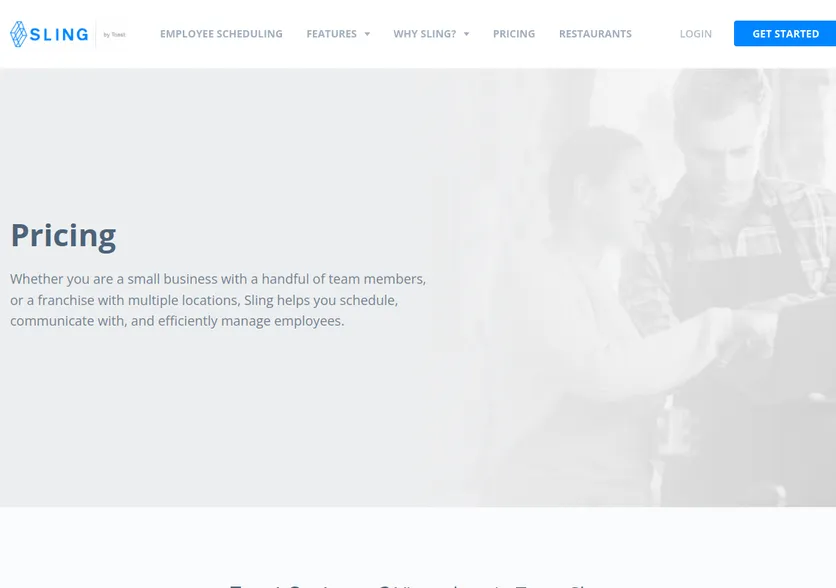
Paid tool Starting price: $1.70/user/month · One dollar and seventy cents per user a month billed annually on Premium, or two dollars billed monthly; Business is three dollars forty cents annual or four dollars monthly; free plan covers scheduling for up to thirty users
Free plan: Free plan for up to 30 users; 15-day free trial on paid plans
This Sling plan is the free-first pick for a campus team, with the full scheduling tool free for up to thirty users. The free plan covers scheduling, time tracking, newsfeed and a labor cost report, while Premium adds an automated time clock and a budget dashboard for one dollar and seventy cents per user a month billed annually. Business adds open shifts, labor budgets and payroll export at three dollars and forty cents.
What we like
- Free scheduling for up to thirty users, not a short trial
- Lowest paid price here at one dollar seventy cents per user
- Time tracking and labor cost reports included free
Watch out for
- The automated time clock waits for the paid Premium plan
- No built-in payroll on any plan
How to try it
- Open the Sling pricing page and start with the free plan
- Add up to thirty staff and build a week of campus shifts
- Upgrade to Premium when you need the automated time clock
6. ZoomShift
Best for: Small campus teams that want scheduling, time clock and time off free up to twenty users
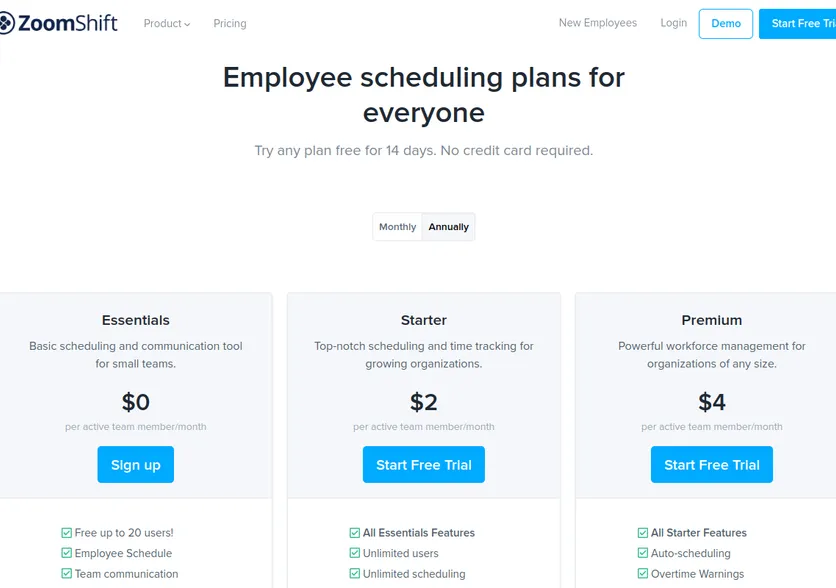
Paid tool Starting price: $2/user/month · Two dollars per user a month billed annually on Starter, or two dollars fifty cents billed monthly; Premium is four dollars annual or five dollars monthly; free Essentials plan covers up to twenty users at one location
Free plan: Free Essentials plan for up to 20 users at 1 location; 14-day free trial
This ZoomShift plan is the low-cost pick for a small campus team, with a free Essentials plan for up to twenty users at one location. Starter adds overtime alerts, shift notes, time off requests and payroll export for two dollars per user a month billed annually, while Premium adds labor cost reports and overtime calculations. The free plan already includes scheduling, a time clock and time off, which is generous at this price.
What we like
- Free plan covers scheduling, time clock and time off for twenty users
- Lowest paid tiers here at two dollars per user a month
- Simple setup with no minimum seat count
Watch out for
- Multi-location pricing is not published on the pricing page
- No built-in payroll processing on any plan
How to try it
- Open the ZoomShift pricing page and start with the free Essentials plan
- Build a week of campus shifts and test the time clock
- Upgrade to Starter when you need overtime alerts and payroll export
7. Findmyshift
Best for: Campus teams that want a flat per-team price with a long free trial
Paid tool Starting price: $25/team/month · Twenty-five dollars a team a month billed annually on Starter, or twenty-eight dollars billed monthly, for up to twenty team members; Business is thirty-nine dollars annual or forty-four dollars monthly for up to one hundred members; Enterprise is seventy-eight dollars annual or eighty-eight dollars monthly for up to three hundred members
Free plan: Free plan for up to 5 team members; 3-month free trial
This Findmyshift plan is the flat-rate pick for a campus team, charging twenty-five dollars a month per team for up to twenty members. Starter covers unlimited shifts, payroll export, annual leave, a mobile app and a time clock, while Business adds team departments, staff scheduling requests and email reminders for thirty-nine dollars a month. A three-month free trial lets a team run a full term before paying anything.
What we like
- Flat per-team price with no per-seat billing at all
- Three-month free trial, the longest here
- Free plan covers a team of five with no time limit
Watch out for
- The price jumps when the team passes twenty members
- No built-in payroll processing on any plan
How to try it
- Open the Findmyshift pricing page and start the three-month trial
- Add your campus team and build a week of shifts
- Check the next team-size band before you hire
8. Hubstaff
Best for: Universities that want scheduling tied to attendance and payroll
Paid tool Starting price: $10/user/month · Ten dollars per seat a month billed annually on Team, or twelve dollars billed monthly; scheduling, attendance and payroll sit on Team, while Starter is four dollars ninety-nine cents and Grow seven dollars fifty cents annual; two-seat minimum
Free plan: No free plan; 14-day free trial
This Hubstaff plan is the pick for a campus that wants scheduling tied to proof of hours, with attendance tracking and payroll on the Team plan. Team costs ten dollars per seat a month billed annually and adds unlimited screenshots, integrations and timesheet approvals. Every person counts as a paid seat, including student workers and managers, and a two-seat minimum sets the floor at nineteen dollars ninety-six cents a month.
What we like
- Scheduling, attendance, payroll and approvals in one plan
- Unlimited screenshots and integrations on Team
- Two months free on annual billing
Watch out for
- Scheduling is not on Starter or Grow, only on Team
- Student workers always count as paid seats
How to try it
- Open the Hubstaff pricing page and start the fourteen-day trial
- Build the campus rota on the Team plan and add attendance tracking
- Check the seat count, since student workers count as paid seats too
Prices above were checked on each vendor’s own website on Nov 27, 2026 and can change — the vendor’s page is the final word. Vendor links are editorial: nobody paid to be listed or ranked here. Vendors who want a featured listing can see how it works on our Get listed page.
How a university should run its rota
Start with the term, not the calendar. Map the term-time, exam and vacation rosters across the semester, then build the rota around those periods and keep a bench of student workers for the surges. Publish a week ahead and confirm changes the moment they happen, because student workers plan classes and second jobs around the schedule.
Count every login when you price a per-user tool, since student workers and part-time staff count as users too, and check whether the cheapest plan covers the time-off and overtime alerts you actually need before you commit to a year. A flat per-team plan can be cheaper than per-seat billing once headcount passes twenty, so run the numbers for your busiest term, not your quietest week.
Before you buy
- Check whether the plan covers term-time, exam and vacation rosters without an upgrade
- Count student workers and part-time staff as users when you price a per-user plan
- Make sure shift swaps need manager approval before they go live
- Confirm the mobile app works for staff who rarely check email
- Test the time clock with the campus team before you pay
Official websites
Official websites of the products reviewed above. Features and prices were checked against these sites when this guide was written, and they can change, so confirm on the vendor site before you buy.
Frequently asked questions
What is the cheapest scheduling tool for a university department?
Sling schedules up to thirty users free, and ZoomShift Essentials is free for up to twenty users at one location. Findmyshift is free for up to five team members, and Connecteam is free for up to ten users with every hub included. A twelve-person library team can run free on Sling or pay twenty-five dollars a month on Findmyshift.
How do we cover a last-minute call-out on campus?
Use a tool with open shifts so student workers can claim the vacancy themselves, such as Sling, Deputy or When I Work. Set the swap rules so only staff trained for that role can claim the shift, and keep manager approval on. A broadcast that reaches every available student worker at once fills a dining hall shift far faster than phoning down a list.
Can a scheduling tool handle term-time and vacation rosters?
Yes, if the plan supports recurring shifts, multi-location rosters and availability rules. Deputy handles recurring rosters with auto-scheduling on Core, Homebase covers unlimited employees per location on paid plans, and Connecteam Expert supports up to twelve schedules. Confirm term-time handling specifically, since rosters change every semester and some tools need a fresh setup each term.
Do we need a separate time clock with these tools?
Most of these tools include a mobile time clock, so a separate purchase is rarely needed. Deputy, Homebase, Sling and ZoomShift all include GPS clock-in, Connecteam adds it on the Operations hub, and Findmyshift includes a time clock on Starter. Hubstaff adds screenshots and attendance tracking on Team, which suits departments that need proof of hours.
Can these tools handle student worker time off and exams?
Yes, if the plan supports time-off requests and availability rules. ZoomShift Starter adds time off requests and overtime alerts, Deputy covers leave management on Lite, and Findmyshift includes annual leave on Starter. Check whether student workers can request time off from the mobile app, since that is where most of them will do it.
Compare the eight tools above, then run a free trial on one department before you move the whole campus over.
Browse Business Tools tools