On this page
An enterprise that wants machine learning without hiring a team of specialists needs a platform that hides the plumbing. Google Vertex AI is the pick that anchors this list, with AutoML training that builds models from tables and images for a few dollars an hour. This guide compares seven low-code machine learning platforms for enterprise teams, with live 2026 prices, free plans and trials, so a business team can ship a first model without a data science department.
How we researched this
We checked the pricing page of every vendor on this list on November 26, 2026, and kept only tools that publish a real dollar price. Each tool had to train or deploy a model with little or no code, offer enterprise controls such as access management or audit trails, and suit a business team rather than a research lab, and we compared entry prices, free plans and how the bill scales with usage.
Compare the tools
| Name | Best for | Starting price | Free plan | |
|---|---|---|---|---|
 Google Vertex AI | Enterprise teams on Google Cloud that want AutoML without managing infrastructure | $3.465/hour | $300 in free credits for new accounts | Visit |
 Roboflow | Enterprise teams that build computer vision models from images and video | $39/month | Free tier | Visit |
 Alteryx | Enterprise analytics teams that want ML inside drag-and-drop workflows | $250/user/month | 30-day free trial | Visit |
 Nanonets | Enterprise teams that automate document work with AI extraction | $100/month | $50 in free credits | Visit |
 BigML | Enterprise teams that need a private ML deployment inside their own cloud | $10,000/year | 3-day free trial | Visit |
 Runway | Enterprise creative teams that generate video and images with AI models | $15/month | Free plan | Visit |
 Paperspace | Enterprise ML teams that want managed notebooks and GPU time on demand | $8/month | Free plan | Visit |
The tools, compared
1. Google Vertex AI
Best for: Enterprise teams on Google Cloud that want AutoML without managing infrastructure
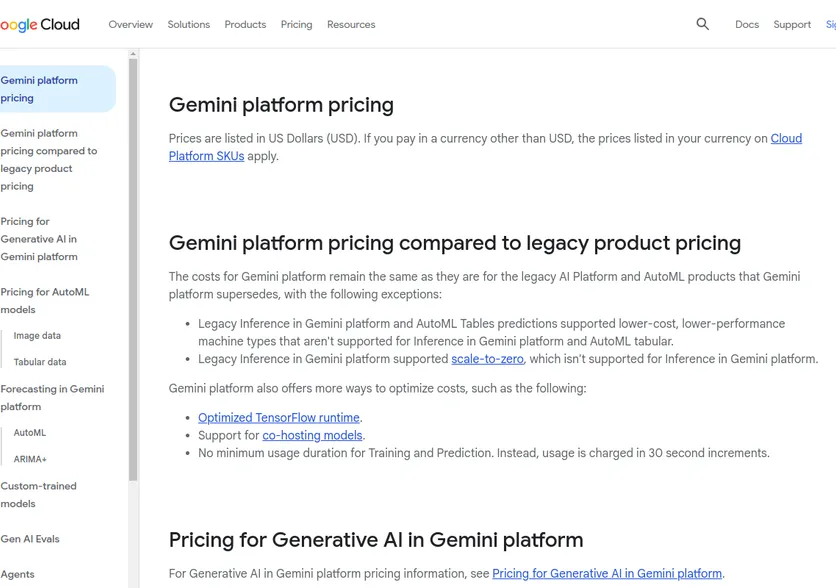
Paid tool Starting price: $3.465/hour · AutoML image training, $3.465 an hour; tabular training is $21.252 an hour
Free plan: $300 in free credits for new accounts
A business team with data in Google Cloud should not have to build training infrastructure, and Google Vertex AI turns that data into models with almost no code. Its AutoML image training costs about three and a half dollars an hour, and the platform handles training, deployment and monitoring in one managed service. It is the best all-round pick for an enterprise that wants serious ML with a bill that follows actual usage.
What we like
- AutoML builds models without code
- Managed endpoints with autoscaling
- Billing follows actual compute usage
Watch out for
- Costs are hard to predict before a first run
- Best value only inside Google Cloud
How to try it
- Open the Vertex AI pricing page and compare AutoML rates
- Prepare a labeled dataset in your Google Cloud project
- Train an AutoML model and check accuracy before deploying an endpoint
2. Roboflow
Best for: Enterprise teams that build computer vision models from images and video
Paid tool Starting price: $39/month · Core plan, $39 a month billed monthly
Free plan: Free tier
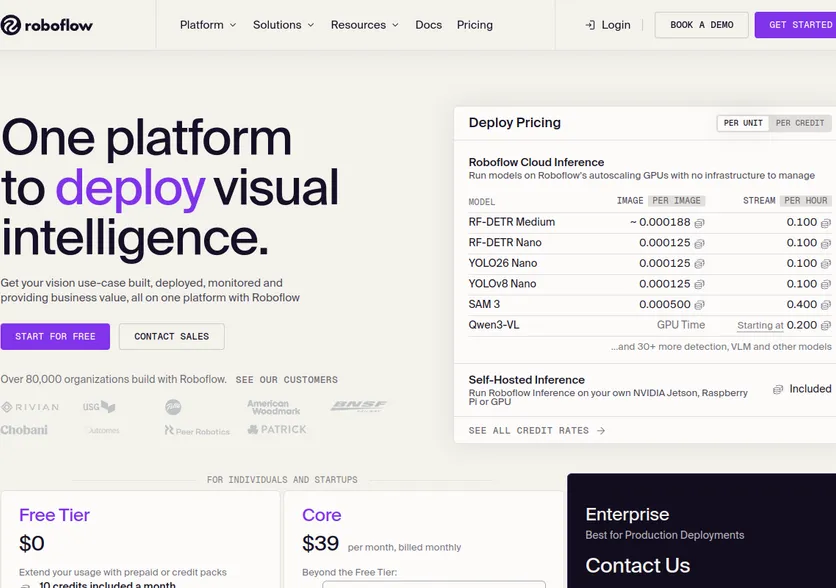
A factory camera or a retail shelf produces images, not spreadsheets, and Roboflow turns those images into working vision models. Its Core plan costs $39 a month billed monthly, and the platform covers labeling, training, active learning and deployment to cloud or edge devices. It is the best pick for computer vision, with a workflow a business team can run without a research lab.
What we like
- Full vision workflow from labeling to deployment
- Active learning improves models with every inference
- Edge deployment to Jetson and Raspberry Pi
Watch out for
- Focused on vision, not tabular data
- Credits add up on large training jobs
How to try it
- Open the Roboflow pricing page and start the free tier
- Upload images and label a first dataset
- Train a model and deploy it to the cloud or an edge device
3. Alteryx
Best for: Enterprise analytics teams that want ML inside drag-and-drop workflows
Paid tool Starting price: $250/user/month · Alteryx One Starter Edition, $250 a user a month billed annually
Free plan: 30-day free trial
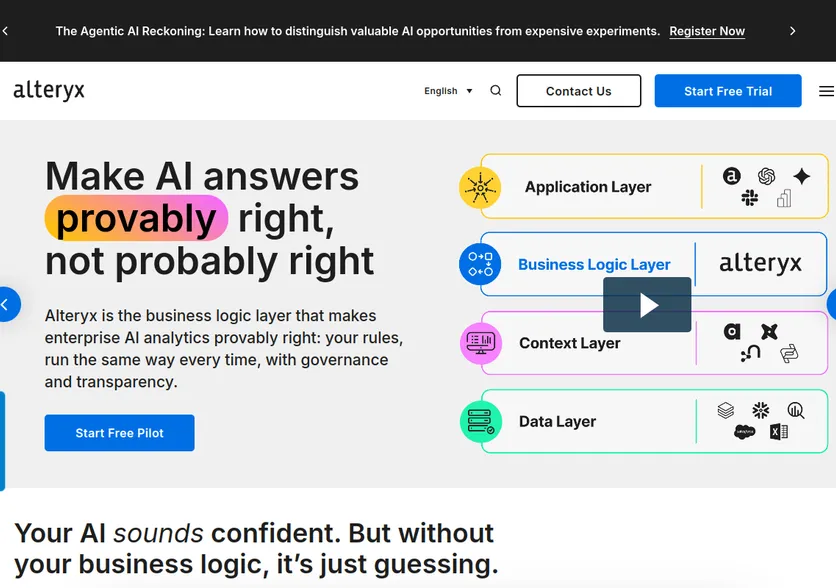
Most enterprise ML starts as an analytics workflow, not a research project, and Alteryx puts machine learning inside that workflow. Its Starter Edition costs $250 a user a month billed annually, and the platform combines drag-and-drop data preparation with AutoML, scheduling and reporting. It is the pick for an analytics team that wants predictions inside the workflows it already runs.
What we like
- ML inside familiar drag-and-drop workflows
- Scheduling and automation included
- Strong governance on higher editions
Watch out for
- Highest per-user price on this list
- Professional and Enterprise editions are quote-only
How to try it
- Open the Alteryx pricing page and compare the editions
- Start the 30-day free trial and connect a data source
- Build a workflow with an AutoML step and schedule it
4. Nanonets
Best for: Enterprise teams that automate document work with AI extraction
Paid tool Starting price: $100/month · Starter plan, $100 a month for 100 credits; $50 in free credits to start
Free plan: $50 in free credits
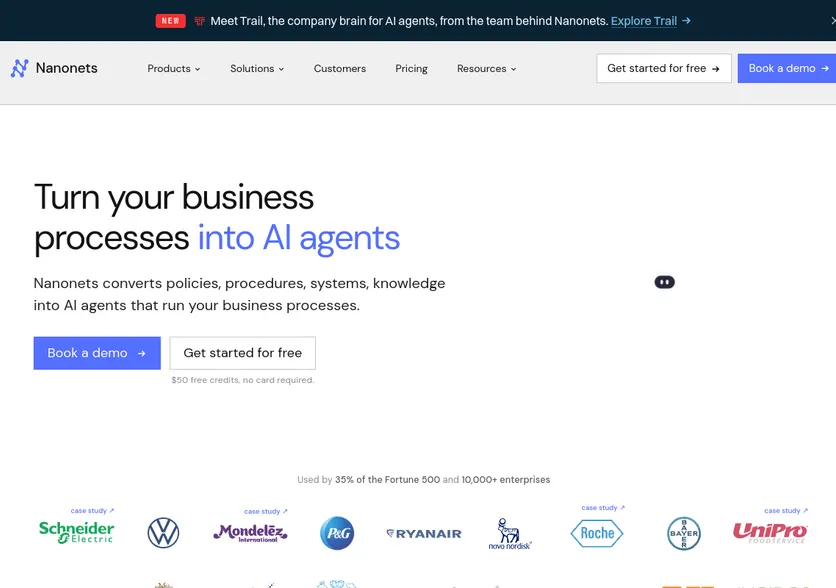
Invoices, orders and forms arrive as documents, not database rows, and Nanonets turns them into structured data with AI. Its Starter plan costs $100 a month for 100 credits, and the platform builds extraction workflows with no code, plus classification and generative AI blocks. It is the pick for a team that wants to automate document-heavy processes without writing a parser.
What we like
- No-code extraction from documents
- Credit pricing scales with volume
- Integrations with ERP and databases on higher plans
Watch out for
- Per-block pricing is hard to forecast
- Growth and Enterprise plans are quote-only
How to try it
- Open the Nanonets pricing page and start with the free credits
- Upload sample documents and train an extraction model
- Build a workflow that routes the results into your system
5. BigML
Best for: Enterprise teams that need a private ML deployment inside their own cloud
Paid tool Starting price: $10,000/year · BigML Lite private deployment, $10,000 a year; Enterprise Bronze is $45,000 a year plus a setup fee
Free plan: 3-day free trial
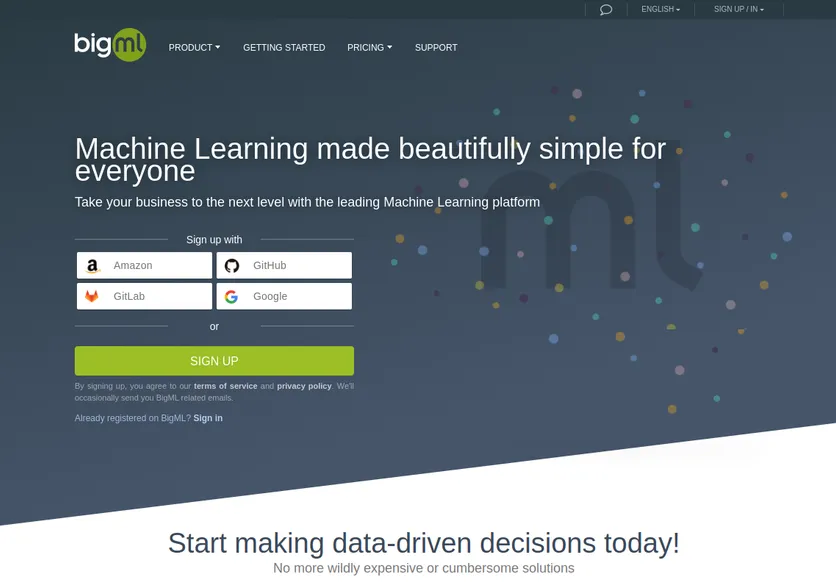
A regulated enterprise cannot always send data to a shared cloud, and BigML sells a private deployment that runs on your own infrastructure. Its Lite deployment costs ten thousand dollars a year, and the platform covers classification, regression, forecasting and anomaly detection with a visual workflow. It is the pick for a team that needs ML under its own roof, with traceability and repeatability built in.
What we like
- Private deployment inside your own cloud
- Full ML toolkit with visual workflows
- Traceable, repeatable model runs
Watch out for
- High entry price for a small team
- Self-hosted setup needs IT involvement
How to try it
- Open the BigML pricing page and compare the deployments
- Check the server and compliance requirements for a private install
- Run a pilot model on your own data before committing
6. Runway
Best for: Enterprise creative teams that generate video and images with AI models
Paid tool Starting price: $15/month · Standard plan, $15 a month on monthly billing; $12 a month billed annually
Free plan: Free plan
A creative team that needs video and images does not need to train a model, it needs to use one, and Runway puts generative models behind a simple editor. Its Standard plan costs $15 a month on monthly billing, and the platform generates video, images, music and voice from text prompts. It is the pick for a marketing or media team that wants AI-generated creative without a machine learning project.
What we like
- Generative video and image models in one editor
- Low entry price for a creative team
- Credit system is easy to understand
Watch out for
- Not a general-purpose ML platform
- Credits do not roll over on Standard and Pro
How to try it
- Open the Runway pricing page and start the free plan
- Generate a test video from a text prompt
- Check the output quality and the credit cost per generation
7. Paperspace
Best for: Enterprise ML teams that want managed notebooks and GPU time on demand
Paid tool Starting price: $8/month · Gradient Pro plan, $8 a month, plus per-hour compute costs on paid instances
Free plan: Free plan
A team that trains models needs notebooks, experiment tracking and GPUs that start in seconds, and Paperspace sells exactly that combination. Its Gradient Pro plan costs $8 a month plus per-hour compute, and the platform covers notebooks, jobs and deployments on cloud GPUs. It is the cheapest entry point on this list and the pick for a team that wants real ML infrastructure without managing servers.
What we like
- Cheapest entry point on this list
- Free GPU tier for getting started
- Notebooks, jobs and deployments in one platform
Watch out for
- Compute costs add up on large training jobs
- Less no-code tooling than AutoML platforms
How to try it
- Open the Paperspace pricing page and compare the Gradient plans
- Start a notebook on a free GPU instance
- Track an experiment and deploy the finished model
Prices above were checked on each vendor’s own website on Nov 26, 2026 and can change — the vendor’s page is the final word. Vendor links are editorial: nobody paid to be listed or ranked here. Vendors who want a featured listing can see how it works on our Get listed page.
How to judge a low-code ML platform for an enterprise
Start with the data you already have, not the model you dream about: a platform that cannot read your tables, images or documents is useless no matter how good its AutoML sounds. Check the billing meter carefully, because low-code platforms bill by the hour, the prediction, the credit or the seat, and the cheapest-looking option often charges for the step you use most. Ask where the model runs and who sees the data, since healthcare and finance teams need deployment inside their own cloud or on premises. Finally, run a pilot on one real business problem with a measurable outcome, and only scale the platform if the pilot beats the current manual process.
Before you buy
- Confirm the platform reads your data sources without custom pipelines.
- Ask exactly what the meter charges: training hours, predictions, credits or seats.
- Check where models run and whether data stays inside your own cloud.
- Run a pilot on one measurable business problem before signing an annual deal.
- Verify export and API access so models can leave the platform if needed.
Official websites
Official websites of the products reviewed above. Features and prices were checked against these sites when this guide was written, and they can change, so confirm on the vendor site before you buy.
Frequently asked questions
What is the cheapest low-code ML platform for an enterprise?
Paperspace Gradient is the cheapest here, with a Pro plan at $8 a month plus per-hour compute costs. Runway Standard is $15 a month and Roboflow Core is $39 a month. The right cheap pick depends on the workload: Paperspace suits teams that already manage GPU time, while Vertex AI suits teams that want AutoML billed by the hour.
Do these platforms need a data science team?
No, that is the point of low-code ML. Vertex AI AutoML, Roboflow, Nanonets and BigML all train models from labeled data without code, and Alteryx adds ML steps to drag-and-drop analytics workflows. A business analyst can ship a first model, though a data scientist still helps with evaluation, bias checks and monitoring once the model is live.
Can these tools deploy models to production?
Yes. Vertex AI deploys models to endpoints with autoscaling, Roboflow deploys vision models to cloud or edge devices, and BigML offers private deployments inside your own cloud. Paperspace Gradient handles training and deployment on GPU infrastructure. Check the deployment options on the plan you would buy, since free tiers often limit endpoints and edge deployment.
Which platform is best for computer vision?
Roboflow is the strongest pick for computer vision, with dataset tools, training, active learning and deployment built for images and video. Runway covers generative video rather than detection, and Vertex AI AutoML handles image classification and object detection. For a factory, retail or safety use case, Roboflow is the most complete vision platform on this list.
Is there a free plan for testing?
Yes. Roboflow, Runway and Paperspace all have free tiers, Vertex AI offers $300 in free credits for new accounts, Nanonets starts with $50 in free credits, and BigML offers a three-day free trial. Alteryx offers a 30-day free trial. Start on the free tier to train one model on your own data before paying.
Need a quick AI experiment? Try free AI tools on Toolsvine right in your browser.
Browse AI Tools (In-Browser, No API) tools