On this page
A customer support team answers the same question fifty times a day, and the chat tool decides whether those answers are fast, consistent and easy to find again. The eight tools below were picked for teams that handle support in chat, from a plain channel app to a shared inbox that covers email and social messages too. Slack leads because its channels and threads keep a busy queue readable for seven dollars and twenty-five cents per user a month, and the rest are ranked on how well they turn chat into resolved tickets.
How we researched this
We checked every price on the vendor pricing page on November 29, 2026, and only included tools with a published US dollar list price. Tools that sell only by quote were left out, as were general help desks that are not chat tools. Prices change, so confirm the current figure on the vendor site before you buy.
Compare the tools
| Name | Best for | Starting price | Free plan | |
|---|---|---|---|---|
 Slack | Support teams that live in chat all day | $7.25/user/month (Pro) | Free plan (90-day message history) | Visit |
 Microsoft Teams | Support teams that already run on Microsoft 365 | $4/user/month (Essentials) | Free plan | Visit |
 Google Chat | Support teams that live in Gmail | $7/user/month (Workspace Starter) | Free plan (personal Google account) | Visit |
 Rocket.Chat | Support teams that need to own their data | $8/user/month (Pro) | Free plan (Community, self-hosted) | Visit |
 Front | Support teams that answer email, SMS and social messages | $25/seat/month (Starter) | No free plan; free trial | Visit |
 Missive | Small support teams that want chat inside email | $14/user/month (Starter) | No free plan; 30-day free trial | Visit |
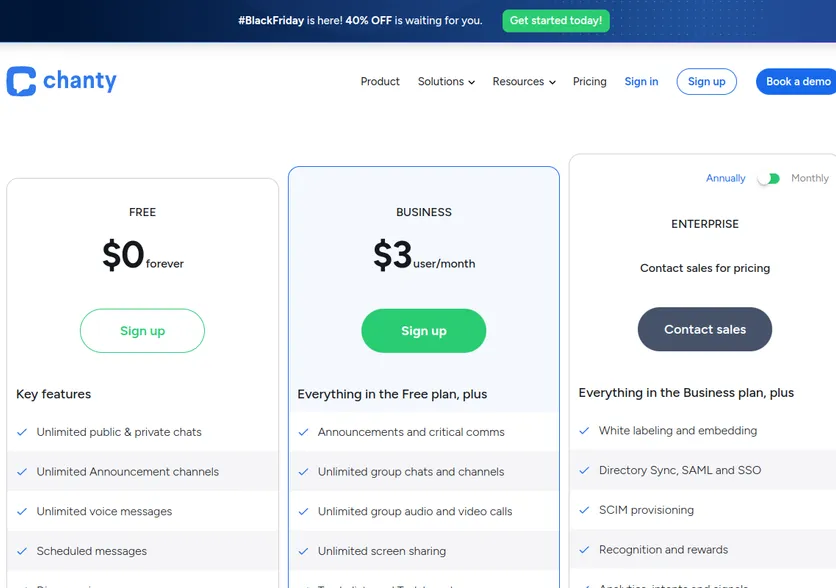
 Chanty | Small support teams that want the cheapest paid chat | $3/user/month (Business) | Free plan (up to 5 users) | Visit |
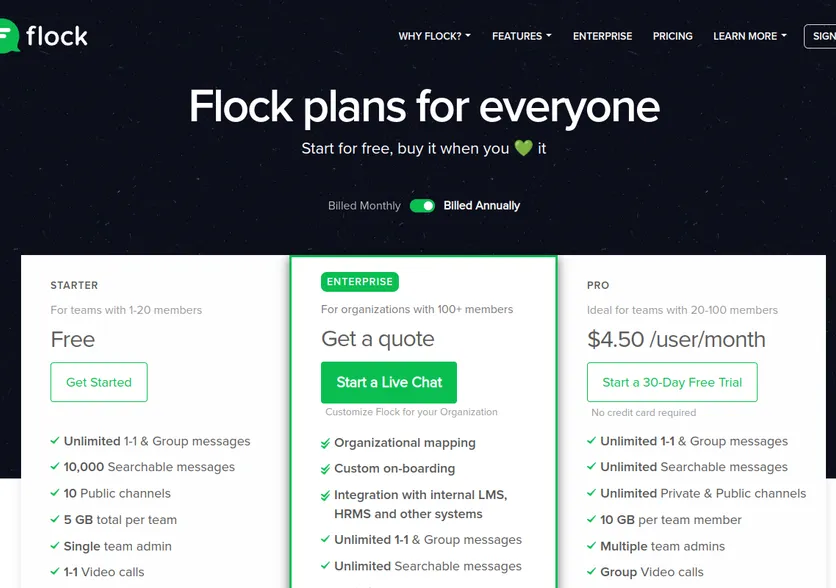
 Flock | Support teams that want Slack-style chat at a lower price | $4.50/user/month (Pro) | Free plan (up to 20 users) | Visit |
The team chat software for customer support teams, compared
1. Slack
Best for: Support teams that live in chat all day
Paid tool Starting price: $7.25/user/month (Pro) · Seven dollars and twenty-five cents per user a month on Pro billed annually (eight dollars and seventy-five cents billed monthly); Business+ is fifteen dollars per user a month billed annually (eighteen dollars monthly), after a June 2025 rise from twelve dollars and fifty cents, though older listings still show the old figure
Free plan: Free plan (90-day message history)
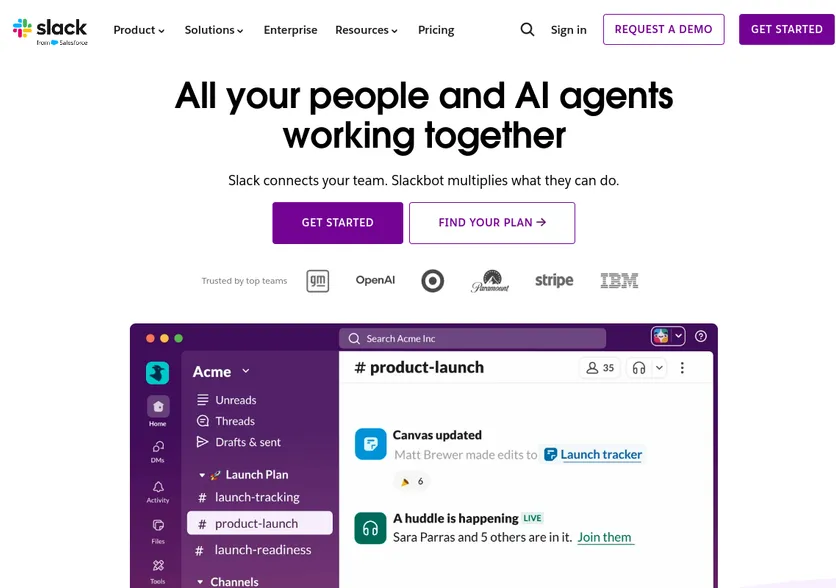
A support team that lives in chat all day needs channels that stay fast with hundreds of messages, and this Slack plan costs seven dollars and twenty-five cents per user a month on Pro billed annually for exactly that. Channels separate each product and each customer queue, threads keep a tricky case in one place, and the app directory connects the help desk so a ticket can start from a message. The free plan keeps only ninety days of history, so a support team that needs a searchable record must pay.
What we like
- Channels separate each product and each customer queue
- Threads keep a tricky case in one place
- Huge app directory connects the help desk
Watch out for
- Free plan keeps only ninety days of history
- Business+ price rose in June 2025 and older listings still show the old figure
How to try it
- Create a channel for each product and each customer queue
- Answer tricky cases in threads so the case stays together
- Connect the help desk so a message can become a ticket
2. Microsoft Teams
Best for: Support teams that already run on Microsoft 365
Paid tool Starting price: $4/user/month (Essentials) · Four dollars per user a month on Essentials billed annually; the free plan covers chat and meetings for small teams, and fuller Microsoft 365 plans that include Teams start higher
Free plan: Free plan
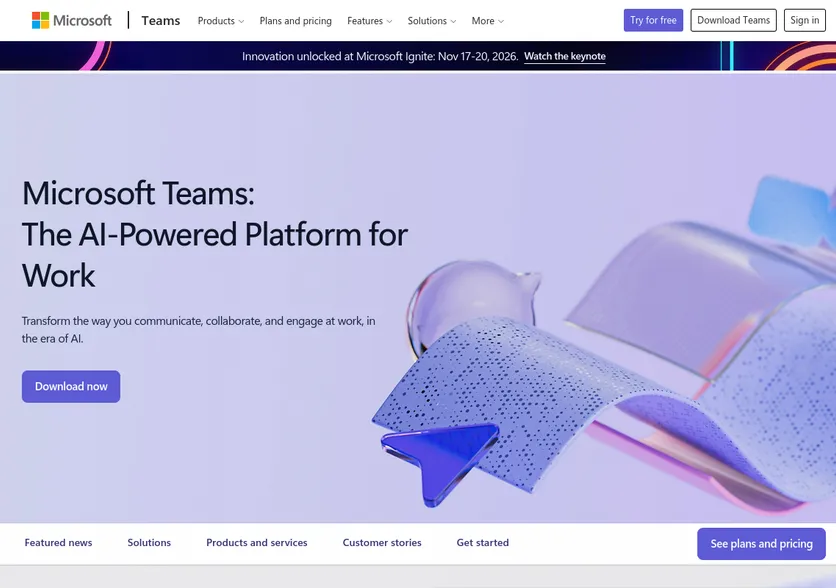
A support team that already runs on Microsoft 365 will find the cheapest chat here, and this Microsoft Teams plan costs four dollars per user a month on Essentials billed annually. Chat, meetings and file sharing sit beside the Office apps the team already uses, and the free plan covers small teams that only need the basics. It is less flexible than Slack for integrations, though the price is hard to beat for a Microsoft shop.
What we like
- Chat, meetings and files sit beside the Office apps
- Cheapest paid chat in this list
- Free plan covers small teams that only need the basics
Watch out for
- Less flexible than Slack for integrations
- Guest access is clunkier than the dedicated chat tools
How to try it
- Create a team for support with channels per queue
- Pin the common answers where agents can find them
- Use meetings for the cases a chat cannot solve
3. Google Chat
Best for: Support teams that live in Gmail
Paid tool Starting price: $7/user/month (Workspace Starter) · Seven dollars per user a month for Google Workspace Business Starter on a one-year commitment, which includes Chat alongside Gmail, Drive and Meet; Standard is fourteen dollars and Plus is twenty-two dollars; Chat is not sold separately
Free plan: Free plan (personal Google account)
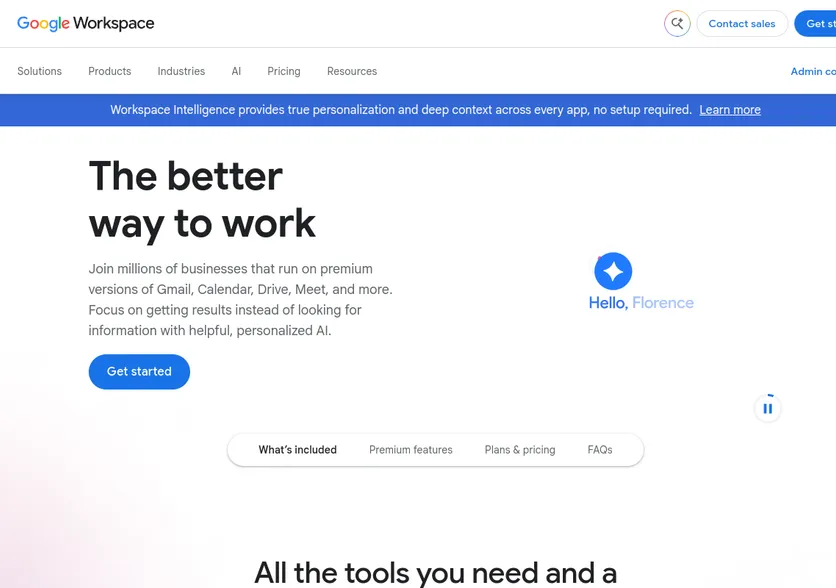
A support team that lives in Gmail will find chat already waiting in the sidebar, and this Google Chat plan costs seven dollars per user a month for Workspace Business Starter on a one-year commitment. Spaces hold the support queue beside the inbox, threads keep each case readable, and Meet is built in for the call that a chat cannot solve. Chat is not sold separately, so the price is really the price of a Workspace seat.
What we like
- Chat sits inside Gmail where the team already works
- Spaces hold the support queue beside the inbox
- Meet is built in for the call a chat cannot solve
Watch out for
- Chat is not sold separately, so the price is a Workspace seat
- Gemini in Chat needs the Standard tier, not Starter
How to try it
- Create a space for each support queue
- Answer cases in threads so the history stays readable
- Start a Meet call from the space when a case needs a voice
4. Rocket.Chat
Best for: Support teams that need to own their data
Paid tool Starting price: $8/user/month (Pro) · Eight dollars per user a month on Pro billed annually; the Community edition is free for self-hosting and Enterprise is quoted; one November 2026 guide treats Pro as quote-only because the vendor page shows no dollar figure without a quote flow, but multiple vendor-page reads agree on eight dollars
Free plan: Free plan (Community, self-hosted)
At eight dollars per user a month on Pro billed annually, this Rocket.Chat plan gives a support team that needs to own its data the managed version of an open-source chat. The Community edition is free for self-hosting, the Pro plan adds standard support and capacity for five hundred users, and the omnichannel tools can pull customer messages from several channels into one queue. One guide treats Pro as quote-only, though multiple vendor-page reads agree on the price.
What we like
- Open-source chat the team can host itself
- Community edition is free for self-hosting
- Omnichannel tools pull messages from several channels into one queue
Watch out for
- One guide treats Pro as quote-only, though vendor reads agree on the price
- Self-hosting needs someone to run the server
How to try it
- Start on the free Community edition to test the fit
- Connect the channels customers write on
- Move to Pro when the team needs standard support
5. Front
Best for: Support teams that answer email, SMS and social messages
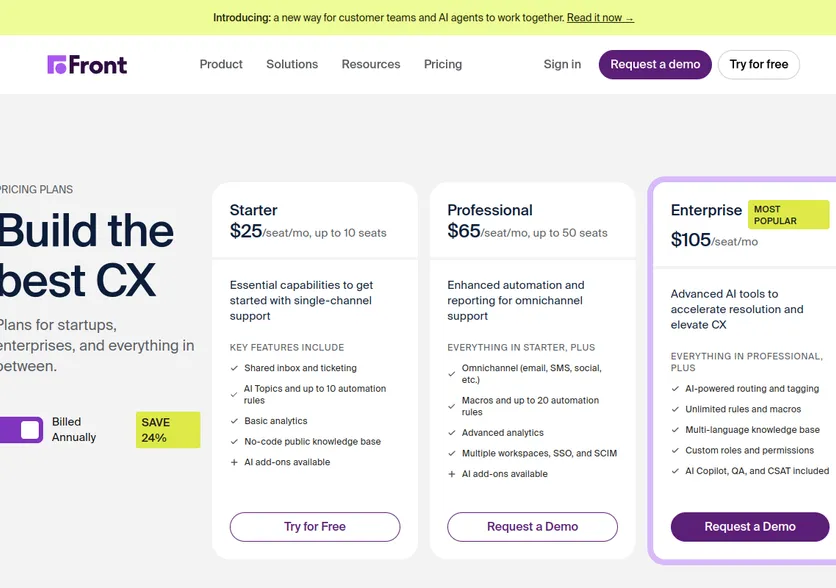
Paid tool Starting price: $25/seat/month (Starter) · Twenty-five dollars per seat a month on Starter billed annually, for up to ten seats; Growth is sixty-five dollars and Scale is one hundred and five dollars on the same basis; most comparison pages still list the older nineteen dollar Starter figure, and a November 19 read showed nineteen dollars while vendor-page reads on November 21 and 25 showed twenty-five dollars, suggesting a recent rise
Free plan: No free plan; free trial
A support team that answers email, SMS and social messages from one place needs a shared inbox more than a chat room, and this Front plan costs twenty-five dollars per seat a month on Starter billed annually for that shared inbox. Teammates can comment inside a thread before replying, assign conversations without forwarding, and see who is working on what. Most comparison pages still list an older lower price, and vendor-page reads in late November show twenty-five dollars, suggesting a recent rise.
What we like
- Teammates comment inside a thread before replying
- Assign conversations without forwarding email
- Covers email, SMS and social messages in one inbox
Watch out for
- Starter price may have risen recently, so confirm at checkout
- Essential rules need the dearer Growth tier
How to try it
- Connect the inboxes the team answers
- Assign each conversation to the right agent
- Comment inside threads before sending the reply
6. Missive
Best for: Small support teams that want chat inside email
Paid tool Starting price: $14/user/month (Starter) · Fourteen dollars per user a month on Starter billed annually (eighteen dollars billed monthly), capped at five users; Productive is twenty-four dollars billed annually and Business is thirty-six dollars; one review claims a permanent free plan, but the vendor pricing page lists no free tier
Free plan: No free plan; 30-day free trial
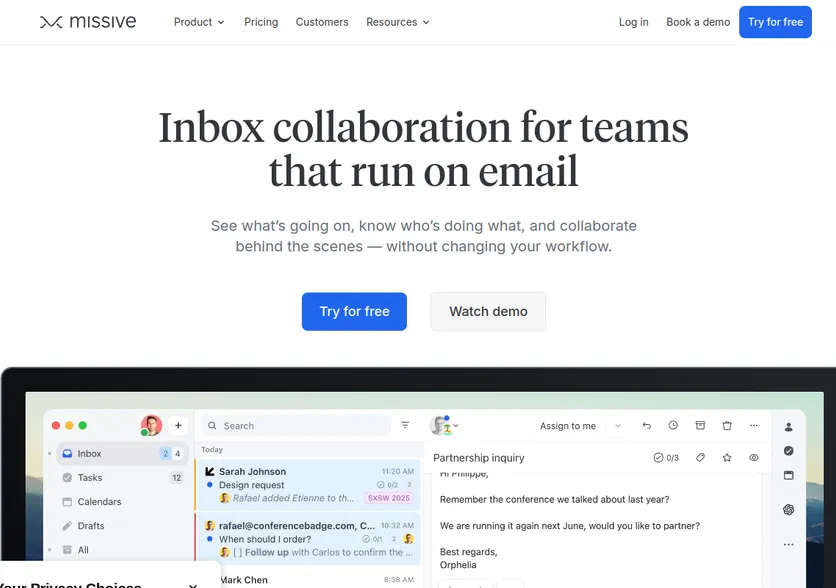
A small support team that wants chat inside its email will find it here, and this Missive plan costs fourteen dollars per user a month on Starter billed annually for a shared inbox with team chat. Conversations can turn into tasks without leaving the thread, and the team can work on email, SMS and social messages together. The Starter plan caps at five users, so a growing team steps up to the dearer Productive tier fairly soon.
What we like
- Chat lives inside the email thread
- Conversations turn into tasks without leaving the inbox
- Covers email, SMS and social messages together
Watch out for
- Starter plan caps at five users
- No free plan, only a thirty-day trial
How to try it
- Connect the shared inboxes the team answers
- Turn each conversation into a task with an owner
- Move to Productive when the team passes five users
7. Chanty
Best for: Small support teams that want the cheapest paid chat
Paid tool Starting price: $3/user/month (Business) · Three dollars per user a month on Business billed annually (four dollars billed monthly); the free plan covers up to five members with unlimited message history; Enterprise is quoted and nonprofits and schools get fifty percent off
Free plan: Free plan (up to 5 users)
A small support team that wants the cheapest paid chat with tasks built in will find it here, and this Chanty plan costs three dollars per user a month on Business billed annually. Channels, direct messages and calls cover the daily work, any message can turn into a task on a Kanban board, and the free plan covers up to five members with unlimited history. The integration library is smaller than the big chat tools, so a team that needs many connections will feel the limit.
What we like
- Cheapest paid chat in this list
- Any message can turn into a task on a Kanban board
- Free plan covers five members with unlimited history
Watch out for
- Integration library is smaller than the big chat tools
- Free plan stops at five members
How to try it
- Create channels for each support queue
- Turn messages into tasks on the Kanban board
- Use group calls for the cases a chat cannot solve
8. Flock
Best for: Support teams that want Slack-style chat at a lower price
Paid tool Starting price: $4.50/user/month (Pro) · Four dollars and fifty cents per user a month on Pro billed annually, for teams of twenty to one hundred members; the free Starter plan covers up to twenty members with ten thousand searchable messages; Enterprise is quoted
Free plan: Free plan (up to 20 users)
A support team that wants a familiar Slack-style chat at a lower price will find it here, and this Flock plan costs four dollars and fifty cents per user a month on Pro billed annually. Channels, direct messages, video calls and shared to-dos cover the daily work, and the free Starter plan covers up to twenty members. The Pro plan caps at one hundred members and group calls at twenty participants, so a large team will outgrow it.
What we like
- Familiar Slack-style chat at a lower price
- Shared to-dos and polls built in
- Free Starter plan covers up to twenty members
Watch out for
- Pro plan caps at one hundred members
- Group calls cap at twenty participants
How to try it
- Create channels for each support queue
- Add shared to-dos for follow-up work
- Use polls to settle quick team decisions
Prices above were checked on each vendor’s own website on Nov 29, 2026 and can change — the vendor’s page is the final word. Vendor links are editorial: nobody paid to be listed or ranked here. Vendors who want a featured listing can see how it works on our Get listed page.
How a support team turns chat into resolved tickets
Give every product and every customer queue its own channel, and never let support questions drift into a general chat where they get lost. Answer in threads so the whole case stays in one place, and pin the answer when the same question comes up twice. Hand a case to the right person with an assignment, not a forwarded message, and close it the same day so the queue only shows live work. When a chat solves a common problem, save the answer as a template for the next agent.
Before you buy
- Check that message history is unlimited on the paid plan, because a support team needs a searchable record
- Make sure the tool connects to the help desk, so a chat can become a ticket without retyping
- Ask whether the tool supports shared inboxes, since support answers email and social messages too
- Confirm the tool works on the devices the team already uses, including phones on the shop floor
- Test the tool with a real support shift before paying, including a busy hour with several chats at once
Official websites
Official websites of the products reviewed above. Features and prices were checked against these sites when this guide was written, and they can change, so confirm on the vendor site before you buy.
Frequently asked questions
What is the best team chat software for customer support teams?
Slack is the best overall pick for most support teams, at seven dollars and twenty-five cents per user a month on Pro, because its channels and threads keep a busy queue readable. Front is the best pick when the team answers email and social messages too, since it is a shared inbox with chat built in. Microsoft Teams is the best value for a team that already runs on Microsoft 365, at four dollars a month.
How much does team chat software cost a support team?
Prices in this list run from three dollars per user a month for Chanty Business to twenty-five dollars per seat a month for Front Starter, with most tools between four and ten dollars a month. A team of ten on Slack Pro should expect roughly seventy-two dollars and fifty cents a month, and the same team on Teams Essentials pays about forty dollars. The free plans cover small teams, so a tiny team may pay nothing at all.
Is Slack or Microsoft Teams better for customer support?
Slack is better when the team needs a deep integration library and threads that keep a busy queue readable. Teams is better when the organisation already runs on Microsoft 365, since chat, meetings and files sit beside the Office apps for four dollars a month. A team that already pays for Microsoft 365 should start with Teams, and a team that needs integrations should pick Slack.
Can a support team use free team chat software?
Yes. Slack, Teams, Google Chat, Chanty, Flock and Rocket.Chat all have free plans that cover a small support team, and Front and Missive offer free trials instead. The free plans usually limit message history, guests or integrations, so a team that needs a searchable record will need a paid plan. Start free, and pay only when the queue grows past the free limits.
Do support teams need a shared inbox as well as chat?
Often, yes. Chat handles the live conversation, but customers also write by email and social message, and those need the same assignment and tracking. Front and Missive cover both in one tool, while Slack and Teams pair with a help desk for the email side. A team that only answers chat can skip the inbox, but a team that answers every channel should buy one tool that covers them all.
Compare the eight tools above, then start with the free Slack plan on the chat tool that matches how the team already answers customers before paying for a full year.
Browse Productivity Tools tools